10 Best HIPAA-Compliant AI Voice Agents for Healthcare & Clinics in 2026
A HIPAA-compliant AI voice agent answers patient phone calls, handles routine requests, and protects protected health information (PHI) while it works. For clinics buried in call volume, that combination is the whole job.
Front-desk teams still field thousands of routine calls a week: appointment scheduling, refill requests, lab-result questions, insurance verification, and post-visit follow-ups. The calls are predictable and repetitive, yet they tie up staff because every one of them can touch PHI.
Getting the compliance part wrong is expensive. Healthcare breaches exposed the records of more than 289 million people in 2024, a 58% jump in a single year and the highest victim count ever recorded, according to the HIPAA Journal’s analysis of HHS breach data. Breach counts kept climbing after that, reaching a record 772 large breaches the following year.
The single largest incident, the Change Healthcare ransomware attack, affected an estimated 192.7 million people, and it started at a business associate rather than the provider itself (HIPAA Journal, HHS OCR). Penalties scale with culpability: willful neglect that goes uncorrected draws up to $2,190,294 per violation category per year under the 2026 adjusted penalty tiers.
So the vendor you choose matters as much as the technology. A voice agent that dazzles in a demo can still fail every test that counts in a regulated clinic: signing a Business Associate Agreement (BAA), encrypting recordings and transcripts, logging every interaction, and protecting PHI across every system it passes through.
This guide reviews the 10 best HIPAA-compliant AI voice agents for healthcare and clinics in 2026. We scored each one on what decides whether it can actually run patient calls: compliance architecture, conversational reliability, healthcare integrations, deployment effort, and cost at scale.
A HIPAA-compliant AI voice agent is a phone-based conversational system that talks with patients and processes their protected health information (PHI) under the safeguards HIPAA requires. It combines speech recognition, a language model, voice synthesis, and telephony inside a secure, audited environment.
Clinics use these agents to automate the routine calls that swamp the front desk: appointment scheduling, refill requests, insurance verification, and post-visit follow-ups. Connected to an EHR or practice-management system, the agent can also check availability, update records, and trigger workflows.
What sets a healthcare voice agent apart from a general voice AI tool is its compliance architecture. To run safely, it needs secure PHI storage and transmission, encrypted recordings and transcripts, detailed audit logs, strict access controls, and a signed BAA between vendor and provider.
Answering a call is the easy part. Protecting the data behind it is where general-purpose voice tools fall down.
A single patient call rarely runs on one system. It usually passes through several layers, and each one can see or store PHI:
Every layer that touches PHI needs its own Business Associate Agreement. That is the question that separates a real healthcare platform from a demo: not "do you sign a BAA," but "how is the whole chain covered before a patient’s data moves through it?"
Ask each vendor to show it. On Retell, you self-sign a BAA at no additional fee, and the security controls, subprocessors, and current certifications sit in the Trust Center and the compliance docs. Confirm the current details there before you deploy.
We treated this as a review, not a directory. We scored each platform on five factors that decide whether it can run patient communication in a regulated clinic.
We combined vendor documentation, vendor trust pages, and hands-on product analysis. Compliance entries below reflect what each vendor states publicly as of August 2026. Where a vendor does not state something publicly, we say so rather than guess. Confirm current status with any vendor before you sign.
Compliance status below reflects each vendor’s own public statements as of August 2026. "Not publicly stated" means we could not find the vendor saying it in public, not that the answer is no. Always confirm in writing.
| Platform | BAA | SOC 2 Type II | Named EHR integrations | Best for | From |
|---|---|---|---|---|---|
| Retell AI | Yes, self-sign, no fee | Yes, Type 1 and Type 2 | Epic, OpenDental, Dentrix, Jane App, eClinicalWorks; API for others | Custom, high-volume healthcare voice agents | ~$0.07/min |
| Hippocratic AI | Not publicly stated | SOC 2 claimed, type not specified | None named publicly | Clinically supervised outbound patient outreach | ~$9/agent-hour (vendor-reported) |
| Assort Health | Operates as a business associate; confirm directly | Not publicly stated | Epic, athenahealth, Oracle Health, write-back during the call | Specialty practices needing EHR write-back | Not public |
| Luma Health | Yes, BAA published publicly | Yes, plus HITRUST r2 and ISO 27001 | Epic, Oracle Health, athenahealth, NextGen, eClinicalWorks, MEDITECH | Health systems wanting voice, SMS, and chat in one platform | Not public |
| Hyro | Not publicly stated | Reported Type II and HITRUST; confirm directly | Epic (Epic Showroom certified), Salesforce, Five9 | Large health systems standardized on Epic | Not public |
| S10.AI | Yes, included on every plan | Vendor-stated; ask for the report | Epic, Oracle Health, athenahealth, eClinicalWorks, 100+ | Clinics wanting a packaged AI medical receptionist | $159/provider/mo |
| ElevenLabs | Yes, Enterprise tier only | Vendor-stated | None named | Teams that need the most natural synthetic voice | Enterprise quote for HIPAA |
| Vapi | Yes, Enterprise or paid HIPAA add-on | Vendor-stated, enterprise-gated | None named | Developers orchestrating their own voice stack | $0.05/min plus $2,000/mo HIPAA add-on |
| Twilio | Yes, Security or Enterprise Edition | Yes | None named | Building custom healthcare telephony from scratch | ~$0.0085/min inbound plus edition fee |
| CloudTalk | Yes, via sales | Yes, report in trust center | None named | Clinics wanting a compliant call center first | $25/user/mo |
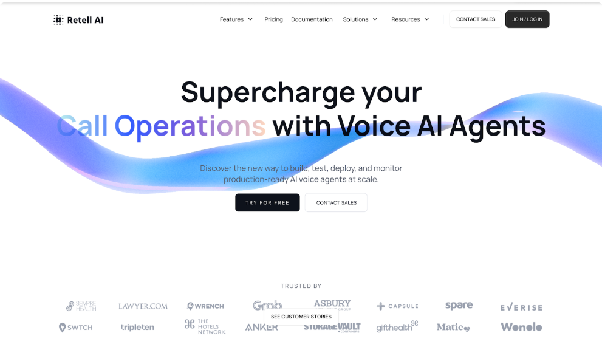
Compliance snapshot: Signs a BAA, self-serve and at no additional fee. SOC 2 Type 1 and Type 2 certified. GDPR compliant with a DPA and EU Standard Contractual Clauses. Connects to Epic, OpenDental, Dentrix, Jane App, and eClinicalWorks, and builds to anything else over API.
Retell AI is built voice-first, which is why it leads the list for teams that handle large volumes of patient calls. Many tools start as chatbots and add voice later. Retell started with the phone call, and it shows in the telephony control and call quality.
Clinics can build agents that answer inbound calls, book appointments, answer questions from a knowledge base, and run outbound reminder campaigns. A visual builder lets teams design the conversation, connect a knowledge base, and test scenarios before going live.
The telephony layer is the standout for healthcare: SIP trunking, verified caller IDs, AI-driven IVR navigation, warm transfer to staff, and post-call analysis in one dashboard. AI quality assurance scores every call rather than a sample, which matters when a clinic runs thousands of calls a week. Teams can also set per-agent data retention from 1 day to 2 years and choose whether to store PHI at all.
Best for: healthcare teams building custom, high-volume voice agents on a voice-first platform.
Verdict: It reads more like call infrastructure than a chatbot with voice bolted on, and the compliance paperwork is unusually easy to clear for a platform this configurable.
Pricing: usage-based, from about $0.07 per minute, with 60 free minutes to test. See Retell pricing.
Compliance snapshot: Claims HIPAA compliance, HITRUST, and SOC 2, but does not state the SOC 2 type publicly and does not confirm BAA terms on its own site. No named EHR integrations published. Ask for all three in writing.
Hippocratic AI builds clinically supervised outbound patient agents, and its safety work is the most documented in this category. The company reports grading from thousands of licensed clinicians against a very large volume of test calls, with human nurse escalation built into the call flow when an agent hits a red flag.
The use cases are outreach rather than front-desk pickup: post-discharge follow-up, chronic care check-ins, care gap closure, and wellness calls. Named health system customers include WellSpan Health, OhioHealth, and Cincinnati Children’s.
Best for: health systems and payers scaling clinical outreach without hiring more nurses.
Verdict: the strongest clinical safety story here, held back by how little of its compliance detail is public.
Pricing: vendor-reported at about $9 per agent-hour. Not published on the company’s own site, so confirm it directly.
Compliance snapshot: Operates as a HIPAA business associate and discusses BAA and subprocessor obligations in its own published material, but does not publish BAA terms directly. SOC 2 is not publicly stated. Names Epic, athenahealth, and Oracle Health with write-back during the call.
Assort Health is the strongest of this group on EHR depth. It publicly names Epic, athenahealth, and Oracle Health, describes write-back during the call, and has published a dedicated athenahealth integration guide. For a practice that judges vendors on whether bookings land in the chart, that is the thing that matters.
The platform runs specialty-specific scheduling logic across more than 20 specialties, covering scheduling, triage, intake, refills, referrals, and after-hours coverage. Published customer results include large drops in hold times and call abandonment.
Best for: specialty practices and multi-provider groups that need bookings written straight into the EHR.
Verdict: the pick when EHR write-back decides the deal, provided their security team can produce a SOC 2 report on request.
Pricing: not public. Demo required.
Compliance snapshot: Publishes its full Business Associate Agreement publicly. SOC 2 Type II, HITRUST CSF r2, and ISO 27001:2022. Names Epic, Oracle Health, athenahealth, NextGen, eClinicalWorks, and MEDITECH.
Luma Health has the most verifiable compliance posture on this list. The BAA is published on its website rather than held behind a sales call, and it stacks SOC 2 Type II with HITRUST r2 and ISO 27001:2022. For a hospital security team, that combination clears most of the questionnaire before the first meeting.
The product spans patient access, engagement, intake, and payments across voice, SMS, and chat. Its inbound phone agent handles patient calls, works out intent, and takes actions in the EHR, including after-hours coverage.
Best for: health systems and medical groups on Epic or athenahealth that want voice, SMS, and chat on one platform.
Verdict: the safest procurement choice on this list, and the one to shortlist when the security review is the bottleneck.
Pricing: not public. Quote required.
Compliance snapshot: Reported SOC 2 Type II and HITRUST through third-party review, but the certifications and BAA terms are not prominent on Hyro’s own pages. Epic integration is certified through the Epic Showroom.
Hyro has the longest track record here, running patient conversations for large health systems since 2018 across call centers, websites, mobile apps, and SMS. Its Epic Showroom certification required passing Epic’s own review, which is a meaningful signal for health system IT.
The platform uses a knowledge-graph approach rather than a purely generative model, which constrains what an agent can say. That trades some conversational flexibility for lower hallucination risk, a reasonable trade in a regulated setting.
Best for: large health systems standardized on Epic that want one assistant across phone, web, and SMS.
Verdict: a safe pick for an Epic-standardized health system, and a poor one for anybody else.
Pricing: not public. Enterprise contracts only, reported to start well into five figures per year.
Compliance snapshot: Includes a signed BAA on every plan at account creation, with no upcharge. States SOC 2 Type II on its own site, though no public report link was found. Names Epic, Oracle Health, athenahealth, eClinicalWorks, and many more.
S10.AI packages an AI medical receptionist, BRAVO, alongside its ambient documentation product. It is the only vendor here that includes the BAA on every plan and signs it at account creation, with no sales negotiation. For a small practice, that removes the single most common blocker.
BRAVO handles scheduling, patient intake, and insurance verification, and the company names a long list of EHR integrations rather than leaving them generic.
Best for: small and mid-size clinics that want a packaged AI receptionist rather than a platform to build on.
Verdict: the fastest route to a compliant AI receptionist for a smaller clinic, as long as their SOC 2 report checks out.
Pricing: from $159 per provider per month on the Practice plan, which includes BRAVO with 1,000 calls a month. 14-day free trial.
Compliance snapshot: Signs a BAA on the Enterprise tier only, paired with zero-retention mode. States SOC 2 Type II. No named EHR integrations.
ElevenLabs makes the most natural synthetic speech available, and plenty of healthcare voice products run its voices underneath. If how the agent sounds is your deciding factor, this is the benchmark.
The compliance path is narrower than the marketing suggests. A BAA requires an Enterprise subscription and zero-retention mode, and PHI must not pass through until that is in place. There are no named EHR integrations, so scheduling and record updates are yours to build.
Best for: teams where voice quality decides the project and engineering capacity is available.
Verdict: the right choice for voice quality, the wrong one if you expected a healthcare product out of the box.
Pricing: paid tiers start at $6 a month, but HIPAA use requires an Enterprise agreement priced on request.
Compliance snapshot: Signs a BAA with an Enterprise subscription or a paid HIPAA add-on. States SOC 2 Type II in enterprise documentation. No named EHR integrations.
Vapi is an orchestration layer for developers who want to choose their own speech-to-text, model, and voice, then wire it to telephony. That flexibility is the point, and it suits teams with an opinion about every component.
Budget for the compliance surcharge. HIPAA mode needs an Enterprise plan or a $2,000 a month add-on on top of per-minute costs, and the quoted platform rate excludes the model provider costs passed through at cost.
Best for: engineering teams that want component-level control over the voice stack.
Verdict: a capable developer platform where the HIPAA add-on materially changes the economics for smaller clinics.
Pricing: $0.05 per minute platform cost plus model provider costs, with a $2,000 a month HIPAA add-on.
Compliance snapshot: Signs a Business Associate Addendum, but only on Security or Enterprise Edition. SOC 2 Type II confirmed. General-purpose CPaaS with no named EHR integrations.
Twilio is the telephony layer underneath a large share of digital health products, including several on this list. It is reliable, global, and thoroughly documented, and its HIPAA-eligible services list is public.
It is infrastructure, not an application. You get the dial tone and the APIs, then you build the agent, the compliance workflow, and the EHR integration yourself. That is a real project, not a configuration exercise.
Best for: organizations with engineering teams building custom healthcare telephony from the ground up.
Verdict: the right foundation for a build, and the wrong answer for a clinic that wants a working agent this quarter.
Pricing: usage-based from about $0.0085 per minute inbound, plus Security or Enterprise Edition fees quoted on request.
Compliance snapshot: Signs a BAA through sales. SOC 2 Type II confirmed, with the report in its trust center, plus ISO 27001:2022. No named EHR integrations.
CloudTalk is a cloud call center platform that added AI voice agents, rather than a voice AI platform that added call center features. If your clinic’s problem is the phone system itself, that origin story is an advantage.
You get routing, queueing, analytics, and a large library of CRM and helpdesk integrations, with compliance documentation that is easy to verify. What you do not get is a named EHR integration, so record updates need custom work through the API.
Best for: clinics that want a compliant call center with AI answering layered on, not a build-your-own platform.
Verdict: the most straightforward compliance paperwork of the general-purpose tools, with the least healthcare depth.
Pricing: from $25 per user per month on annual billing.
Voice AI in healthcare has moved from experiment to infrastructure. Clinics now use agents for scheduling, intake, insurance checks, and follow-ups without burying the front desk.
The catch is that few platforms are built for the regulated part. Once you add a signed BAA, telephony reliability, and EHR integration, the shortlist gets small fast.
Some tools here are infrastructure for engineering teams. Others are ready-to-run patient-communication products. Pick based on how much control and scale you need.
If your goal is reliable, high-volume patient calls, a voice-first platform tends to win. Retell stood out for telephony reliability, low latency, and a design aimed at live patient call agents rather than chatbot automation. If your bottleneck is the security review instead, Luma Health publishes the most verifiable compliance stack of the ten.
Start where your call volume hurts most, scheduling, outreach, or inbound triage, and test an agent there first. That is usually the fastest, lowest-risk way to see impact. For a closer look at how this works across a health system, see our healthcare voice AI overview and the AI receptionist use case.
A HIPAA-compliant AI voice agent talks with patients over the phone while protecting protected health information (PHI) under HIPAA. It needs secure infrastructure, encrypted recordings and transcripts, access controls, audit logging, and a signed Business Associate Agreement between the provider and the vendor.
Often yes. A single call can pass through telephony, speech-to-text, a language model, text-to-speech, and the platform. Each system that stores or processes PHI needs a BAA, so ask the vendor how the full chain is covered before any patient data moves.
Type I checks that security controls exist on a single date. Type II checks that they worked over several months of real use. For patient data, Type II is the stronger signal.
Yes, though coverage varies a lot. Purpose-built healthcare platforms name specific systems such as Epic, Oracle Health, athenahealth, and eClinicalWorks, and write bookings straight into the chart. General-purpose voice platforms usually name none, which means your team builds the integration over API.
Current systems handle routine, well-defined calls reliably: scheduling, refills, reminders, and simple questions. Accuracy drops with heavy accents, background noise, complex clinical detail, and unusual requests. Set up a clear escalation path so the agent hands those calls to a person with the context attached.
They are when the platform is built for it. Look for a signed BAA, encryption in transit and at rest, role-based access control, multi-factor authentication, audit logging, and configurable retention. Confirm every claim against the vendor’s trust page or audit report rather than its marketing copy.
The common ones are appointment scheduling, rescheduling and cancellations, prescription refill requests, insurance verification, patient intake and prescreening, appointment reminders, post-visit follow-ups, and after-hours coverage. Calls needing clinical judgment should route to staff.
Pricing splits into three shapes. Usage-based platforms charge per minute, starting around $0.07. Packaged clinic products charge per provider per month, often between $150 and $200. Enterprise health system platforms quote custom annual contracts. Watch for HIPAA surcharges, which can add thousands a month on some developer platforms.
Retell answers, understands, and resolves patient calls, then hands off to your team when it matters. You can self-sign a BAA before any PHI moves. Try Retell free or talk to sales.
See how much your business could save by switching to AI-powered voice agents.
Total Human Agent Cost
AI Agent Cost
Estimated Savings
A Demo Phone Number From Retell Clinic Office