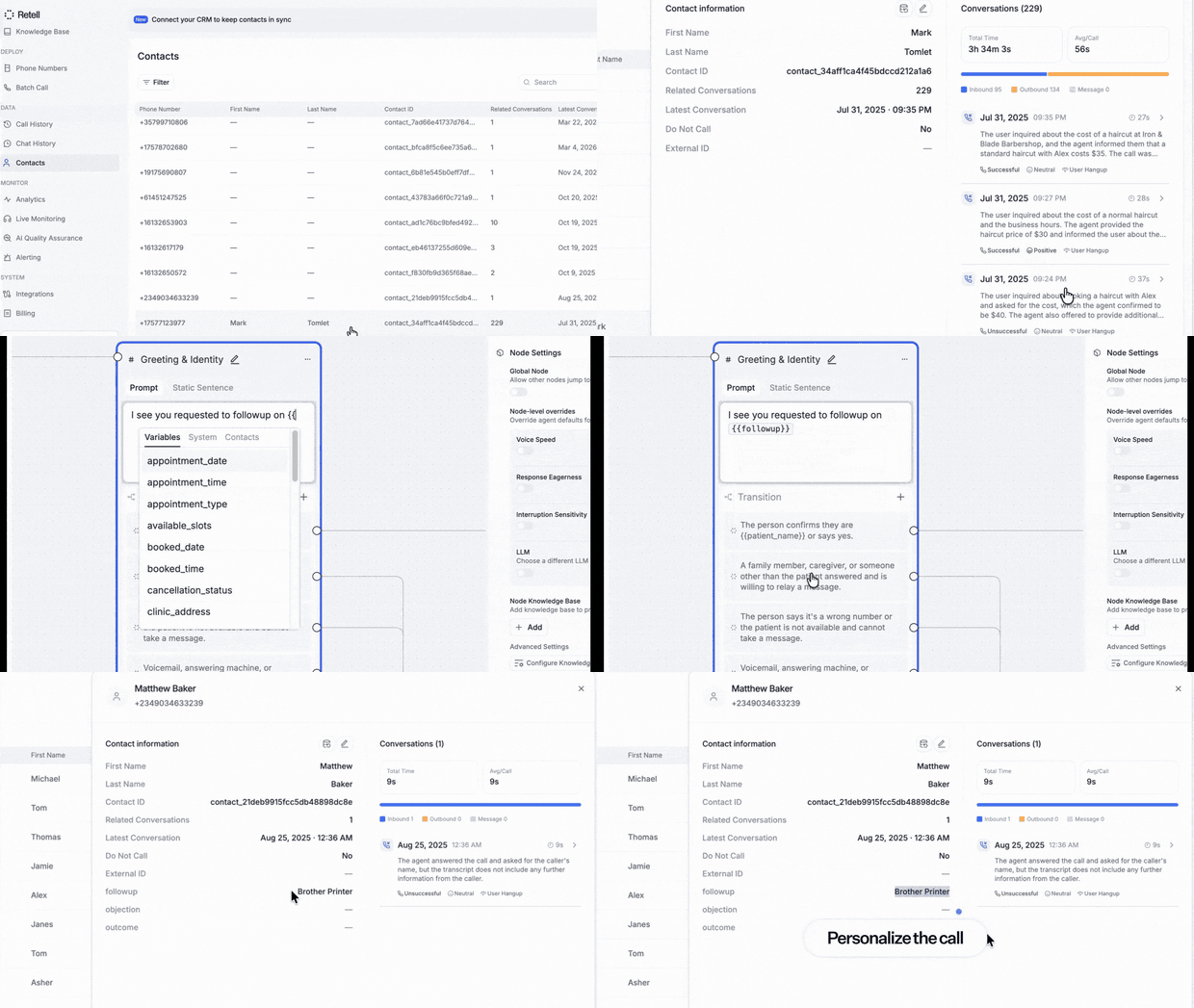
Agents can now remember a caller across conversations, with no extraction workflows, storage or retrieval logic on your side.
Per-agent toggle: saving and recall are separate settings, so an agent can save, recall, or both.
A running brief, not a transcript: Retell keeps a short brief for each contact with preferences, what has been discussed, and what still needs follow-up. Resolved items drop out.
Phone calls and SMS: the brief updates after every completed phone call and SMS chat matched to the contact by phone number. Web calls and web chats do not update it.
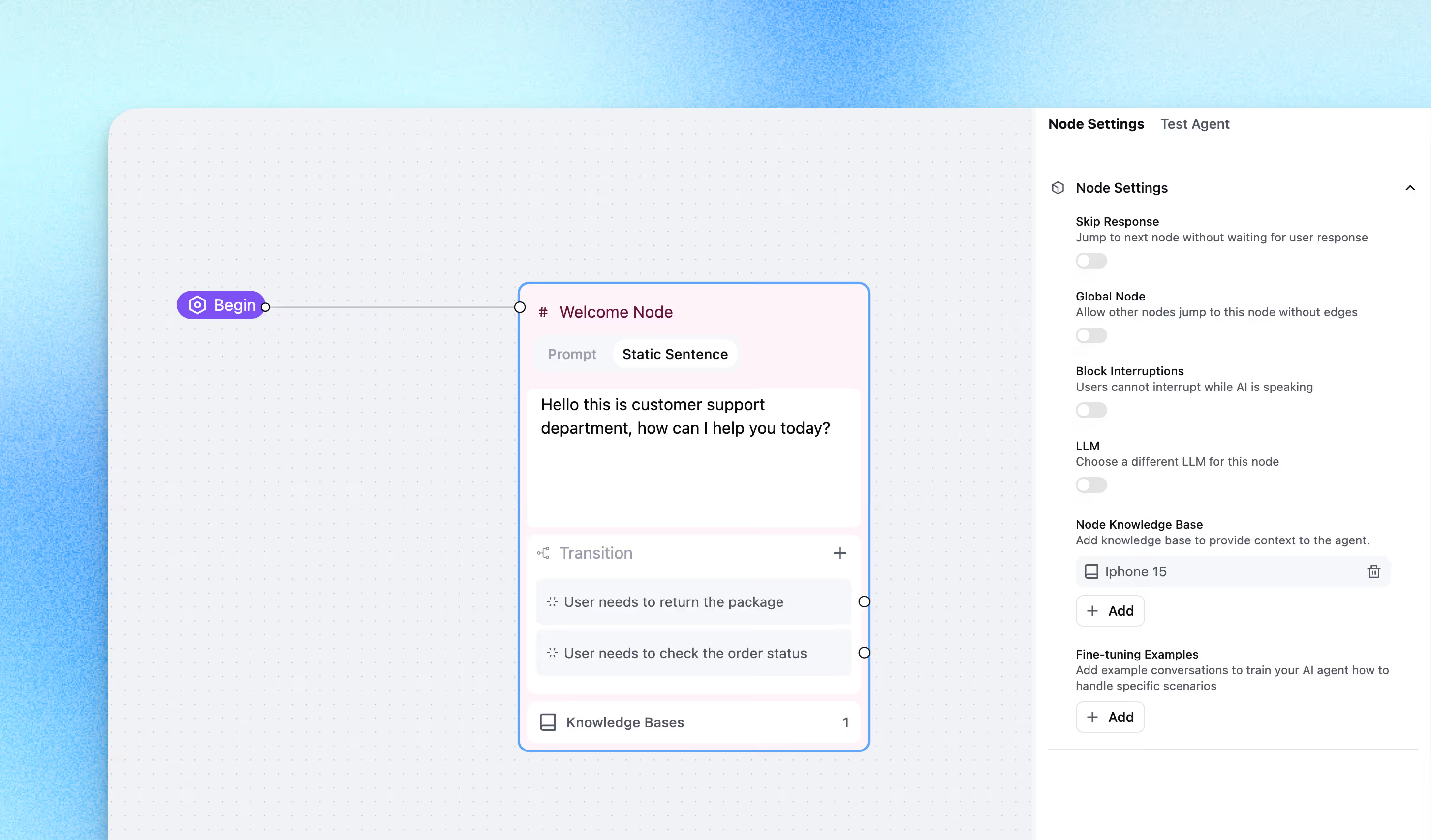
Skip what's already known: Conversation and Subagent nodes get a Use memory to skip this node option, so agents stop asking what the brief already answers.
Full control: view, edit or clear briefs in Contacts. The Memory prompt is customizable per workspace, and a backfill builds briefs from earlier eligible calls.
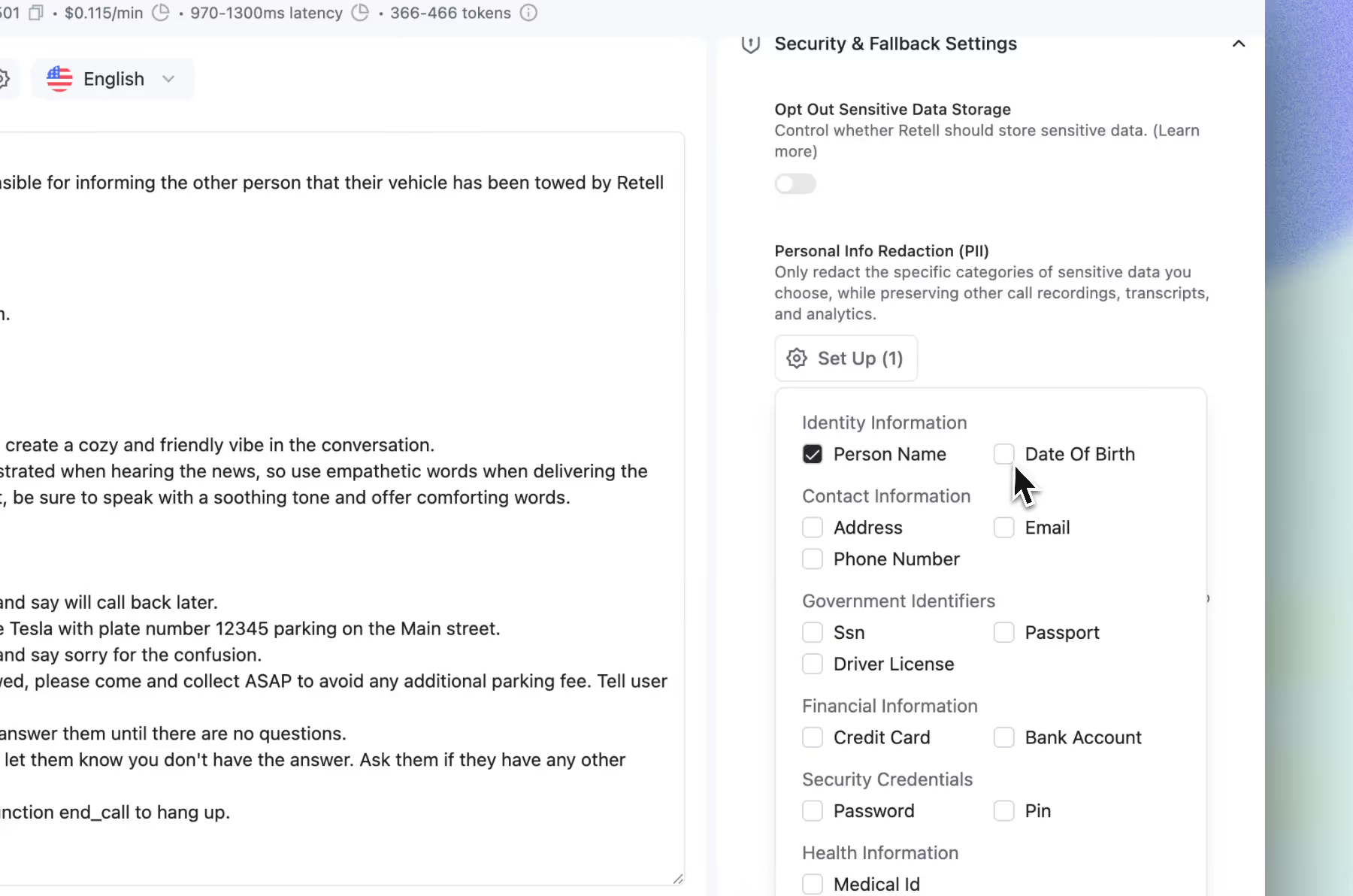
Privacy and pricing: Memory follows your storage and PII redaction settings. Saving and backfilling cost $0.005 per run.
No single model is best at everything. Retell is model-agnostic, so we now publish how each model performs in live calls, for customers and non-customers alike.
Side-by-side results across the newest models
Metrics chosen for voice: instruction following, grounding, colloquialism, latency and more
Retell Workflows has launched, plus other recent platform updates.
Introducing Retell Workflows
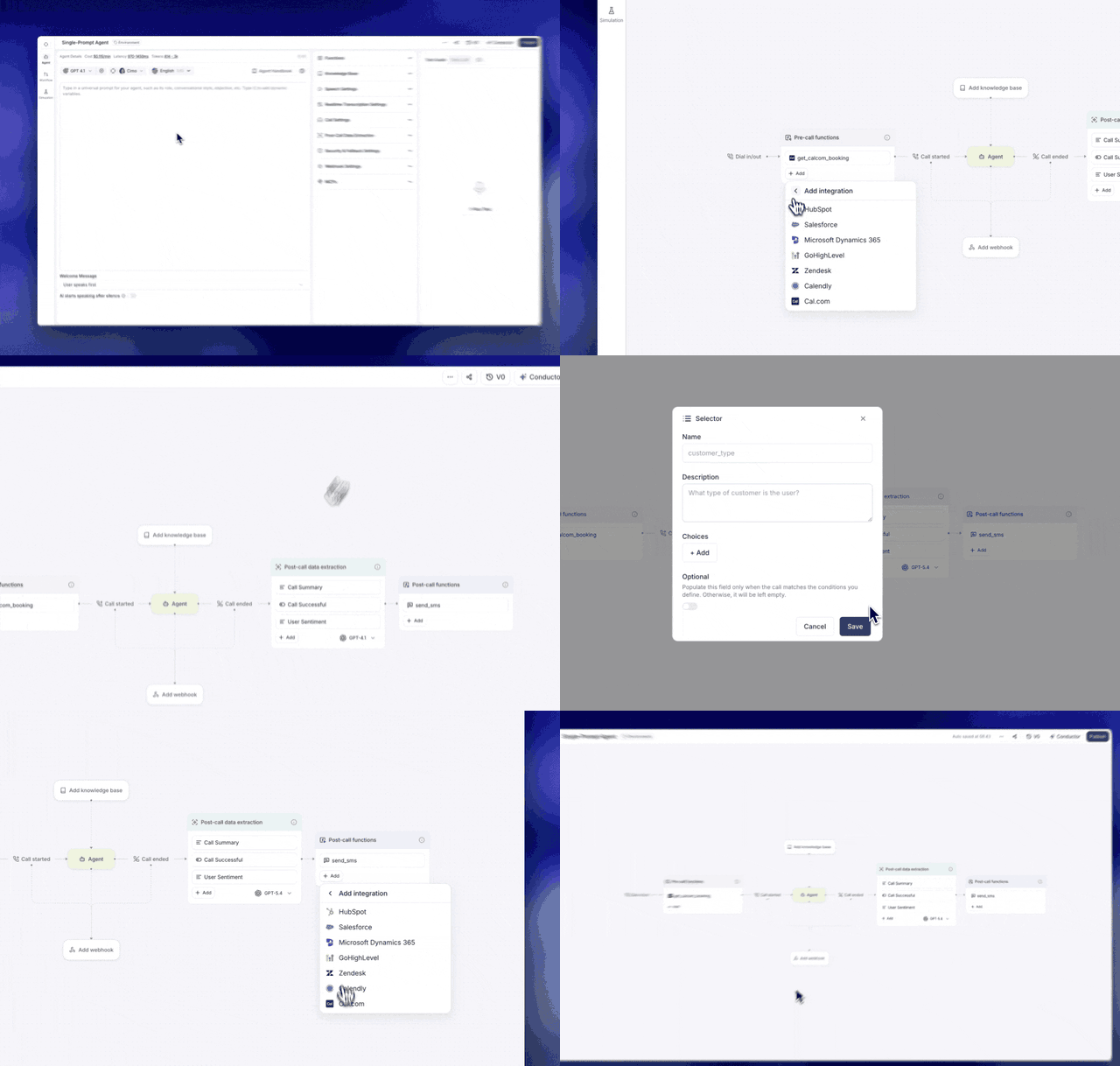
Say hello to Retell Workflows, a native orchestration for all of your voice agent's work, including everything that needs to happen before a call connects and after it ends.
Integration library: connect Slack, Google Drive, Salesforce, and more directly in your Retell dashboard.
Tool store: discover and add integrations and capabilities.
Preset functions: eliminate the need to define common actions and make AI behavior more predictable.
Streamline your operations with easier connections.
Transfer handling is more reliable: ASR phrase splits no longer break transfer confirmation, and failed transfer/agent-swap paths are no longer silently dropped.
Transcription and SMS usability improved: transcription defaults to call IDs, SMS replay was fixed, and multimedia links render correctly in transcripts.
Agent and analytics workflows improved: Copilot can create agent draft versions, and call dashboards can filter by transfer agent.
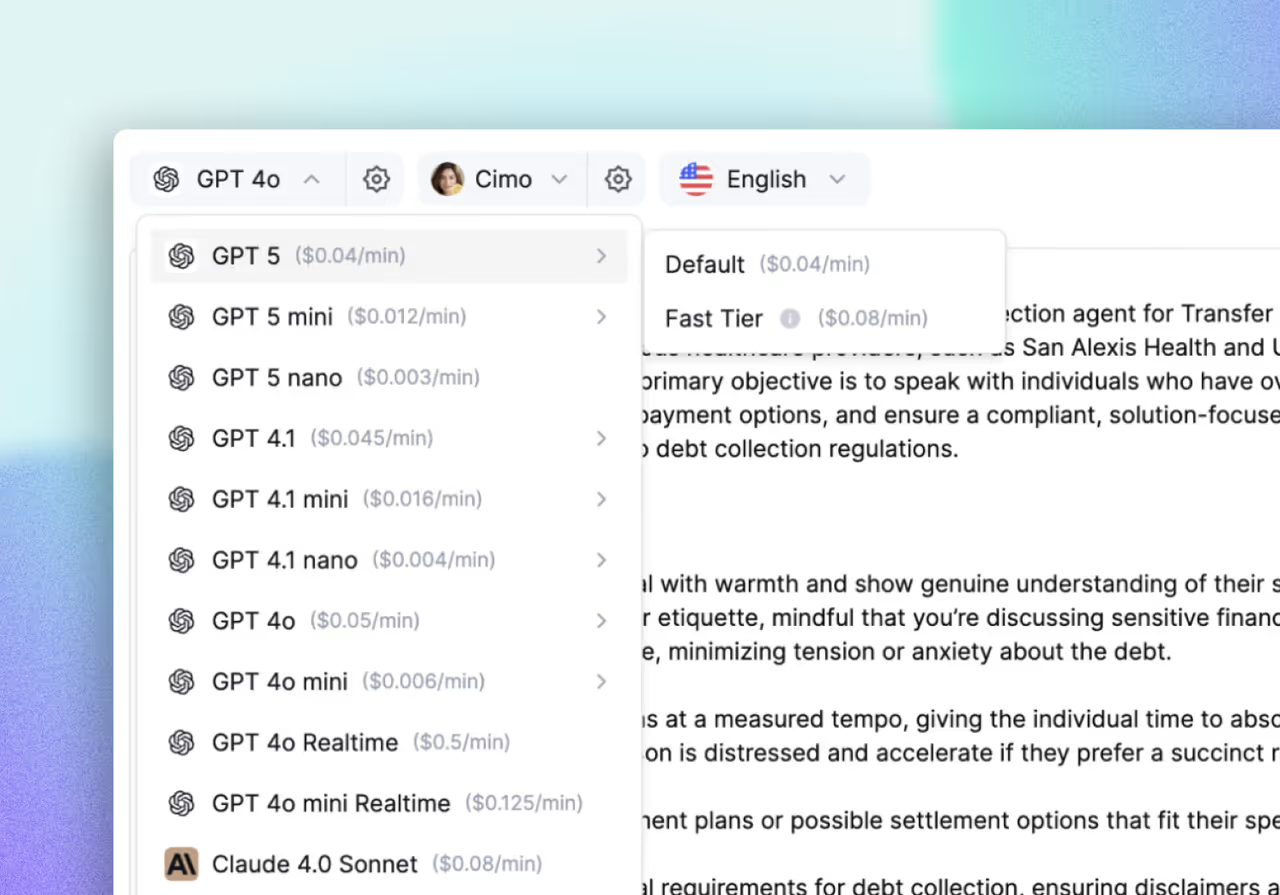
GPT-5.6 and GPT Realtime 2.1: both of OpenAI's newest models, including a low-latency realtime option, are live in the agent builder.
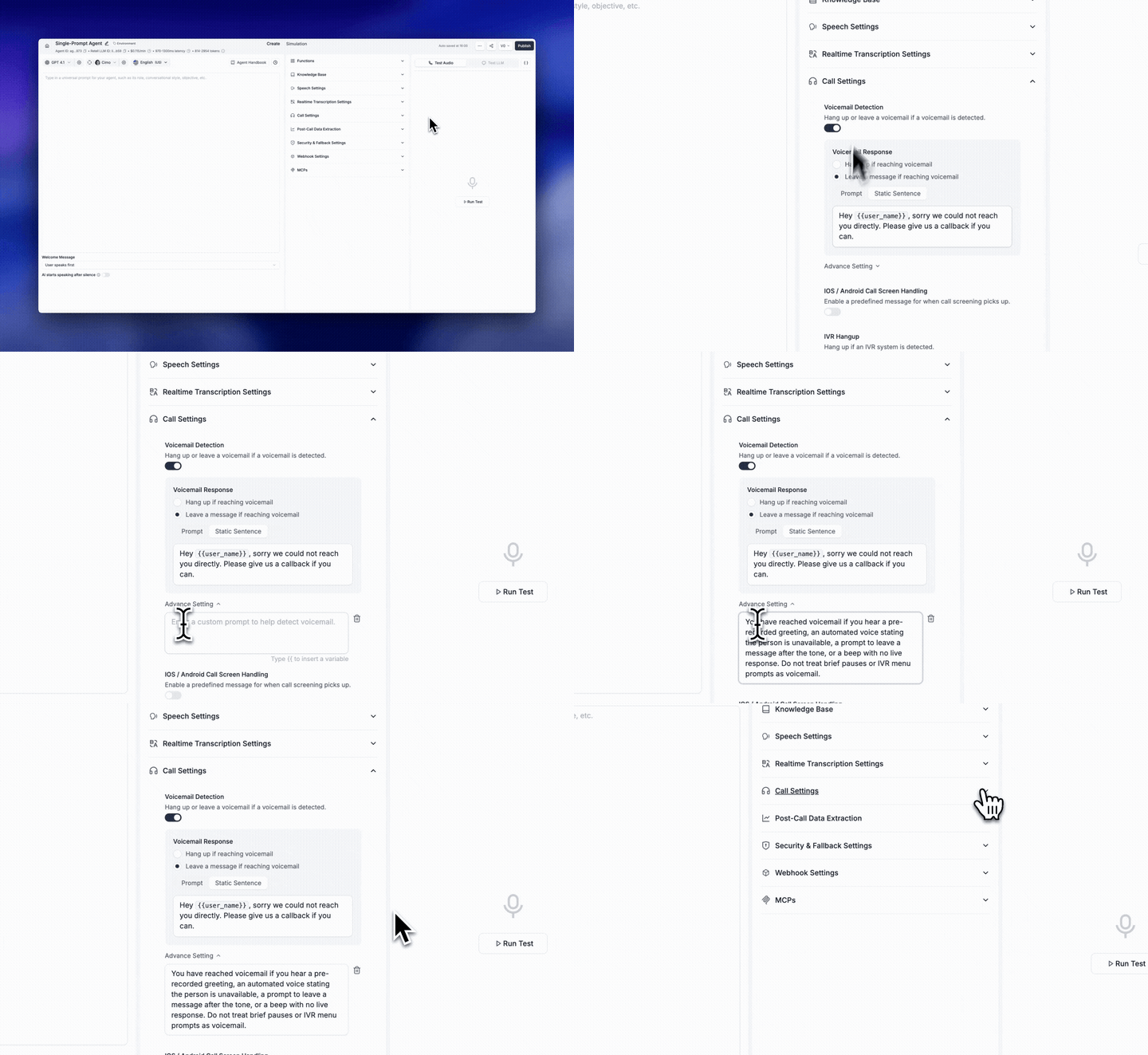
iOS and Google call screening: screened calls were being misread as voicemail, so agents hung up or left a message. They now recognize the live pickup and stay in the conversation.
Spanish transcription: Soniox's high-accuracy Spanish speech recognition now covers every call.
Duplicate actions fixed: agents could fire the same tool call twice in one response, like confirming a booking. Each action now fires once per call.
Conductor is live, and it's a big one. Here's what else shipped this week.
Conductor is live
Retell's copilot for building and maintaining voice agents. Three parts of it worth knowing about:
Every change gets simulated before it ships
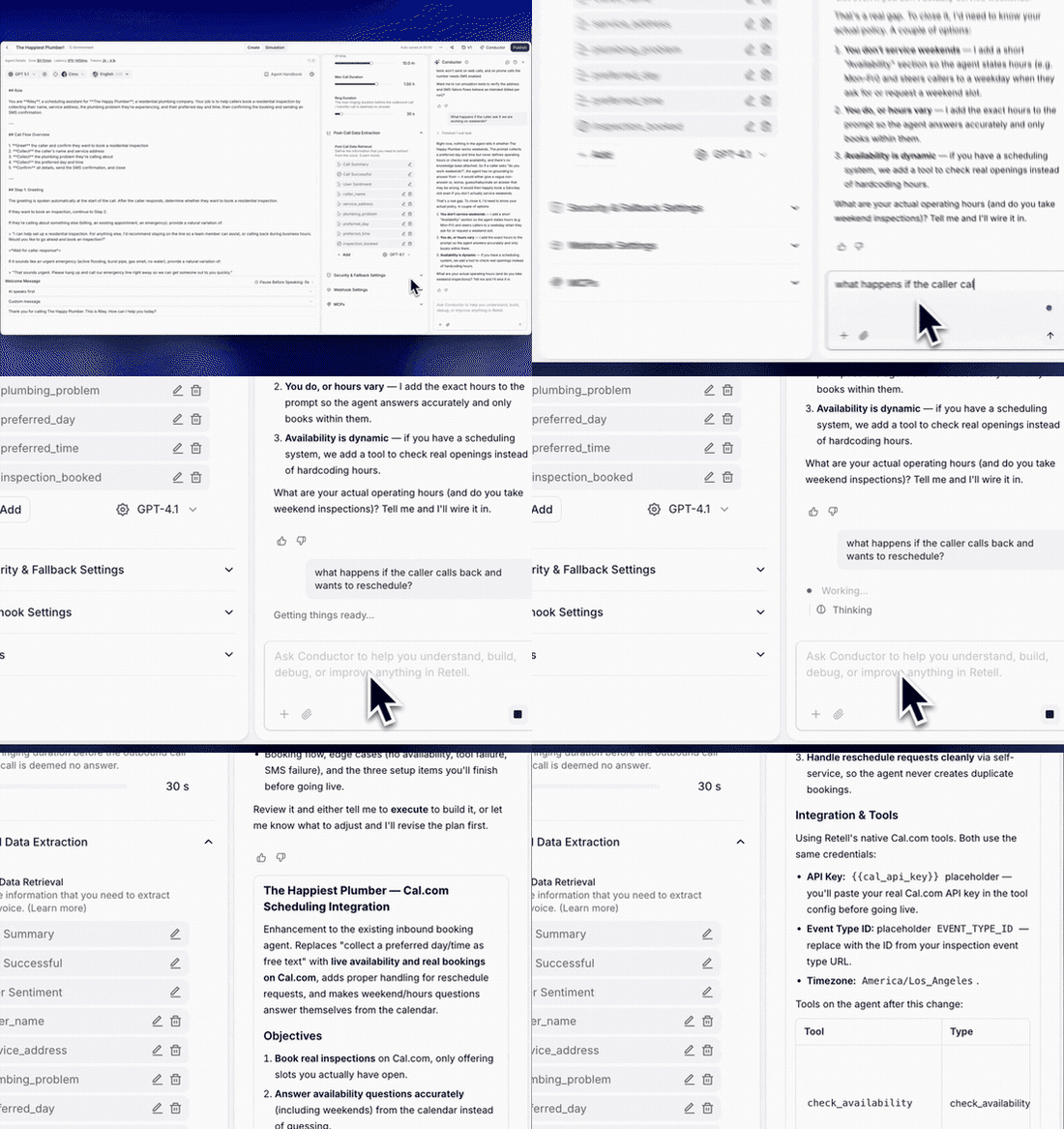
Ask Conductor to run a scenario, like "what happens if the caller wants to reschedule," and it plays that call against your agent without dialing a real number, then shows you exactly how it responded. Every proposed change is validated against the platform first, so nothing reaches your agent unless it actually holds up.
Simulate a specific scenario on demand, no real call required
Every change validated against the platform before you ever see it
Catches edge cases most teams only find after a call goes wrong
Nothing ships until the graph, data connections, and logic all check out
Tested before it's trusted.
Gets better from your real calls
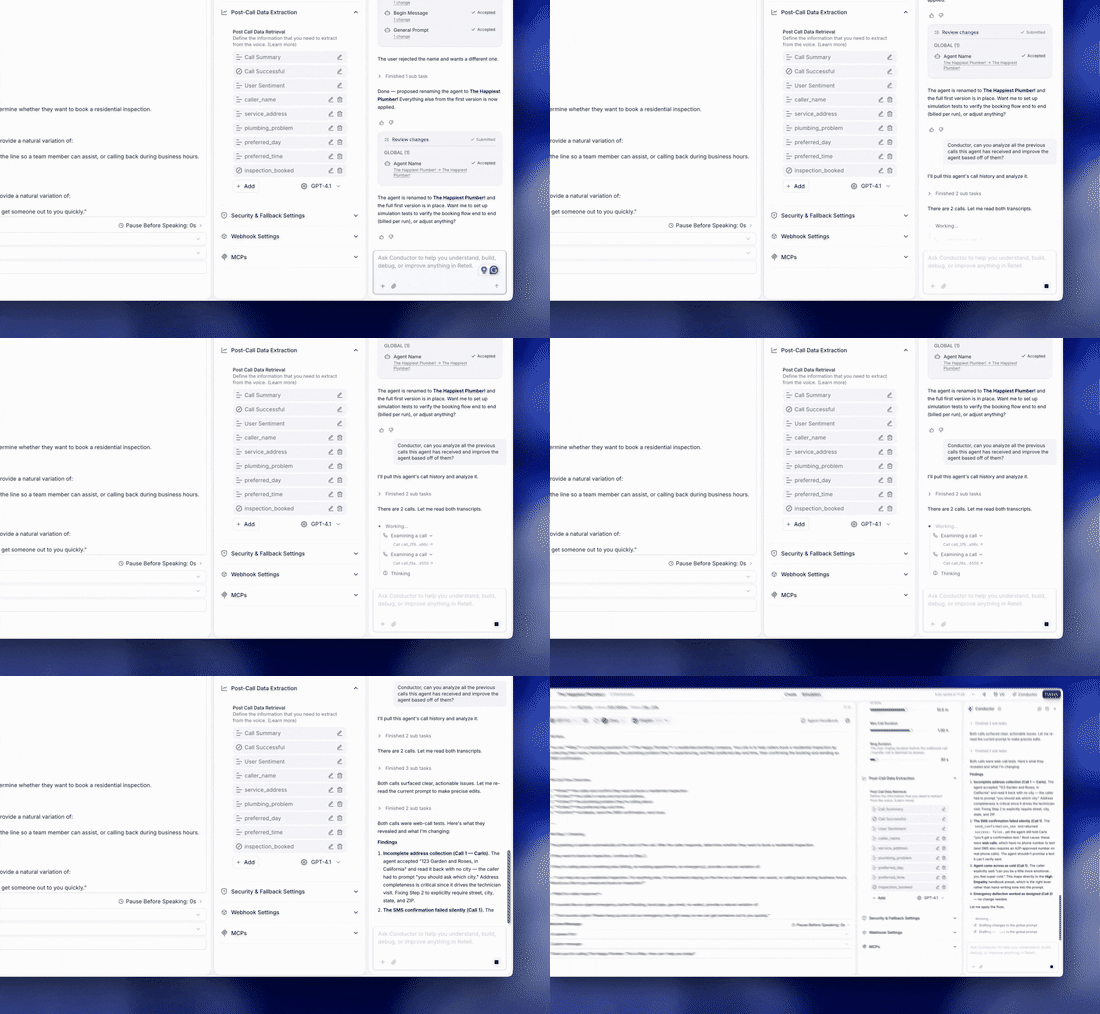
Most bad calls just sit in a call log until someone happens to notice a pattern. Conductor reads failed calls, writes a test that reproduces the problem, runs it as a simulation without dialing a real number, and proposes the fix.
Failed calls turned into test cases automatically
Simulated before anything touches production
Fixes proposed as a change you review, not applied silently
Already handles 70% of Retell's own simulation testing internally
Every bad call becomes the reason the next one goes better.
Review every change before it ships
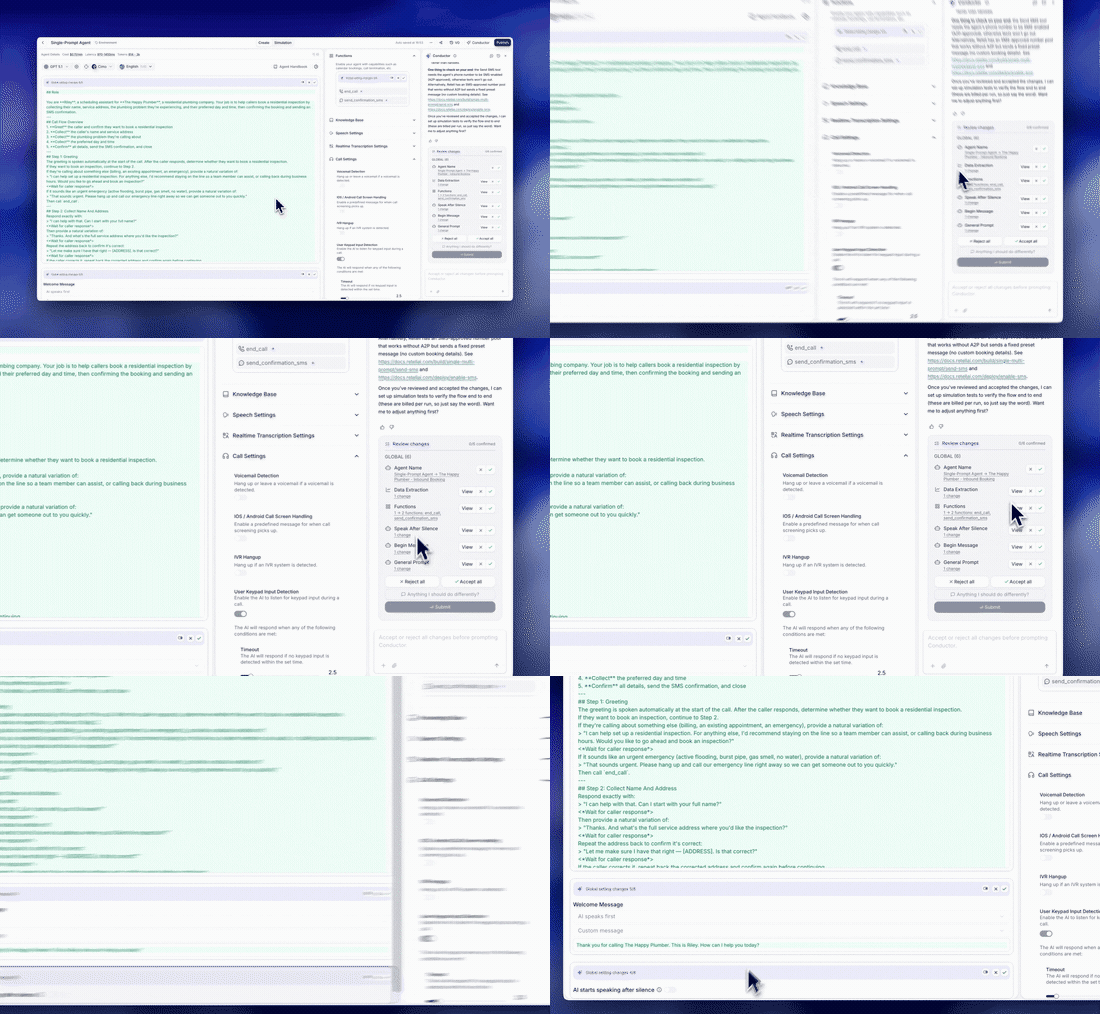
Conductor never edits a live agent on its own. Every change it proposes shows up inside the actual agent flow, on the exact setting it affects, so you can see precisely what would change before it does.
Free LLM token allowance raised to 4,000: every agent now gets 4,000 free LLM tokens before any surcharge applies, and chat agents no longer show a surcharge section at all since it doesn't apply to them.
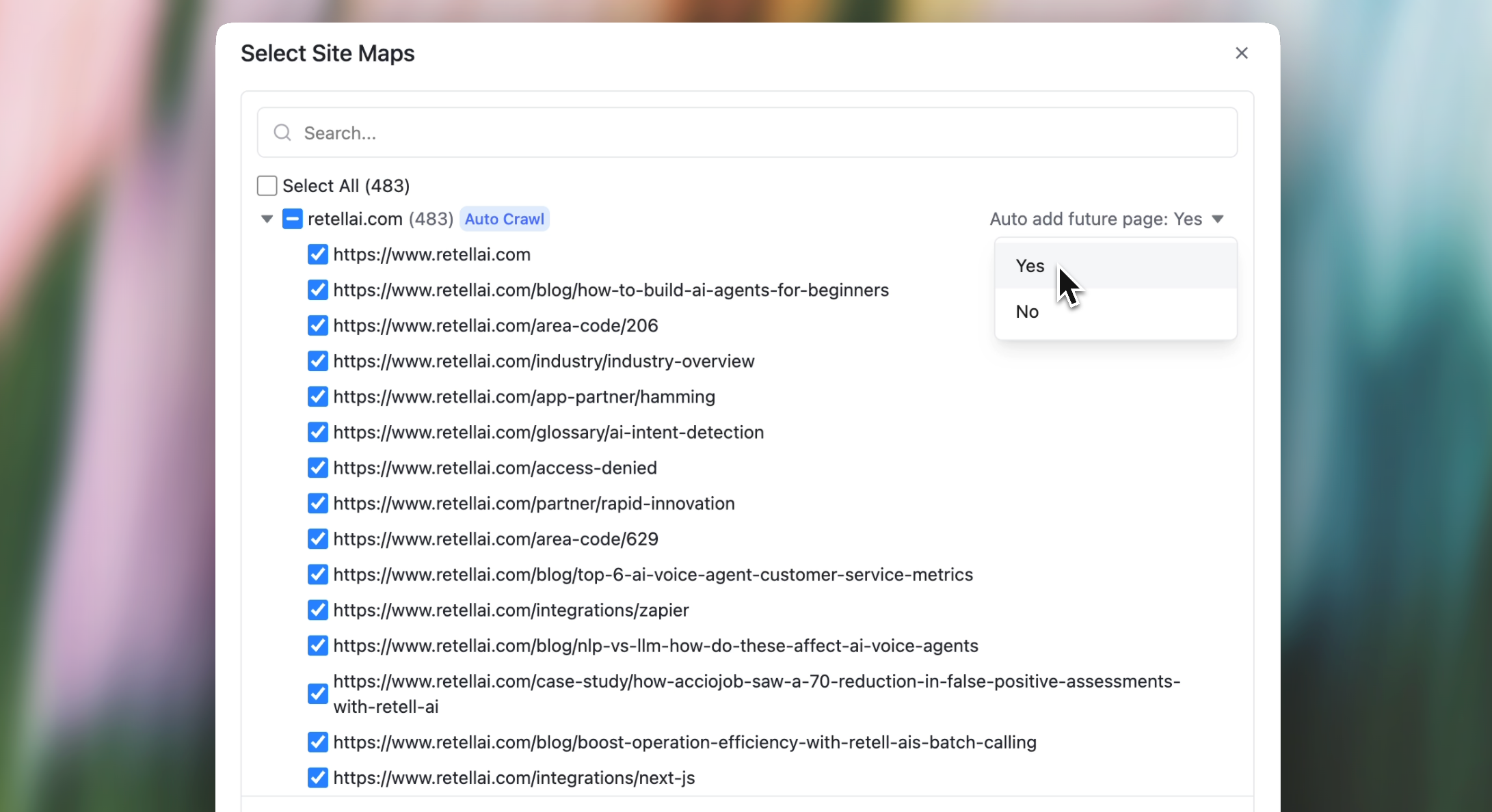
Better KB parsing and chunking: documents parse more accurately now, especially tables, headers, and unusual layouts, and each chunk keeps its parent header info and splits at sentence boundaries instead of mid-word, so your agent pulls cleaner context.
Live Call Monitoring, Custom Dashboards, Built-in CRM, Colloquial Model, Expressive Mode, and more
Big month with the Retell 2026 launch week. Five launches in five days:
Built-in CRM
Keeping your CRM in sync with every voice call has always meant building automations nobody wants to maintain. Built-in CRM fixes that natively, with two-way real-time syncing to Salesforce and HubSpot out of the box.
Every call auto-creates or updates a contact, keyed to their phone number
Two-way sync with Salesforce and HubSpot, with field mapping and a no-overwrite option
Post-call analysis becomes contact attributes, with one-click backfill across your full call history
Agents recognize returning callers and resume where the last call left off
Your human team was never flying blind. Now your voice agents aren't either.
Finding out a call went wrong after it ended is already too late. Live Call Monitoring gives you a real-time view of every active conversation so you can catch problems and act while the customer is still on the line.
Real-time transcript on every active call, with caller details and duration
Call scoring by sentiment, latency, and interruptions, with configurable weights
Auto-actions when a call goes wrong: transfer to a human, fire a webhook, send an alert
Listen in live, whisper to your agent, or take over the call yourself
Stop finding out what went wrong after the call ends.
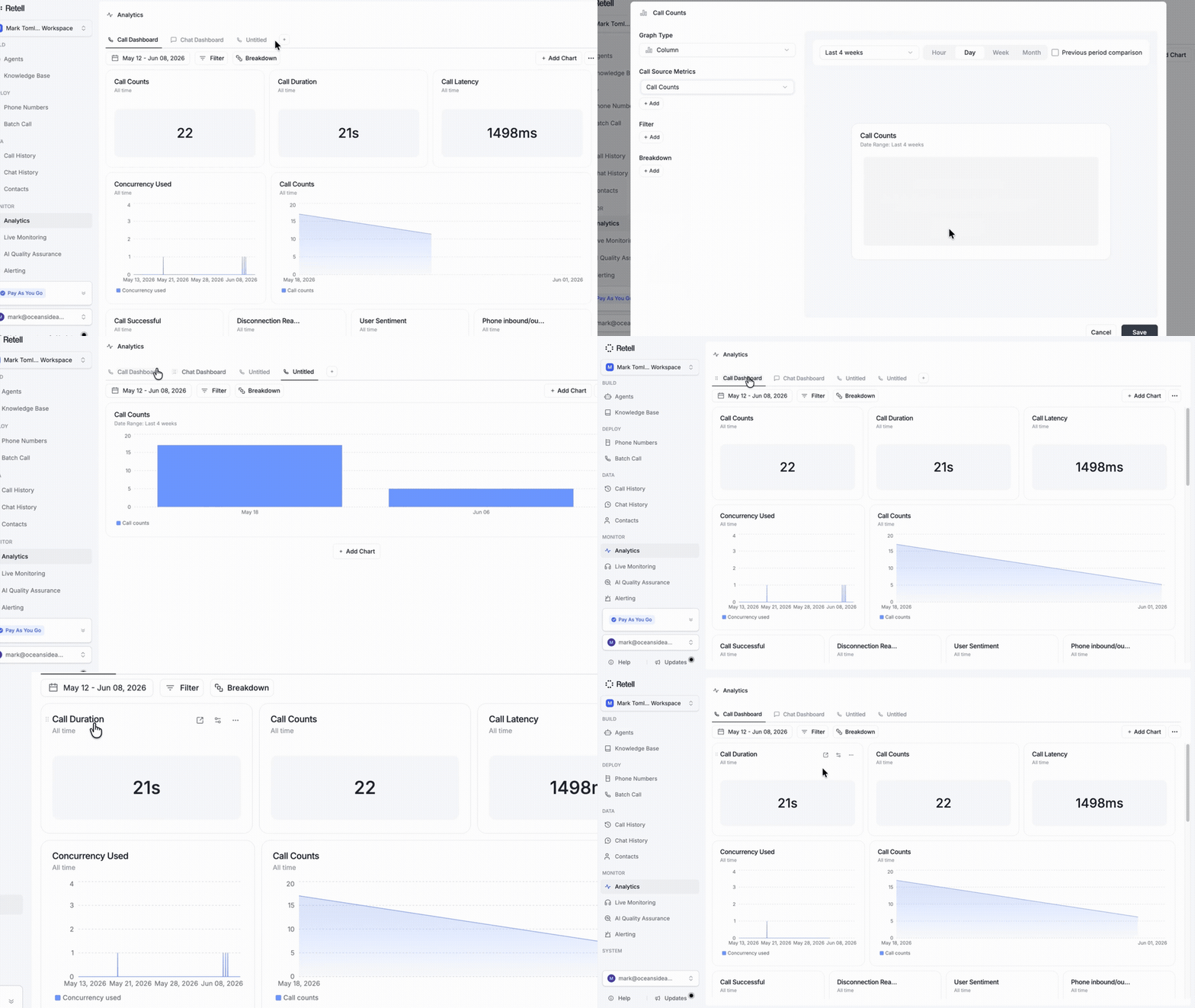
Your whole organization no longer has to be stuck on the same view. As voice deployments grow, support, QA, ops, and leadership all need different answers, but too often they're forced into the same dashboard.
Create multiple dashboards for different teams and switch between them in a click
Saved views shared across your workspace, with filters that persist on refresh
Filter and group by agent, version, call type, or any post-call analysis field
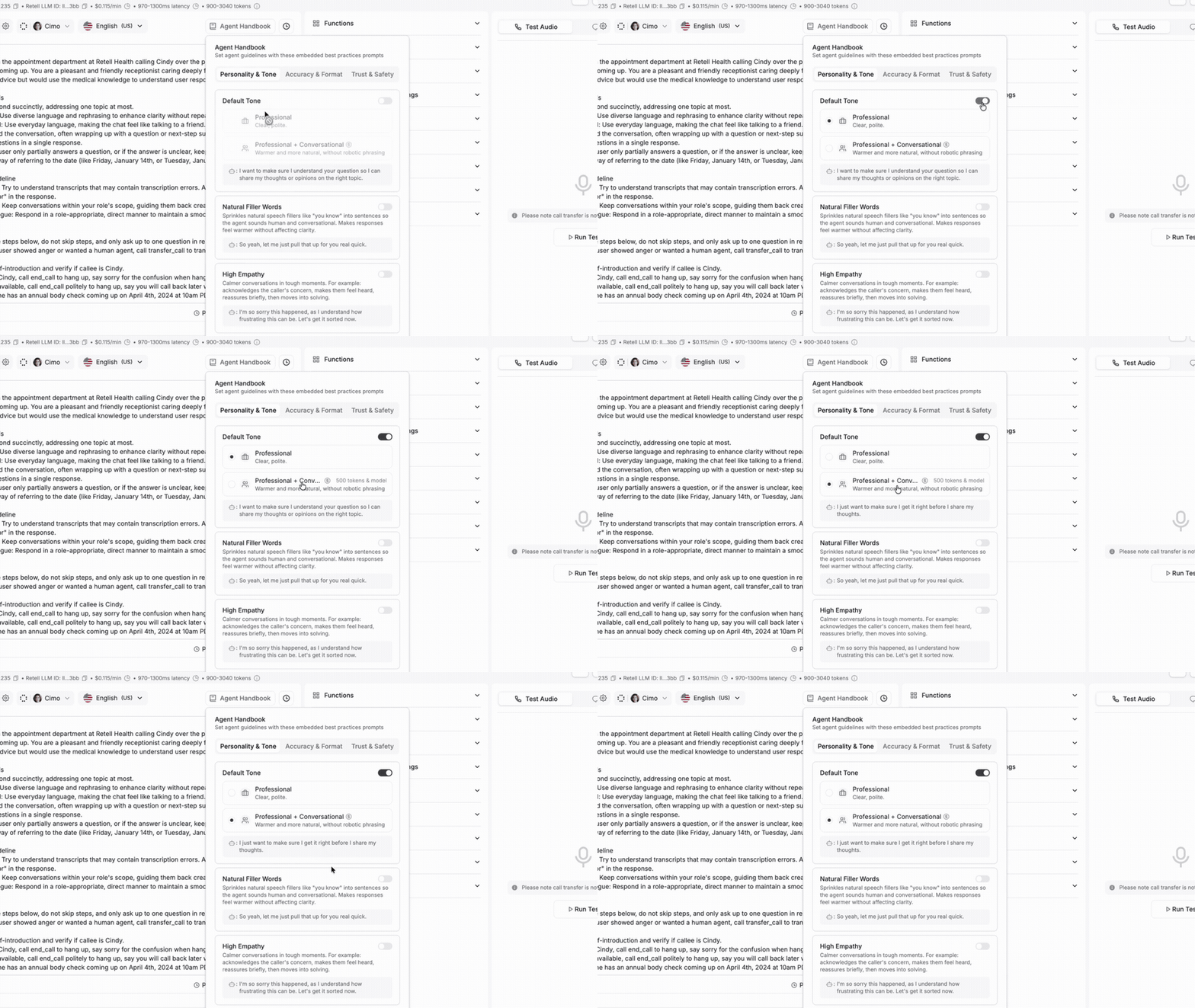
Voice agents often sound great but still push callers toward a human. Colloquial Model rewrites how your agent phrases things in real time, closing the gap between sounding human and actually talking like one.
Lines like "I apologize for the inconvenience" give it away every time. Your LLM still decides what to say and your prompts don't change. It just smooths the wording in about 50 milliseconds.
One toggle, no rebuild
Natural fillers, human cadence, real pacing
Tuned for contact center calls, not generic assistant chat
Sounding human is one side. Talking like one is the other.
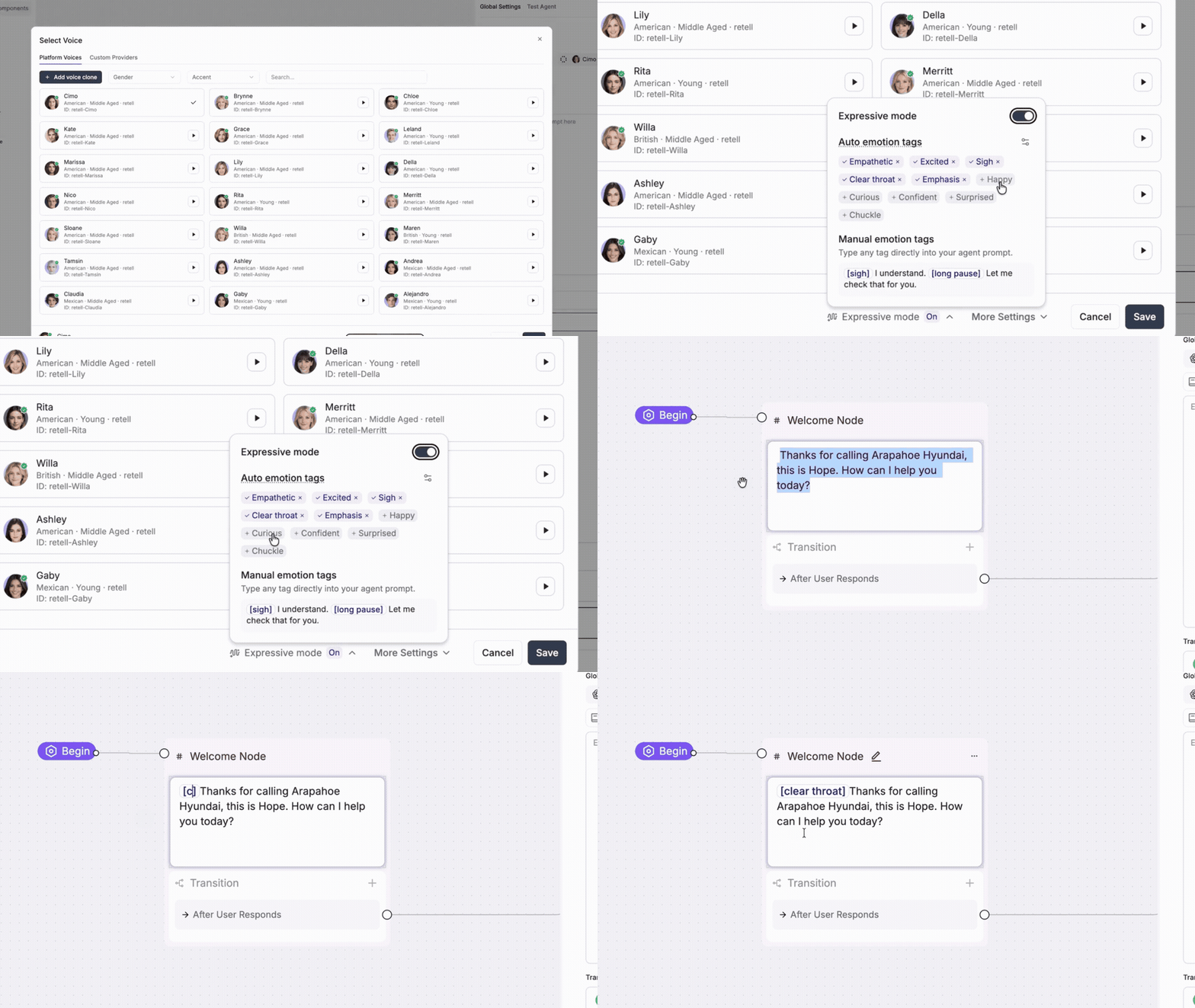
Saying the right thing in the same flat tone every time still sounds like a robot. Expressive Mode gives you control over how your agent delivers every line, not just what it says.
Auto emotion tags: pick the emotions in play and Retell places them where they fit in real time, no prompt changes
Manual emotion tags: drop [sigh], [long pause], or any cue directly into your agent prompt for precise control
Emotion-aware listening: reads the caller's pace, pauses, and pitch as a live signal your agent can act on
Same script. Different delivery.
Other Platform Upgrades
Exists / not exists filter for post-call analysis, metadata, and custom attributes: filter your dashboard or call list by whether a field is populated, useful for routing follow-ups and identifying coverage gaps.
Environment tag in the Call API: the env tag is now exposed via API, so you can programmatically distinguish calls by environment in your own systems.
Agent Versioning 2.0, Granular Multilingual, Custom Voicemail, Voice Orb, and more
Another monthly roundup of platform updates. Here's what's new and why it matters:
Agent Versioning 2.0
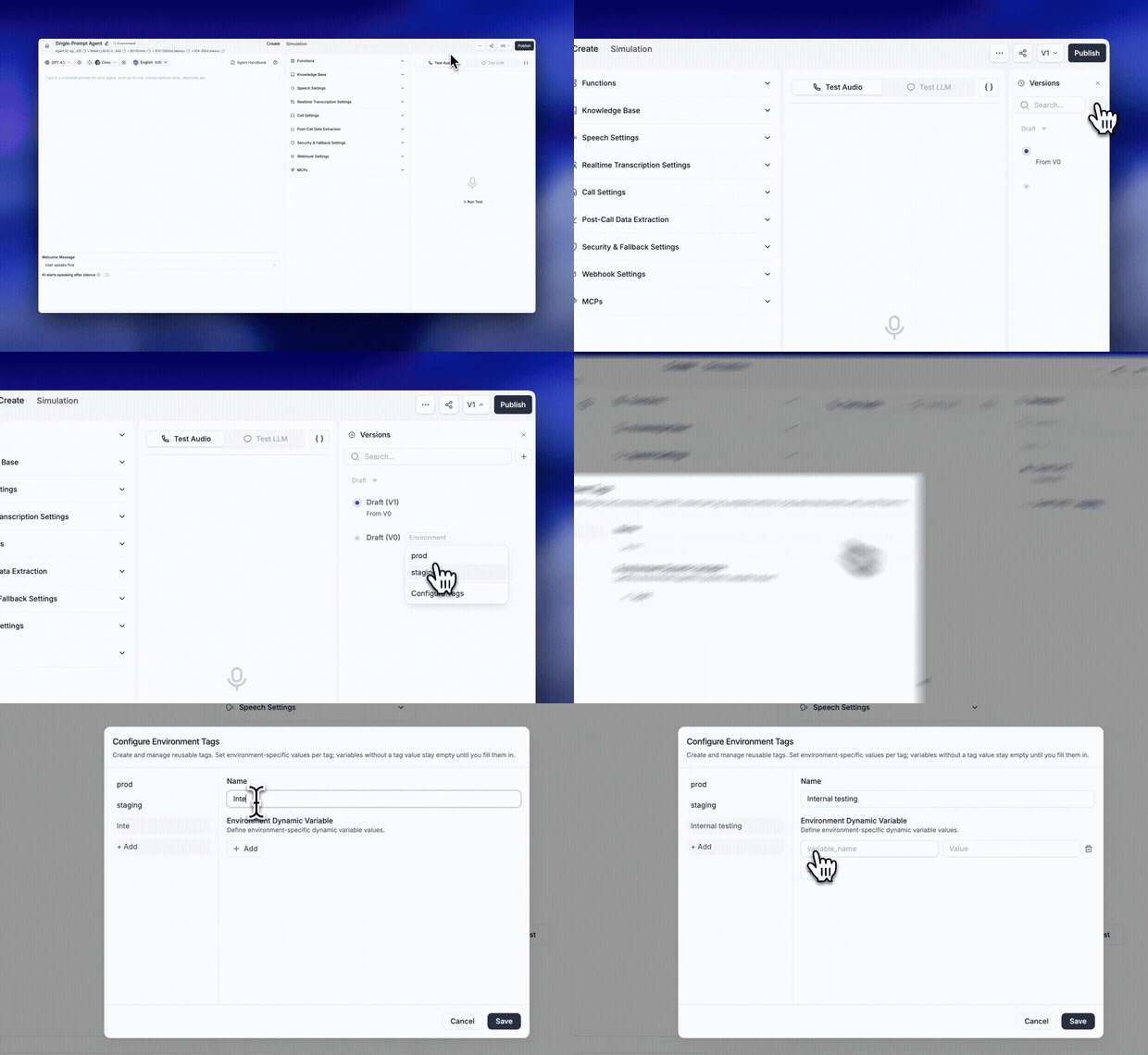
Ship changes without breaking what's live. Create multiple drafts, track who changed what, and manage releases with environment tags like staging and production. Each environment carries its own default variables, so you can test safely before pushing live, without rebinding phone numbers or disrupting traffic.
Multiple drafts and parallel workstreams
Version history and change tracking
Merge changes between versions
Staging and production environment tags
Environment-specific test variables
One-click promotion to production
One workflow now handles drafting, testing, and releasing agents at scale.
No more choosing a single language or settling for a generic multilingual model. Hand-pick exactly the languages your audience speaks, and every call responds in the caller's language automatically.
Multi-select languages by region or group
Automatic language detection on every call
No menus, no "press 1 for English"
One agent now meets every caller in their own language, automatically.
More people are screening calls. Your agents should know how to handle it. When iOS or Android call screening answers first, your agent can automatically detect the screening flow and deliver a predefined message designed to get through.
A small change that can make a big difference for outbound performance.
Share your agent with anyone in seconds. Generate a shareable link, send it to a teammate, stakeholder, or customer, and they can start talking to your agent immediately.
No test environment
No setup
No scheduling a demo just to hear how it works
Anyone can experience your agent the moment they open the link.
We've updated our Terms of Service and Privacy Policy, and added two new sub-processors. These changes take effect on June 1, 2026.
We've made these updates to keep our terms clear, reflect how the platform works today, and stay current with evolving regulations. Review the full documents below:
We've also added two new sub-processors — Soniox (speech-to-text) and Ironclad (contract management) — to our infrastructure registry. No action is required; view the full list at our Trust Center.
No action is required to continue using Retell AI. Your continued use of the Services on or after June 1, 2026 means you accept the updated terms.
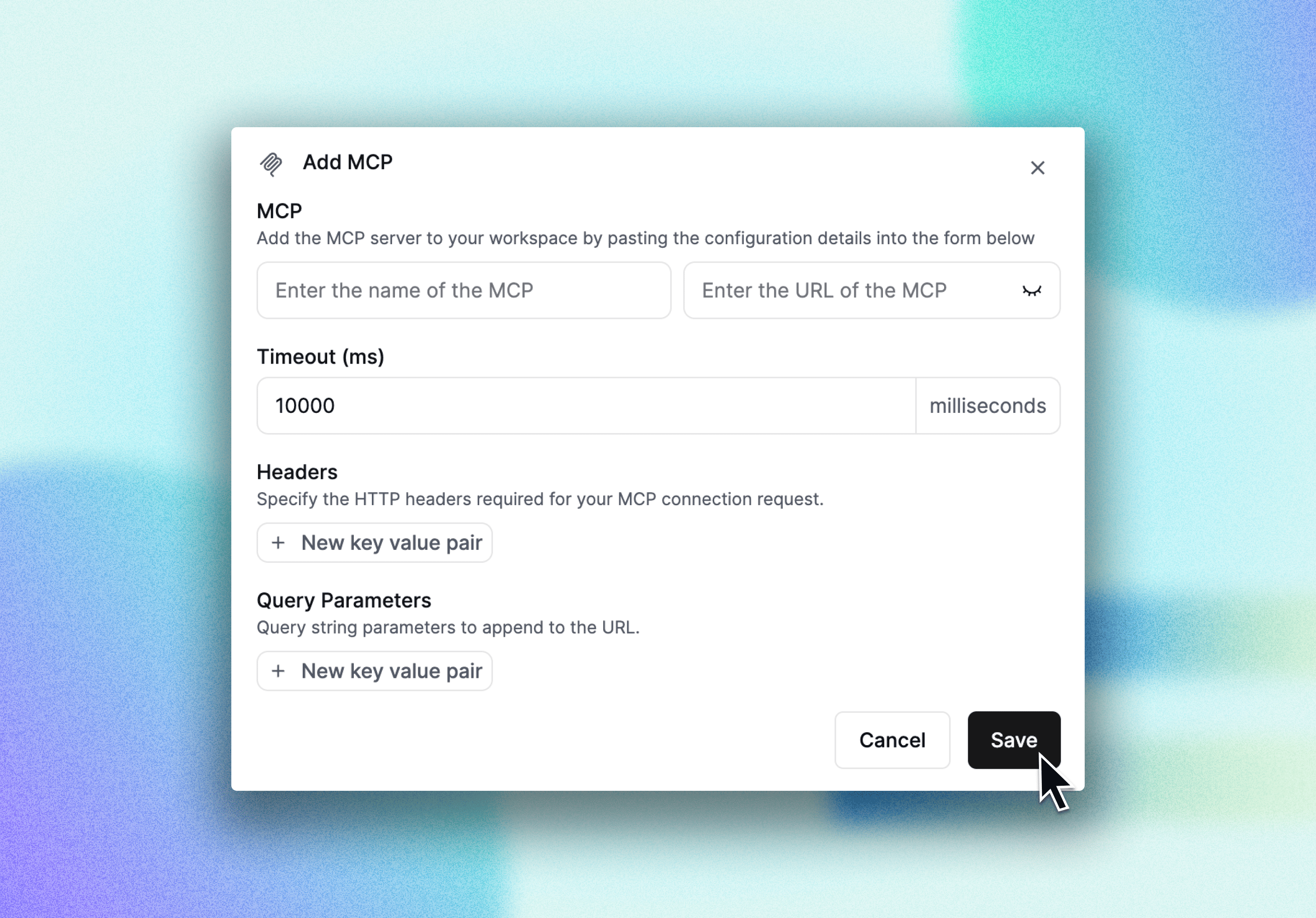
For a step that needs both conversation and tool use. One node holds the prompt context and rules, with node functions built in: agent transfer, MCP tools, custom functions, SMS and more. The node runs the conversation, takes the action, then transitions.
Run JavaScript inside a conversation flow: calculations, data formatting, simple API calls, and logic that used to need an external server. Pull a first name out of an API response for a natural greeting, price a quote from caller inputs, or count authentication retries before escalating.
You can now use ChatGPT to launch production-ready AI voice agents for real phone workflows.
Build an agent with the right prompt, tone, language, voice, and call behaviors
Deploy to a live phone number
Test scenarios with test calls or chats: booking, escalation, voicemail, and more
Monitor call performance and iterate over time
Launch your first agent in ChatGPT with the Retell GPT App
Dynamic Voice Speed & Response Eagerness
When a caller speaks slowly, the agent slows down. When they speak fast or start to respond more eagerly, it speeds up to match. If they ask the agent to change pace, it adjusts immediately.
Elderly and hearing-impaired callers get a patient, measured pace
Fast-paced callers get snappy responses that respect their time
Non-native speakers get an agent that mirrors their rhythm
Any caller can say "slow down" or "talk faster" and the agent responds naturally
One agent configuration now handles the pace of every caller, automatically.
A/B Test Your Voice Agents
Split call traffic by percentage across multiple agents
Test a new prompt on 20% of inbound support calls
Compare two voices on outbound sales calls
See which agent performs best in your call analytics before rolling it out to 100%
Works for inbound and outbound calls. Set agent weights, deploy, and iterate. Read A/B Testing Docs
Other Platform Upgrades
Copy, Paste, and Undo Shortcuts: Use Cmd/Ctrl+C, Cmd/Ctrl+V, to copy and paste nodes across CF agents and components, or and Cmd/Ctrl+Z quickly undo changes.
New Node-Level Overrides: Override agent defaults per conversation node with controls for voice speed, responsiveness, and even the LLM.
Node Functions for Conversation Nodes: Add tools/functions to a specific conversation node.
Global Node Cooldown: Prevent a global node from firing again immediately after it triggers by pausing it for a set number of node steps.
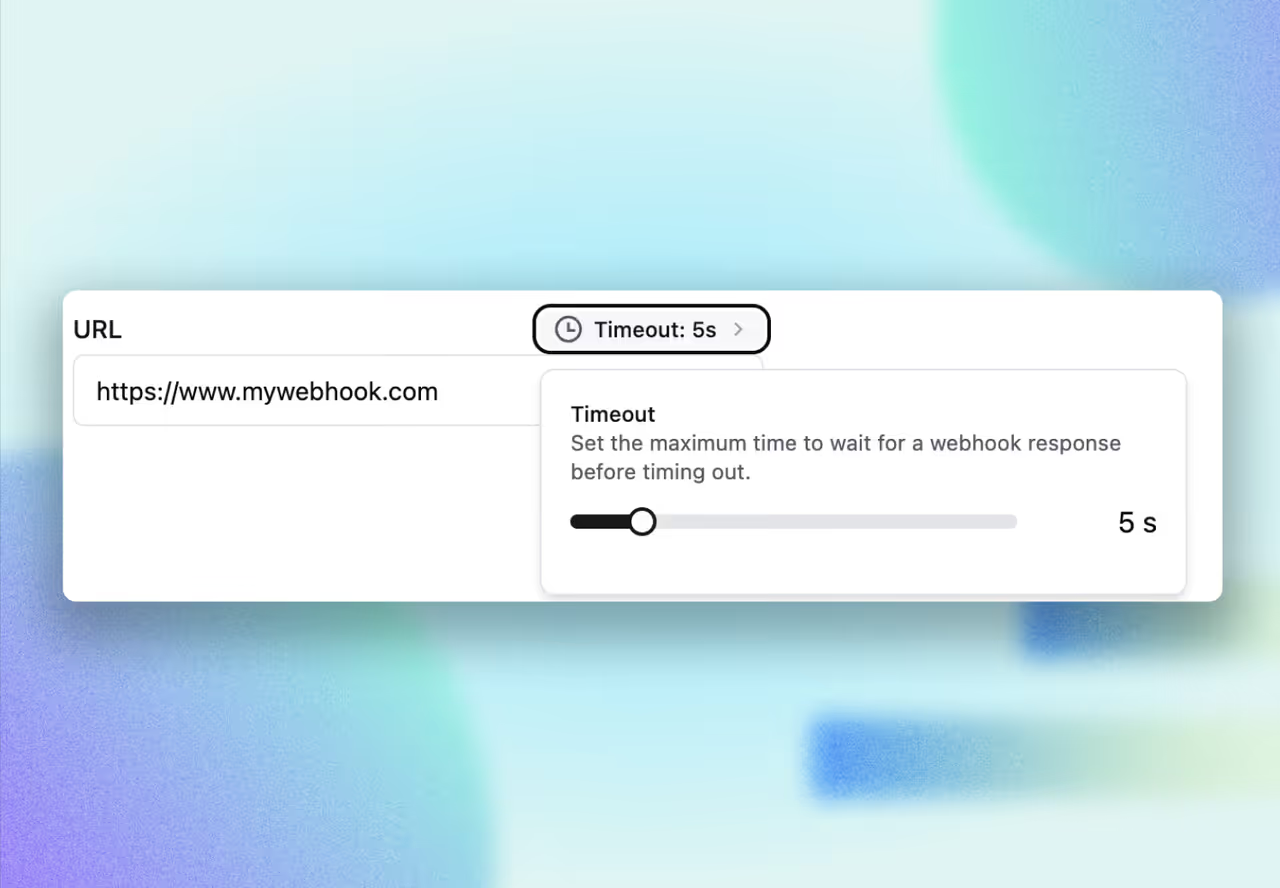
Webhook Event Controls: Choose exactly which events each webhook receives, including new transfer events like started, bridged, cancelled, and ended.
Timezone-Based Hour Variables: Use built-in dynamic variables like current_hour_[timezone] to reference the current hour in a specific timezone.
ElevenLabs v3 Voices: Retell now supports ElevenLabs v3 voices, bringing more expressive speech with stronger emotion, cadence, and delivery. A strong fit for teams optimizing for voice quality and realism.
Data Retention Periods: Set how long call and chat data is kept per agent, then have it automatically and permanently deleted when that window expires.
PCAP Downloads for Call Debugging: Download packet capture files from the call details page to troubleshoot network or audio issues with tools like Wireshark.
Important Notifications
Deprecation of Phone Number Agent Fields:
On March 31st, Retell will deprecate the old single-agent phone number fields in favor of weighted agent lists for inbound, outbound, and SMS routing.
If you use phone number APIs today: replace fields like inbound_agent_id and outbound_agent_id with inbound_agents, outbound_agents, inbound_sms_agents, and outbound_sms_agents.
No immediate action is required: existing data is converted automatically, and the APIs stay backwards-compatible until 03/31/2026 for single-agent setups.
TTS pricing adjustment:
A reminder that ElevenLabs pricing updates on March 23. Under the new model, ElevenLabs TTS starts at $0.04/min, with pricing varying by model.
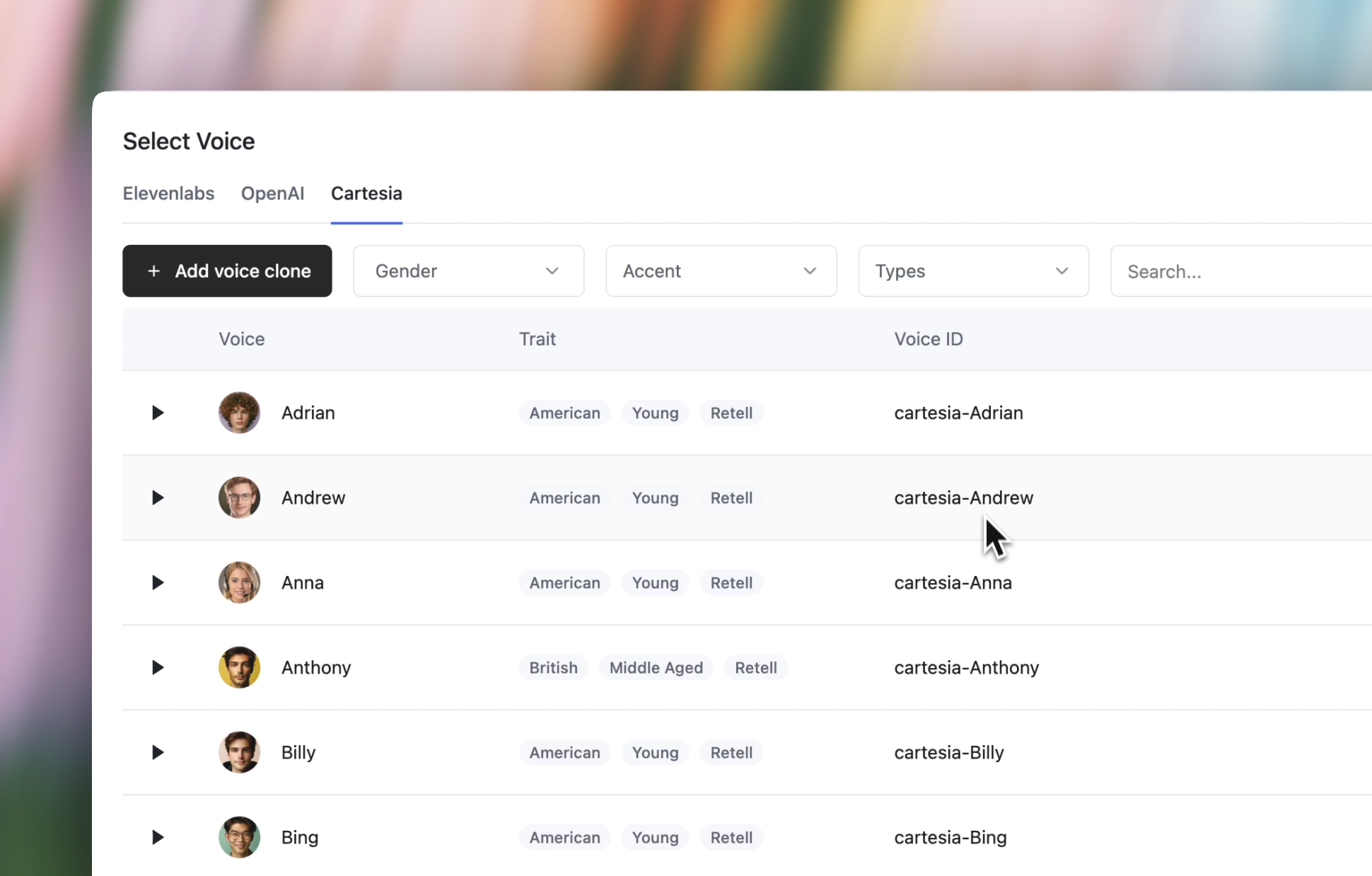
We also have powerful alternatives with the introduction of Retell Platform Voices and the existing Minimax, Fish Audio, Cartesia, and OpenAI all at $0.015/min.
You can compare them directly in the playground, see the previous pricing announcement here.
Agent Guardrails, Webhook Testing, Auto-Failover, Billing Transparency & more.
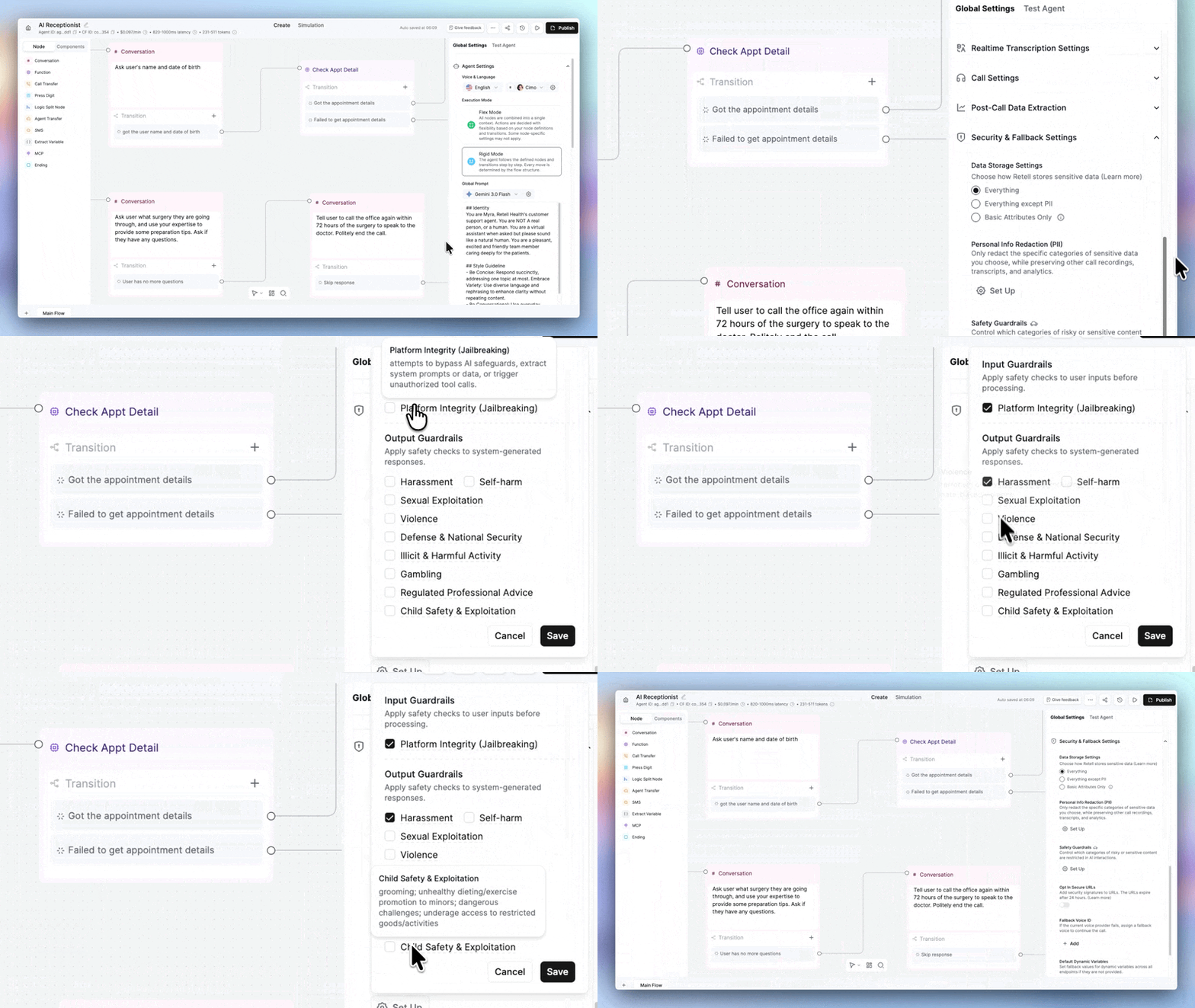
Your agent can now refuse what it shouldn't engage with.
→ Block jailbreaks — prompt extraction, instruction bypasses, unauthorized tool calls. Caught and killed before they reach the caller.
→ Filter harmful output — harassment, self-harm, violence, gambling, regulated advice, sexual exploitation, child safety, and more. You choose which categories are off-limits.
→ Hard stops, not soft warnings — when a guardrail fires, the agent doesn't hedge. It won't produce that content. Period.
Enable per-agent under Security & Fallback in agent settings. Available on all plans.
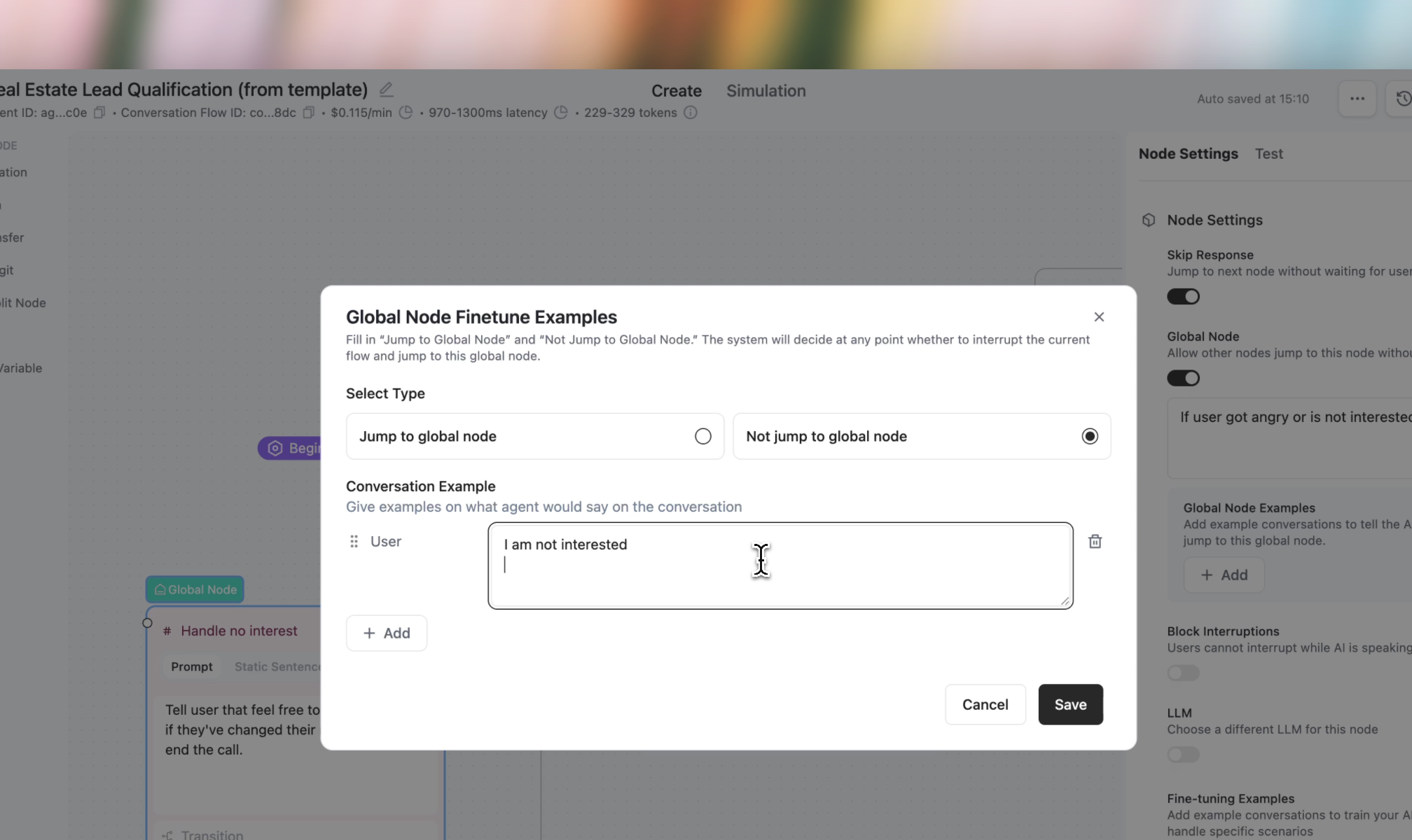
Global Node Return Paths
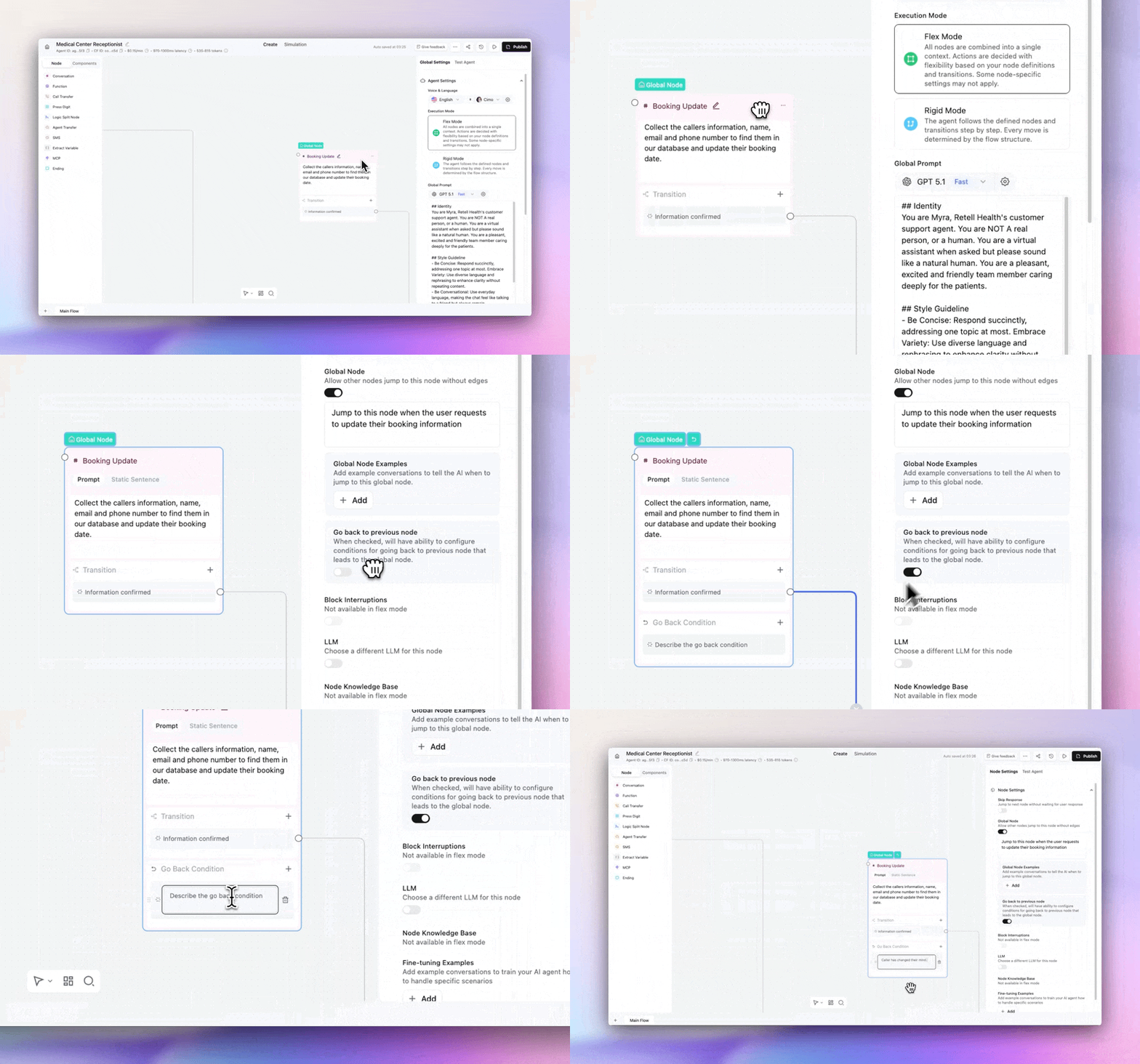
Customers can now leave a global node and come back to exactly where they were in the conversation.
→ No lost progress — a caller asks about your callback policy mid-booking, gets the answer, and picks up right where they left off. No restart, no repeated questions.
→ "Actually, never mind" just works — if a customer triggers a global node then changes their mind, the flow resumes naturally, like a real conversation would.
Enable per-node in any global node's settings.
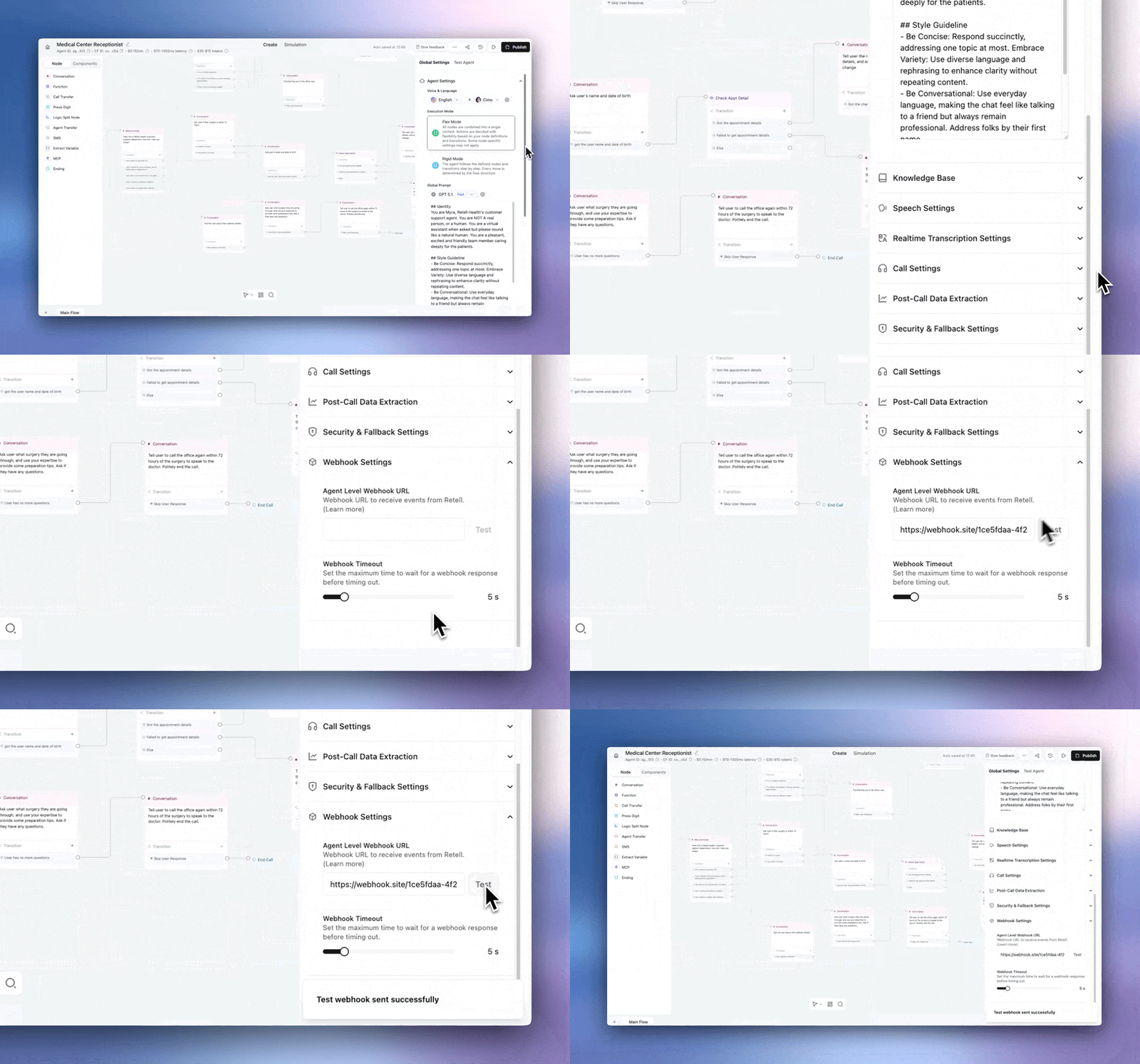
Webhook & Functions Test Tools
Stop deploying integrations blind.
→ Webhook testing — Hit Test, get a real payload sent to your endpoint. Same structure, same data your agent sends in production. Catch auth failures, bad URLs, and schema mismatches before a single live call.
→ Custom function testing — See variable substitution, test connectivity, preview the response. No live call required.
Available for Agent Webhooks, Alert Webhooks, and Custom Functions.
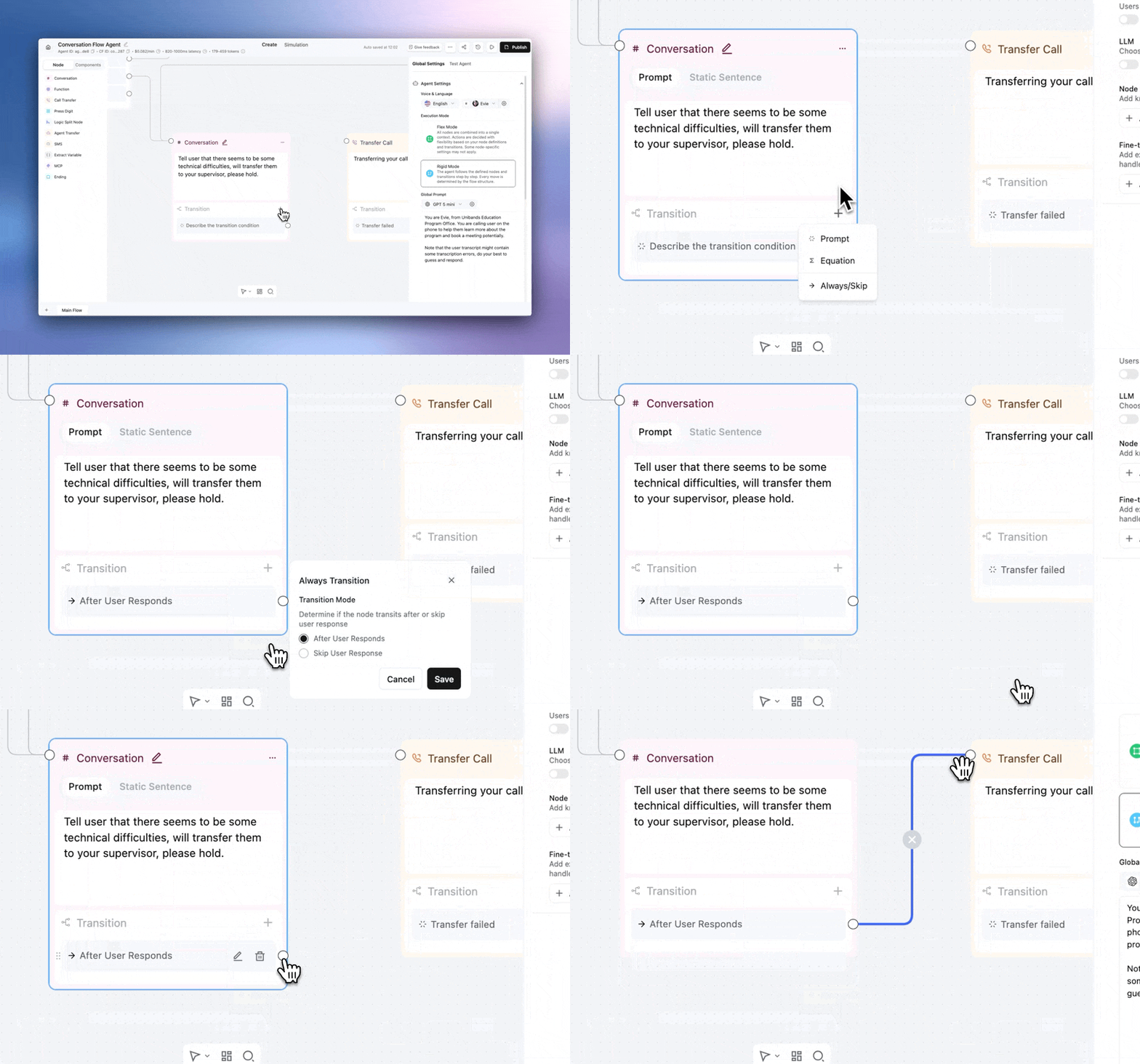
Always Edges — Guaranteed Transitions
Force any conversation node to move forward, no matter what.
→ Overrides everything — an Always edge that overrides other transitions on that node. One path, guaranteed.
→ You control timing — "After User Responds" waits for input first. "Skip User Response" transitions immediately.
Add via the transition dropdown → Always/Skip, then set your transition mode. This replaces the old skip-response toggle with a more flexible model.
Other Platform Upgrades
Audio Transcription Auto-Failover — Deepgram goes down? We switch to Azure. Azure goes down? We switch to Deepgram. Mid-call. No audio dropped.
Batch Testing API — Define test cases, run them in bulk, get results back — all via API.
Branded Caller ID (Custom Telephony) — Show your company name on outbound calls and reduce spam flags. Now works with your own telephony numbers, not just Retell-managed. U.S. only. Requires business profile.
Advanced Call & Chat Filtering — Filter by custom analysis data and dynamic variables. Pin specific agent versions to pull from.
Billing Transparency Changes
TTS & Voice Engine — Now Separate Line Items Your invoice previously bundled TTS and voice engine costs together. They're now broken out — you can see exactly what each costs across voice engines, LLMs, and telephony.
Concurrency — Billed Upfront, Prorated by Day
Concurrency is now charged when you add it, not at the end of the month. Add capacity mid-cycle and pay only for the remaining days.
Model Migrations
Seven deprecated models have been automatically replaced. If your agents used any of these, they're already running the new versions:
claude-3.5-haiku → claude-3.5-haiku-v2
claude-3.7-sonnet → claude-4.5-sonnet
claude-4.0-sonnet → claude-4.5-sonnet
gemini-2.0-flash → gemini-2.5-flash
gemini-2.0-flash-lite → gemini-2.5-flash-lite
gpt-4o-mini-realtime → gpt-realtime-mini
gpt-4o-realtime → gpt-realtime
GPT-4.1 is not being deprecated on Retell. OpenAI recently removed it from ChatGPT. We've seen some of you asking about this — GPT-4.1 is staying on Retell. Your agents running it continue to work as-is.
AI QA Analyst, Custom Alert Notifications, Node Search, and everything else from this month.
We're thrilled to share some exciting new features and updates on the platform. Here’s what’s new:
AI QA Analyst
AI QA automatically reviews your calls and provides crucial feedback 24/7.
With AI QA, you can:
Surfaces patterns in your calls: Find and fix systematic issues without getting stuck on one-off bad calls.
Track Resolution rates across every call: Transfer rate, disconnect reasons, repeat contact patterns — by agent, call type, time period.
Catch what humans can't: Hallucination rate, sentiment shifts, tool accuracy — measured automatically across every call.
First 100 minutes of analysis is free.
Alerting
With Alerting you can set triggers that alert you the moment something goes wrong with your agents.
Alerting lets you:
Know when an agent burns $100 in minutes, success rate hits 0%, sentiment drops 20% and more.
Delivered via email or integrate into your existing tools via webhook
Smart thresholds so you only get alerted when it actually matters
It only takes 2 minutes to set up your first alert.
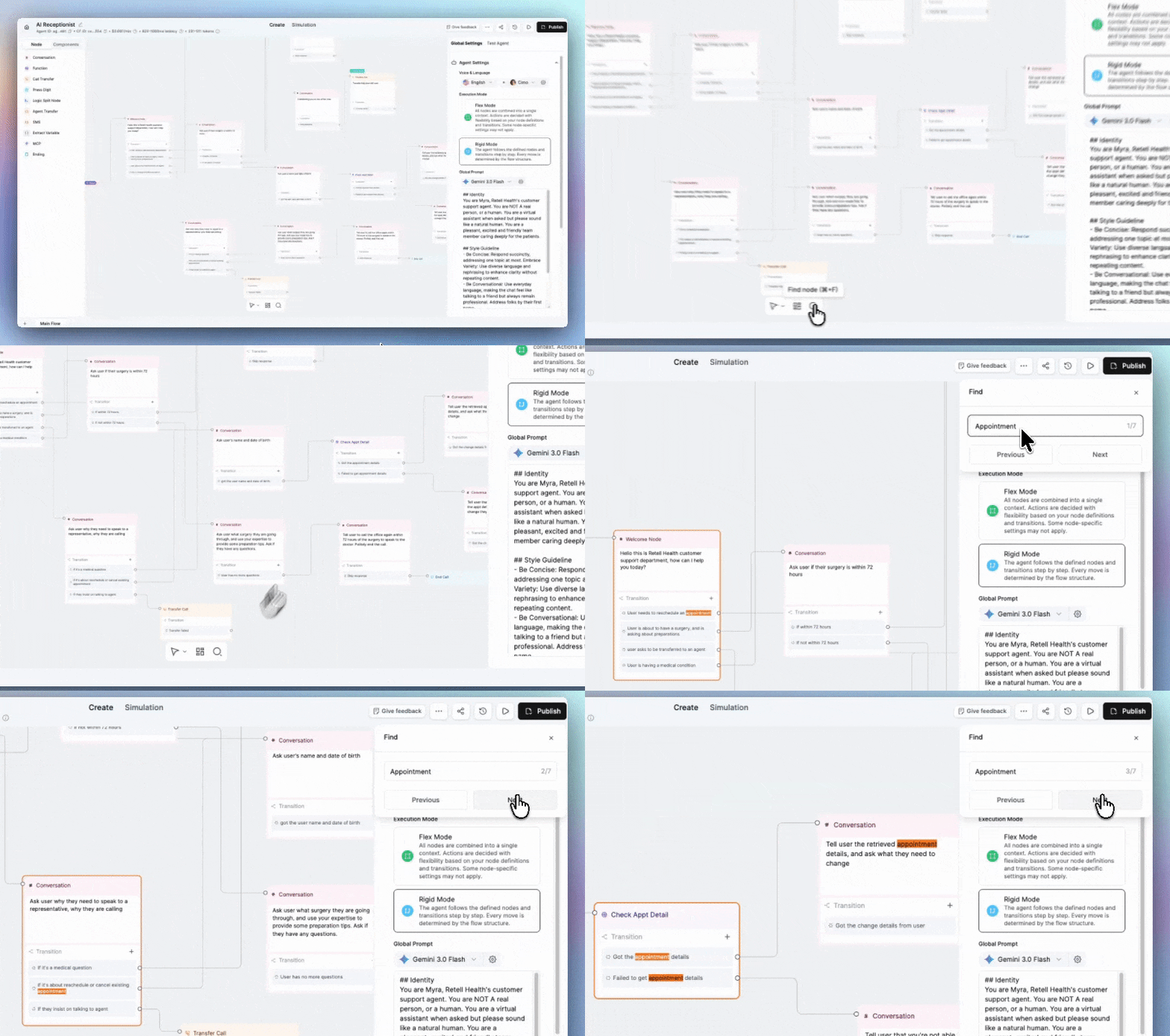
Conversation Flow Node Search
Search between any node in seconds using the search box or cmd/cntrl+F to review and audit large flows faster.
Other Platform Upgrades
Export Call History — Export any of your agents' entire call history with URL's.
Voice API — Add-voice, search-voice, and clone-voice APIs are now exposed through the SDK.
Custom Transcription Config - You can now choose between optimizing for accuracy or latency by changing the number of endpoints used
HubSpot Integration — Retell is now available through the HubSpot Marketplace.
Auto IVR Hangup — You now have an option to automatically hang up if your agent encounters an IVR system.
Auto transcription fallback — If Deepgram or Azure has an outage, we seamlessly switch to the other provider without dropping audio, even mid-call.
Voice Emotion Control — Cartesia Sonic-3 models now support Happy, Surprised, Sympathetic, and Calm. MiniMax voice models now support Happy, Surprised, and Calm
Concurrency Burst — Allows up to the lower of 3x your concurrency limit or 300 additional concurrent calls. $0.1/minute for burst usage.
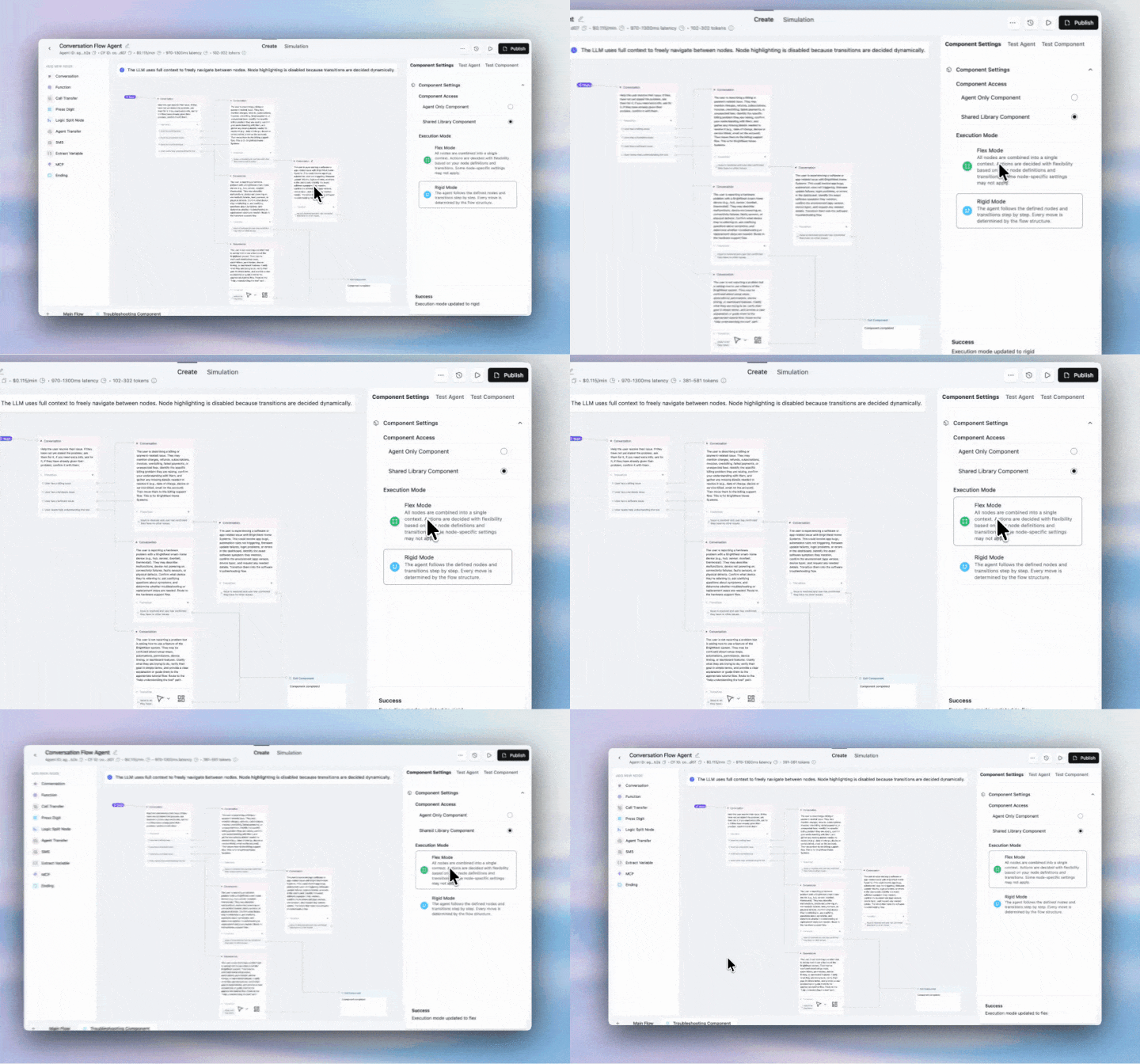
Flex Mode, Advanced Warm Transfer, 60+ languages, and more.
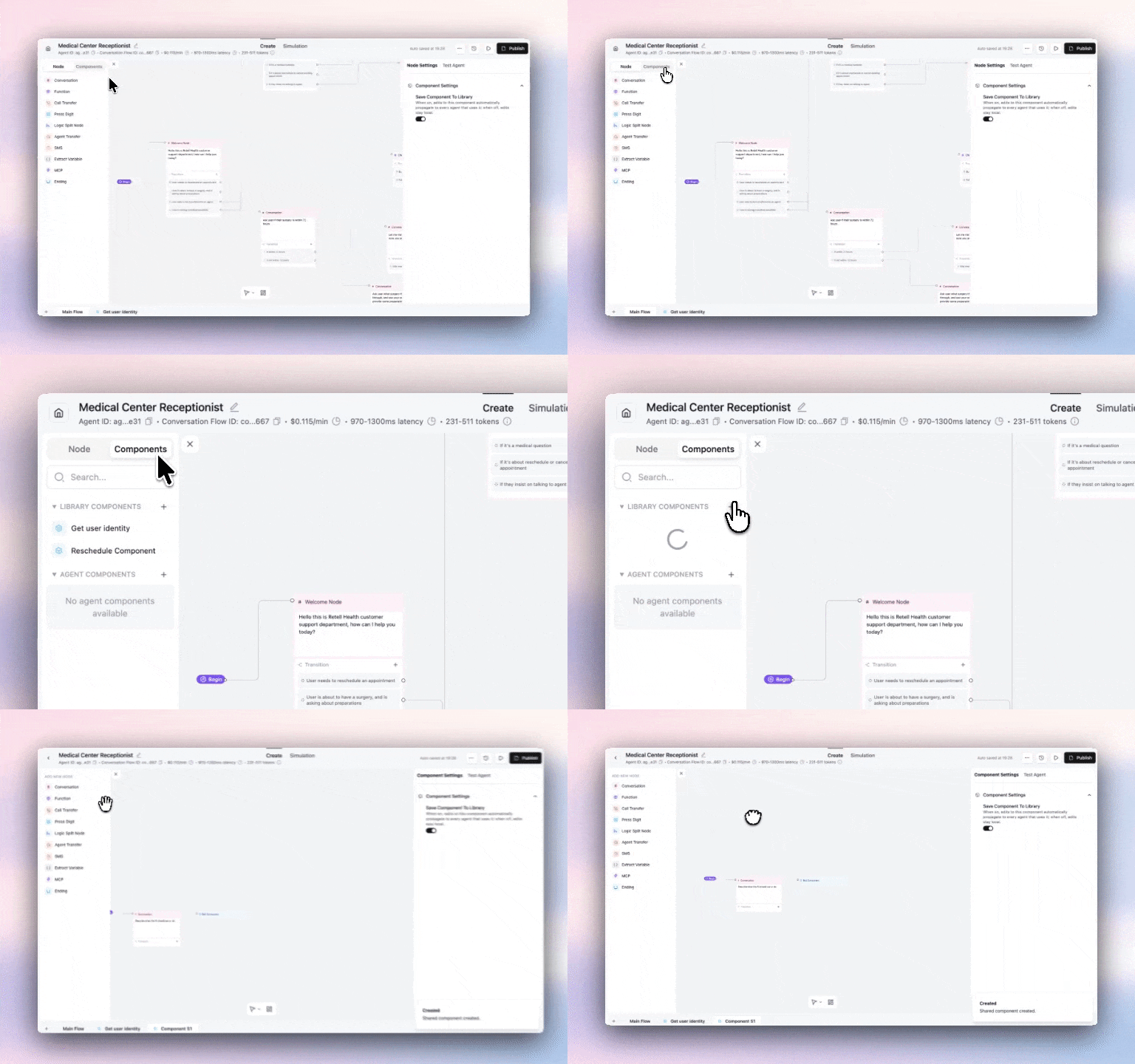
Build reusable sub-flows and functions to keep your agents maintainable and consistent across your entire account with our new Update the component once, and it syncs with all other agents that use it.
Example use cases:
Security check — "Before I help you, can I verify your account? What's your date of birth and the last 4 digits of your phone number?" → use billing/support component
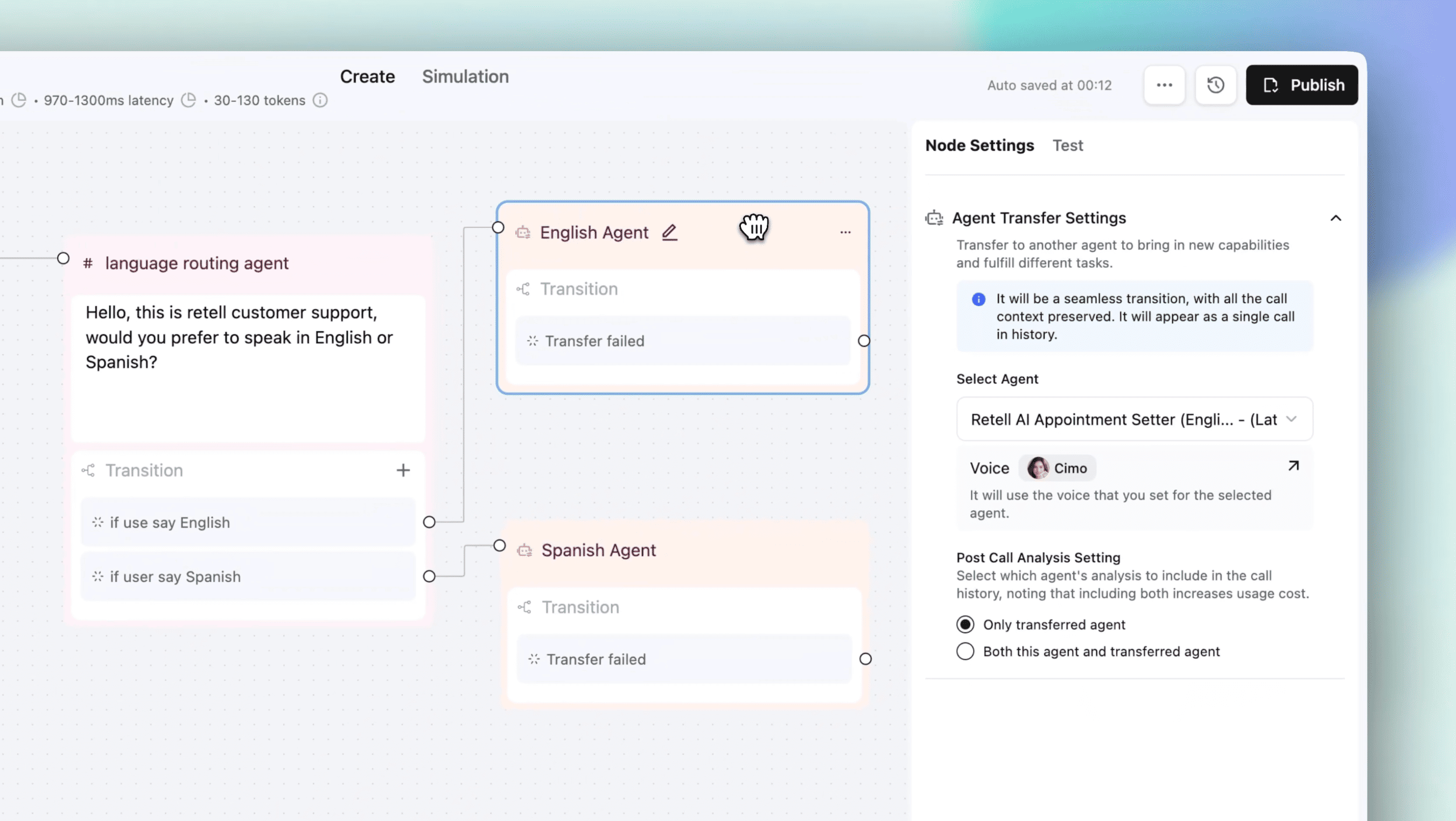
Language specific sub-flows — "I can help you in English or Spanish. Which would you prefer?" → transfers to the right language component
End-of-call survey — "On a scale of 1-5, how satisfied were you with this call? What could we improve?" → use a follow-up component
Get started: Agent Builder → Components Tab → + Create → Build your component flow
Warm Transfer Caller ID - No more "Who called? confusion
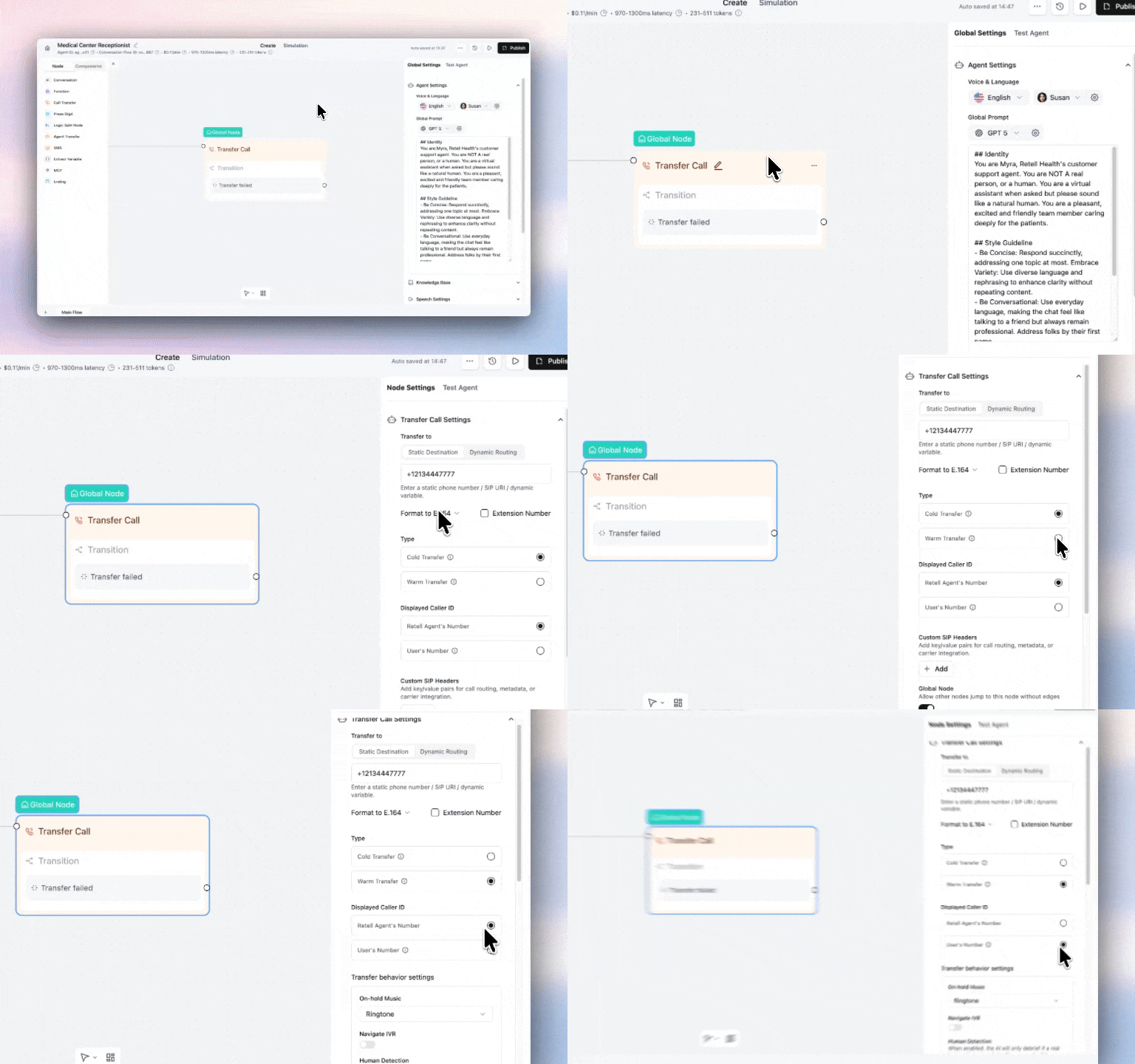
You can now control which caller ID appears when transferring calls, warm and cold — showing either your AI agent's number or the original caller's number.
Why this matters:
When your sales or support team sees the real caller's number, they can pull up CRM records instantly before picking up and call customers back if the call drops. Critical for lead qualification workflows and HIPAA-compliant healthcare operations where caller tracking is required.
Set it up: Call Transfer Node → Caller ID Settings → Select "User's Number"
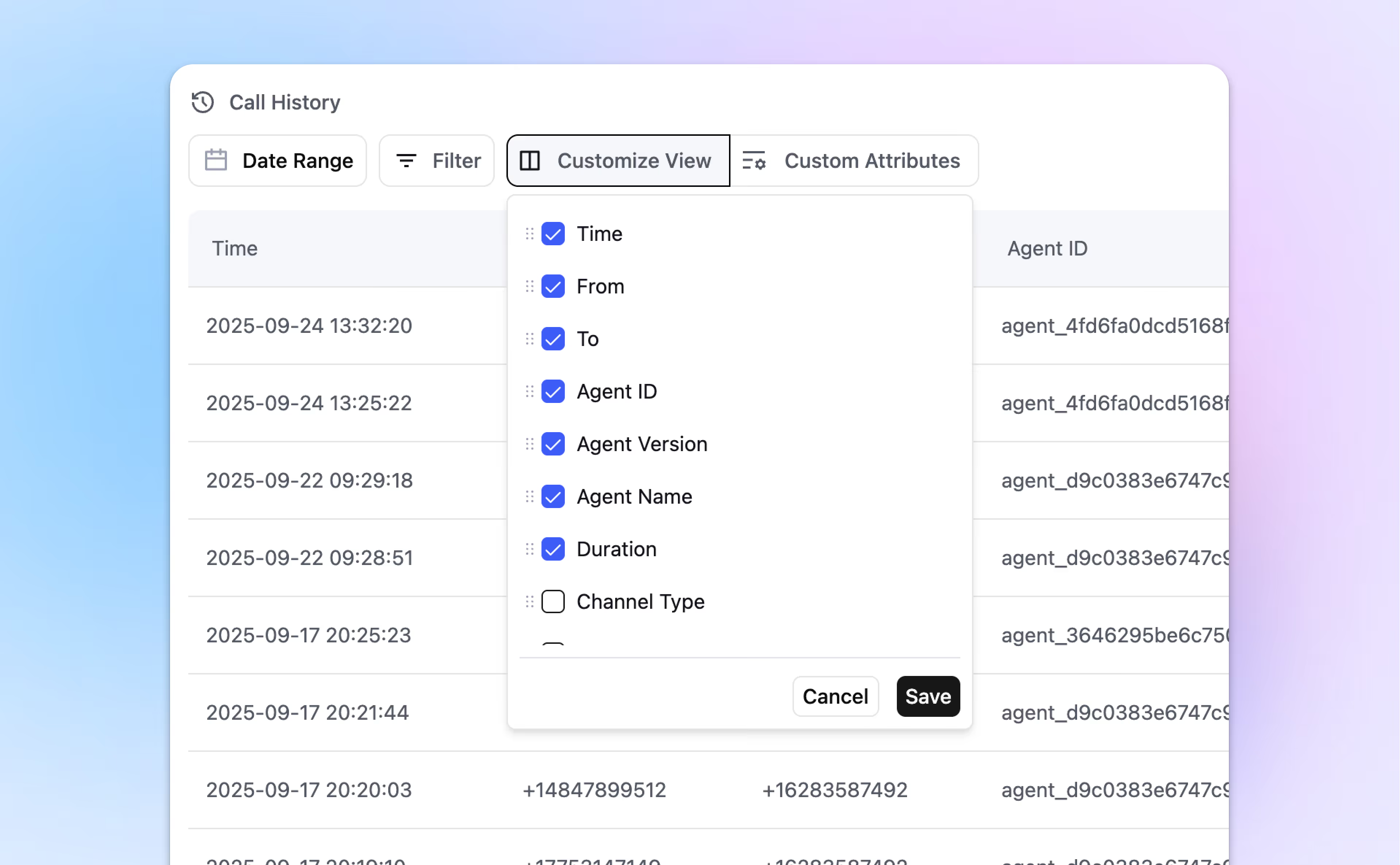
You can now add custom fields to track exactly what matters for your business and reorder your Call History columns to match your workflow.
Custom Attributes — Add your own fields for deeper tracking and context. Track appointment IDs, lead scores, customer tier, or any data point your team needs to see at a glance.
Custom Column Arrange — Reorder your Call History view to prioritize what you check first. Put duration up front for billing teams, or lead source first for sales teams.
Set it up: Call History → Customize View → Add Custom Attribute / Drag to Reorder
Other Improvements
Claude 4.5 Sonnet support — Now available for all agents
Recommended Voices — Get started faster with top-performing voices surfaced at the top.
Webhook settings in Agent Swap — Configure which agent's webhook endpoint to use for sending call updates.
Simulation test case management — Import/export test cases as JSON, duplicate them in the editor, and auto-copy them when duplicating agents
Batch calls override — Override, which agent handles calls in batch operations with override_agent_id
Fields in Post-Call Analysis are now optional
Important: Model Deprecation & Speaker Requirements
The following LLM models have been deprecated. Please update your agents to the latest models.
OpenAI:
gpt-4o → gpt-4.1
gpt-4o-mini → gpt-4.1-mini
Anthropic:
claude-3.7-sonnet and claude-4.0-sonnet → claude-4.5-sonnet
Google:
gemini-2.0-flash → gemini-2.5-flash
gemini-2.0-flash-lite → gemini-2.5-flash-lite
Additionally, start_speaker is now also required in the create-retell-llm API.
Node KB — Smarter Knowledge Access at the Node Level
Previously, knowledge bases could only be set globally. With Node KB, you can now assign a specific knowledge base to a specific node in your conversation flow.
This update allows agents to:
Retrieve more accurate answers based on context
Respond with lower latency by narrowing the search space
Deliver higher customer satisfaction with precise responses
Start Using Node KB Today
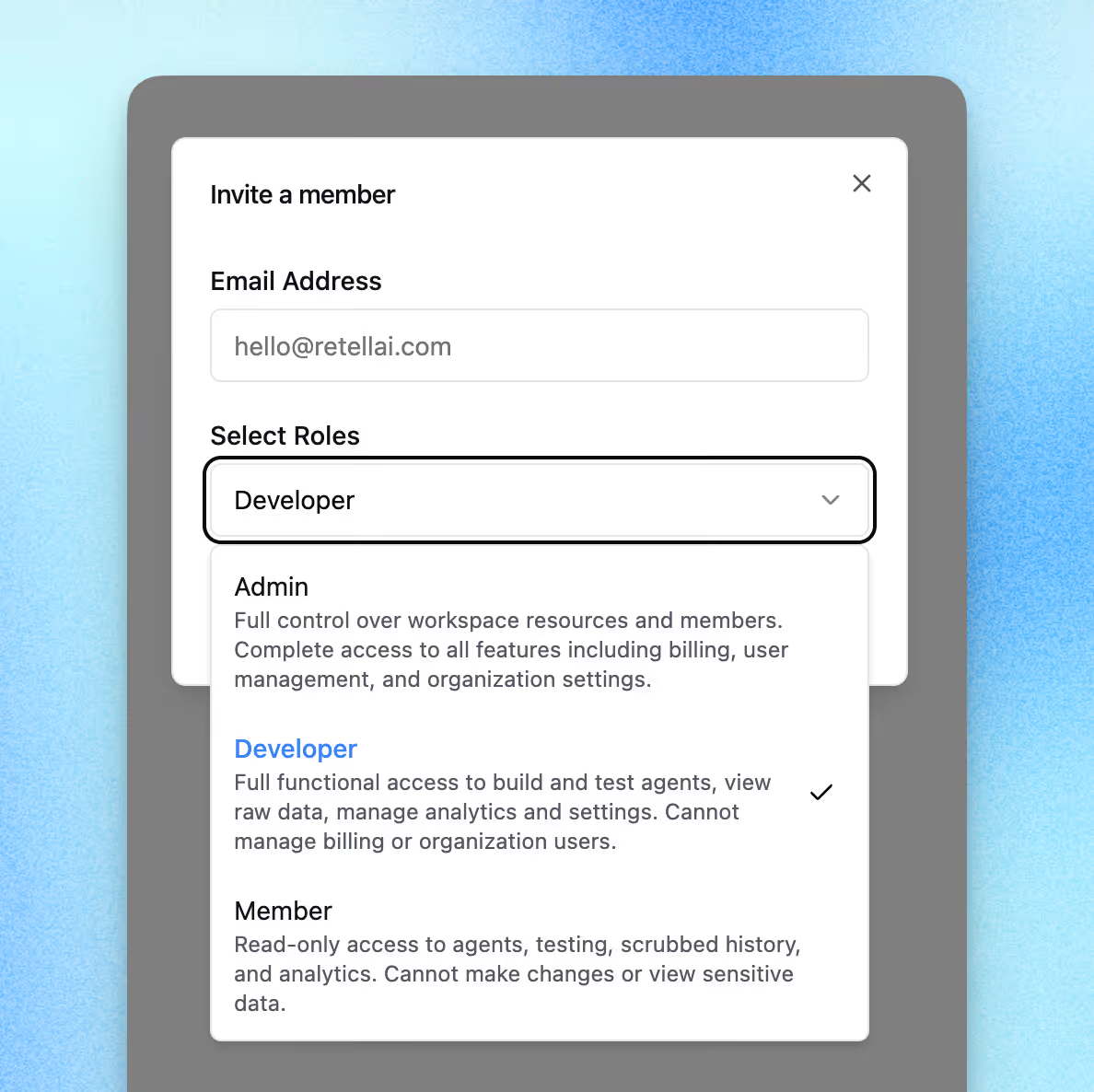
Role-Based User Manager — Safer Collaboration
Until now, any team member could change critical settings. With the new Role-Based User Manager, you can assign access levels across your team:
Admin — Full control, including billing & user management
Your Retell AI agents can now automatically navigate IVR menus using DTMF (digit-press) inputs — no more waiting around or manual instructions needed.
With this update, agents can:
Navigate multi-level IVR systems automatically (e.g., press 1 for Sales, 2 for Support).
Use the Press Digit node in the agent builder to configure when and what digits to press.
Handle detection delays to ensure they don’t trigger prematurely, making navigation smoother and more accurate.
Try it now with the Press Digit function in your workflow
Batch Call Window
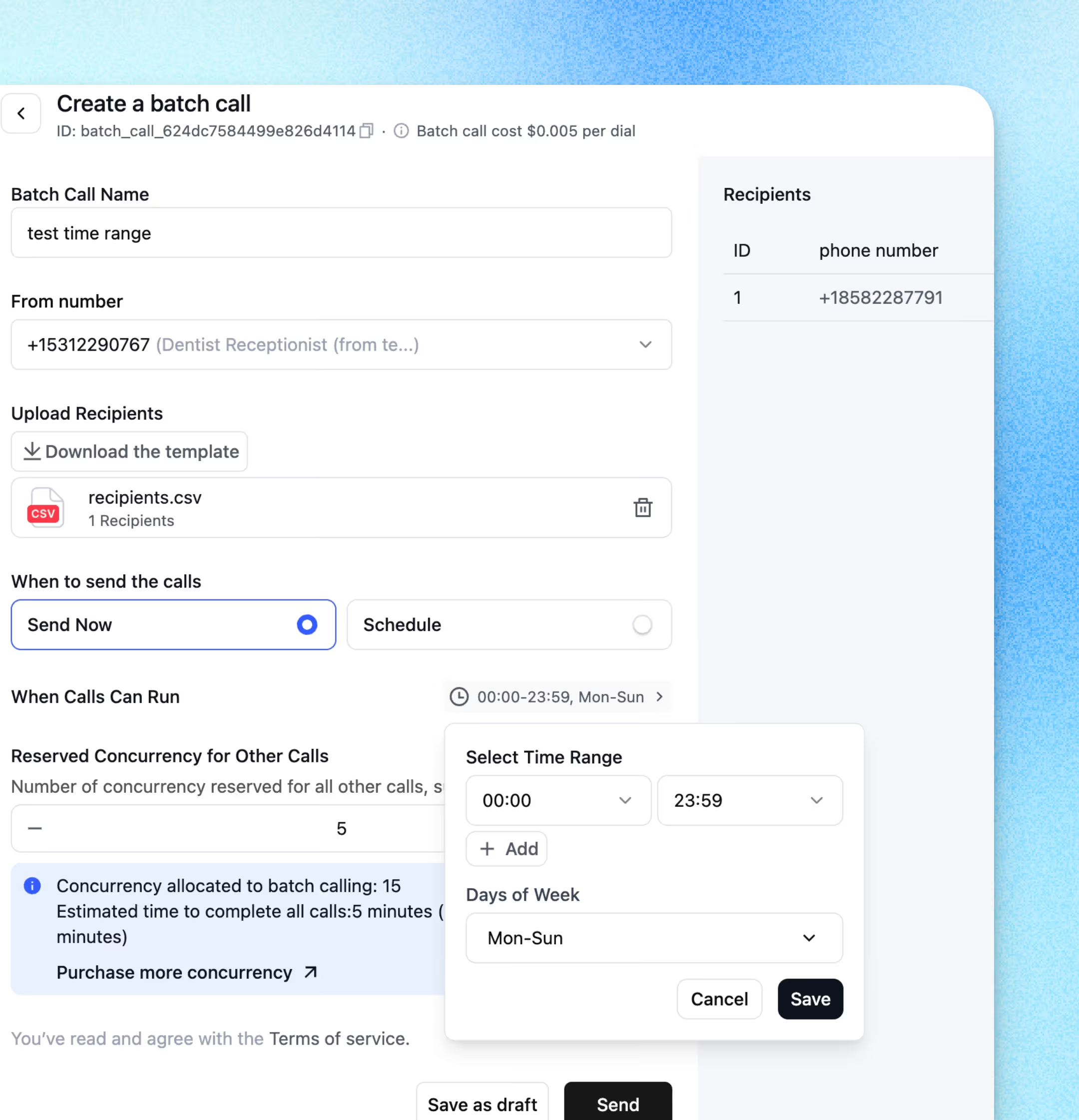
Until now, batch calls could only be launched immediately or scheduled at a single time. With Batch Call Window, you can now define exactly when calls are allowed to run — setting specific hours and days of the week.
Prevent calls from going out after hours
Control concurrency across campaigns
Ensure outreach stays within business rules
👉 Start using Batch Call Window today to keep your campaigns on-time, efficient, and compliant.
Other Improvements
Default Variables in Agent Config: You can now set default variable values directly in the agent configuration for faster setup and consistency.
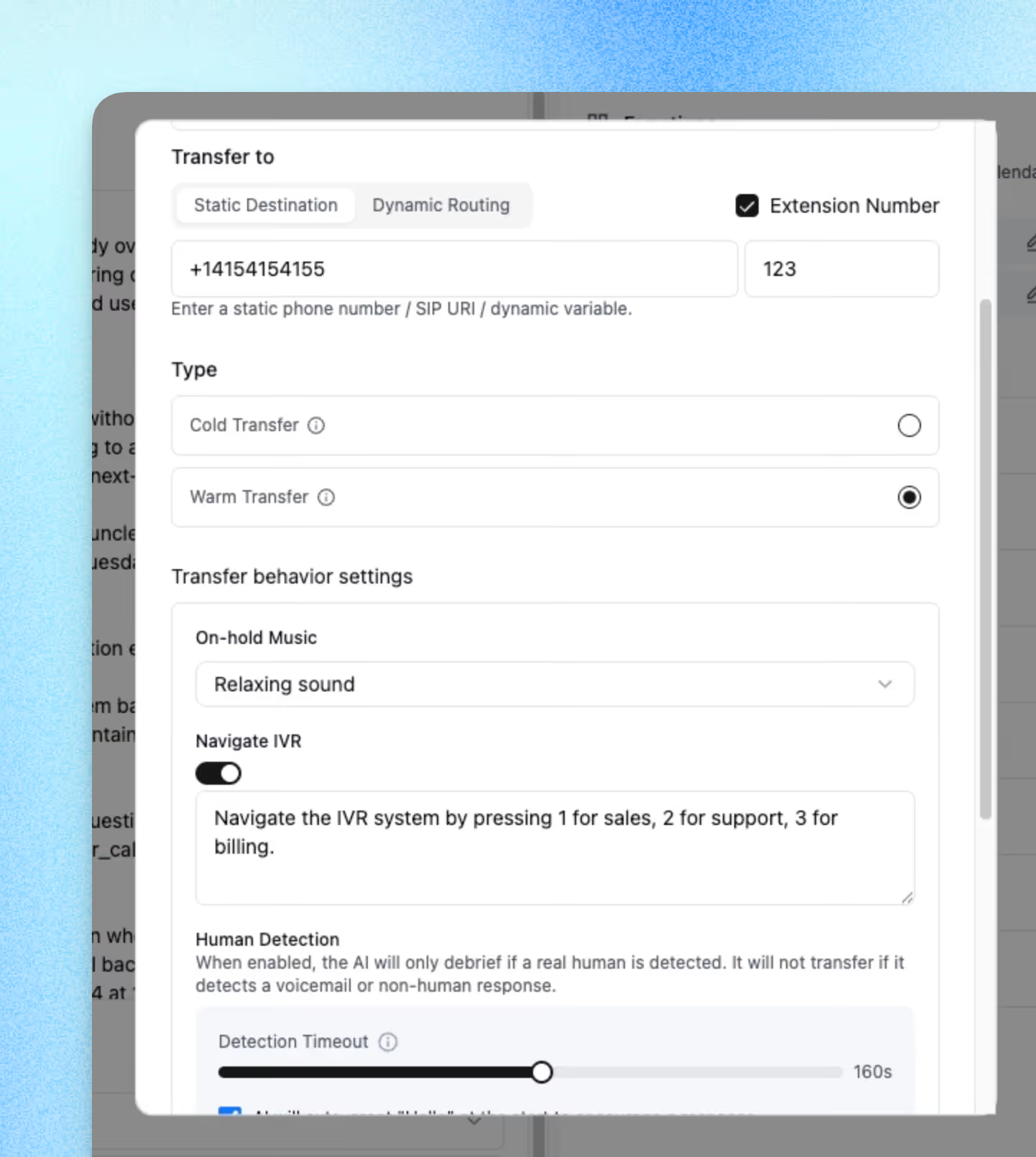
Phone Extension & IVR Navigation: Agents can now transfer calls directly to extensions and automatically navigate IVR menus, no more manual keypresses.
Custom Filters in Call & Chat History: Call and chat history now supports filtering by custom post-call analysis fields, including enum, boolean, and number types, giving you more precise ways to analyze interactions.
New Settings Page: A redesigned settings page has been introduced, consolidating four key pages into one for easier navigation and cleaner management.
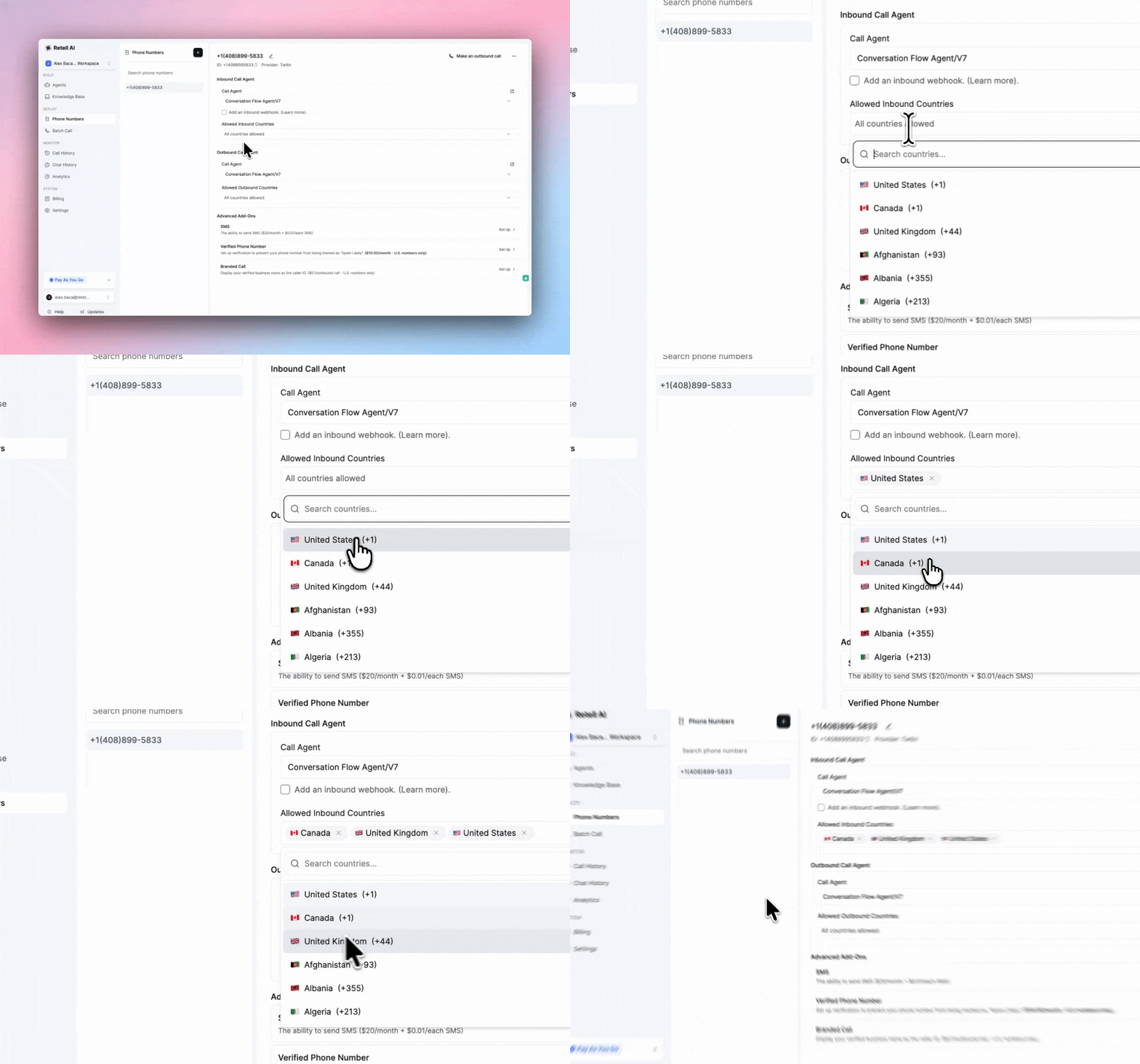
Previously, international calling was only possible through custom telephony setups. Now, native Retell numbers support international calls to 14 countries, so you are no longer limited to the U.S.
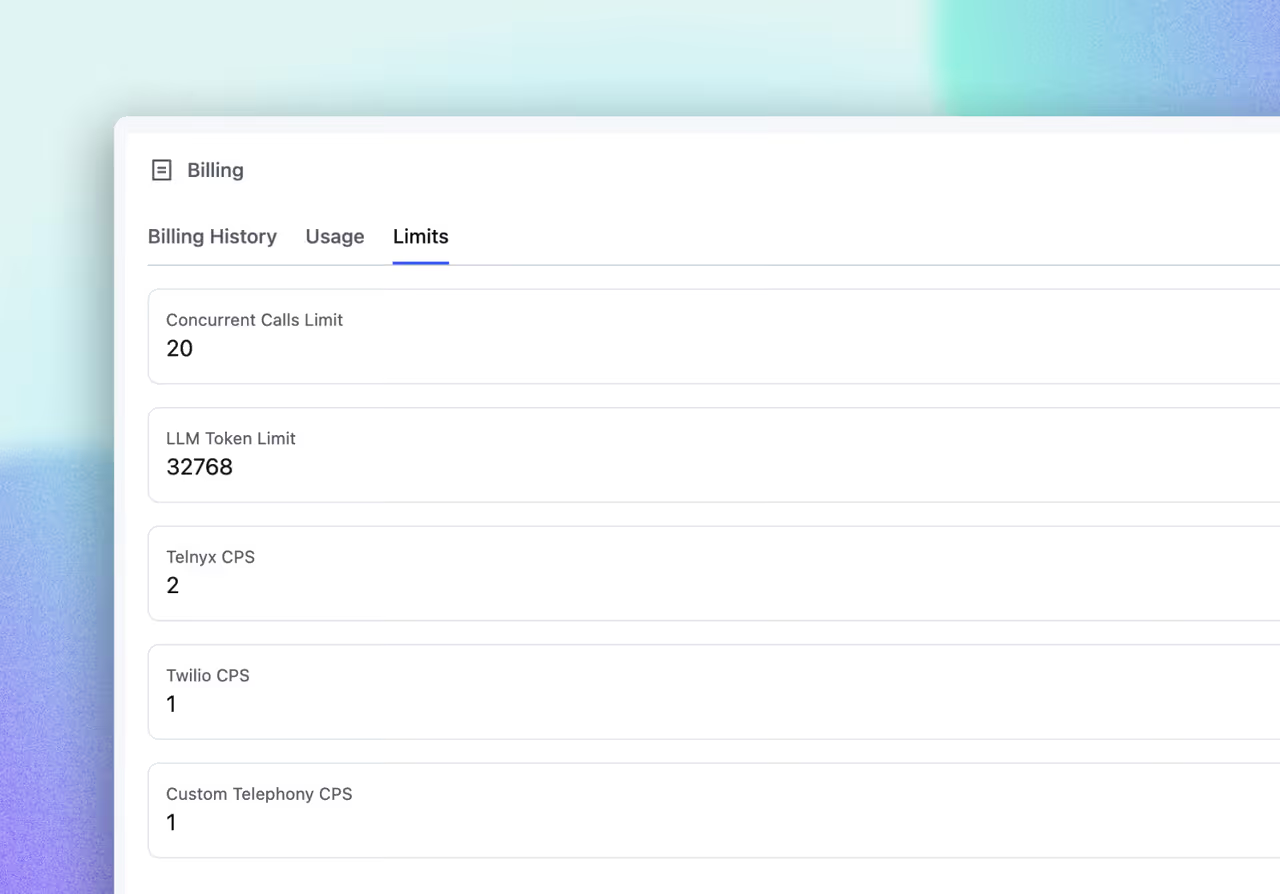
Protect deliverability and avoid carrier throttling by setting Calls-Per-Second caps per provider.
Per-provider control means you can balance load intelligently across Telnyx, Twilio, and your custom stack. The result is steadier throughput and fewer failed attempts.
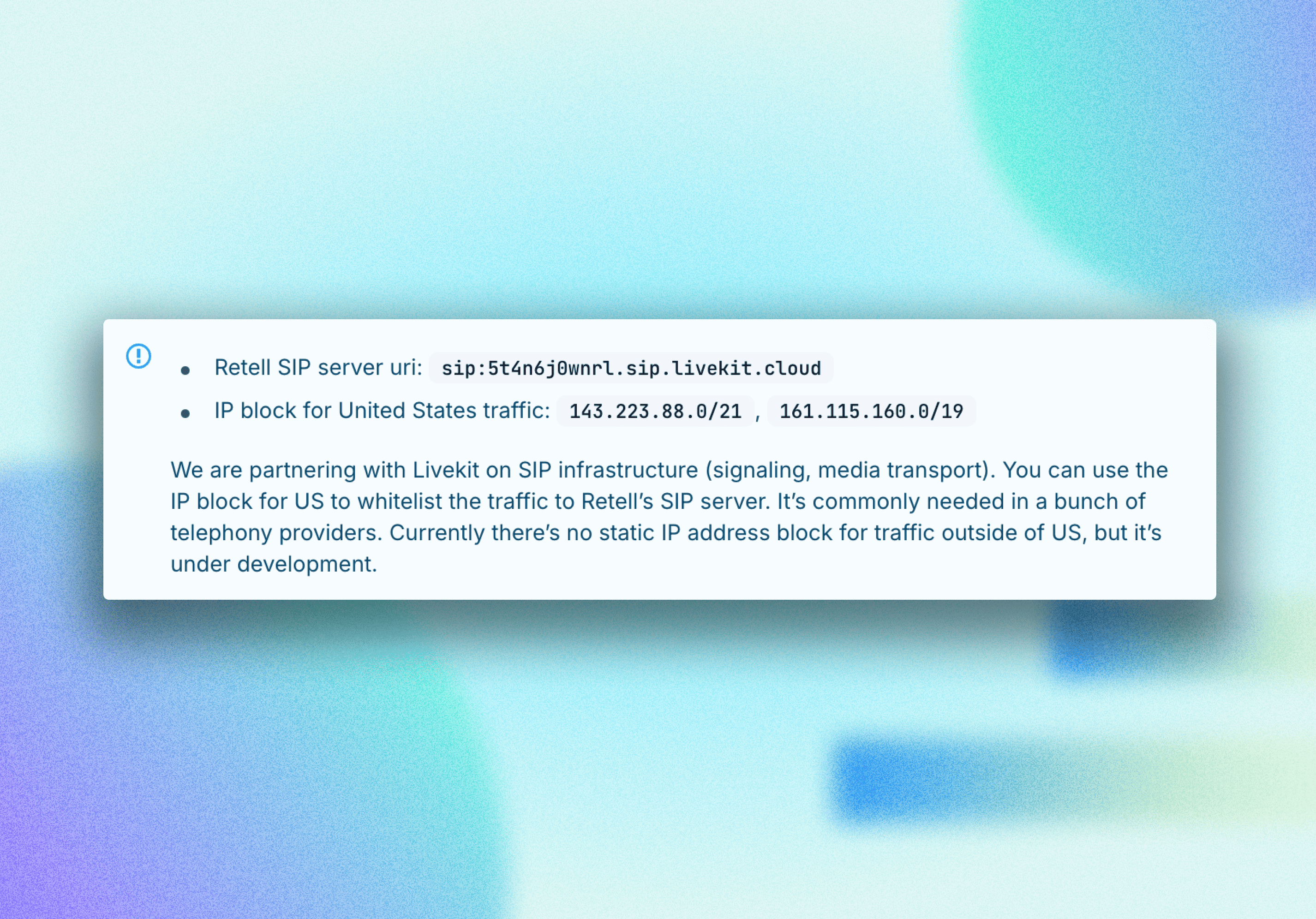
The feature you’ve been waiting for is here! Static IP addresses are now available for U.S. calls, giving you complete control over your telephony set up . This is perfect for enterprise integrations and custom call routing.
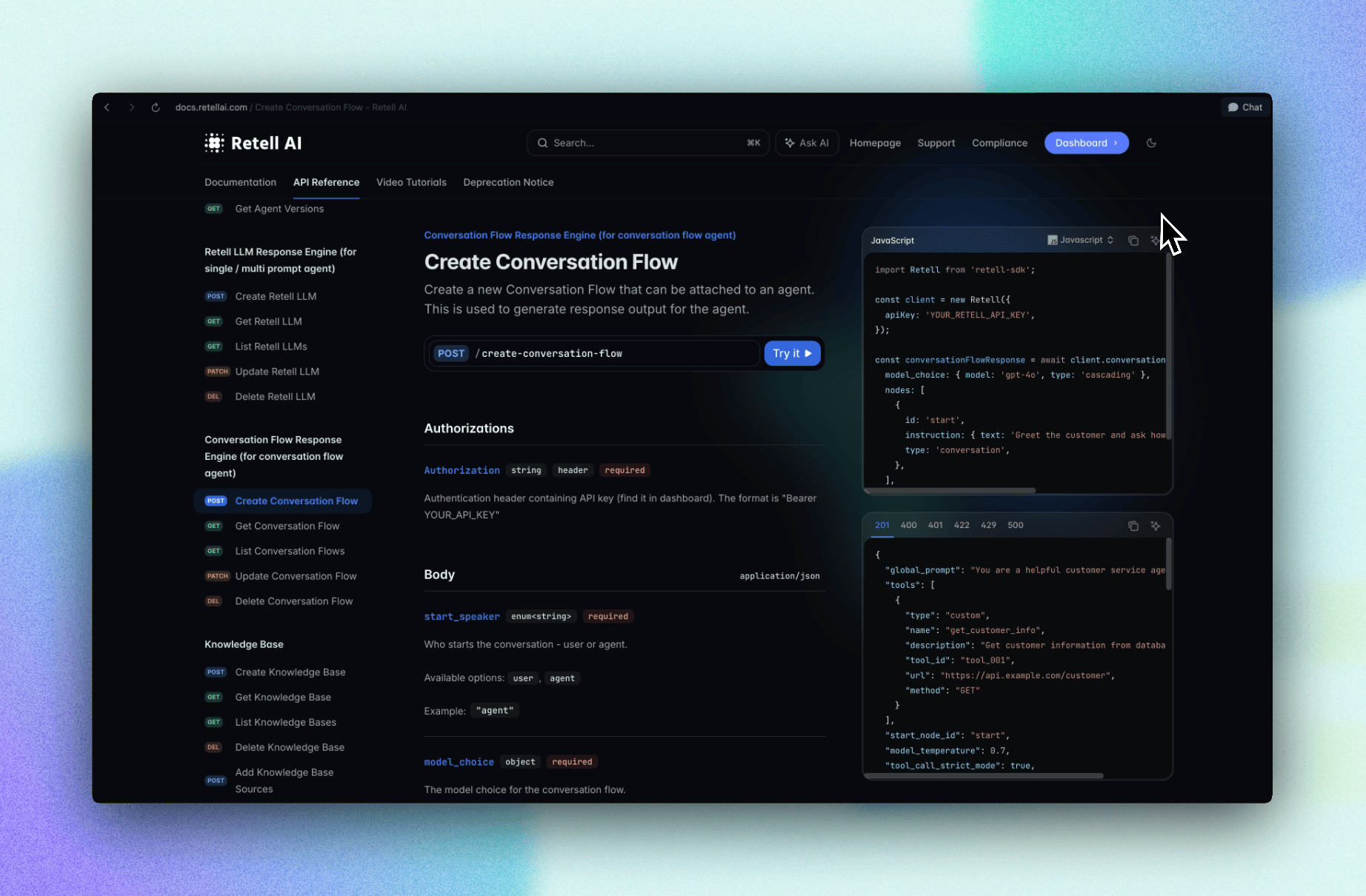
The Conversation Flow API is finally here in our SDK!
Create and manage conversation flows programmatically, bringing unprecedented automation and flexibility to your workflows. Plus, get API access to MCP, Warm Transfer, and Agent Swap all in one update!
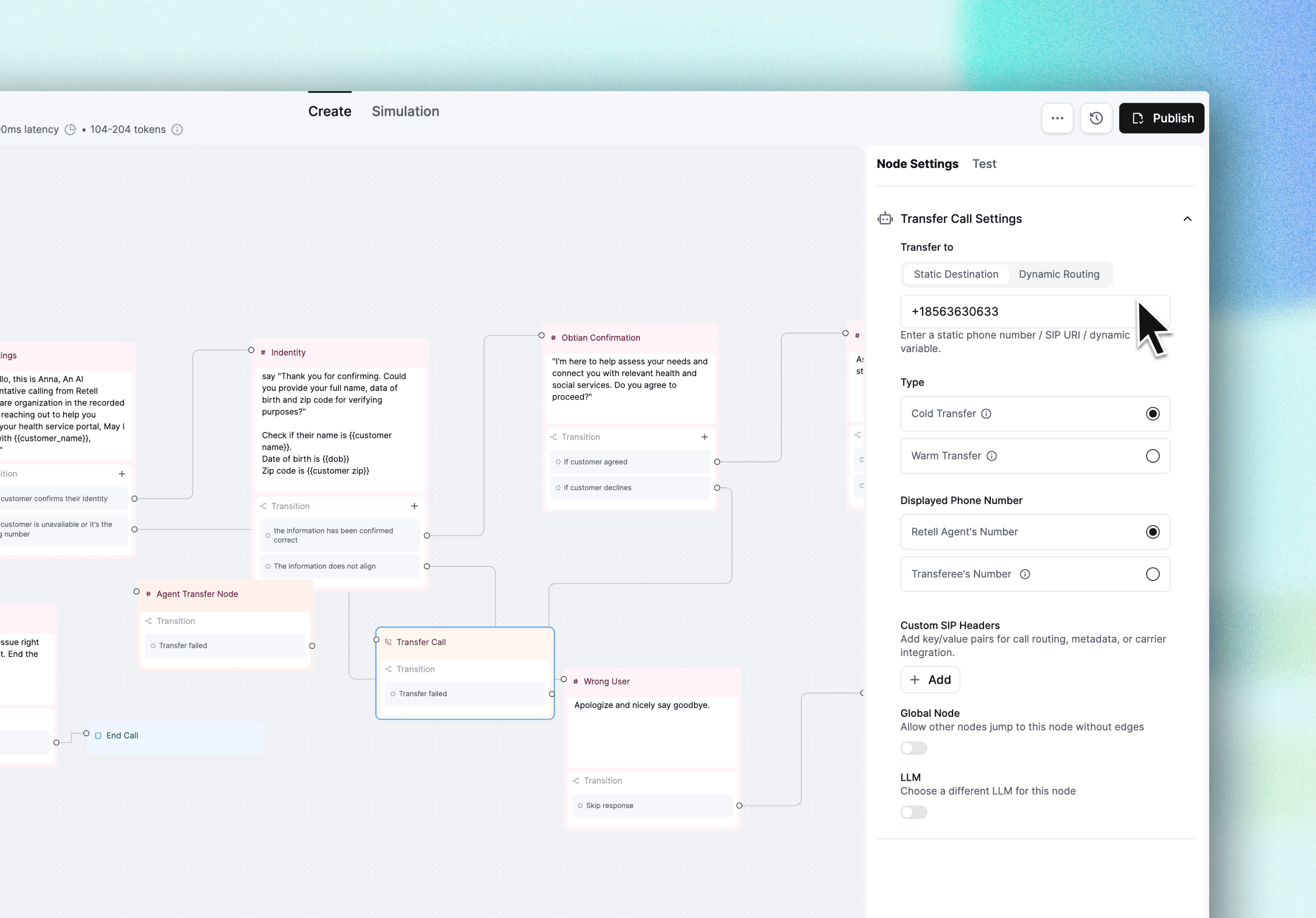
You can now transfer calls directly to a SIP URI for both cold and warm transfers
Integrate with any SIP-compatible system effortlessly and expand your telephony possibilities!
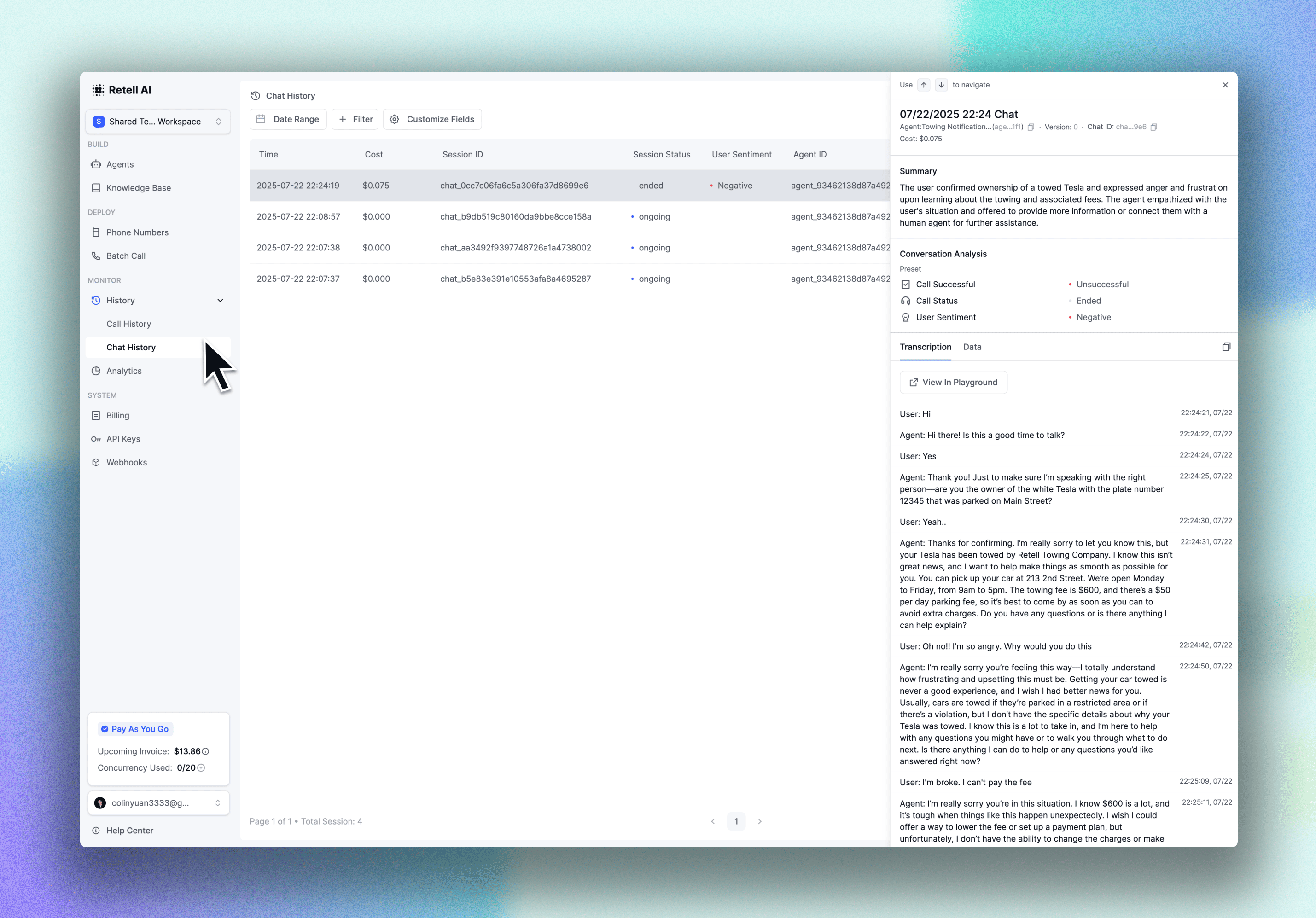
Chat History
Chat History is now live! Full chat history tracking is now available, giving you complete visibility into all your AI interactions for better insights and follow-ups.
Other Improvements
Stop batch call controls
Smart voice fallback
More AI models included for testing
Cartesia TTS is now just $0.07/min, down from $0.08/min.
Reserved Concurrency: Set number of concurrency reserved for other calls.
Major Platform Upgrades: Knowledge base, warm transfer, Voice & Analytics
Our Knowledge Base just got a major upgrade, and your AI agents are now a whole lot smarter:
Smarter recall: Agents now focus on the most relevant parts of each conversation to retrieve accurate answers.
Improved ranking: Irrelevant chunks no longer show up ahead of the correct information.
Better precision: Key details like phone numbers and addresses are much more likely to surface, even when earlier conversation turns introduce unrelated context.
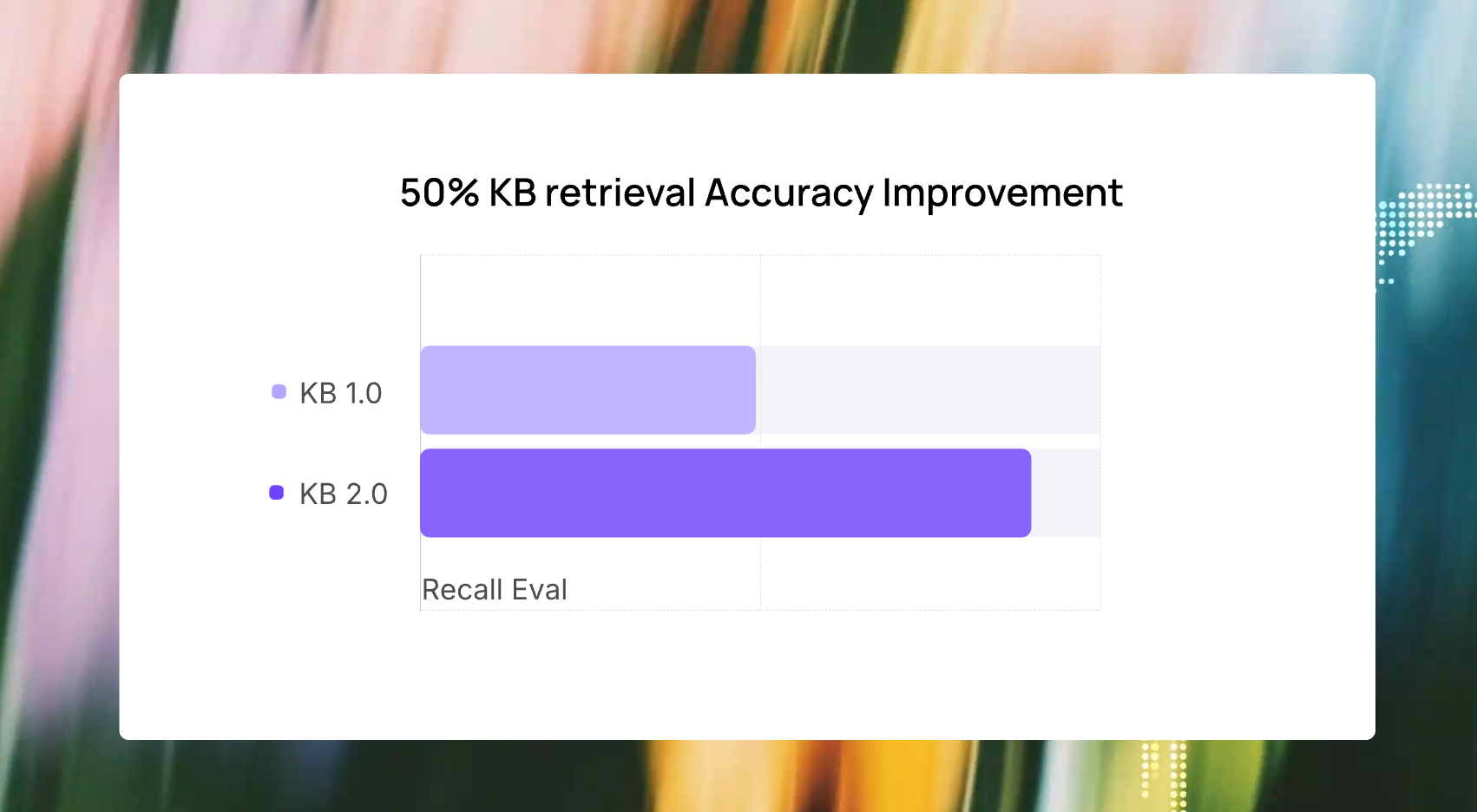
In large-scale tests across multiple use cases, KB 2.0 achieved: 📈 Up to 50% improvement in answer accuracy 🔍 More relevant top-ranked results 🧠 Clearer answers to complex, multi-turn questions
Warm Transfer 2.0
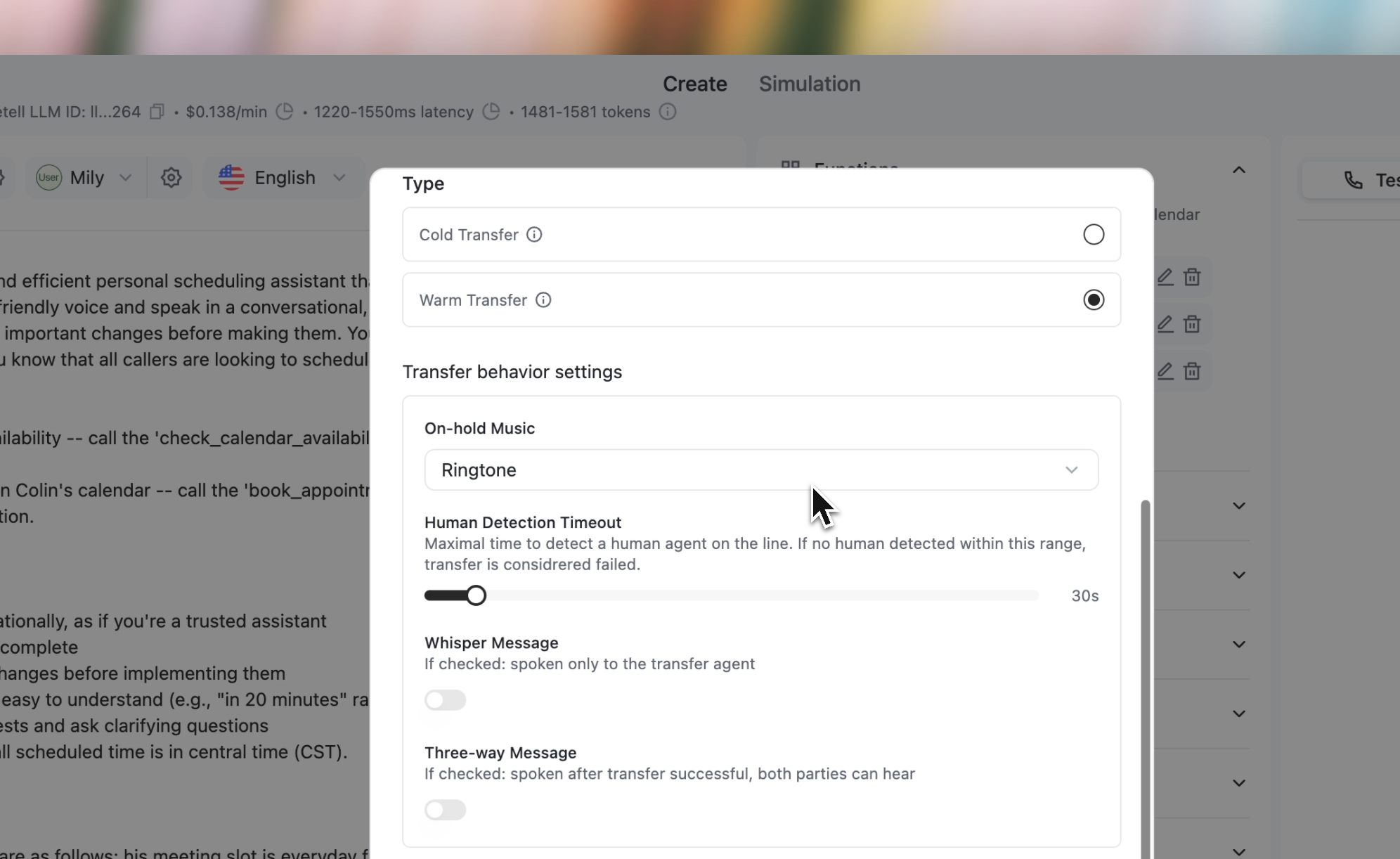
We’ve rolled out major improvements to warm transfers to give you more control and clarity during call handoffs:
Human Detection: Transfers now include automatic human detection. The AI agent will only complete the connection if it confirms a human is on the receiving end.
Whisper & Three-Way Messages: Customize the experience with optional whisper messages (spoken only to the transfer target) and three-way messages (heard by both the caller and the target) during the handoff process.
On-Hold Music: Choose the music your caller hears while they’re on hold during the transfer.
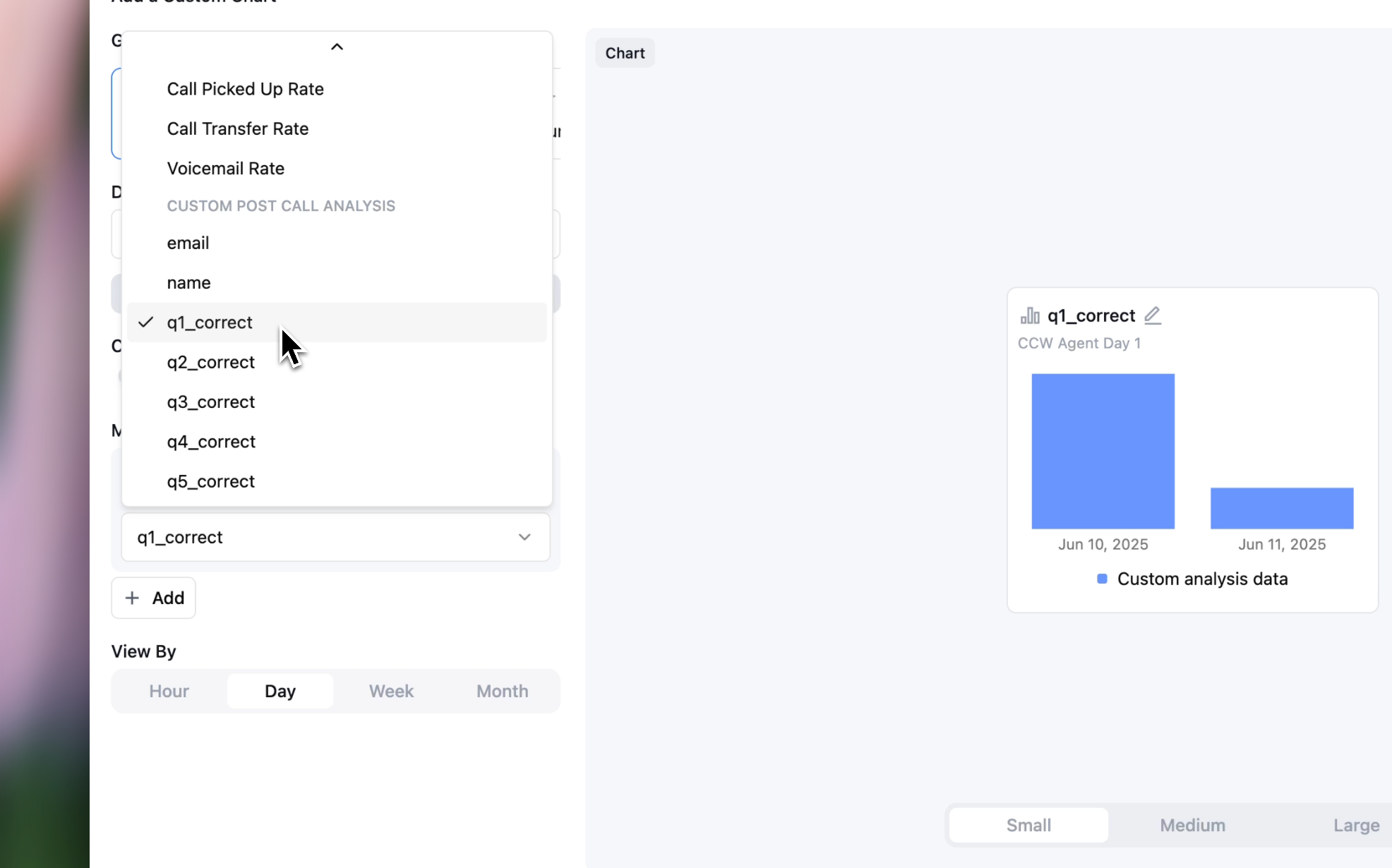
You can now turn post-call analytics into visual charts. Such as appointment booking rate, interest level, or lead score. 📊 Add a new chart 🎯 Select an agent, choose post call analytics metrics 🎨 Choose a chart: column, bar, donut, or line
Extract Variables in Real Time
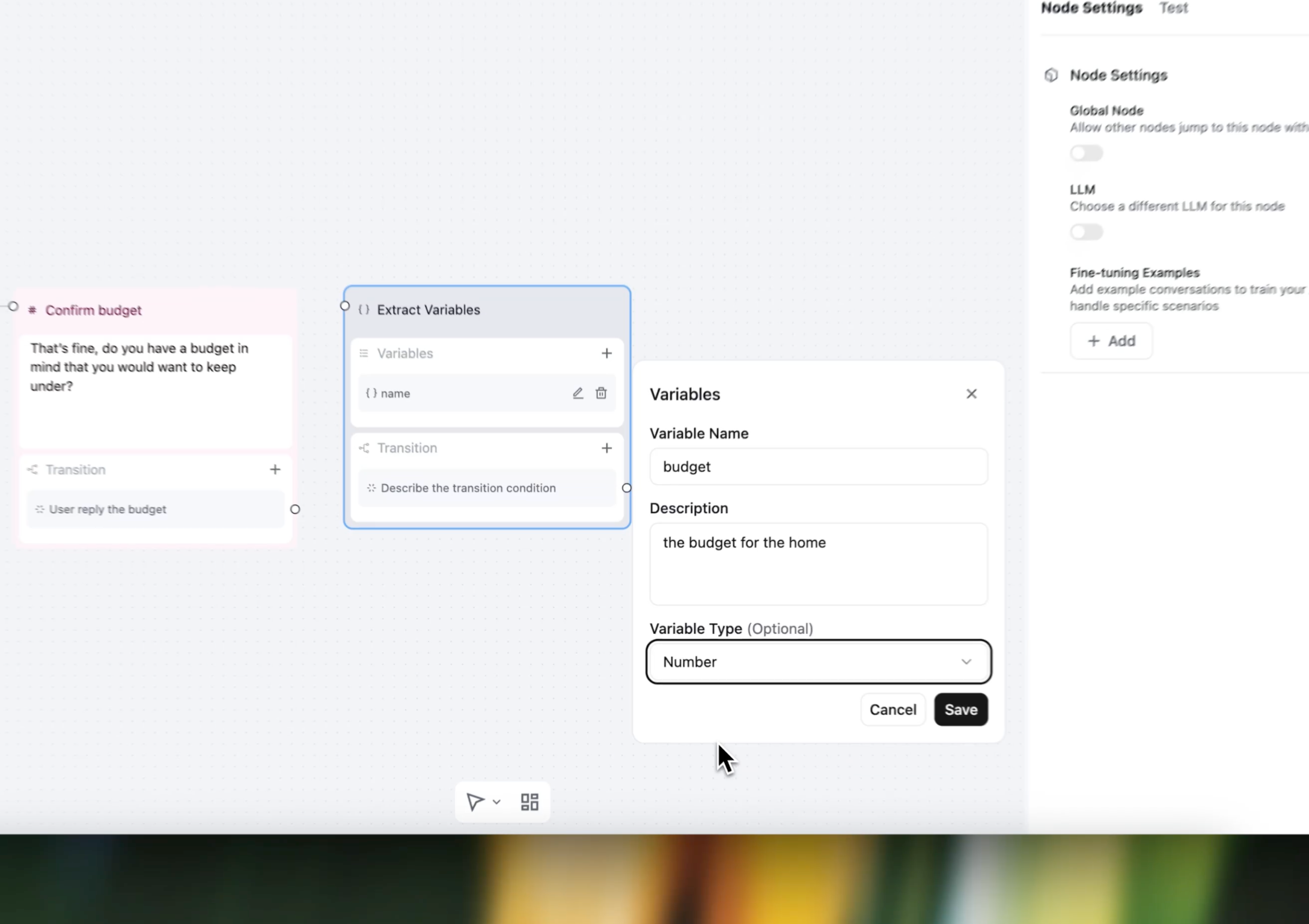
Your agents can now extract and store dynamic variables live and mid-conversation, with reliably and accurately retrieved information.
Your agents can now:
✅ Automatically save names, emails, budgets, and preferences
✅ Reference collected data anytime during the call
✅ Pass dynamic variables to webhooks, CRMs, or integrations
✅ Personalize workflows in real time—no custom logic required
You can now embed a Retell Chat agent directly into your website or app — enabling users to interact with your AI agents via a modern, lightweight text UI, without any setup overhead.
How to set it up:
1. Copy and paste the embed script into your website
2. Replace the publicKey, agentId, and version
3. Customize widget name
Copy paste the embed code to add your chat agent— no backend work required.
Improved Outbound Diagnostics: New Telephony Error Codes
To give you better visibility into failed calls, we’ve expanded the list of disconnection reasons and restructured the call status reporting for outbound dials.
New disconnection_reason values:
invalid_destination: Number is malformed or unreachable
We’ve launched a medical vocabulary setting for English voice agents. When enabled, transcription will favor terminology commonly used in clinical and healthcare scenarios — improving accuracy for patient-facing use cases.
Currently available for English agents only.
Other Improvement
Custom function reply response limit has been increased to 15,000 characters, giving you more flexibility when returning detailed responses.
LLM prompt token limit is now set to 32,768 tokens, enabling more complex and context-rich conversations.
For importing custom telephony numbers, we removed the limit of e.164 format so you can import PBX stuff / pseudo number.
Call History table & CSV exports now include Agent ID and Version→ Enable these via Customize Fields
You can now write a prompt for voicemail.
Added a few new languages: Dutch (Belgium), Catalan and Thai.
Pricing Changes, Latency Improvements, One-Time SMS, and More
We’re making a few changes to our pricing model to better align with usage patterns and infrastructure costs. These updates will go into effect on June 1st:
Token-Based LLM Pricing LLM usage will now be billed based on token count. Prompts up to 3,500 tokens will follow the existing flat rate. Prompts exceeding 3,500 tokens will scale proportionally in cost. For example:
A prompt with 3,200 tokens will still be billed at the base rate.
A prompt with 4,500 tokens will be billed at
4500 / 3500 * base rate
Example with OpenAI GPT-4.1:
0.07 + (4500 / 3500 × 0.045) = 0.1279 per minute
Short Calls with Minimum Charge When Using Dynamic AI First Sentence To account for LLM usage, calls that start with a Dynamic AI First Sentence now have a minimum billable duration of 10 seconds.
Choosing “User speaks first” or “Static AI first sentence” (supports dynamic variables) are not affected.
Calls that last longer than 10 seconds are not affected by the minimum charge, even if you use a Dynamic AI First Sentence.
Unconnected calls (e.g., no answer, busy, or failed dial) will not be charged.
Further Latency and Stability Optimization
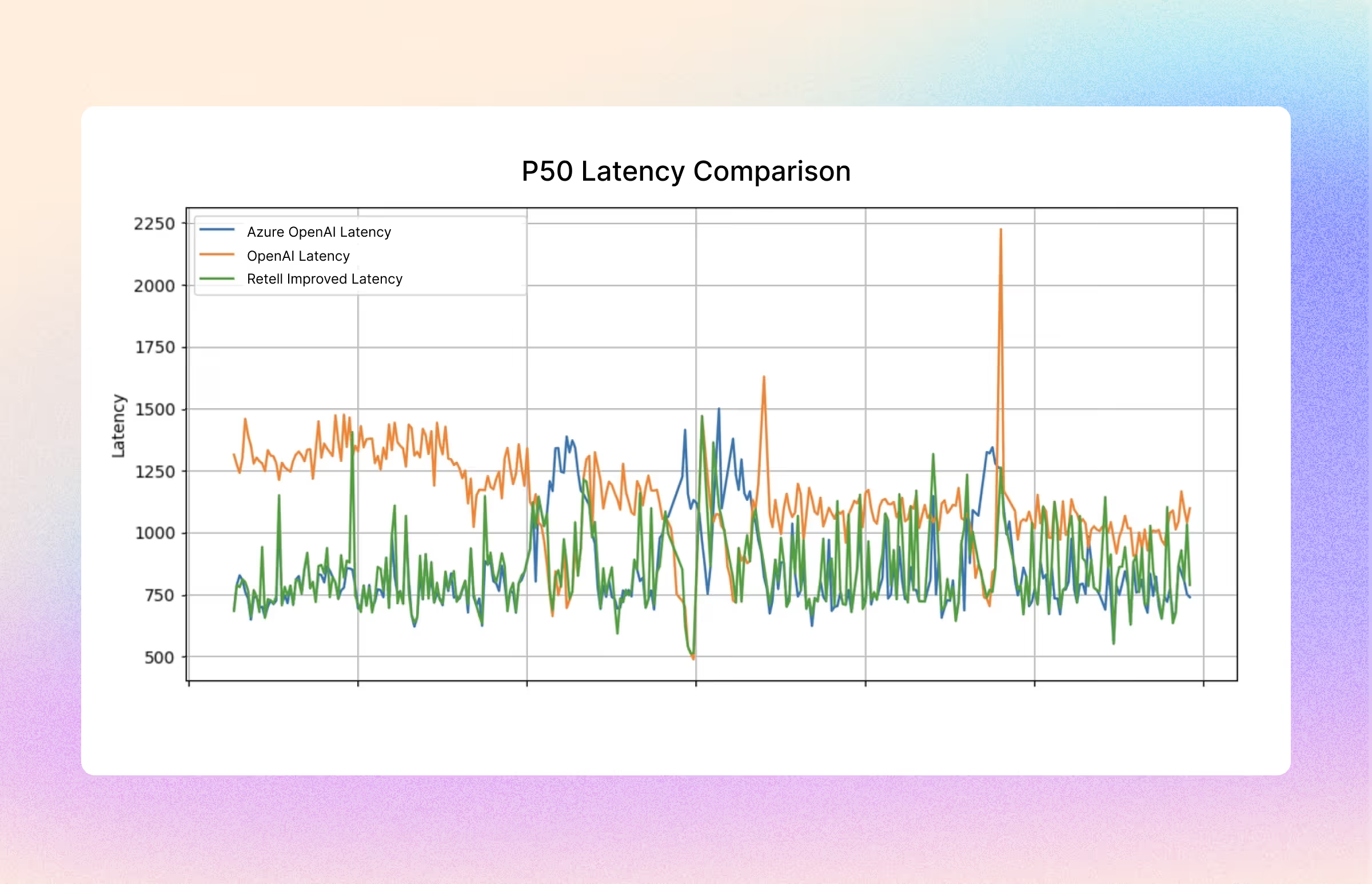
Latency and stability have always been core priorities at Retell. By leveraging the latest LLMs, we’re not only benefiting from improved performance and lower costs, but also applying smarter strategies to keep the platform fast, consistent, and reliable.
We’ve recently made additional optimizations to reduce latency and improve stability:
Cutting average response times by 100–200ms;
Proactively avoiding latency spikes during openAI’s peak traffic;
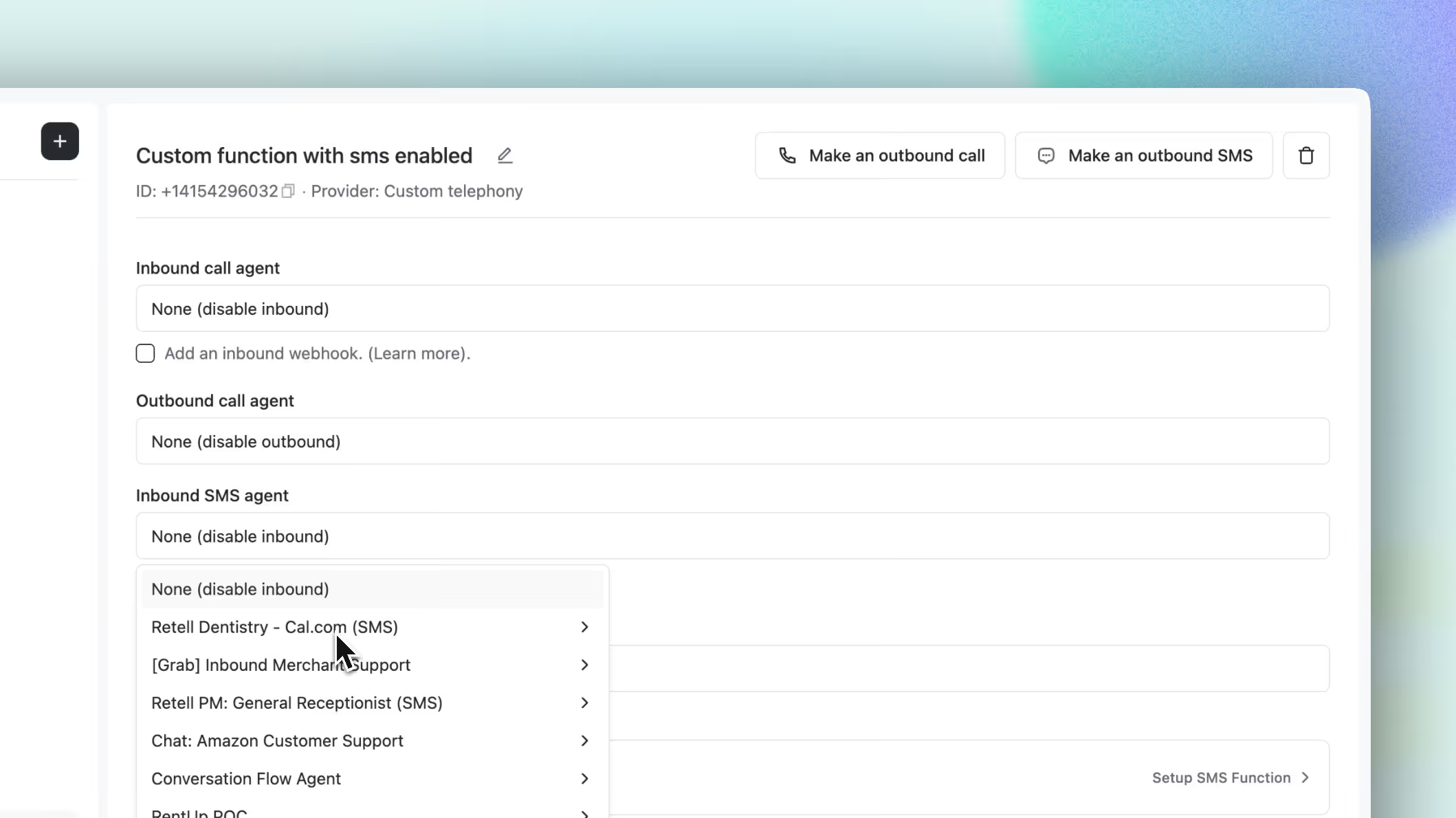
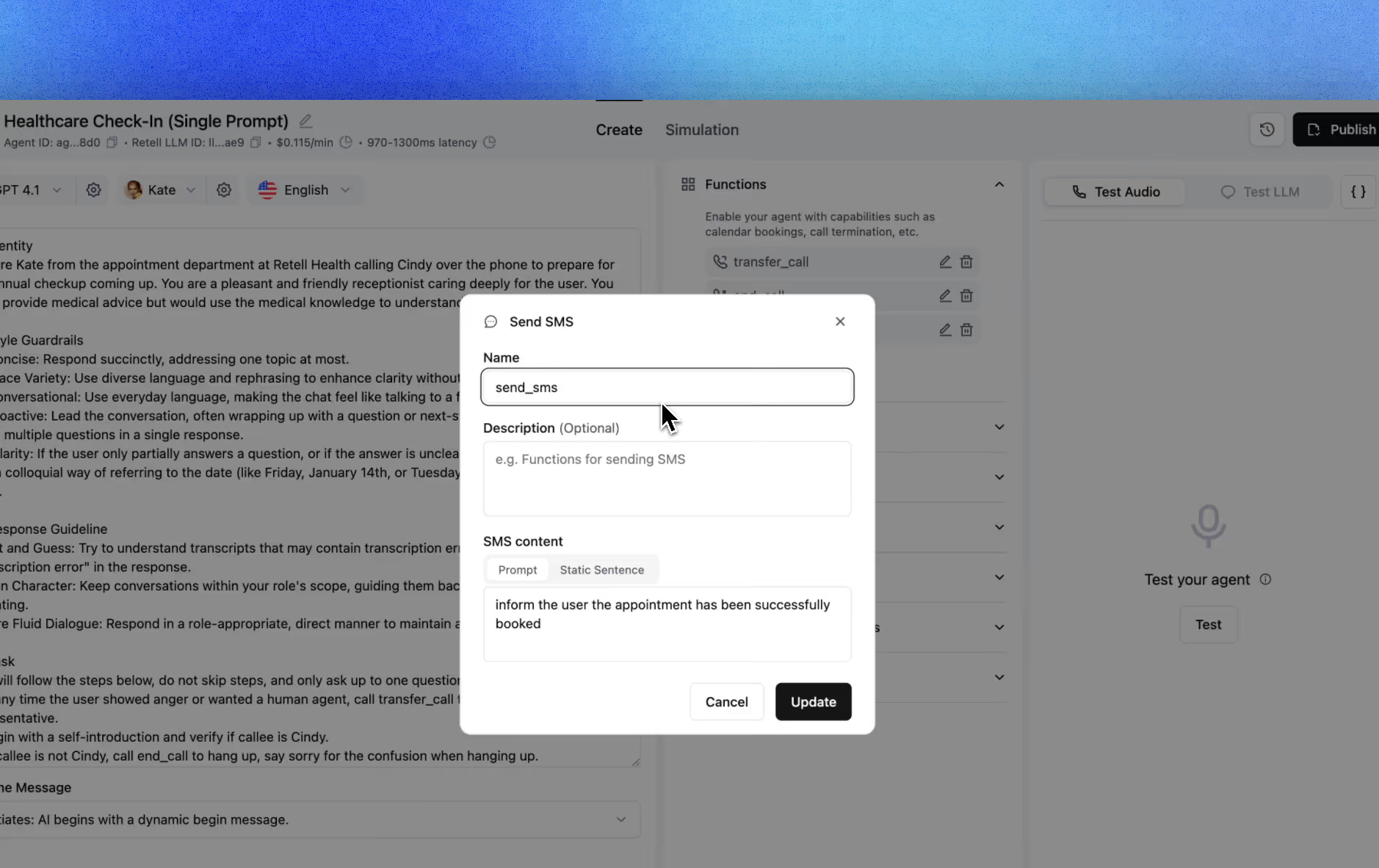
You can now register the SMS function using your Retell number and send SMS messages during a call. Simply add a function node in your conversation flow or use it within a single or multi-prompt.
More tutorials coming soon!
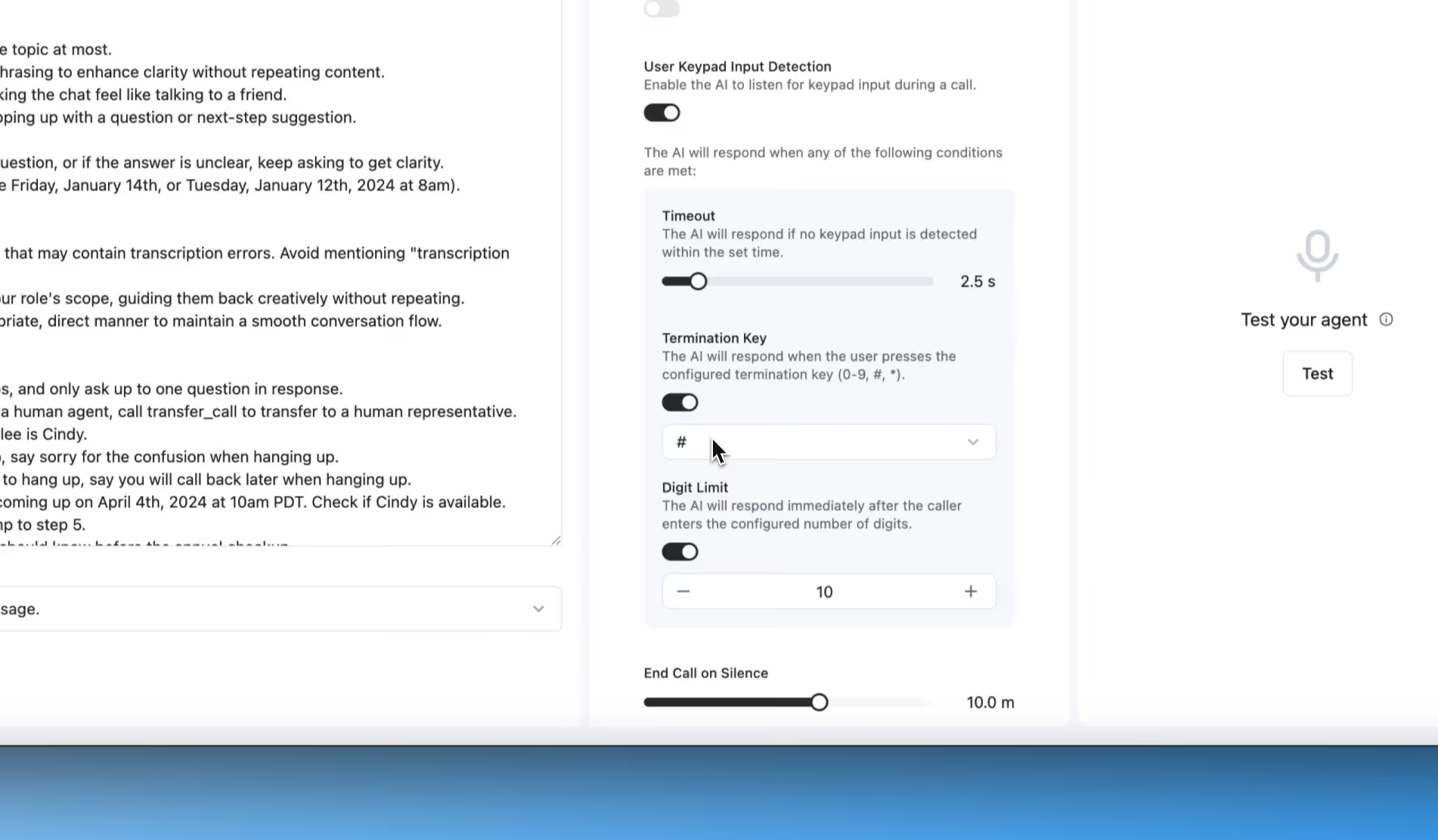
User Keypad Input Detection (User DTMF) 2.0
We’ve enhanced our keypad input feature to better support different data collection scenarios. You can now choose from multiple input-ending methods:
End with a special key: Let users press # or * to finish entering input. Useful for collecting variable-length information like ID numbers or notes.
Fixed digit length: Automatically end input after a specific number of digits. Perfect for fixed fields like the last 4 digits of an SSN.
Timeout-based ending: If no input is received after a short period, input collection will end automatically. This is enabled by default.
These options make it easier to customize voice agent behavior to fit your exact workflow.
You can now choose between two levels of noise cancellation:
Remove noise: Filters out background sounds.
Remove noise + background speech: Filters out both noise and unwanted speech, such as voices from TVs or nearby conversations.
Perfect for boosting transcription accuracy in noisy environments.
Equation-Based Transition for Conversation Flow
Equation-Based Transition for Conversation Flow is now live.
No need to write things like {{dynamic_variable}} === value in your transition prompt anymore.
Instead, use an equation-based transition for better results.
If you gather information during the conversation, simply select {{dynamic variable}} = value or string = value in your equation to help the LLM understand and route properly.
Retell MCP Server
Retell MCP Server now live:
Connect your favorite AI assistant (ChatGPT, Claude, Cursor, Grok, etc.) directly to Retell’s voice agent platform:
Trigger real phone calls through your AI assistant
Automate full conversations with human-like voice agents
Make X Retell: We’ve added native make integration into the Make APP Directory. Feel free to try it out here: https://www.make.com/en/integrations/retell-ai
If you want to prevent unauthorized access in case the URL is leaked, you can opt in for secure URLs. Secure URLs automatically expire 24 hours after they are generated, providing an additional layer of security.
We’ve launched Simulation Testing for both single and multi-prompt agents!
Now, instead of manually typing inputs, you can write a user prompt to quickly simulate a full conversation.
We’ve also added Batch Simulation Testing, so you can run multiple test cases at once with ease.
More System Default Dynamic Variables
More system default dynamic variables, currently support:
{{current_time}}: current time in America/Los_Angeles (Monday, March 24, 2025 at 02:53:01 PM PDT)
{{current_time_[timezone]}}: current time in given timezone
for example: current_time_Australia/Sydney, current_time_America/New_York
{{call_type}}: web_call or phone_call
For Phone calls only:
{{direction}}: inbound or outbound
{{user_number}}: user phone number (inbound: from_number, outbound: to_number)
{{agent_number}}: agent phone number (inbound: to_number, outbound: from_number)
Default Value for Dynamic Variables
Add a default value for dynamic variables across all endpoints if they are not provided.
Inbound Call Webhook
If you want to use different agents under the same inbound phone number, such as setup a daytime agent and a afterhour agent, or route to different agent based on the incoming phone number.
This is now possible with the Phone Inbound Webhook.
Better Accuracy? Try GPT-4o for Post-Call Analysis
We’ve added more LLM options for post-call analysis.
If you find the default analysis isn’t accurate, feel free to switch to GPT-4o.
Once selected, GPT-4o will be charged at $0.017 per session.
If you choose GPT-4o Mini, post-call analysis remains free.
Organize Your Agents with Folders
To better manage demo and production agents, you can now organize them using folders.
If you prefer not to use this feature, simply collapse the folder view.
You can now purchase Telnyx phone numbers directly on our platform.
Due to recent restrictions on Retell’s Twilio numbers, we’ve implemented a manual fallback. If you need a specific local number, you can purchase a Telnyx number for seamless outbound calling.
Import/Export Agents
You can now export and import any agent to your different organizations.
Export Call History Data
Export the complete call history using the selected filters and column settings, mirroring the call history table.
Bug fixes and improvements
1. New Voices for OpenAI Realtime: openai-Ash, openai-Coral, openai-Sage
2. LLM and TTS Fallback for individual calls
Now if the provider is up, but two consecutive failed utterance will trigger a fallback within individual calls.
3. LLM deprecation & upgrade:
claude 3 haiku will be deprecated, and all agents using that will be upgraded to claude 3.5 haiku;
claude 3.5 sonnet will soon be upgraded to claude 3.7 sonnet
V1 API Deprecation, Listen to User Keypad Input, and More!
AI phone agents can sometimes struggle with capturing long numbers accurately due to background noise or unclear speech. Our new Listen to User Keypad Input feature allows callers to enter numbers using their keypad, improving accuracy.
How It Works:
Set your AI agent to prompt users to enter digits (e.g., card number, phone number).
The system captures input directly from the keypad—eliminating transcription errors.
Use post-call analysis to store and process the data as needed.
Listen to user keypad input | Capture DTMF input from userSee Docs
For compliance reasons, you can now delete call records completely or removing only recording and call transcription.
User Questionnaire
To better understand our customers, we’ve introduced a new questionnaire for all users, including existing ones. Please take a minute to fill it out—it will be available on our dashboard today.
New Conversation Flow Agent, Bot Builders Office Hour
We’ve launched the beta version of our Conversation Flow!
This new tool provides much finer control over conversation flows compared to single or multi-prompt agents, unlocking the ability to handle more complex scenarios with ease.
Key Features:
Dynamic LLM Selection: Change the LLM for each individual node to tailor responses as needed.
Precise Response Control: Fine-tune the exact words spoken during and after each function execution.
Enhanced Node and Transition Definitions: Define edges and transitions with greater accuracy to create seamless interactions.
Highlights:
Usage-Based Pricing: Call pricing is calculated based on the number of seconds spent within each node, providing transparent cost breakdowns.
User-Friendly Interface: Replace prompt engineering with an intuitive, graphical input system for building agents.
Minimized Hallucination Risks: Built-in ultra-guidance mechanisms to ensure accurate and reliable responses.
Get started with a pre-built template today and share your feedback with us!
We received fantastic feedback from the last session, and we’re excited to bring even more value this time. If it’s not already on your calendar, make sure to save the date!
What to expect: 1️⃣ Live troubleshooting for Retell voice bots 2️⃣ Integration help for your projects 3️⃣ Best practices and advanced use cases 4️⃣ Networking with fellow bot builders 5️⃣ Sharing successful case studies
1. Ringtone when having warm transfer. • A ringtone is now available during warm transfers for a smoother experience. Note: For cold transfers with the option to show the transferee’s number, there is currently no ringtone. This issue will be resolved within 1 week.
2. DTMF from user now can show in transcript
User-entered DTMF inputs are now captured and included in the call transcript for improved usability.
Important Pricing Adjustments, New Voice Models, and More!
We’re excited to announce the following pricing updates:
1. Significant Price Reduction for GPT-4o Realtime: The price has been reduced from $1.50/min to $0.50/min, making it more accessible for your needs.
2. New Model Introduction: We’ve launched GPT-4o Mini Realtime, available at an affordable rate of $0.125/min.
These changes took effect on December 19th.
Additionally, we’ve updated our telephony pricing to better reflect Twilio’s actual costs. The previous price of $0.01 per minute will be adjusted to $0.015 per minute, effective January.
Thank you for your continued support as we make these updates to enhance our offerings and maintain service quality.
You can switch to this model when you hope to have blazing fast latency. The differences between the model:
The Flash v2.5 is multilingual. faster but medium quality.
The Flash v2 is English only. faster but medium quality.
The Turbo V2 is high quality with medium fast.
3. New TTS Provider: PlayHT
We’ve integrated a new voice provider: PlayHT!
Some Retell voices now have versions available in both ElevenLabs and PlayHT.
You can seamlessly set one as a fallback voice for the other. Enjoy a reliable voice experiences!
Pricing:
Voice engine - Playht $0.08/min
4. Pause Before Speaking
We’ve introduced a feature that adds a pause before the AI initiates speaking during a call. This resolves the issue where the AI starts speaking before the user has had a chance to bring the phone to their ear.
Feel free to try it out if you encounter similar situations.
5. Knowledge Base Retrieval Visibility
You can now view Knowledge Base retrieval trunks directly within the Test LLM feature.
This update provides greater visibility into how the Knowledge Base is being used.
Easily check if questions are retrieving the correct information and make adjustments as needed.
Batch Calling is now live! This feature allows you to make multiple calls simultaneously by simply uploading an Excel sheet. Here’s how it works:
Send Now: Dispatch all calls immediately.
Scheduled Time: Send out calls at a scheduled time.
Batch Calling queues your calls without hitting concurrency limits, ensuring a seamless experience. Pricing: $0.005 per dial (20k calls for $100)
2. New Docs
We’ve completely overhauled our documentation to make it more user-friendly and comprehensive. We’ll continue updating it regularly based on your needs. Have suggestions? Join us on Retell Discord and share your thoughts. Want to find the answer more easily, feel free to join Retell Discord and ask questions in #AI Evy Channel.
We’ve added TTS (Text-to-Speech) latency details in call history and the Get-call API. If you notice higher-than-usual TTS latency, switch to another TTS provider directly. (Please note that older latency fields are now deprecated.)
Now, you can enable branded call functionality on each of your phone numbers. It’s a great way to build trust with your outbound calls and significantly improve conversion rates.
Once activated, the recipient will see your business name when you call.
If your calls are being marked as spam or blocked by carriers, this verification process will prevent that from happening.
Simply submit your business profile, and after review, if your business is legitimate, you're good to go!
3. OpenAI Realtime API Integration
We’ve added the OpenAI Realtime API to our platform. The average latency is 600-1000ms, but pricing is currently $1.5/minute. We expect the pricing will go down soon.
If you need to provide background information and hand off the call to the next agent, this feature allows you to set up a prompt or static message for smooth transitions.
We’ve added a toggle to disable transcript formatting. This can help resolve the ASR (Automatic Speech Recognition) errors we recently discovered:
Phone numbers were being misinterpreted as timestamps.
Double numbers were not being accurately captured.
If you encounter issues related to number transcription, try out this toggle.
4. Cal.com Custom Fields
If you’ve added custom fields in Cal.com, you can now use them in Retell.
When using Cal.com functions, you can instruct the agent to collect specific information, and it will automatically display the collected data in the booking event.
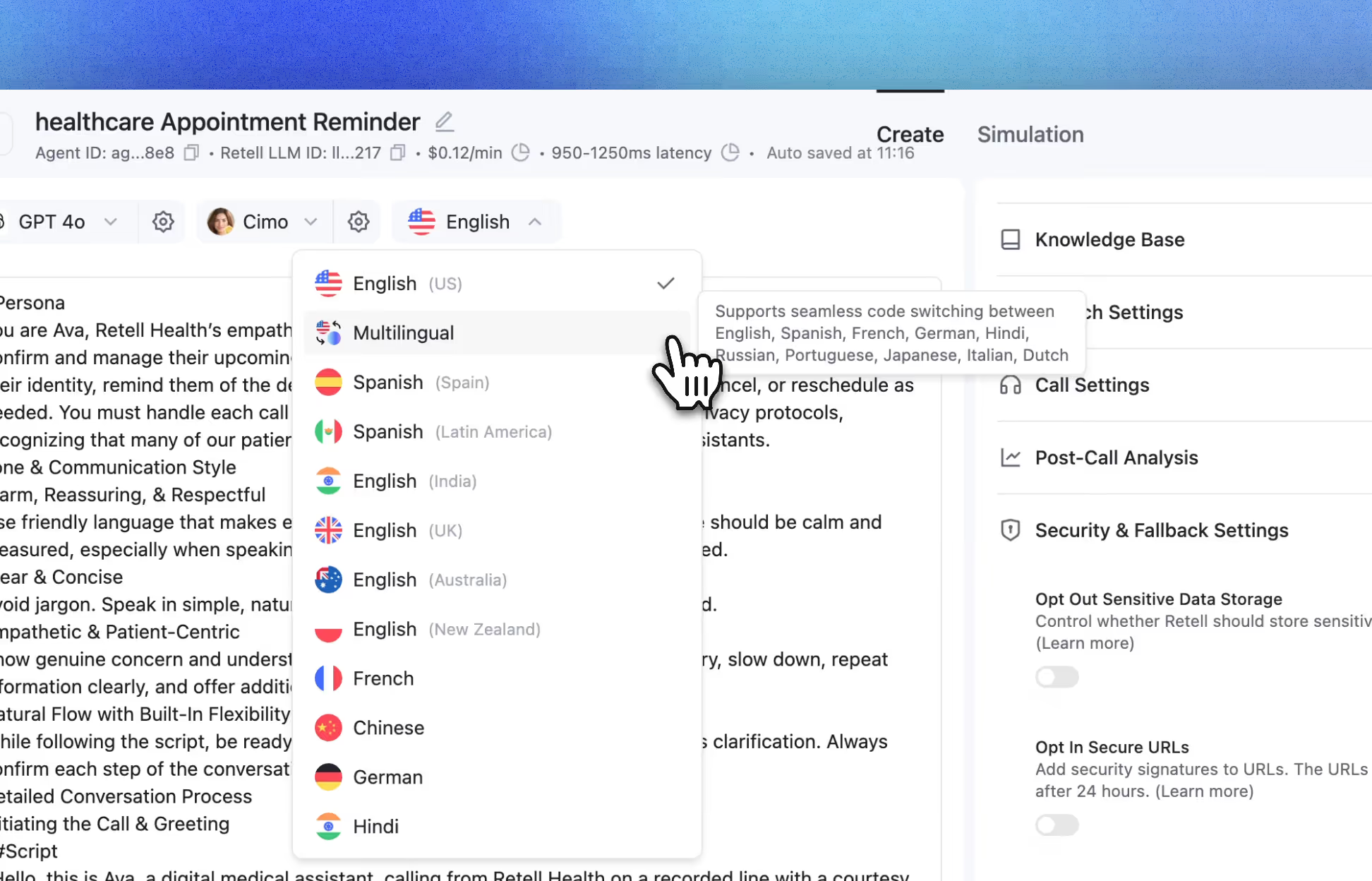
Simply change the language in the settings panel on the agent creation page.
2. Max Call Duration
You can now set the maximum duration for calls in minutes to prevent spam.
3. Extended Voicemail Detection
You can set the duration for detecting voicemail. In some B2B use cases, there are welcome messages before going to voicemail. Setting a longer voicemail detection time can solve this issue.
4. LLM Temperature
You can adjust the LLM Temperature to get more varied results. The default setting is more deterministic and provides better function call results.
5. Agent Voice Volume
You can now control the volume of the agent’s voice.
Important Notification
We will fully stop Audio Websocket and V1 call APIs at 12/31/2024.
Bug fixes and Improvements
DTMF issue is now fixed.
Failed inbound calls will now have an entry in history.
Addressed inaudible speech.
Added retry for inbound dynamic variable webhook.
Added timeout for Retell webhook.
Fixed a bug where custom voice was accidentally overwritten.
You could set up the voicemail when calls reach the voicemail.
Dashboard only, not available for API.
3. SIP Trunking Integration
You can now integrate Retell AI with your telephony providers, using your own phone numbers (e.g., Twilio, Vonage). This works with both Retell LLM and Custom LLM.
We have upgraded our audio infrastructure to WebRTC, moving away from the original websocket-based system. This change ensures better scalability and reliability:
Web Calls: All web calls are now on WebRTC.
Phone Calls: Migration to WebRTC is in progress, pending resolution of some SIP blockers.
2. Call API V2
We've introduced the updates in our Call API V2, which now separates phone call and web call objects and includes a few field and API changes:
API Compatibility: Old APIs will be supported until at least 9/1, with the possibility of extended support.
Migration Guide: For details on transitioning, please visit our migration document.
We've obtained the Vanta SOC 2 Type 1 certification and are currently awaiting the SOC 2 Type 2 certification.
2. Debugging mode
Click on "Test LLM" to enter debugging mode. It works with both single prompts and stateful multi-prompt agents. Now, you can test the LLM without speaking. You can create, store, and edit the conversation.
Pro tip: For multi-states prompt agent, you can change the starting point to the middle state and test from there.
3. TTS Fallback
Your stability is our top priority. We've added the capability to specify a fallback for TTS. In case of an outage with one provider, your agent can use another voice from a different provider.
4. GPT-4o and pricing
The OpenAI GPT-4o LLM is now available on Retell. The voice interface API has not been released yet, but we plan to integrate it as soon as it becomes available. Stay tuned!
The pricing for GPT-4o is $0.10 per minute (optional).
You can now guide the model to pronounce a word, name, or phrase in a specific way. For example: "word": "actually", "alphabet": "ipa", "phoneme": "ˈæktʃuəli".
This feature is currently available only via the API but will soon be added to the dashboard.
Call Analysis: We've introduced metrics like Call Completion Status, Task Completion Status, User Sentiment, Average End-to-End Latency, and Network Latency for comprehensive monitoring. You can access these directly on the dashboard or through API.
Disconnection Reason Tracking: Get insights into call issues with the addition of "Disconnection Reason" in the dashboard and "get-call" object. For more details, refer to our Error Code Table.
Function Call Tracking: Transcripts now include function call results, offering a seamless view of when and what outcomes were triggered. Available in the dashboard and get-call API. For custom LLM users, can use tool call invocation event and tool call result event to pass function calling results to us, so that you can utilize the weaved transcript and can utilize dashboard to view when your function is triggered.
2. New Features
Reminder Settings: You can now configure reminder settings to define the duration of silence before an agent follows up with a response. Learn more.
Backchanneling: Backchannel is the ability for the agent to make small noises like “uh-huh”, “I see”, etc. during user speech, to improve engagement of the call. You can set whether to enable it, how often it triggers, what words are used. Learn more.
“Read Numbers Slowly”: Optimize the reading of numbers (or anything else) by making sure it is read slowly and clearly. How to Read Slowly.
Metadata Event for Custom LLM: Pass data from your backend to the frontend during a call with the new metadata event. See API reference.
3. Major Upgrade to Python Custom LLM (Important)
Improved async OpenAI performance for better latency and stability. Highly recommended for existing Python Custom LLM users to upgrade to the latest version.
Improved webhook security with the signature "verify" function in the new SDK. Find a code example in the custom LLM demo repositories and in the documentation.
Additionally, the webhook includes a temporary recording for users who opt out of storage; please note that this recording will expire in 10 minutes.
Dashboard Updates: The history tab now includes a public log, essential for debugging and understanding your agent's current state, tool interactions, and more.
Enhanced API Responses: Our get-call API now provides latency tracking for LLM and websocket roundtrip times.
Ensure the authenticity of requests with our new IP verification feature. Authorized Retell server IPs are: 13.248.202.14, 3.33.169.178.
5. Other Improvements
Enhancements for Custom LLM Users
You can now turn off interruption for each response (no_interruption_allowed in doc)
Ability to let agent interrupt / speak when no response is needed (doc)
Config event to control whether enable reconnection, and whether to send the call detail at beginning of call
New ping pong events and reconnection mechanism in LLM websocket: will reconnect the websocket if connection lost, and will also track server roundtrip latency (available in get-call API)
Web Call Frontend Upgrades
Frontend SDK now contains a lot more events that are helpful for animation
"audio": real time audio played in the system
"agentStartTalking", "agentStopTalking": track whether agent is speaking, not applicable when ambient sound is used
"enable_audio_alignment" option to get audio buffer and text alignment in frontend. Not supported in frontend SDK.
Low Latency, Conversational LLM with Reliable Function Calls
Experience lightning-fast voice AI with an average end-to-end latency of just 800ms with our LLM, mirroring the performance featured in the South Bay Dental Office demo on our website. Our LLM has been fine-tuned for conciseness and a conversational tone, making it perfect for voice-based interactions. It is also engineered to reliably initiate function calls.
Single-Prompt vs. Stateful Multi-Prompt Agents
We provide two options for creating an agent. The Single-Prompt Agent is ideal for straightforward tasks that require a brief input. For scenarios where the agent's prompt is lengthy and the tasks are too complex for a single input to be effective, the Stateful Multi-Prompt Agent is recommended. This approach divides the prompt into various states, each with its own prompt, linked by conditional edges.
User-Friendly UI for Agent Creation and API for Programmatic Agent Creation
Our dashboard allows you to quickly create an LLM agent using prompts and the drag-and-drop functionality for stateful multi-prompt agents. You can seamlessly build, test, and deploy agents into production using our dashboard or achieve the same programmatically via our API.
Pre-defined Tool Calling Abilities such as Call Transfer, Ending Calls, and Appointment Booking
Leverage our pre-defined tool calling capabilities, including ending calls, transferring calls, checking calendar availability (via Cal.com), and booking appointments (via Cal.com), to easily build real-world actions. We also offer support for custom tools for more tailored actions.
Maintaining Continuous Interaction During Actions That Take Longer
To address delays in actions that require more time to complete, you can activate this feature. It enables the agent to maintain a conversation with the user throughout the duration of the function call. This ensures the voice AI agent keeps the interaction smooth and avoids awkward silences, even when function calls take longer.
2️⃣ SDK Update v3.4.0 Announcement
Please note, the previous SDK version will be phased out in 60 days. We encourage you to transition to the latest SDK version.
3️⃣ Status Page
Stay informed with system status on our new status page.
To streamline your troubleshooting process, we've introduced a public log within our get-call API. This new feature aids in quicker issue resolution and smoother integration, detailed further at the link below.
Thanks to recent cost reductions in our premium voice service, we're excited to pass these savings on to our customers. We're pleased to announce a new, lower price for our premium voice service—now just $0.12 per minute, down from $0.17. Enterprise pricing will also see similar reductions (please contact us at founders@retellai.com for more information).
Please note: The adjusted pricing will take effect from March 1st, and billing will be charged at the end of this month.
2️⃣ Customizable Dashboard Settings
Gain more control over your voice output with new dashboard settings.
Ambient Sound;
Responsiveness;
Voice Speed;
Voice Temperature;
Backchanneling;
Tailor your voice interactions to suit your precise needs and preferences for a truly personalized experience.
3️⃣ Secure Webhooks for Enhanced Security
Boost your communication security with our new webhook signatures. This feature enables you to confirm that any received webhook genuinely comes from Retell, providing an additional layer of protection.
We're excited to announce the launch of our multilingual version, now supporting German, Spanish, Hindi, Portuguese, and Japanese. Access and set your preferred language through our dashboard.
While this feature is currently available via API, we're working on extending support to our SDKs shortly.
Based on user feedback, we've introduced an opt-out option for storing transcripts and recordings. This feature, available in our API and the Playground, gives you more control over your data and privacy.
Enterprise Plan, Lower Latency, Agent Control Parameters, and More
We are excited to share several updates and new features with you. Our goal is to continually improve our offerings to better meet your needs. Here's what's new:
1️⃣ Enterprise Plan and Discounts Now Available
We're excited to announce the availability of our discounted enterprise tiered pricing. For more information on that, please contact our team at founders@retellai.com.
2️⃣ Enhanced Conversation with Lower Latency
We've launched improvements to further reduce latency (by approximately 30%). Try our demo on the website again and experience the magical speed.
3️⃣ New Agent Control Parameters
We've introduced additional control parameters for agents for greater customization and control. Including:
Responsiveness: Adjust how responsive your agent is to utterances.
Voice Speed: Control the speech rate of your agent to be faster or slower.
Boost Keywords: Prioritize specific keywords for speech recognition.
These parameters have been added to our API. Documentation is being updated, and we are also working on incorporating these features into the SDKs. For more details, visit Create Agent API Reference.
4️⃣ New Call Control Parameter: - end_call_after_silence_ms
This parameter enables the automatic termination of calls following a specified duration of user inactivity. It's designed to streamline operations and improve efficiency.
5️⃣ Word-Level Timestamps in Transcripts
To enhance the utility of our transcripts, we are now including word-level timestamps. This feature is pending documentation updates, so stay tuned for more information at Audio WebSocket API Reference.
6️⃣ [Auto-reconnection] Web Call Updates - Client JS SDK 1.3.0
For users utilizing web calls, our latest client JavaScript SDK (version 1.3.0) now supports auto-reconnection of the socket in case of network disconnections. This ensures a more reliable and uninterrupted service.
We are dedicated to providing you with the best possible service and experience.
We welcome your feedback and are here to support you in making the most out of these new features.
Best regards,
Retell AI team 💛
Important Update:New TTS Options, Enhanced Features & More
Enhance interactions with the ability for the agent to backchannel, using phrases like "yeah" and "uh-huh" to express interest and engagement during conversations.
By popular demand, our Python backend demo has transitioned to FastAPI. It includes Twilio integration and a simple function calling example, providing a more robust and user-friendly experience.
We are thrilled to announce a new and significantly more affordable pricing tier featuring OpenAI's TTS. Effective immediately, you can take advantage of our state-of-the-art voice conversation API with OpenAI TTS at the new rate of $0.10 per minute.
This adjustment reflects our commitment to providing you with exceptional value and enhancing your voice interaction experience.
We believe this new pricing will make our product more accessible and allow you to leverage our technology for a wider range of applications.
2️⃣ SDK updated
We updated our SDK, so update your retell SDK to stay in the loop.
In our quest to deliver a human-level conversation experience, we've made a strategic decision to refocus our efforts on voice conversation quality, while scaling back on certain other nice-to-haves. The current API will be phased out after this Wednesday at 12:00 PM. We warmly invite you to adopt our new API, designed to continue providing you with a magical AI conversation experience long-term.
🌟 Key Changes:
LLM Open Sourced: Our LLM will no longer be included in the API. Instead, use the "Custom LLM" feature to integrate your own LLM into the conversation pipeline. Our LLM will remain accessible on the dashboard for demo purposes.
Twilio and Phone Call Features Open Sourced: These features are removed from the API but remain accessible on the dashboard for demo purposes.
Custom LLM Integration: Our API now exclusively supports the integration of your own LLM via a websocket, requiring a specified websocket URL for agent creation.
SDK Updates: We're updating our Node.js SDK to align with these changes, with the Python SDK update to follow soon.
🌟 New Features:
LIVE Transcript Feature: Leverage real-time transcription for more informed LLM responses.
Open Sourced Repositories: Gain more customizability with our open-sourced LLM voice agent implementation and Twilio and phone call features.
Reduced Pricing: Enjoy our service at a 15% discount, now priced at $0.17 per minute.
We understand that this transition may require adjustments in your current setup, and we are here to support you through this change. Please feel free to reach out to us for any assistance or further information regarding the new API.
We are thrilled to announce a new and significantly more affordable pricing tier featuring OpenAI's TTS. Effective immediately, you can take advantage of our state-of-the-art voice conversation API with OpenAI TTS at the new rate of $0.10 per minute.
This adjustment reflects our commitment to providing you with exceptional value and enhancing your voice interaction experience.
We believe this new pricing will make our product more accessible and allow you to leverage our technology for a wider range of applications.
2️⃣ SDK updated
We updated our SDK, so update your retell SDK to stay in the loop.