7 Best AI Sales Prospecting Tools for 2026
12
MIN READ
October 14, 2026

Your team can pull 5,000 perfect-fit prospects in an afternoon. That part got easy, no doubt. Reaching enough of them, fast enough, before the lead goes cold is where it falls apart.
That gap is where the pipeline quietly dies. Reps lose the day to research and data entry, the best leads sit untouched, and the ones who get a call often get it a week too late.
This is the job AI sales prospecting tools can easily take over. They find and enrich leads, score them by intent, and, in the newest tools, call and qualify prospects without a rep lifting a finger.
This guide breaks down the 7 best AI sales prospecting tools for 2026, what each does well and where it fits your stack.
Pulling a list of good leads is easy now. Any rep can do it before lunch but getting to those leads while they still care is the part that breaks.
Cold email used to carry this load. You'd send a few thousand, a handful would bite, and the math worked. It doesn't anymore.
Open rates are down around 18%, replies hover near 1%, and buyers delete the rest on sight. More volume just means more ignored email.
What works now is speed. Answer a lead in the first few minutes and your odds jump. Wait a day and it's usually dead. The catch is that reps spend about 70% of their week on research and admin, so the lead that needed a call at 2pm gets one next Tuesday, if at all.
That math is why AI took over the top of the funnel. Gartner expects 75% of B2B teams to run some kind of AI sales development by the end of 2026. The tools do the slow, repetitive work, so reps can be on calls instead of building lists.
| Tool | Best for | Starting price |
|---|---|---|
| Retell AI | Calling and qualifying your lead list with AI voice agents | Pay-as-you-go from $0.07/min, plus $10 free credits |
| Apollo | All-in-one contact data and email outreach for SMB teams | Free plan; paid from $49/user/mo (annual) |
| ZoomInfo | Enterprise-grade contact data and intent signals | Custom quote, roughly $15,000/yr minimum |
| Clay | Multi-source enrichment and custom prospecting workflows | Free plan; paid from $149/mo |
| 6sense | Predictive intent and account-based targeting | Free plan; paid by custom quote (often $35k+/yr) |
| Cognism | Compliant global data and phone-verified mobiles | Custom quote, two-part platform plus per-seat |
| Instantly | High-volume cold email at a flat, volume-based rate | From $37/mo (about $30/mo billed annually) |
Table Caption: The 7 best AI sales prospecting tools for 2026
We left off anything we couldn't verify is still in active use. Every tool here has a real user base in 2026 and a deep bench of reviews on G2 or similar, so you're looking at products teams actually run, not ones that only look good in a demo.
Pricing comes straight from each tool's own page, cross-checked against independent 2026 breakdowns, so the numbers match what you'd pay today. And since prospecting covers everything from finding leads to enriching, scoring, and reaching them, we sorted the tools by the one job each does best, which is what the table reflects.

You've got more leads than your team can call. A rep gets through maybe 40 a day, the list keeps growing, and the good ones go cold waiting in the queue.
Retell calls them for you. It's a voice AI that takes a list and works it, dialing, holding a real conversation, qualifying the prospect, and booking the meeting if they're a fit. One agent runs hundreds of these at once, day and night, so a lead that came in at 9pm gets a call at 9:01 instead of next Tuesday. That speed is most of the game. Teams using it report cutting response times from over 90 minutes to under five, and covering with one agent what used to take seven or eight reps.
It won't find you leads or build a database, that's what the data tools are for. Retell is the part that turns the list into conversations.
Batch Call fires through a CSV list.Branded Call ID puts a real name on the screen so people pick up. The agent books meetings inside the call, and once it hangs up,post-call analysis drops the transcript, qualification answers, and outcome intoHubSpot or Salesforce on its own.
Teams sitting on more leads than they can call, losing the good ones to slow follow-up.
Pay-as-you-go, from $0.07 per minute, billed only for what you use
Free credits, $10 to start, enough to build and test before you pay
Add-ons, Batch Call at $0.005 per dial, Branded Call ID at $0.10 per call, extra concurrency at $8 per line per month
Enterprise, custom volume pricing with dedicated support, quote-based
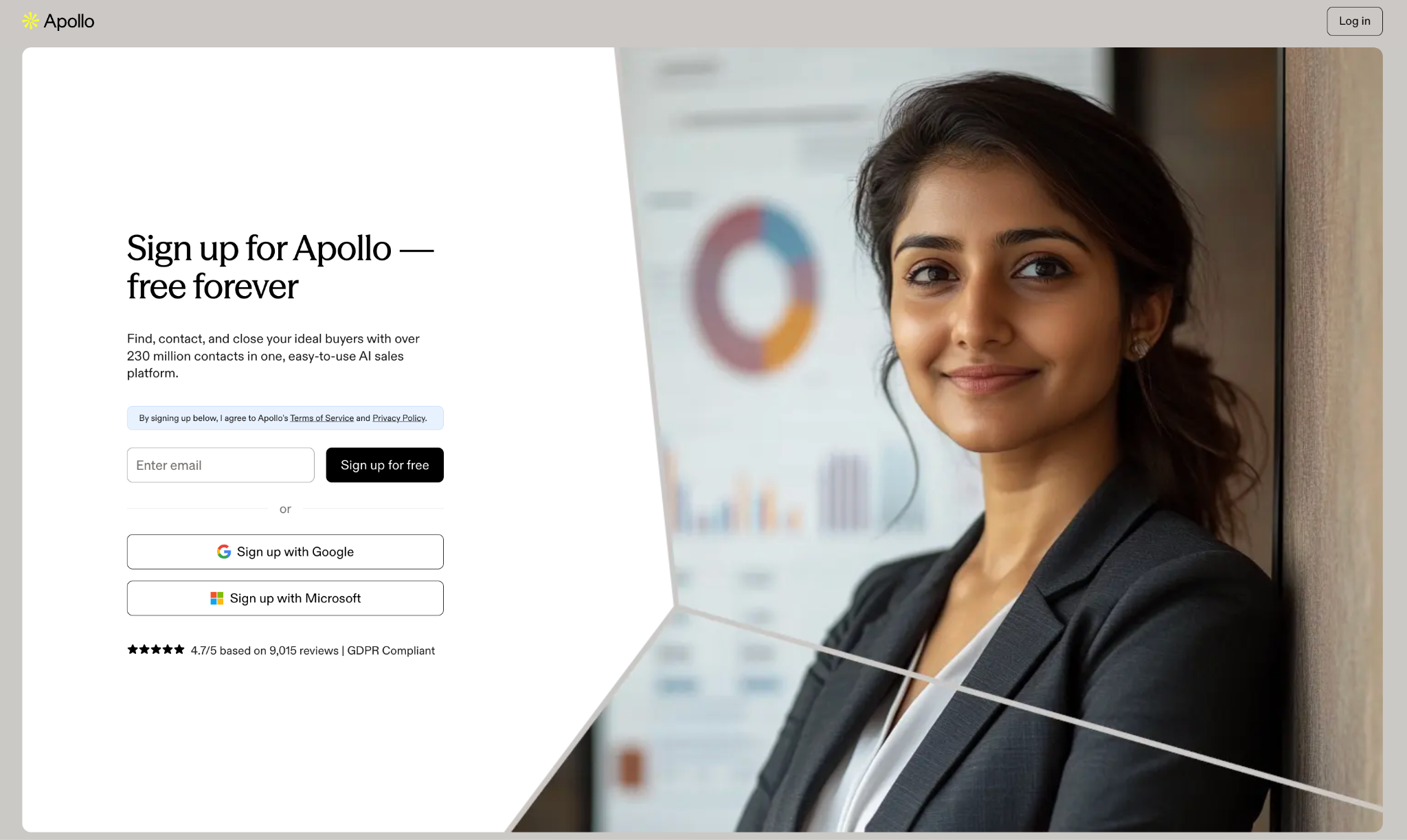
If you're starting from scratch and need contacts plus a way to email them, Apollo is usually where teams land first. It pairs a database of more than 200 million contacts with a built-in sequencer, so you can find a prospect, pull their email, and drop them into an outreach campaign without leaving the tool or paying for a second one.
That all-in-one setup is the draw. Smaller teams get a database, email sending, and a basic dialer for roughly the price of a standalone data tool, which is why it carries a 4.7 rating across more than 9,000 G2 reviews.
The catch is the credit system. The sticker price covers the seat, but pulling mobile numbers at volume burns credits fast, and heavy users routinely spend well above the headline rate once overages kick in.
Apollo is strongest for US-based, email-first prospecting at SMB scale. The contact data on North American companies holds up, the sequencer is genuinely good for the price, and the free plan is real enough to test before you commit. It syncs to HubSpot and Salesforce so the data lands in your CRM.
Startups and small teams that want contact data and email outreach in one tool, without stitching together a stack.
Free plan, limited credits, 2 active sequences, Gmail only
Basic, $49 per user per month (annual), or $59 monthly
Professional, $79 per user per month (annual), adds the dialer and AI email features
Organization, $119 per user per month (annual), 3-seat minimum, adds SSO and advanced controls

ZoomInfo is the enterprise data tool teams reach for when the contact info has to be right. Its database goes deeper than most, accurate direct dials, verified mobiles, firmographics, and intent data that flags when an account starts researching what you sell. If you're selling six-figure deals into large companies, a wrong number or a missed signal is expensive, and that accuracy is what you're buying.
It's priced like an enterprise tool. There's no public pricing, contracts run annually, and a small team starts around $15,000 a year before intent data and extra seats push it higher. For a large sales org working big accounts, the math works. For a small team doing high-volume outbound, it's overkill and you'll feel it on the invoice.
Data quality is the whole pitch. Phone accuracy beats the cheaper databases, the intent signals surface accounts already in-market, and it slots into the CRMs and sales tools big teams already run. For account-based selling up-market, little else competes.
Enterprise and mid-market teams with the budget for premium data, selling into accounts where bad data costs real money.
Custom quote only, no public list price
Entry point, around $15,000 per year for a small team (reported, not official)
Contracts, annual, with intent data and seats adding to the total

Clay is the tool RevOps people get slightly obsessive about. Instead of locking you into one database, it pulls from dozens of data providers at once and runs them in a waterfall, so if the first source doesn't have an email or a mobile, it tries the next, then the next.
You build the logic in a spreadsheet-style table and layer AI on top to research, score, and write to each row. The result is enrichment and list-building that bends to whatever workflow you can dream up.
That power is also the catch. Clay rewards people who like building systems and frustrates people who just want a list handed to them. There's a real learning curve, and the credit-based pricing climbs as your workflows get more elaborate, since every enrichment step and AI call spends credits.
Clay shines when your prospecting has rules. Pull a list, enrich it across 20-plus sources, score each lead against your ICP, branch the outreach based on what you find, all in one table. For teams that want custom, signal-driven list-building rather than an off-the-shelf database, nothing else is this flexible.
RevOps-led teams who want to build custom enrichment and scoring workflows, not just buy a contact list.
Free plan, limited credits to try it
Paid plans, from $149 per month, scaling with credit volume
Enterprise, custom pricing, commonly $2,500 per month and up for high-volume teams
A lot of outbound lands on people with zero interest in buying right now. 6sense exists to fix this. It tracks buying signals across the web, the quiet research a company does long before anyone fills out a form, and points you toward accounts in-market today. You aim your effort at the twenty companies actively looking this month and leave the cold thousands alone.
For account-based teams, reaching a company mid-research carries real weight. 6sense finds that window. It serves enterprises and prices like it. Plans run into the tens of thousands a year, the figure comes by quote, and you'll want a marketing-ops or RevOps person to run it well. A lean team without one will struggle to see a return.
It scores every account by buying stage and surfaces the ones heating up. It feeds those signals into your outreach. It pushes the same intelligence into ad targeting, so sales and marketing finally work the same list. For coordinated ABM at scale, few tools reach this depth.
Enterprise and mid-market teams running account-based plays who want to aim outreach at accounts showing genuine buying intent.
Free plan, limited monthly credits to try it
Paid plans, quote-based, with no public list price
Typical spend, often $35,000 a year and up
Cognism earns its reputation on clean, compliant data, with real strength in Europe. Its database holds phone-verified mobile numbers and contacts gathered to meet GDPR rules, so teams selling into the UK and EU reach real people on the first try and stay on the right side of regulators. For outbound into regulated or international markets, this compliance-first approach carries genuine weight.
The data comes at an enterprise price. Cognism sells through quotes rather than a public page, and the structure splits into a platform fee plus a per-seat license, so a five-person team often lands somewhere in the range of twenty to forty thousand a year. A smaller team with a tight budget will feel the size of the commitment.
European mobile data is the headline strength, with phone-verified numbers that hold up where cheaper databases fade. Coverage stays solid across international markets, and the contact records sync into Salesforce, HubSpot, and the sequencers a sales team already runs. For compliant outbound into the EU and UK, few options come close.
Teams selling into Europe and other regulated markets who want phone-verified, compliant contact data they can dial with confidence.
Quote-based, with no public list price
Two-part model, a platform fee plus per-seat licensing
Typical spend, roughly $22,500 to $37,500 a year for a five-person team
Instantly runs cold email at volume without wrecking your deliverability. It connects an unlimited number of sending inboxes, rotates sends across them to protect your domain reputation, and warms those inboxes up in the background, so a small team pushes serious email volume while staying out of spam folders. For founders and agencies living in cold outreach, this setup does a lot of heavy lifting.
Pricing stays refreshingly flat. The volume-based model charges by sending capacity rather than per seat, so a team of twenty pays the same as a team of five at the same tier. The headline rate covers email sending alone, though.
Lead data and the built-in CRM come as separate subscriptions, so a full stack climbs well past the entry price once you add those pieces.
Deliverability is the strong suit, with inbox rotation and built-in warmup keeping campaigns landing as volume scales. The flat, capacity-based pricing rewards bigger teams. A built-in lead database and CRM sit available for anyone who wants the whole motion in one place.
Founders, agencies, and outbound teams running high-volume cold email who want strong deliverability at a flat rate.
Growth, from $37 per month, around $30 per month billed annually
Hypergrowth, around $97 per month for higher sending volume
Lead database and CRM, sold as separate add-ons, raising the full-stack cost
A prospecting stack works as a relay. Each tool hands off to the next, and a gap at any stage starves everything downstream. Here is how the seven map to the stages of that handoff.
Build the list: Apollo and ZoomInfo sit at the front, where raw contact and company data enters your pipeline. Apollo suits teams sourcing US contacts on a budget, while ZoomInfo fits larger orgs paying for depth and verified direct dials.
Sharpen and enrich it: Clay layers on top of whatever data you pull, running it through multiple sources to fill gaps and add context. Cognism slots in here too for teams who need phone-verified, compliant numbers across Europe.
Time it with intent. 6sense watches for accounts moving into a buying window, so your list gets ordered by who deserves a touch this week rather than next quarter.
Reach the list: This is where the pipeline gets made or lost. Instantly carries the email side at volume, where cold email deliverability matters, and Retell carries the phone side, calling and qualifying the leads the earlier stages surfaced, then booking the meetings.
The pattern worth noticing sits at the end. Teams pour budget into the first four stages, finding, enriching, scoring, and then lean on a thin layer of human reps to do the reaching. Leads pile up faster than anyone can call them, and the spend on data goes to waste.
Pairing a strong data stack with an AI calling layer like Retell closes that final stretch, so the prospects you worked to find actually hear from you while they still care.
The tools have already changed what a small team can reach. A pile of good leads sits one search away, and the work of enriching, scoring, and dialing them no longer needs a room full of reps. What separates teams now is how little of that pipeline they let slip through.
Pick the stage where your own pipeline leaks. Thin or stale data points you toward Apollo, ZoomInfo, or Clay. Poor timing on outreach calls for intent from 6sense. Leads going cold before anyone reaches them points to the gap Retell fills, an AI voice layer that calls and qualifies while the interest is still warm.
Start with the one stage costing you the most, prove it out, and expand from there. A single fix in the right place tends to pay for the next one.
They take over the repetitive front of the job, list-building, first-touch outreach, and follow-up chasing. Human reps move to the work AI handles poorly, like nuanced conversations, complex objections, and closing. Industry forecasts expect AI to automate a large share of routine sales tasks by 2028, with reps shifting toward higher-value selling rather than disappearing.
It ranks your leads by how likely each one is to convert. The tool studies past deals and live behavioral signals, then scores incoming leads against those patterns, so reps work the warmest prospects first instead of guessing.
Quality varies by tool and region. Enrichment platforms run a contact through several sources and verify it before it reaches your list, which lifts accuracy on emails and direct dials. Coverage tends to be strongest in North America and Europe and thinner elsewhere, so checking a vendor's data on your own target market before committing saves money later.
Many connect to LinkedIn for sourcing and enrichment, pulling contact details, tracking job changes, and capturing prospects straight from Sales Navigator. Coverage and method differ by tool, so confirm the specific LinkedIn workflow you need before you buy.
Major platforms sync with HubSpot, Salesforce, and similar systems out of the box, writing enriched contacts and outreach activity to the right record. The cleaner the sync, the less manual logging your reps face, so a smooth CRM connection deserves weight in your decision.
See how much your business could save by switching to AI-powered voice agents.
Total Human Agent Cost
AI Agent Cost
Estimated Savings
A Demo Phone Number From Retell Clinic Office