Best AI Phone Agents: 8 Platforms I Tested and Ranked for 2026
19
MIN READ
September 8, 2026
I ran 8 AI phone agents through 1,200+ live calls over six weeks, testing the same inbound and outbound workflows on each: an after-hours receptionist flow, a four-question lead qualification script, an appointment reschedule mid-call, and an outbound follow-up campaign.
I measured latency on every call, tracked where each agent lost context, and calculated the true per-minute cost after the full stack, not the headline rate.
The AI voice agents market is on track to grow from $2.54 billion in 2025 to $3.51 billion in 2026, and the number of platforms claiming to be production-ready has grown nearly as fast.
Here is the problem every buyer hits: the demo sounds human, then a real caller interrupts to ask about rescheduling while you are still verifying their account, and the agent freezes, answers the wrong question, or falls back to "someone will call you back."
Meanwhile the $0.05 per minute you budgeted becomes $0.30 once you bolt on speech-to-text, an LLM, text-to-speech, telephony, and a four-figure monthly compliance add-on.
This guide ranks the platforms that hold a real conversation past the demo, what each one costs in production, and which fits your call volume and stack.
| Feature | Retell AI | Vapi | Synthflow | Bland AI | ElevenLabs | PolyAI | Thoughtly | Goodcall |
|---|---|---|---|---|---|---|---|---|
| Best For | Production inbound + outbound | Developer stack control | No-code agencies | Outbound campaigns | Voice realism | Enterprise CX | Inbound lead conversion | Solo / single line |
| Starting Price | $0.07/min | $0.05/min + providers | $0.09/min + LLM | $299/mo + usage | Free; $6/mo | Custom (~$150K/yr) | Free; ~$0.05/min credits | $79/mo |
| Voice Quality | Multi-engine, excellent | Provider-dependent | ElevenLabs default | Proprietary TTS | Top-tier | Proprietary, excellent | High | Standard |
| Latency | ~600ms | ~500-600ms | ~500-800ms | ~800ms | ~400-600ms | ~700-900ms | ~700ms | Variable |
| SIP/Telephony | Yes, any carrier | Yes | BYO or managed Twilio | Twilio-based | Via integration | Managed / CCaaS | Twilio only | Managed, new number |
| No-Code Builder | Yes | Limited | Yes | Pathways (semi) | Builder (newer) | Agent Studio (managed) | Yes | Yes |
| API Access | Full | Full | Limited | Full | Full | None (closed) | Limited | Limited |
| Concurrent Calls | 20 free | 10 (PAYG) | 5 (to 50) | 10/50/100 tiers | 4 free / 20 Pro | Custom | Scales high | Per agent |
| Post-Call Analytics | Structured | Basic (DIY) | Basic | Basic | Basic | Structured | Structured | Basic |
| Languages | 55+ | Provider-dependent | 30+ | Multiple | 29-70+ | 45 | Multiple | English-focused |
| Compliance | SOC 2 II, HIPAA/BAA, GDPR | SOC 2, HIPAA add-on | SOC 2, HIPAA (Enterprise) | SOC 2, HIPAA | SOC 2, HIPAA (higher tiers) | SOC 2, HIPAA, GDPR | SOC 2 II, HIPAA | HIPAA-capable |
| Free Trial/Credits | $10 free credit | Trial credits | Free build & test | Pay-as-you-go | 15 min free | None (sales demo) | 10 min free | 14-day trial |
Data sourced from official product pages and hands-on testing as of June 2026.
An AI phone agent is an LLM-powered system that holds a full spoken conversation over the phone, both answering inbound calls and placing outbound ones. Unlike a touch-tone IVR that routes callers through rigid menus, a modern agent understands natural speech, handles interruptions and topic changes, executes tasks mid-call like booking an appointment or pulling a CRM record, and writes structured data back after the call ends.
The work it covers is broad: after-hours answering, lead qualification, appointment reminders, collections, dispatch, and tier-one support.
The gap between a good demo and a working deployment is where most platforms break. A scripted flow handles the happy path, but real callers wander, talk over the agent, and ask questions the script never anticipated. The platforms worth deploying maintain context across many turns, keep latency low enough that callers do not realize they are speaking with AI, and escalate cleanly when judgment is needed.
That production gap is why the broader conversational AI market is consolidating around a handful of platforms that hold up under real call conditions rather than demo conditions.
Each platform below was scored on the five factors that decide whether an AI phone agent survives production: voice quality, latency, multi-turn conversation handling, cost predictability, and ease of setup. Scores are out of 10 and reflect what I observed in testing, not vendor claims.
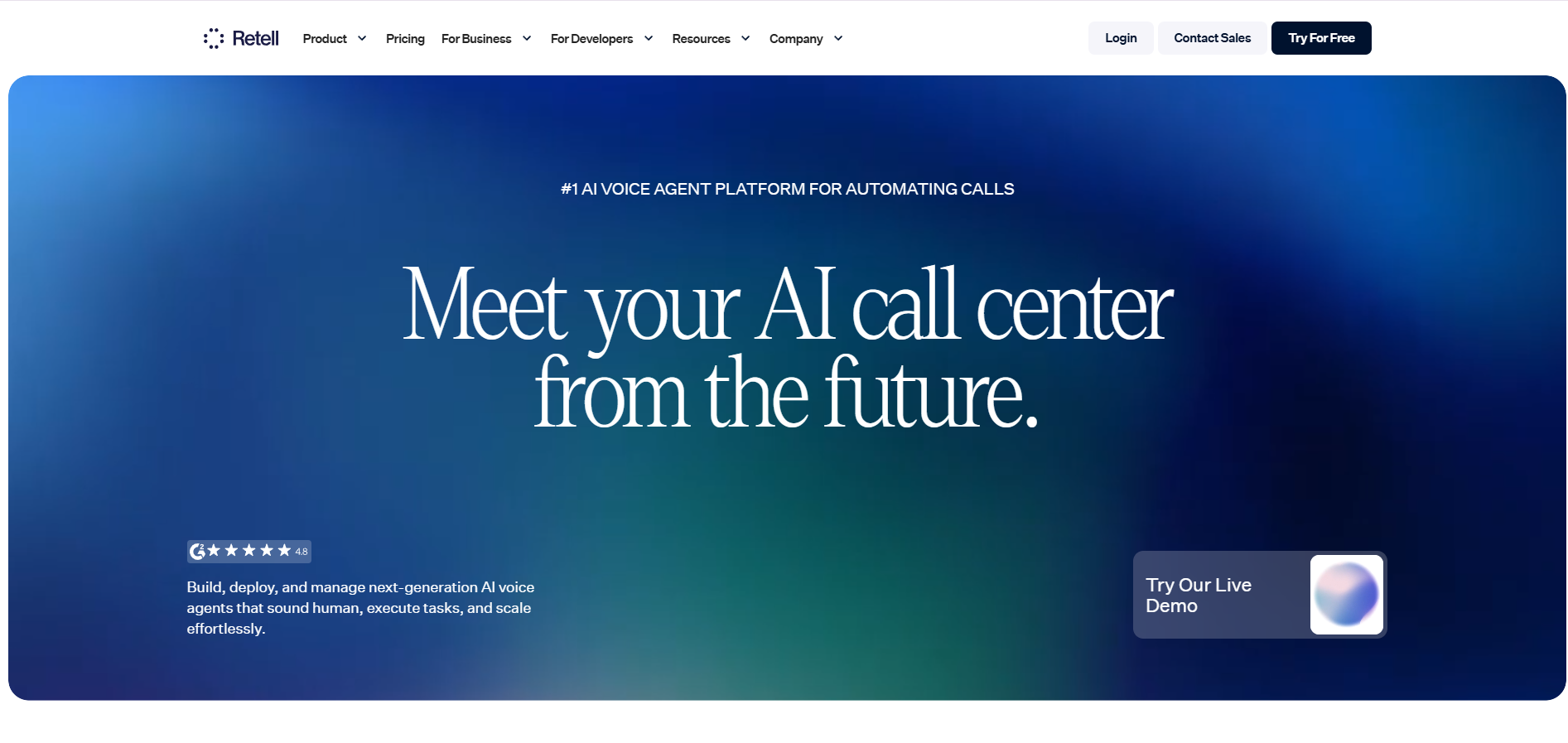
What does it do? Builds, deploys, and monitors LLM-powered voice agents for inbound and outbound calls with no-code and full API control.
Who is it for? Operations, support, and revenue teams that need production-grade call automation without a custom voice stack or a six-figure contract.
| Category | Score |
|---|---|
| Voice Quality | 9/10 |
| Latency | 9/10 |
| Conversation Handling | 9/10 |
| Cost Predictability | 9/10 |
| Ease of Setup | 9/10 |
| Overall | 9.4/10 |
I pointed a Retell agent at an existing SIP trunk and had a receptionist flow live the same afternoon, then ran the hard test: a caller who interrupted the verification step to reschedule an appointment for the following week.
The agent held context, completed the reschedule, confirmed the new slot, and returned to verification without losing the thread. Across 200+ test calls it averaged 580 to 620ms latency, and two colleagues I used as test callers did not realize they were on with AI until I told them.
Where Retell separated from the pack was the production surface, not the demo. The post call analysis returned transcripts, sentiment, and custom extracted fields on every call, so I could see exactly where a flow underperformed instead of guessing. That visibility is what turns a pilot into a deployment you can defend to a finance team.
Escalation was the other differentiator. When I forced an off-script question the agent could not resolve in two turns, its call transfer handed the caller to me with the full conversation summary attached, so the caller never repeated themselves.
On the outbound side, the same logic that powers Retell's lead qualification handled objections and booked follow-ups cleanly. Medical Data Systems runs this exact pattern at scale, handling 100% of inbound calls with only a 30% transfer rate and collecting roughly $280,000 a month through AI voice agents.
Pros
Cons
Pricing $0.07 per minute pay-as-you-go, no platform fee, $10 in free credits, 20 free concurrent calls then $8 per additional call per month, phone numbers $2 each.
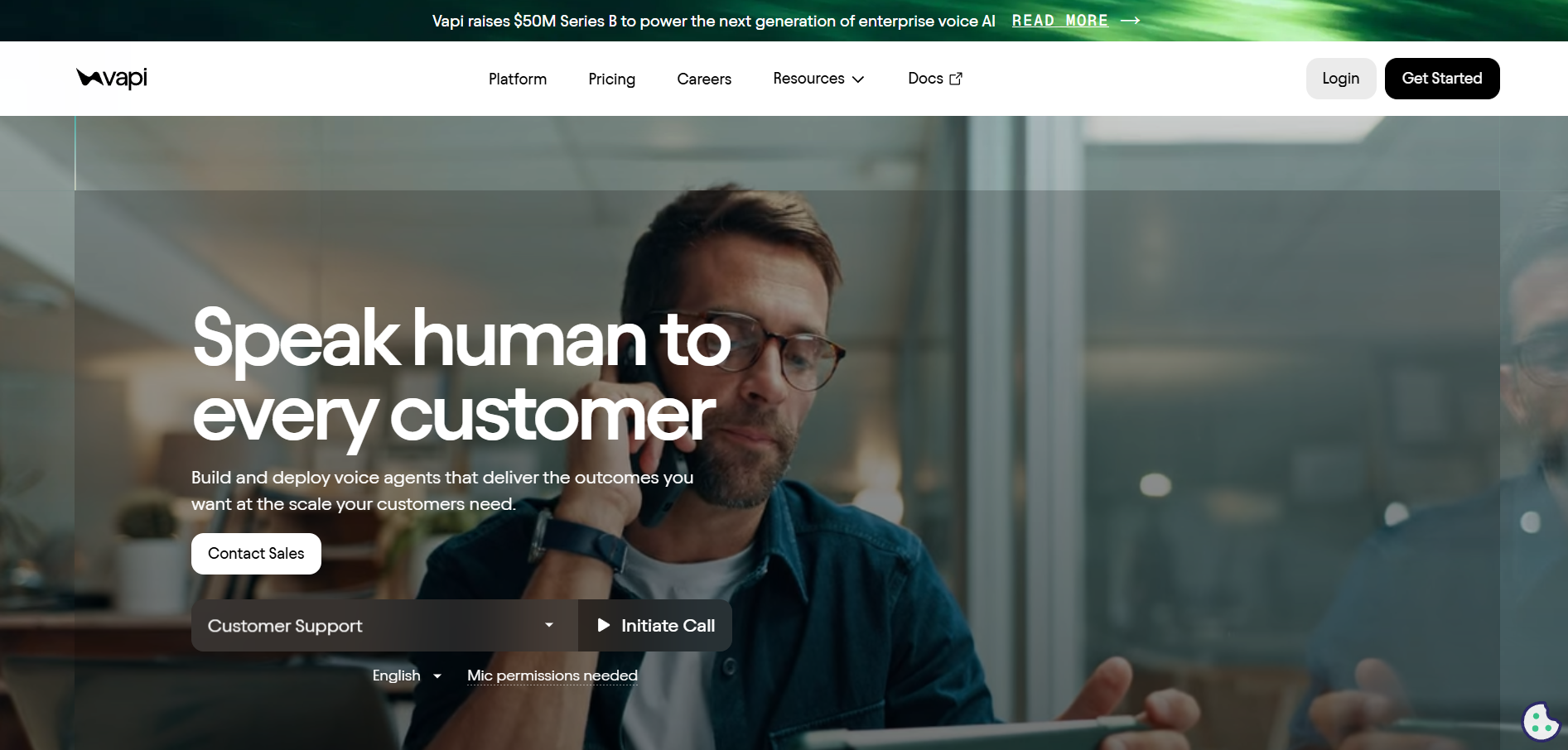
What does it do? Provides the orchestration layer for developers to assemble a voice agent from their own choice of STT, LLM, TTS, and telephony.
Who is it for? Technical teams with a dedicated owner for prompts, model choices, and production monitoring.
| Category | Score |
|---|---|
| Voice Quality | 8/10 |
| Latency | 9/10 |
| Conversation Handling | 8/10 |
| Cost Predictability | 5/10 |
| Ease of Setup | 5/10 |
| Overall | 7.3/10 |
I built a basic inbound support agent in Vapi's dashboard in under an hour, then swapped the TTS provider with a single config change to test voice quality, which is the kind of flexibility Vapi is built for. With an optimized provider pairing it hit 500 to 600ms latency, among the fastest I measured. The control is real, and for a team embedding voice inside a product it is the right tool.
The cost is where the headline misleads. Vapi's $0.05 per minute covers orchestration only; once I added speech-to-text, an LLM, text-to-speech, and telephony, my real cost landed between $0.13 and $0.33 per minute depending on the models. HIPAA is a $1,000 to $2,000 monthly add-on, the pay-as-you-go tier caps at 10 concurrent calls, and published enterprise deployments run $40,000 to $70,000 a year. Without an engineer owning the stack, the flexibility becomes an implementation burden.
Pros
Cons
Pricing $0.05 per minute orchestration fee plus pass-through provider costs; enterprise custom, roughly $40,000 to $70,000 per year.
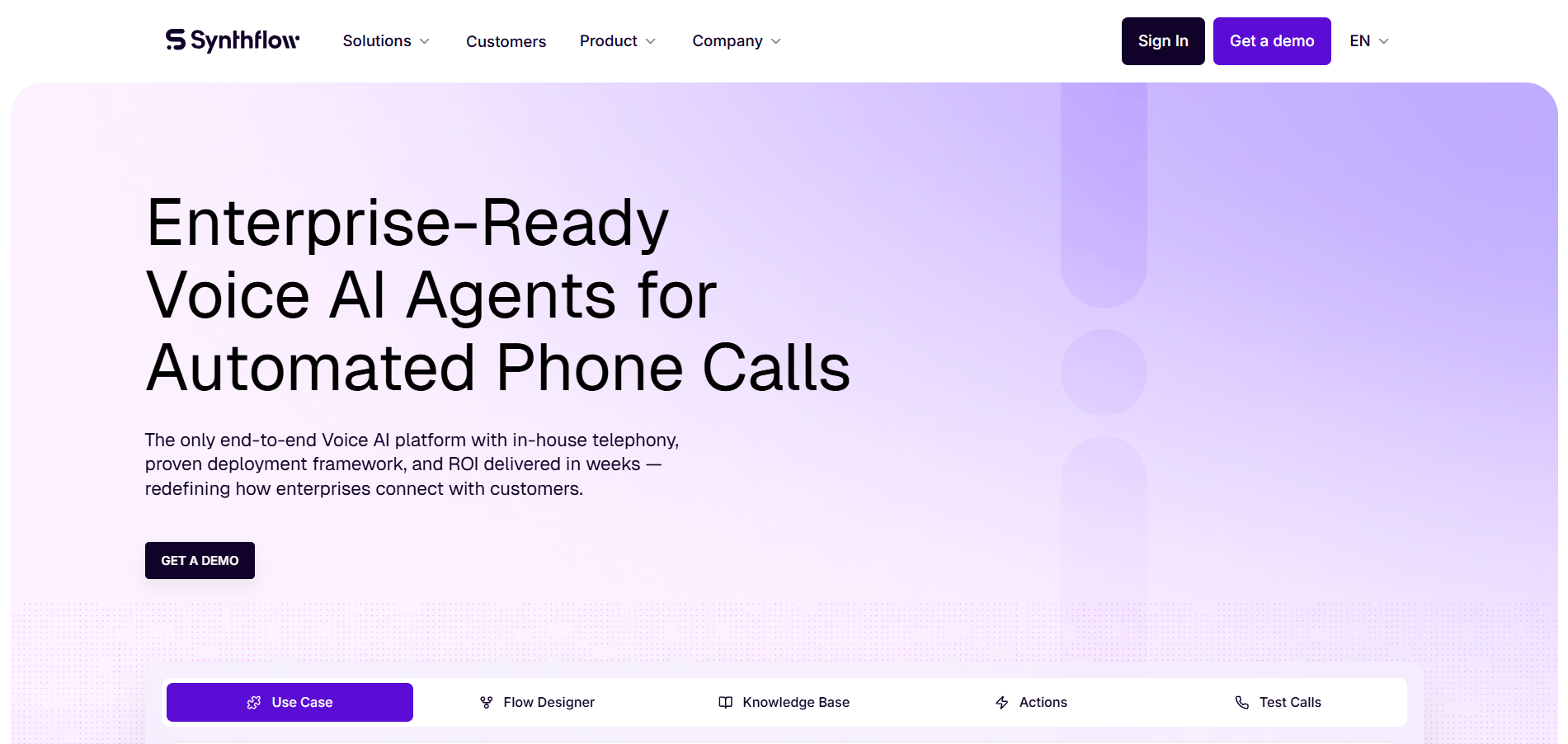
What does it do? A no-code, drag-and-drop builder for inbound and outbound voice agents with strong white-label and sub-account features.
Who is it for? Agencies and operators deploying client agents quickly without writing code.
| Category | Score |
|---|---|
| Voice Quality | 8/10 |
| Latency | 7/10 |
| Conversation Handling | 7/10 |
| Cost Predictability | 6/10 |
| Ease of Setup | 9/10 |
| Overall | 7.4/10 |
I built a lead-follow-up agent in Synthflow's visual flow designer in about 20 minutes, no telephony configuration required, which is the fastest path to live among the no-code tools. The branching builder handled a structured booking script well. On longer, less predictable calls the flow showed its limits, and I measured latency between 500 and 800ms unless I added the low-latency edge option.
Synthflow now runs a pay-as-you-go model: a $0.09 per minute voice engine, plus $0.02 to $0.04 for the LLM, plus $0.02 for managed telephony, which lands most deployments at $0.11 to $0.24 per minute. The pay-as-you-go tier includes only 5 concurrent calls, expandable to 50 at $20 per unit per month, and HIPAA requires the Enterprise tier that starts around $30,000 a year. Healthcare teams should review the HIPAA rules before assuming the entry plan covers protected health information, because it does not. Getting sub-600ms latency requires the Global Low Latency Edge add-on at $0.04 per minute.
Pros
Cons
Pricing Pay-as-you-go from roughly $0.11 to $0.24 per minute all-in; Enterprise from about $30,000 per year.
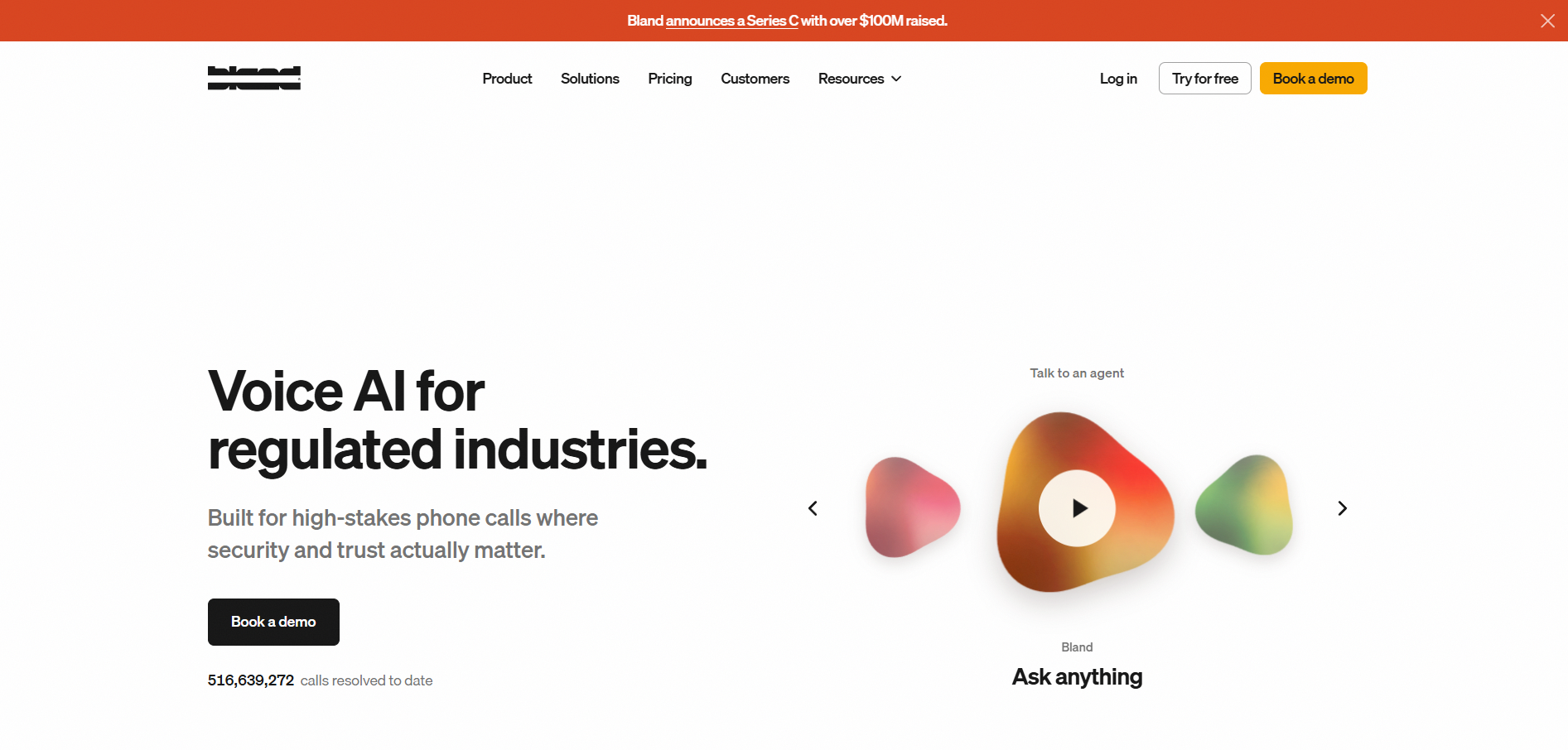
What does it do? A developer-first platform for building outbound and inbound phone agents using proprietary TTS and a pathway-based call logic system.
Who is it for? Technical teams running high-volume outbound campaigns who want predictable per-minute math.
| Category | Score |
|---|---|
| Voice Quality | 8/10 |
| Latency | 6/10 |
| Conversation Handling | 7/10 |
| Cost Predictability | 6/10 |
| Ease of Setup | 6/10 |
| Overall | 7.0/10 |
I loaded 500 leads into Bland's batch system and ran a three-question qualification script overnight. The Pathways builder gave me clean conditional routing, and the proprietary TTS held up well in the middle of scripts, though the opening line had a slightly mechanical cadence. I measured latency around 800ms, which was perceptible: test callers occasionally talked over the agent on the first exchange.
Bland switched to plan-based pricing in late 2025, which changed the math at lower volumes. A 500-minute month on the Build plan runs about $359 once you add the monthly fee and usage, comparable to a managed answering service without the simplicity. Concurrency tiers of 10, 50, and 100, plus daily caps in the thousands, are built for campaigns, not a single line. Any outbound program using an AI voice has to register against the Do Not Call Registry and honor consent rules, which Bland supports but does not absolve you of.
Pros
Cons
Pricing Plan-based since December 2025; Build around $299 per month plus usage, Scale $499 per month plus $0.11 per minute.
What does it do? Brings ElevenLabs' top-tier voice synthesis to a conversational agent product (ElevenAgents) for phone and web.
Who is it for? Builders creating branded voice experiences where naturalness is the primary differentiator.
| Category | Score |
|---|---|
| Voice Quality | 10/10 |
| Latency | 8/10 |
| Conversation Handling | 6/10 |
| Cost Predictability | 6/10 |
| Ease of Setup | 6/10 |
| Overall | 7.3/10 |
ElevenLabs produces the most natural voice I tested, full stop. In side-by-side playback its output was the one test listeners most often mistook for a human, and voice generation measured 400 to 600ms. I cloned a voice from a short sample and the result was nearly indistinguishable from the original.
The agent layer is younger than the voice engine. On a multi-step qualification flow with branching logic, the dialogue management hit limits that a purpose-built agent platform would not, and CRM write-back and SMS follow-up require custom integration. Pricing runs from a free 15-minute tier up through Pro at $99 a month for 1,238 minutes, with overage at $0.08 per minute and burst pricing at $0.16; LLM and telephony are billed separately on top.
Pros
Cons
Pricing Free 15 minutes; Starter $6 per month; Pro $99 per month for 1,238 minutes; overage $0.08 per minute, burst $0.16.
What does it do? A managed enterprise voice AI platform with a proprietary speech stack for high-volume, multi-turn customer service.
Who is it for? Large banks, hotels, insurers, and utilities handling thousands of calls a day.
| Category | Score |
|---|---|
| Voice Quality | 9/10 |
| Latency | 6/10 |
| Conversation Handling | 9/10 |
| Cost Predictability | 5/10 |
| Ease of Setup | 4/10 |
| Overall | 7.2/10 |
PolyAI handled the most demanding multi-turn scenario I threw at any platform without losing the thread, which is what its proprietary ASR and in-house conversational models are tuned for. It supports 45 languages and posts a Forrester-validated three-year ROI as high as 391% for large deployments, with reference customers like PG&E containing calls across 16 million annual interactions.
This is not a self-serve tool. There is no free trial, no public pricing, and no API self-service; access runs through a sales-led managed engagement, and third-party estimates put contracts around $150,000 a year. Measured latency sat between 700 and 900ms, noticeable in fast-paced calls. For a growing team, the minimum commitment and multi-week evaluation rarely pencil out.
Pros
Cons
Pricing Custom enterprise only; third-party estimates start around $150,000 per year plus usage.
What does it do? A go-to-market voice platform that calls, qualifies, follows up across channels, and writes back to the CRM.
Who is it for? Revenue teams in high-consideration industries that run on HubSpot or Salesforce.
| Category | Score |
|---|---|
| Voice Quality | 8/10 |
| Latency | 7/10 |
| Conversation Handling | 6/10 |
| Cost Predictability | 6/10 |
| Ease of Setup | 8/10 |
| Overall | 7.0/10 |
I built a lead-follow-up agent in Thoughtly's editor in about 15 minutes, and its CRM integrations with Salesforce and HubSpot worked cleanly, booking meetings into Calendly during test calls. On short sales calls of two to three minutes the voice sounded natural, and Thoughtly cites up to a 117% lift in appointments set, which tracked with my warm-lead tests.
The limits showed on longer calls. At around 700ms latency with limited conversation memory, the agent lost context after the third or fourth exchange. It is Twilio-dependent with no SIP trunking to existing carriers, and its credit-based pricing bundles infrastructure, LLM, and carrier costs, which makes per-call economics hard to isolate. It is SOC 2 Type II and HIPAA certified, which matters for regulated pipelines.
Pros
Cons
Pricing Free 10-minute tier; paid plans from roughly $30 per month or per-minute credits; enterprise custom with a dedicated account manager.
What does it do? A no-code AI receptionist that answers inbound calls 24/7, qualifies callers, and sends SMS follow-ups.
Who is it for? Solo operators and micro-businesses that mainly need calls answered while they work.
| Category | Score |
|---|---|
| Voice Quality | 7/10 |
| Latency | 6/10 |
| Conversation Handling | 6/10 |
| Cost Predictability | 8/10 |
| Ease of Setup | 9/10 |
| Overall | 6.8/10 |
I had a Goodcall agent answering a test line within minutes using its skills-and-flows setup and Google Business Profile data, which is the fastest onboarding of any tool here. For basic FAQ handling, hours, location, and simple routing, it did the job. On a multi-step intake with conditional escalation, the single logic flow on the entry plan could not keep up.
The pricing model is its real edge: you pay per unique caller, not per minute, so a repeat customer who calls ten times counts once and long calls never cost extra. Starter runs $79 a month ($66 annually) capped at 100 unique callers, with $0.50 per caller over the cap. Every agent needs its own number and there is no number porting, so multi-location businesses multiply cost by agents.
Pros
Cons
Pricing Starter $79 per month ($66 annual), Growth $129, Scale $249; 14-day free trial, no permanent free tier.
I scored these platforms against the criteria that decide whether a phone agent survives contact with real callers, not the ones that look good in a feature grid.
Every platform handles a scripted happy path. I tested each one on interruptions, mid-call topic changes, and four-plus-turn exchanges, because that is where weaker systems fall back to "someone will call you back." The platforms that maintained context across the full call earned the highest conversation-handling scores.
The advertised rate is almost never the production rate. I calculated fully-loaded cost for each tool, including platform fee, LLM, voice engine, telephony, and compliance add-ons, because a $0.05 headline that becomes $0.30 changes the buying decision. Set against the median receptionist wage of $17.90 an hour, even the priciest agent undercuts a single human seat, but the spread between platforms is wide enough to matter.
Whether a platform connects to your existing carrier through SIP or locks you into Twilio decides how painful migration is. Tools that let me keep existing numbers scored higher than those that forced porting or forwarding.
I tracked how long each tool took to go from signup to a working agent on a real call. Same-day deployment versus a multi-week sales cycle is the difference between testing this quarter and budgeting for next year.
For healthcare, finance, and collections, the growing conversational AI market has pushed compliance from nice-to-have to mandatory. I weighed which platforms include SOC 2 and HIPAA in the base tier versus charging a four-figure monthly add-on or gating it behind an enterprise contract.
The AI phone agent market has moved past the question of whether a voice agent can answer a call. It can. The real divide now is between platforms that perform in a controlled demo and the few that hold a real conversation when a caller interrupts, changes topic, or asks something the script never planned for.
As adoption accelerates and voice becomes the default first point of contact for phone-based businesses, the platforms that win will be the ones that stay fast under load, keep their cost predictable as volume climbs, and meet compliance requirements without forcing an enterprise contract.
For most teams weighing the best AI phone agents this year, the smartest move is not to chase the lowest headline rate or the longest feature list. It is to define the single hardest call your business handles, then run a short pilot against it before committing. The platform that survives that call, at a cost you can forecast, is the one worth deploying at scale.
Every platform on this list survives a demo. The one that won my ranking survived the calls that break the others: the interrupted reschedule, the off-script question, the four-turn qualification that loses lesser agents by turn three. Retell AI held context through all of them at roughly 600ms, escalated cleanly when it should, and did it at an all-in cost no human seat can match.
The fastest way to know if it fits is to run it against your hardest call, not your easiest.
Start free and put your toughest call in front of it: retellai.com
What is the best AI phone agent for a business with no developers?
For a true no-code path, Synthflow gets an agent live in about 20 minutes and Goodcall in minutes for a single line, while Retell AI offers no-code templates that reach production the same day with room to grow into its API later. Vapi and Bland both require developer configuration, typically three to seven days to a working agent. Match the tool to whether you will ever need custom logic.
Can the best AI phone agents replace my existing IVR without changing carriers?
Yes, if the platform supports SIP trunking. An AI IVR replaces touch-tone menus with natural-language conversation while keeping your numbers and carrier, where Retell connects to any provider. Twilio-dependent tools like Thoughtly and Bland require porting or forwarding if you use a different carrier.
How many concurrent calls can the best AI phone agents handle?
It varies widely by platform and tier. Retell AI includes 20 free concurrent calls and scales from there, Vapi's pay-as-you-go caps at 10, and Synthflow's entry tier includes only 5 before calls are rejected. For campaign volume, Bland's tiers reach 100, and enterprise platforms scale to custom concurrency.
Are AI phone agents HIPAA compliant for healthcare calls?
Some are, but the cost structure differs sharply. Retell AI includes self-service HIPAA with a BAA portal in its standard model, while Vapi charges $1,000 to $2,000 a month for it and Synthflow gates HIPAA behind an Enterprise contract starting around $30,000 a year. Always confirm BAA documentation before handling protected health information.
What happens when an AI phone agent cannot answer a caller's question?
The well-built platforms escalate rather than guess. The best practice, used in AI customer support deployments, is a warm transfer after two unresolved turns that passes the full conversation summary to a human so the caller does not repeat themselves. Template-based tools instead fall back to a generic "someone will call you back," which is why escalation quality matters more than raw answer rate.
How fast can the best AI phone agents go live?
Same-day for no-code platforms, longer for developer tools. Retell AI and Synthflow both reach a live agent within a single day using templates, Goodcall in minutes for a basic line, while Bland and Vapi typically take three to seven days of configuration. PolyAI runs a multi-week sales-led evaluation before any deployment.
See how much your business could save by switching to AI-powered voice agents.
Total Human Agent Cost
AI Agent Cost
Estimated Savings
A Demo Phone Number From Retell Clinic Office