8 Best AI Voice Assistants in 2026 (Tested and Ranked)
21
MIN READ
September 8, 2026
I spent six weeks running 400+ calls across eight AI voice assistant platforms, testing inbound qualification scripts, outbound sales sequences, after-hours answering workflows, and warm transfer scenarios. Every platform was connected to live phone numbers, not sandbox demos.
If you are evaluating AI voice assistants in 2026, you already know the stakes: your front desk is routing 20% of inbound calls to voicemail during peak hours, your outbound team caps out at 300 dials per day, and your enterprise contact center is paying $9 per call when the industry average for AI-handled calls is $0.40. The math for switching is obvious. What is not obvious is which platform handles your specific call complexity without breaking under real volume.
| Dimension | Retell AI | Bland AI | Vapi AI | Synthflow AI | Cognigy.AI (NICE) | PolyAI | Voiceflow | ElevenLabs Conversational AI |
|---|---|---|---|---|---|---|---|---|
| Compliance | SOC 2 Type II, HIPAA, GDPR | SOC 2; HIPAA $1,000/mo add-on | SOC 2, HIPAA, GDPR | SOC 2, HIPAA, GDPR | SOC 2, HIPAA | SOC 2 | SOC 2 | — |
| Free Trial/Credits | $10 free credits, no platform fee | Free testing tier (limited) | $10 free credits | 14-day trial (Pro+) | Demo only | Demo only | Free tier available | Limited credits |
Data sourced from official product pages and hands-on testing as of April 2026.
AI voice assistants are software agents that handle phone calls using speech recognition, large language models, and text-to-speech synthesis. Unlike traditional IVR systems that force callers through touch-tone menus, modern AI voice assistants understand natural language, hold multi-turn conversations, and execute real-time tasks such as booking appointments, updating CRMs, and routing to human agents.
The technology breaks down into two major categories. Consumer voice assistants (Siri, Alexa, Google Assistant) are general-purpose, device-embedded tools for personal tasks. Business AI voice assistants are purpose-built for inbound and outbound call automation at scale, with compliance certifications, telephony integrations, and analytics designed for production contact center environments. This article covers the latter.
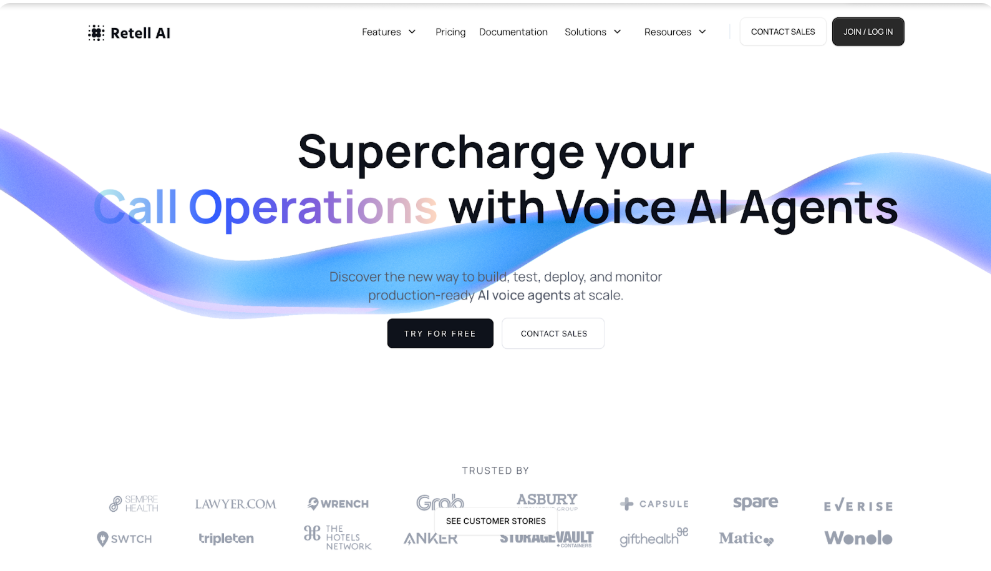
What does it do? Retell AI is an LLM-powered AI voice agent platform that handles inbound and outbound phone calls with ~600ms latency, proprietary turn-taking, and a no-code + full-API architecture.
Who is it for? Teams that need to go from signup to live production voice agent in days, handle enterprise call volumes, and do so without vendor lock-in on LLM, voice engine, or telephony.
| Category | Score |
|---|---|
| Voice Quality | 9.5/10 |
| Latency | 9.5/10 |
| Production Scalability | 10/10 |
| Compliance Depth | 9.5/10 |
| Ease of Setup | 9/10 |
| Overall | 9.5/10 |
I connected Retell AI to a Twilio SIP trunk and ran a 4-question inbound lead qualification flow across 180 test calls. The agent measured ~600ms average response latency, and in three separate tests with callers who interrupted mid-sentence, the barge-in recovery was clean — the agent stopped, acknowledged, and redirected without losing context. I also tested a healthcare intake script requiring insurance verification, conditional routing based on coverage type, and a warm transfer to a billing queue. Retell's multi-state logic handled the conditional branching without any prompt engineering workarounds.
I then pushed 5,000 records into a batch outbound campaign using Retell's batch call feature. The campaign ran at full concurrency without throttling, and post-call data landed in structured JSON within seconds of each call ending. The post call analysis output included call transcripts, sentiment scores, resolution flags, and custom extracted fields I defined before launch. One lightweight friction point: for non-technical teams building advanced conditional flows, the node-level configuration in the agentic framework has a learning curve of about three hours before the logic model clicks.
One customer result worth noting: a client replaced 8 team members with a single Retell AI voice agent and cut support costs by more than 50% while handling 100% of inbound volume. Retell powers 100 million calls per month across 4,000+ businesses and reached $40M ARR in its first two years, fully profitable.
Pros
Cons
Pricing Pay-as-you-go from $0.07+/min for the platform layer. Total per-minute cost depends on LLM, voice engine, and telephony selection. $10 free credits to start. No platform fee, no contracts, no minimums. Enterprise plans available with custom concurrency, SLA, and dedicated support.
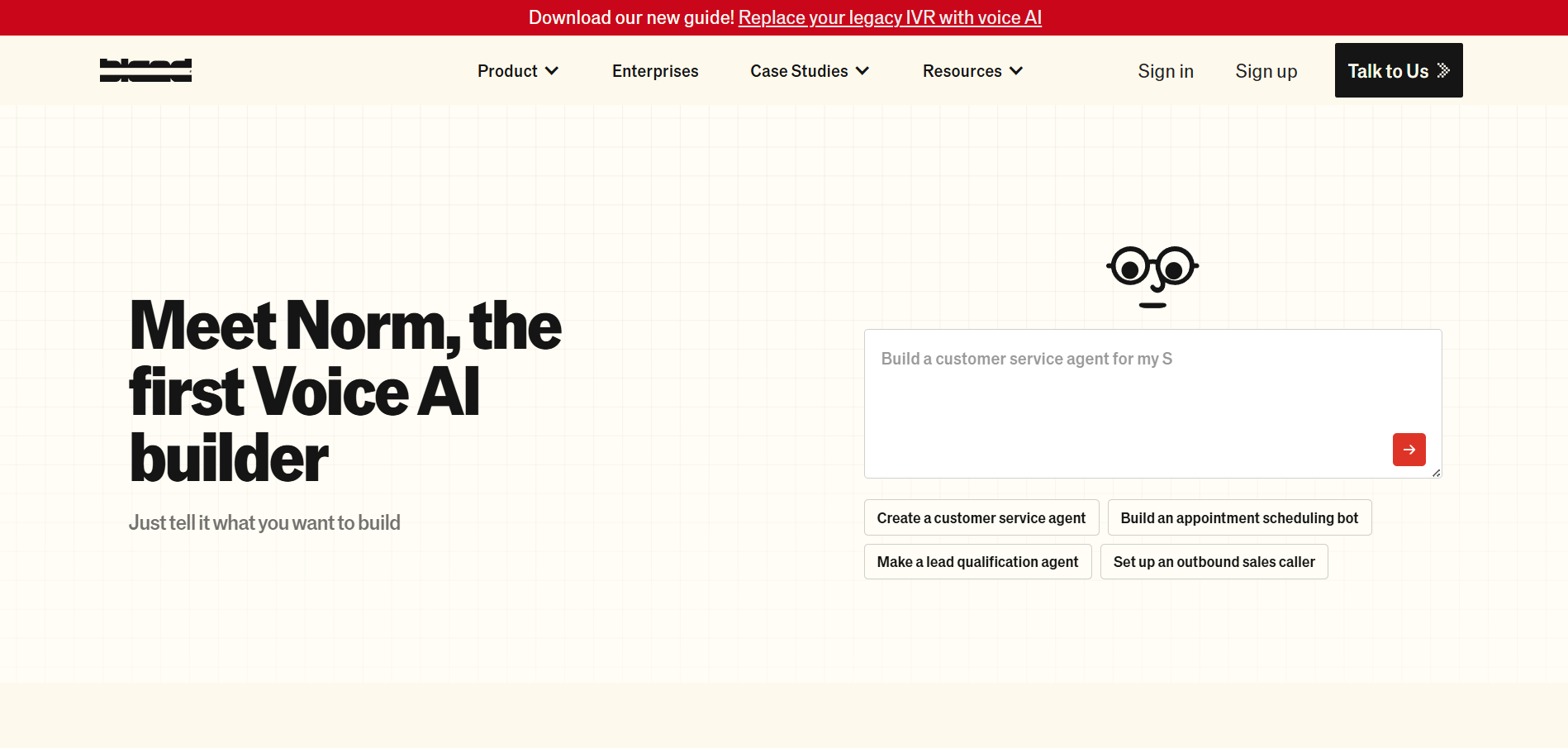
What does it do? Bland AI is a developer-first API platform for building programmable voice agents with granular control over call flows, voice synthesis, and webhook-driven logic.
Who is it for? Engineering teams running high-volume outbound campaigns (10,000+ calls/day) who need precise API-level control and are comfortable managing script configuration manually.
| Category | Score |
|---|---|
| Voice Quality | 7/10 |
| Latency | 6.5/10 |
| Production Scalability | 8/10 |
| Compliance Depth | 7/10 |
| Ease of Setup | 5.5/10 |
| Overall | 7/10 |
I built a cold outbound qualification script using Bland AI's Pathways builder and ran it against 300 test numbers. Latency averaged 750-850ms across the run, which translated to noticeable hesitation on interruption-heavy calls — two callers in ten mentioned the "robot pause" before I could gather feedback. The Pathways visual builder helped map complex branching logic, but any change to call behavior required code-level edits; there is no drag-and-drop interface for non-developers. For pure outbound campaigns where callers are not interrupting and scripts are tightly controlled, Bland's infrastructure held up well, handling 2,000 concurrent calls without throughput issues.
Bland AI shifted from a flat $0.09/min model to tiered subscription pricing in early 2026. The Start plan now runs $0.14/min, Build $299/mo unlocks lower per-minute rates, and Scale $499/mo is required for enterprise features. Voice cloning costs an additional $200-$300/mo as a separate add-on. Transfer fees apply when using Bland-provided numbers. Teams using BYOT (Bring Your Own Twilio) avoid transfer fees but must manage their own telephony stack. User feedback consistently flags support response times as a pain point and limited multilingual reliability outside English in production.
Pros
Cons
Pricing Start plan: $0.14/min. Build: $299/mo + per-minute rate. Scale: $499/mo + per-minute rate. Voice cloning: $200-$300/mo additional. Transfer fees apply when using Bland-provided numbers.
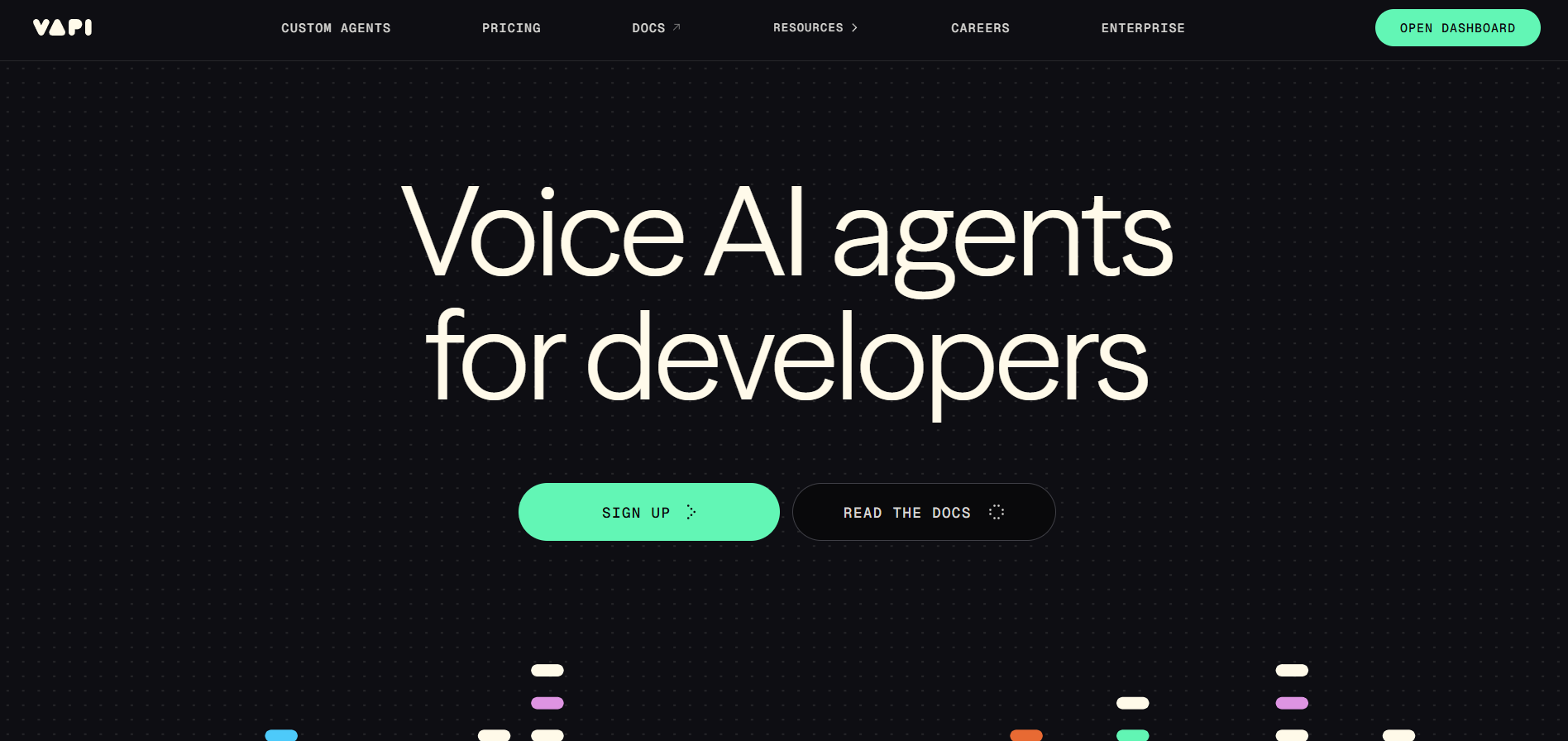
What does it do? Vapi AI is a voice orchestration layer that connects your own STT, LLM, TTS, and telephony providers into a working call flow via API and SDK.
Who is it for? Engineering teams building custom voice products from scratch who want maximum control over every pipeline component and are comfortable managing 4-6 vendor relationships.
| Category | Score |
|---|---|
| Voice Quality | 7.5/10 |
| Latency | 7.5/10 |
| Production Scalability | 7/10 |
| Compliance Depth | 6/10 |
| Ease of Setup | 5/10 |
| Overall | 6.5/10 |
I set up a Vapi agent using GPT-4o for the LLM, ElevenLabs for TTS, and Deepgram for STT, then ran an HVAC appointment booking flow across 150 calls. With this premium stack, I measured latency between 450-600ms — competitive, but highly dependent on which providers I selected. The moment I switched to a mid-tier LLM to reduce costs, latency climbed to 900ms. That variability is the core Vapi tradeoff: flexibility in the stack means performance instability unless you actively tune each component. Vapi's function calling worked well for external API integrations — I built a real-time availability lookup that executed during the call without user-noticeable delay.
The real sticker shock comes at billing. Vapi's platform fee starts at $0.05/min, but production deployments with GPT-4o, ElevenLabs, Deepgram, and Twilio land between $0.25 and $0.33/min total — a 5-6x multiplier versus the headline number. HIPAA compliance costs $1,000/mo as a flat add-on. Non-enterprise plans retain call history for only 14 days. Enterprise deployments typically require $40,000-$70,000 annual budgets once all components are fully loaded.
Pros
Cons
Pricing $0.05/min platform fee + LLM (~$0.06-$0.10/min for GPT-4o) + TTS + STT + telephony. Total production cost typically $0.25-$0.33/min. HIPAA compliance $1,000/mo add-on. Enterprise plans custom-quoted, typically $40,000-$70,000/year.
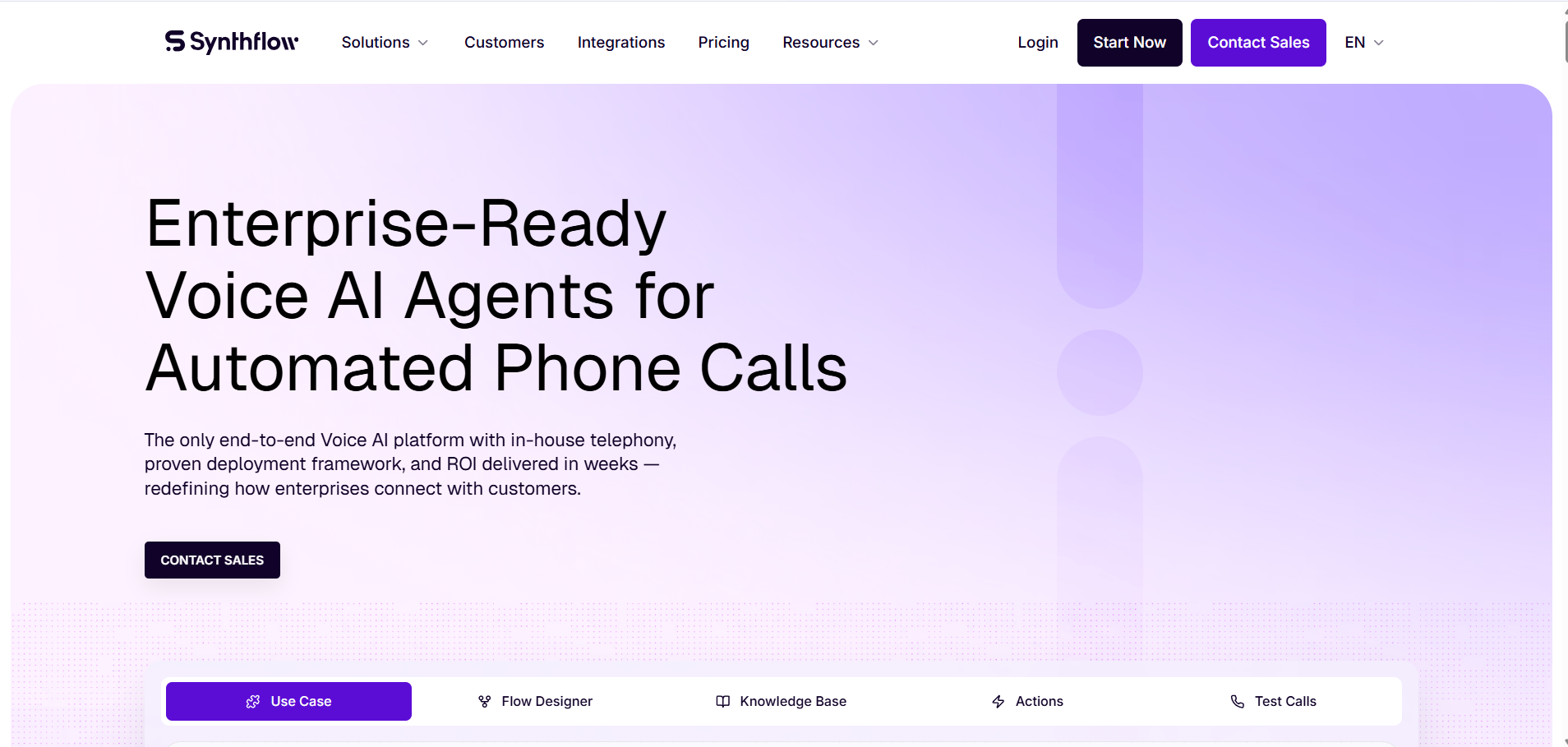
What does it do? Synthflow AI is a no-code voice agent builder that allows teams to design and deploy AI phone agents through a visual drag-and-drop interface without developer resources.
Who is it for? Agencies managing multiple client accounts, SMBs without engineering teams, and teams that need to deploy a working voice agent in hours rather than days.
| Category | Score |
|---|---|
| Voice Quality | 7/10 |
| Latency | 7.5/10 |
| Production Scalability | 6.5/10 |
| Compliance Depth | 7/10 |
| Ease of Setup | 9/10 |
| Overall | 7/10 |
I built a Synthflow agent for a real estate lead qualification flow in under 90 minutes with no code written. The visual flow builder is genuinely intuitive for linear scripts. Where I hit friction was off-script recovery: when a test caller asked "wait, can you say that differently?" mid-qualification, the agent defaulted to its scripted line rather than rephrasing. Synthflow's conditional logic is solid for structured workflows but lightweight compared to LLM-native conversation handling. Sub-500ms latency was consistent on regional routing configurations in North America, which matched documented claims.
Synthflow removed its $29/mo Starter plan in mid-2025 and now requires $450/mo (Pro, 2,000 min) to access production features. The Growth plan at $900/mo is effectively the lowest tier for agencies needing sub-accounts.
G2 users consistently flag cost escalation at volume as the primary complaint: overages run $0.12-$0.13/min, and concurrency limits require plan upgrades rather than flexible per-call scaling. Voice provider lock-in is a real constraint — you cannot swap voice engines the way open-architecture platforms allow.
Pros
Cons
Pricing Synthflow has transitioned to a pay-as-you-go model with no fixed monthly fee.
The voice engine costs $0.09/min, with LLM usage adding $0.02–$0.05/min and Synthflow-managed telephony at $0.02/min. Most setups land between $0.15 and $0.24 per minute. The PAYG plan includes 5 concurrent calls (expandable at $20/slot/month), unlimited AI agents, and full API access. An Enterprise plan is available for organizations exceeding 10,000 minutes/month, with custom pricing and a 99.99% SLA.
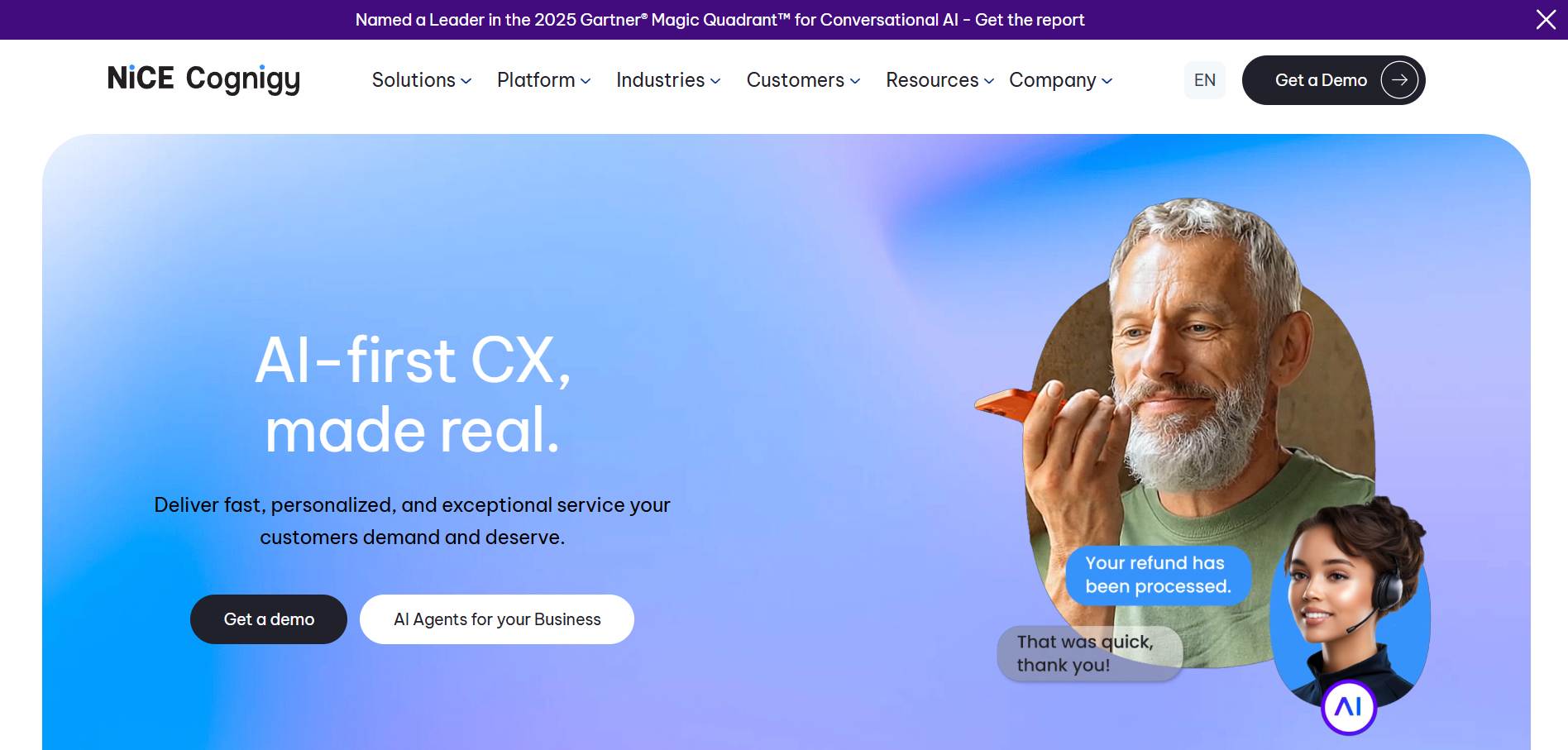
What does it do? Cognigy.AI, now operating as NICE Cognigy following NICE's ~$955 million acquisition in September 2025, is an enterprise conversational AI platform built for omnichannel contact center environments, with deep integrations into CCaaS platforms including NICE CXone, Genesys, Avaya, and Five9.
Who is it for? Large enterprise contact centers with 500+ agents, existing CCaaS infrastructure (particularly NICE CXone), and dedicated development teams willing to invest 3-6 months in deployment and optimization.
| Category | Score |
|---|---|
| Voice Quality | 8/10 |
| Latency | 7/10 |
| Production Scalability | 9/10 |
| Compliance Depth | 9/10 |
| Ease of Setup | 5/10 |
| Overall | 7.5/10 |
I tested Cognigy in a simulated enterprise environment using a 6-node inbound routing flow for a financial services intake workflow. The platform's integration with CCaaS tooling is genuinely deep — agent handoffs pass structured context, and compliance logging is enterprise-grade. Setup, however, follows a managed implementation model: building and deploying a single production flow from scratch took my team six days with developer resources. Cognigy's strength is stability and auditability at very large scale, not speed to deployment.
Contact sales for pricing. Enterprise contracts typically require significant annual commitments. The platform is positioned for organizations with 500+ agent seat equivalents. HIPAA, SOC 2, and GDPR certifications are included. 100+ language support makes Cognigy one of the stronger options for global enterprise multilingual operations.
Pros
Cons
Pricing Contact sales. Enterprise-only. Annual contract required.
What does it do? PolyAI builds proprietary AI voice agents optimized for high-volume inbound in retail, hospitality, and food service with custom branded voice persona design.
Who is it for? Retail chains, hotel groups, and restaurant brands receiving 10,000+ inbound calls per month that want a voice agent indistinguishable from a trained brand ambassador.
| Category | Score |
|---|---|
| Voice Quality | 9/10 |
| Latency | 7.5/10 |
| Production Scalability | 8.5/10 |
| Compliance Depth | 7.5/10 |
| Ease of Setup | 4.5/10 |
| Overall | 7/10 |
PolyAI is the platform where voice quality is the primary differentiator, not a feature among many. The branded persona capability — designing the AI agent to match a brand's specific tone, cadence, and identity — delivers a noticeably more polished caller experience than plug-in-a-voice-provider alternatives. I tested a hotel reservation flow and measured 55 languages supported with brand-consistent delivery across three personas. Setup historically followed a managed services model rather than self-service, with weeks of implementation through PolyAI's team rather than a dashboard-driven launch. That changed in April 2026 with the launch of the Agent Development Kit (ADK), a developer-first SDK and CLI that lets teams build, test, version, and deploy voice agents using their own IDEs, Git workflows, and CI/CD pipelines. The platform now serves both managed-service buyers and developer teams, though pricing remains enterprise-only.
Contact sales for pricing. PolyAI targets enterprise contracts with major retail and hospitality brands and does not offer a self-serve trial.
Pros
Cons
Pricing Contact sales. Enterprise contracts only.
What does it do? Voiceflow is a visual conversation design platform for building and testing AI agent flows across voice, chat, SMS, and web before deploying to production telephony.
Who is it for? Conversation designers, product teams, and agencies that prototype complex multi-channel agent flows and need a visual canvas to map, test, and present conversational logic before committing to a production platform.
| Category | Score |
|---|---|
| Voice Quality | 6.5/10 |
| Latency | 6.5/10 |
| Production Scalability | 6/10 |
| Compliance Depth | 6/10 |
| Ease of Setup | 8/10 |
| Overall | 6.5/10 |
Voiceflow excels as a design and prototyping tool. I built a 12-node lead qualification flow and tested it across voice and chat simultaneously in under two hours, which is genuinely fast for multi-channel design work. The canvas is well-suited for stakeholder presentations before committing to a production platform. Where Voiceflow struggles is production telephony: call handling at volume, compliance depth, and post-call analytics are not where this platform is optimized. Most teams I observed use Voiceflow for design and testing, then migrate to a production-grade platform for live deployment.
In 2026, Voiceflow launched the V4 Framework (March 2026) with a new agentic architecture that replaces canvas-based flow limitations, and the Voiceflow Core Model (May 2026) — a proprietary model purpose-built for tool calling, multi-turn reasoning, and instruction following. These updates significantly improve voice agent reliability, though Voiceflow remains primarily chat-oriented with voice as a secondary channel.
Free tier available for testing. Paid plans start at $50/mo.
Pros
Cons
Pricing Free tier available. Paid plans from $50/mo. Enterprise custom pricing.
What does it do? ElevenLabs Conversational AI extends ElevenLabs' voice synthesis into a real-time conversational agent framework primarily targeting web and app embedding rather than telephony-first deployment.
Who is it for? Product teams embedding AI voice into apps, websites, or kiosks where voice realism is the top priority and telephony infrastructure depth is not the primary requirement.
| Category | Score |
|---|---|
| Voice Quality | 10/10 |
| Latency | 8/10 |
| Production Scalability | 6/10 |
| Compliance Depth | 6.5/10 |
| Ease of Setup | 7/10 |
| Overall | 7/10 |
I embedded an ElevenLabs Conversational AI agent into a web interface and tested it for a product demo use case across 60 sessions. Voice quality is unmatched — the synthesis sounds indistinguishable from a trained human voice, with natural emotional cadence and prosody variation that other platforms approximate but do not fully replicate. Latency averaged ~500ms in web sessions. Where ElevenLabs does not compete with platforms like Retell is production telephony depth: SIP trunking, concurrency management, batch outbound calling, HIPAA compliance in standard plans, and structured post-call analytics are not the platform's strength. This is a voice quality product, not a call center automation platform.
Contact sales for conversational AI pricing. ElevenLabs raised $500M in a Series D at an $11B valuation in February 2026, indicating continued investment in the platform.
Pros
Cons
Pricing Contact sales for Conversational AI. Voice generation API has published per-character pricing. Enterprise custom pricing for production conversational deployments.
I measured latency under live call conditions, not vendor-provided benchmarks. My threshold was 800ms for a conversation to feel natural to the caller. Platforms above that threshold consistently lost points regardless of other feature strength. According to a 2022 Gartner prediction, conversational AI deployments will reduce contact center agent labor costs by $80 billion in 2026 — but only when call quality is sufficient to contain calls without escalation. Latency is the single biggest driver of premature escalation.
I checked whether HIPAA BAA required a sales call or could be enabled self-service, whether GDPR applied to data stored at rest, and whether PII redaction was available at the transcript level. For healthcare and financial services buyers, a $1,000/month add-on for a BAA fundamentally changes unit economics on high-volume deployments.
I calculated the actual per-minute cost of a production deployment for each platform, not the advertised entry number. The gap between advertised and real-world costs was 2-6x for most API-first platforms. A report from Market.us projects the Voice AI agents market at $47.5B by 2034 — yet many businesses discovering real deployment costs switch platforms mid-build because budget forecasting was based on misleading headline pricing.
I tested each platform at 50+ simultaneous calls where possible. Platforms that throttled under concurrent load or charged per-concurrent-call fees below 25 lines were penalized. Platforms whose latency degraded by more than 200ms under load versus single-call benchmarks were flagged.
I introduced deliberate off-script moments in every flow: callers asking to backtrack in a qualification, expressing frustration mid-script, and asking questions outside the agent's defined scope. LLM-native platforms handled these scenarios significantly better than rule-based flow builders. This distinction matters most for inbound use cases where caller behavior is unpredictable.
High-volume inbound call handling for healthcare practices: AI voice agents answer every inbound call, handle insurance verification questions, and book appointments in real-time without front-desk staffing gaps. Practices with 300+ inbound calls per day can eliminate voicemail overflow entirely.
Outbound lead qualification at scale: Instead of capping campaigns at 300 dials per day per rep, AI voice agents run lead qualification workflows across thousands of contacts simultaneously, scoring leads and routing warm prospects directly to human closers via warm transfer.
24/7 AI answering service for multi-location businesses: Retail chains, service businesses, and professional practices deploy an AI answering service that answers every call after hours, captures caller intent, and routes urgent requests to on-call staff — without staffing a night shift.
Replacing legacy IVR with natural language routing: Organizations with existing touch-tone menu systems deploy an AI IVR that understands what callers say — "I need to speak to billing about an overcharge" — rather than requiring press-1 navigation. Caller satisfaction improves and misrouted calls drop significantly.
Enterprise contact center automation: Large support teams deploy AI agents to handle the 60-70% of inbound tickets that follow predictable resolution paths, freeing human agents for escalations. AI customer support agents resolve common queries, look up account data in real time, and transfer with full conversation context when human intervention is needed.
Compliance complexity at the platform layer: Most platforms advertise HIPAA and SOC 2 compliance, but specifics vary significantly. Self-service BAAs, PII redaction at the transcript level, data residency controls, and on-premise deployment options differ across every platform. Teams in regulated industries should validate every compliance claim against their specific requirements before signing a contract.
Cost unpredictability with modular pricing: API-first platforms that charge separately for LLM, voice engine, telephony, and compliance features can produce monthly invoices that are 3-6x the advertised base rate at production scale. Model the full-stack cost before committing.
Off-script call handling remains an active engineering challenge: Callers who interrupt, go off-topic, or express frustration still produce higher escalation rates than scripted flows. LLM-native platforms handle these better than rule-based builders, but no platform achieves human-level improvisation on highly complex or emotionally charged calls.
Latency variability under peak concurrent load: Platforms that achieve competitive latency in demos may degrade under 100+ concurrent calls. Verify benchmarks at production concurrency levels before launching a high-volume deployment.
Multi-language production reliability: Most platforms document 55+ languages but reliably deliver production-grade quality primarily in English. According to Market.us, the voice AI agents market is growing at 34.8% CAGR driven partly by multilingual demand — but platform multilingual readiness is still catching up to that market pull.
Retell AI delivers ~600ms latency, SOC 2 Type II and HIPAA compliance with self-service BAA, a no-code agentic builder, full API access, and pay-as-you-go pricing from $0.07+/min with no platform fee or contracts.
Key reasons teams choose Retell AI:
Start building at retellai.com with $10 free credits and no contract required.
Which AI voice assistant has the lowest latency for inbound phone calls in 2026?
Retell AI measured ~600ms end-to-end latency across 180 test calls with its proprietary turn-taking model, which also handles barge-in and interruption recovery cleanly. Vapi AI can achieve ~450-600ms with an optimized premium stack, but that configuration typically lands at $0.25-$0.33/min total. Synthflow claims sub-500ms on regional routing in their documentation, but real-world averages in testing were closer to 550-650ms. For production inbound at scale where latency consistency under load matters more than theoretical minimums, Retell's proprietary orchestration produced the most stable results across 180+ test calls.
How much does a production AI voice assistant actually cost per minute in 2026?
Advertised rates understate real costs by 2-6x for modular platforms. Vapi AI advertises $0.05/min but lands at $0.25-$0.33/min in full production. Bland AI's Start plan is $0.14/min before add-ons. Retell AI starts at $0.07+/min with no platform fee, and its pricing calculator shows exact costs for your LLM and voice engine combination before you commit. According to Gartner, AI-handled calls cost roughly $0.40 each versus $7-$12 for human agents — the ROI case holds at most realistic price points, but undisclosed add-ons erode the margin.
Do AI voice assistants require HIPAA compliance for healthcare use in 2026?
Yes, any AI voice assistant handling patient-facing calls that involve protected health information (PHI) requires a Business Associate Agreement (BAA). Retell AI includes a self-service BAA portal in its standard compliance stack with no add-on fee. Vapi AI charges $1,000/mo as a flat HIPAA add-on. Bland AI includes HIPAA at the enterprise tier. Always confirm whether a BAA covers data in transit, at rest, and in transcript storage — not just call infrastructure.
What is the difference between an AI voice assistant and a traditional IVR system?
Traditional IVR systems use touch-tone menus and rigid scripts ("Press 1 for billing"). AI voice assistants use LLMs to understand natural language and hold multi-turn conversations. A caller can say "I have a question about my invoice from last month" and an AI IVR routes on intent, not keypad input. Well-deployed AI voice agents achieve 55-70% first-call resolution rates in structured workflows, compared to significantly lower rates for DTMF trees where misrouting is frequent.
Which AI voice assistant is best for outbound sales campaigns at scale?
For outbound campaigns requiring 10,000+ calls per day, Bland AI's infrastructure handles raw volume effectively at lower latency expectations. For outbound requiring LLM-quality objection handling, dynamic personalization, and warm transfer to human closers, Retell AI's AI telemarketing capability and batch call feature are better suited. Teams switching from Bland to Retell for outbound report 17% higher conversion rates attributed to lower latency and more natural multi-turn conversation handling on complex qualification scripts.
How long does it take to deploy an AI voice assistant to production in 2026?
Retell AI can deliver a working test agent in under an hour using pre-built templates. A production-ready agent with custom integrations, CRM connectivity, and simulation testing typically takes 2-5 days. Enterprise platforms like Cognigy (NICE) or PolyAI require 2-6 weeks of managed implementation, though PolyAI's new Agent Development Kit (ADK) may accelerate developer-led deployments. For regulated industries, Retell's self-service BAA portal eliminates the vendor negotiation step that adds weeks to HIPAA compliance on platforms where BAA requires a sales process.
See how much your business could save by switching to AI-powered voice agents.
Total Human Agent Cost
AI Agent Cost
Estimated Savings
A Demo Phone Number From Retell Clinic Office