8 Best Conversational AI Platforms for Ticket Deflection on Phone Calls in 2026
21
MIN READ
October 21, 2026
The best conversational AI platforms for ticket deflection on phone calls in 2026 are Retell AI, Bland AI, Vapi, Synthflow, PolyAI, NiCE Cognigy, Thoughtly and Telnyx Voice AI. We compared them on how they resolve support calls before a ticket is created, how they hand unresolved calls to your helpdesk, what they cost, and which compliance programs they cover.
Who this list is for. This list covers ticket deflection on phone calls. If most of your tickets start in chat or email, the AI built into your helpdesk, such as Zendesk AI or Intercom Fin, is the usual starting point. Voice deflection matters when a large share of contacts still arrive by phone, because a caller cannot be sent a help-center link; the agent has to resolve the issue in the conversation, or file the ticket for you.
| Platform | Best for | Free Trial/Credits |
|---|---|---|
| Retell AI | Best overall platform for voice-first ticket deflection at scale | $10 free credit, no card required |
| Bland AI | Best for developer teams building custom deflection workflows | Free tier (limited) |
| Vapi | Best for engineers who want full stack control over deflection agents | $10 free credits |
| Synthflow | Best no-code deflection builder for agencies and mid-market teams | 14-day trial on Pro+ |
| PolyAI | Best managed enterprise deflection for high-volume contact centers | No free trial |
| NiCE Cognigy | Best for omnichannel deflection across voice, chat, and messaging | Free trial available |
| Thoughtly | Best for small support teams launching deflection quickly | Free plan |
| Telnyx Voice AI | Best for telephony-native teams wanting integrated deflection | Pay-as-you-go |
Data from each vendor's pricing page and docs, checked October 2026.
Conversational AI for ticket deflection uses LLM-powered voice and chat agents to resolve customer support requests before they ever create a ticket in your queue. These agents listen to callers using speech-to-text, interpret the issue through a language model, retrieve answers from connected knowledge bases, and either resolve the request autonomously or route to a human with full context.
Deflection pays when a resolved call costs less than the ticket it replaces; the cost section below shows how to work that out for your own queue. Gartner predicts agentic AI will autonomously resolve 80% of common customer service issues by 2029, driving a 30% drop in operational costs. The platforms in this list handle the voice channel, where deflection is hardest and most valuable.
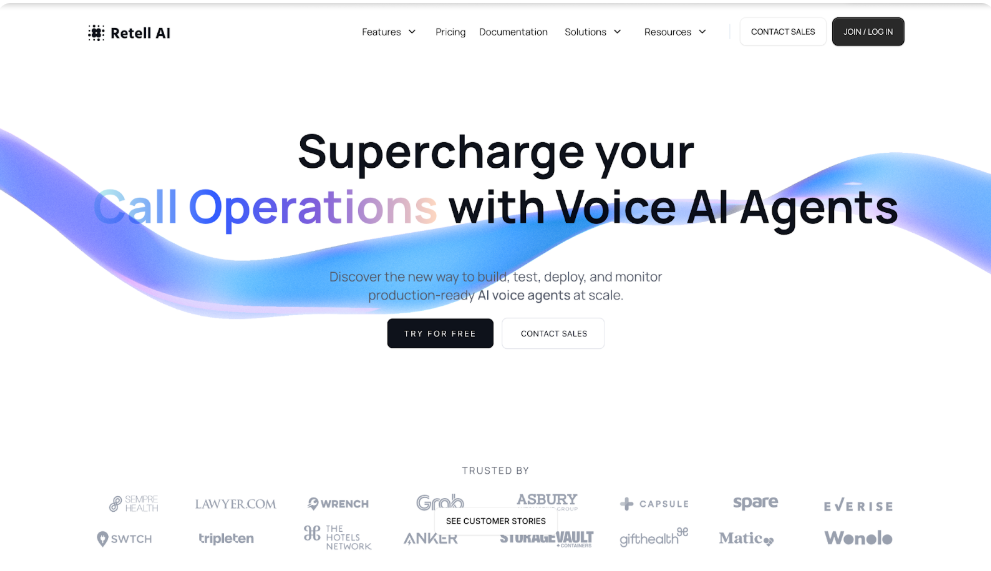
What does it do? Full-stack AI voice agent platform for building, deploying, and monitoring voice agents that resolve support calls before they reach a human queue.
Who is it for? Support operations leaders, contact center managers, and agencies who need production-grade deflection with both no-code and API access.
Retell AI is built to resolve a support call end to end and, when it cannot, to leave a usable record behind. You build the agent with a drag-and-drop flow builder or the API, connect a knowledge base that syncs from your help docs, and route calls in over any SIP trunk, including Twilio, Telnyx and Vonage.
When a caller needs a person, warm transfer plays a private summary to the human before the caller joins, so no one repeats themselves (call transfer). When no one is free, the agent can open a Zendesk ticket with a summary of the call. Every call produces a transcript, summary, sentiment score and any custom fields you define in post call analysis, so you can see which call types deflect and which need script work. One IT service desk customer contained 65% of internal tickets with Retell.
Pros
Cons
Pricing From $0.07 per minute, pay as you go, with $10 free credit. No platform fee or minimums. The rate depends on the LLM, voice and telephony you choose. Enterprise pricing available.
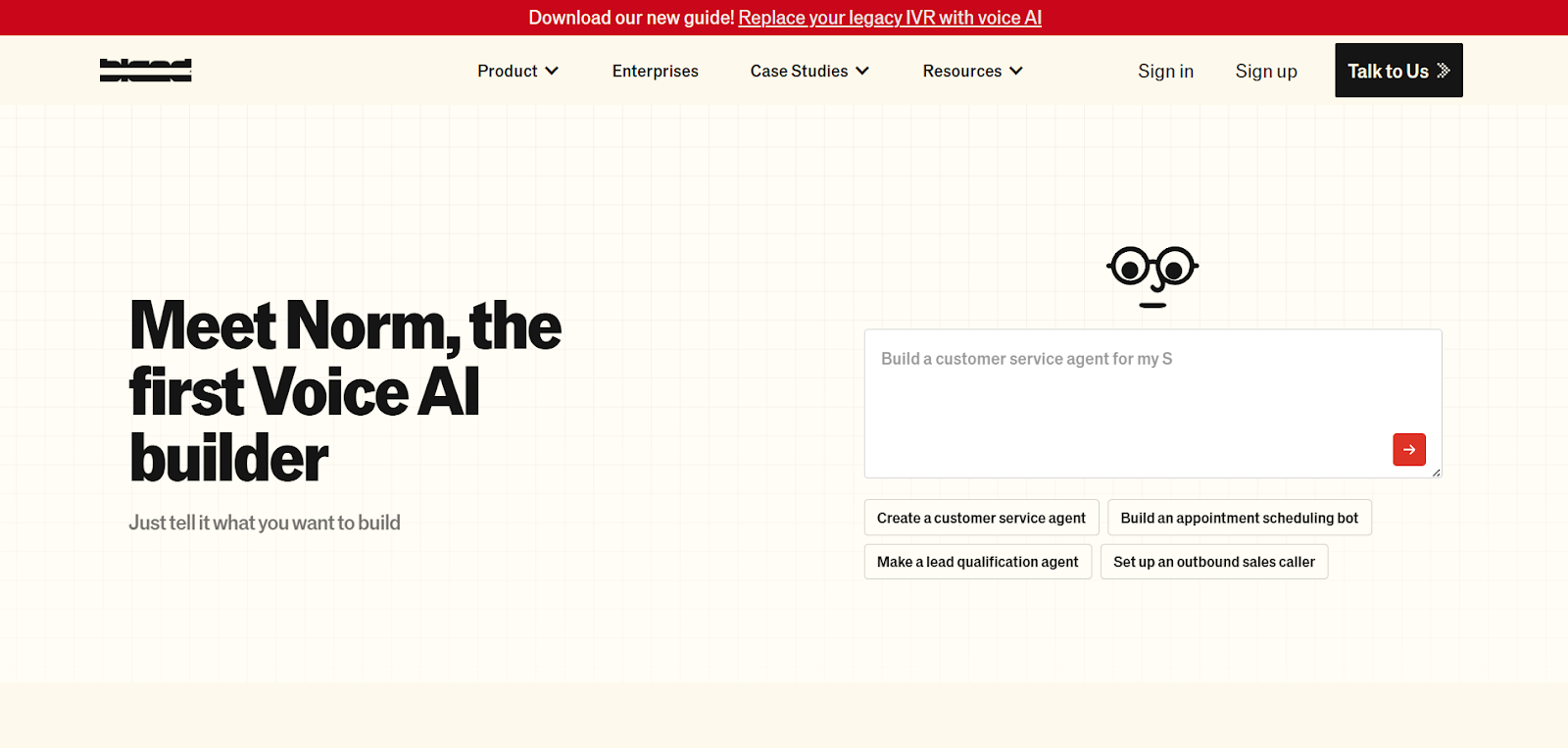
What does it do? Programmable voice AI platform for automating phone calls with full API control over deflection logic, routing, and call scripting.
Who is it for? Engineering teams who want webhook-level control over how support calls are triaged, deflected, and escalated.
Bland updated its pricing structure in December 2025. The free tier now charges $0.14/min, up from the widely advertised $0.09/min. Paid plans (Build at $299/mo, Scale at $499/mo) reduce rates to $0.12 and $0.11/min respectively. Transfer fees ($0.025/min) and failed-call minimums ($0.015 each) add up on support queues with moderate escalation rates.
Pros
Cons
Pricing $0.14/min on free Start tier. Build plan: $299/mo + $0.12/min. Scale plan: $499/mo + $0.11/min. Enterprise custom pricing available.
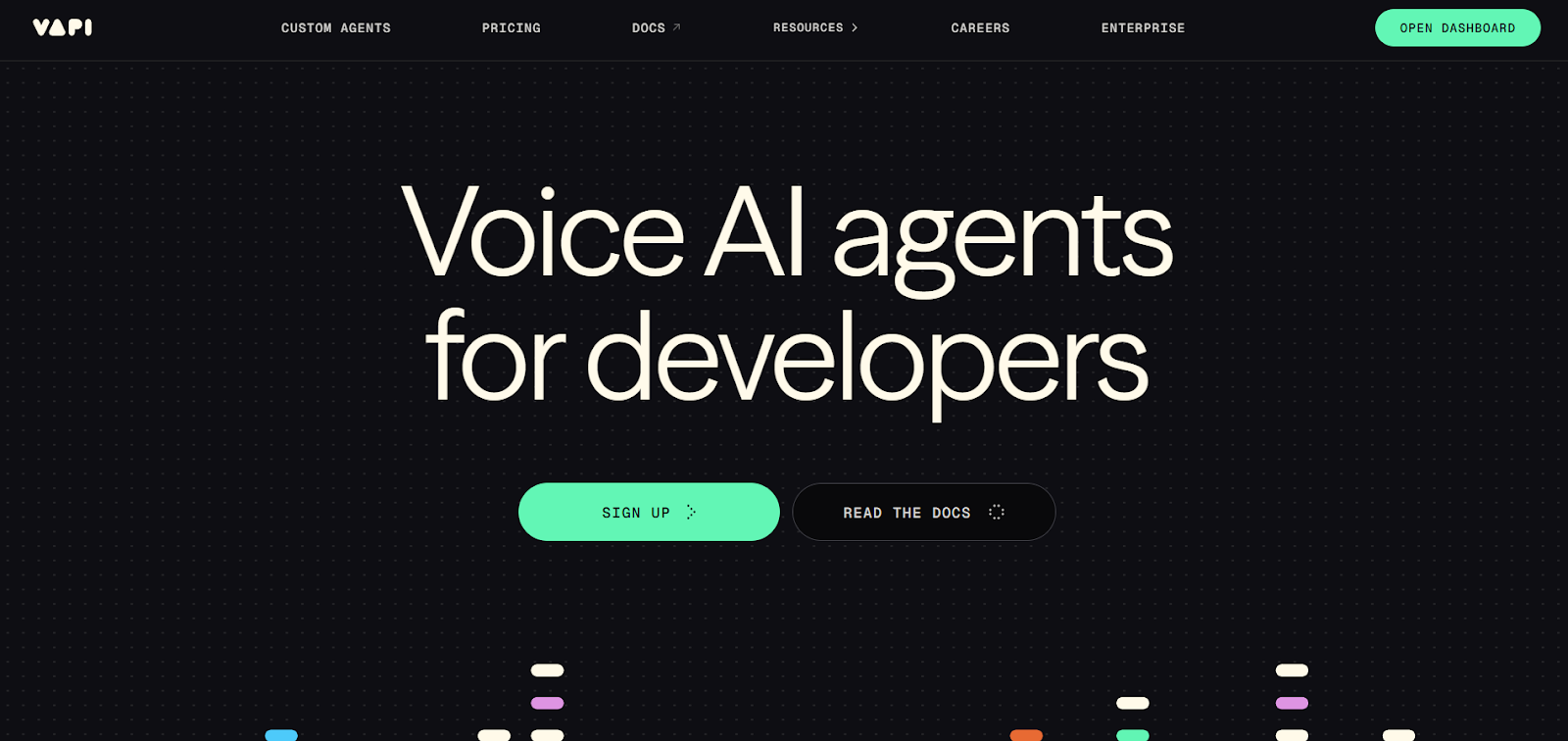
What does it do? Developer-first voice AI orchestration layer that connects STT, LLM, TTS, and telephony into working deflection workflows via API.
Who is it for? Engineering teams who want to choose every component in their deflection pipeline and control it programmatically.
Pros
Cons
Pricing $0.05 per minute platform fee. Vapi's pricing calculator shows a total of about $0.082 to $0.129 per minute once speech, model and telephony are added. Enterprise plans available.
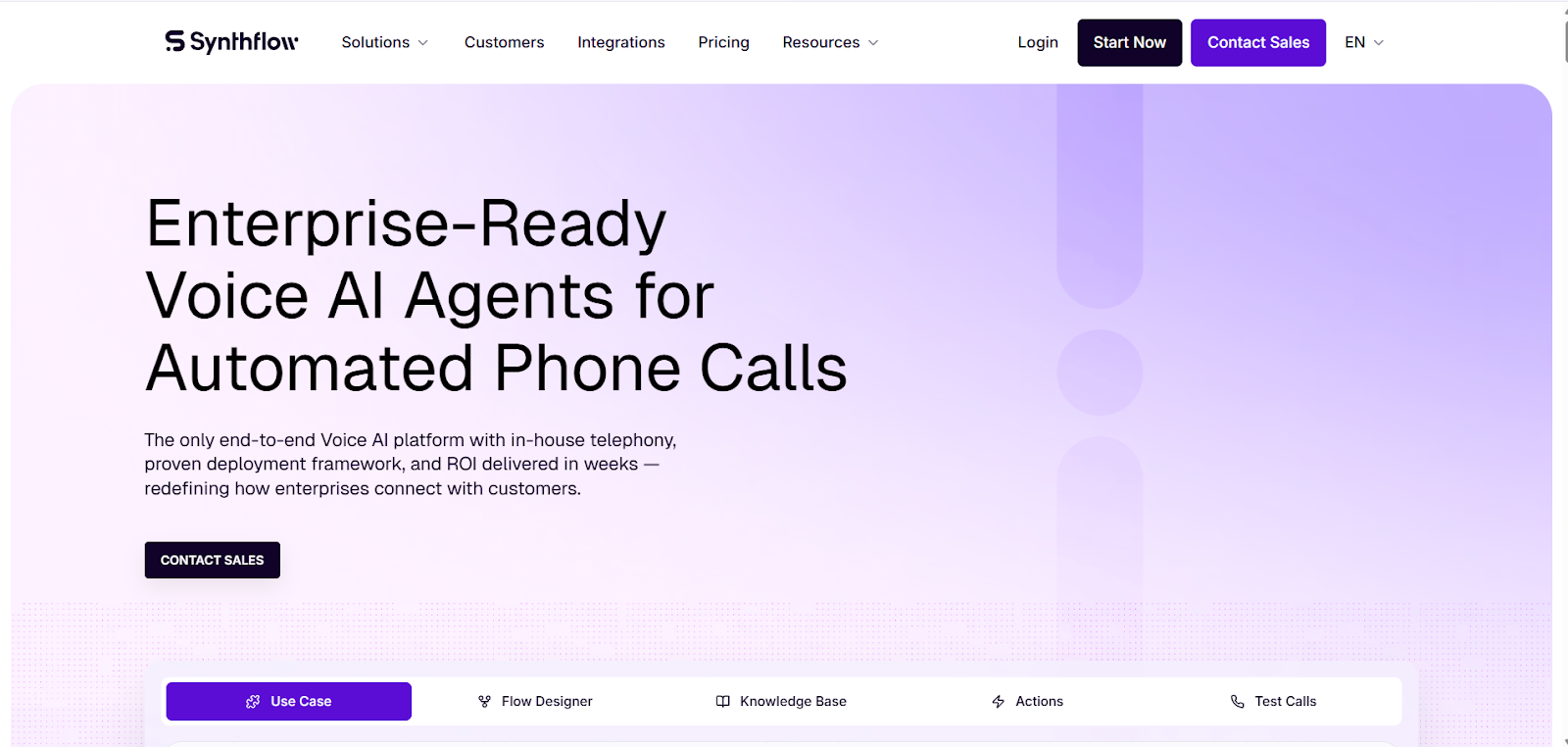
What does it do? No-code voice AI platform for building and deploying deflection agents through a visual interface with drag-and-drop conversation logic.
Who is it for? Support operations teams, agencies, and mid-market businesses who want to deploy deflection without engineering resources.
Synthflow removed its $29/month Starter plan after its June 2025 Series A round. The entry point is now the Pro plan at $450/month for 2,000 minutes. Overages run $0.12-$0.13/min. For teams processing under 2,000 support minutes monthly, the per-deflection cost is high.
Pros
Cons
Pricing Pro: $450/mo for 2,000 mins. Growth: $900/mo for 4,000 mins. Agency: $1,400/mo for 6,000 mins. Enterprise custom pricing from $0.08/min.
What does it do? Fully managed enterprise voice AI platform where PolyAI's team builds, integrates, deploys, and maintains deflection agents on your behalf.
Who is it for? Large enterprises in banking, insurance, hospitality, and healthcare that handle tens of thousands of inbound support calls daily.
PolyAI operates differently from every other platform on this list. You do not build the agent yourself. Their team designs your deflection logic, trains the NLU models, integrates with your CCaaS platform (Genesys, Five9, Cisco, Amazon Connect), and manages performance post-launch.
The barrier is cost and control. There is no self-serve option, no free trial, and no visual builder. Every change goes through PolyAI's team, which means iteration cycles are slower than self-serve platforms.
Pros
Cons
Pricing Custom enterprise pricing.
Cognigy is now NiCE Cognigy, part of NICE, which acquired it in September 2025.
What does it do? Enterprise conversational AI platform that deploys deflection agents across voice, chat, SMS, WhatsApp, and messaging channels from a single workflow.
Who is it for? Large contact centers running omnichannel support who need unified deflection logic across every channel.
Cognigy is priced for enterprise. The platform requires technical resources for setup and ongoing optimization, and the learning curve is steeper than no-code alternatives.
Pros
Cons
Pricing Custom enterprise pricing.
What does it do? No-code AI voice agent builder with drag-and-drop conversation flows designed for teams that want quick deployment without engineering overhead.
Who is it for? Small to mid-size support teams who need basic deflection running within hours, not weeks.
Thoughtly's SOC 2 and HIPAA compliance make it viable for regulated industries at a fraction of the enterprise competitors' cost. The free plan includes limited minutes, and paid tiers start at approximately $99/month.
Pros
Cons
Pricing Free plan available with limited minutes. Paid plans starting at approximately $99/month. Per-minute billing applies. Enterprise pricing available.
What does it do? Telecommunications platform with built-in voice AI capabilities that combine carrier-grade telephony with conversational AI for call deflection.
Who is it for? Teams already running telephony on Telnyx who want to add AI deflection without introducing a separate voice AI vendor.
Telnyx's per-minute AI pricing ($0.06-$0.08/min) is competitive, and existing Telnyx customers avoid the double-billing complexity of running separate telephony and AI vendors.
Pros
Cons
Pricing $0.06-$0.08/min for AI voice features on top of standard Telnyx telephony rates. Pay-as-you-go with no platform fee.
A voice agent that cannot resolve a call should leave a ticket behind, with the transcript attached, so your team never starts from zero. Deflection that drops unresolved callers into a queue with no record just moves the ticket to a worse channel.
Check three things in each vendor's docs. First, can the agent look up the caller in your helpdesk during the call, for example by phone number? Second, can it create or update a ticket with a subject, a summary and the transcript? Third, does a transfer to a live agent carry the same context?
Retell AI has native Zendesk tools: the agent can search for the caller by phone number, read their open tickets, create a ticket summarized from the conversation, or add a comment to an existing one (docs). After the call, the transcript, summary and custom fields are sent by webhook or API, and warm transfer briefs the human agent before the caller joins.
| Platform | Helpdesk ticketing | Transfer context |
|---|---|---|
| Retell AI | Native Zendesk tools: look up caller, create and update tickets; webhook and API for others | Whisper briefing on warm transfer |
| Bland AI | Webhooks and API | Not published in the docs we checked |
| Vapi | API, or Zendesk via Make, Zapier or Pipedream | Not published in the docs we checked |
| Synthflow | Native Zendesk Help Center sync into the knowledge base; tickets via Zapier or Make | Not published in the docs we checked |
| PolyAI | Through your CCaaS platform | SIP headers or Handoff API |
| NiCE Cognigy | Handover to Salesforce, Genesys, NiCE CXone and others | Transcript sent at handover (NiCE CXone) |
| Thoughtly | Not published in the docs we checked | Not published in the docs we checked |
| Telnyx Voice AI | API | Warm transfer with a private consult that delivers handoff context |
Sources: Retell, Synthflow, PolyAI, Cognigy, Telnyx. Vapi: no native Zendesk integration found in Vapi docs; third-party connectors exist.
Ticket deflection saves the difference between what a human-handled ticket costs you and what an AI-resolved call costs, multiplied by the number of calls the AI fully resolves. The benchmark most teams start from is MetricNet's: the average North American service desk cost per ticket was $15.56, with a range from $2.93 to $46.69 (BMC). By channel, MetricNet's 2021 data puts the North American range anywhere from $0.74 to $104.68 per ticket (ManageEngine, citing MetricNet).
To work out your own number:
What is a realistic call deflection rate? It depends on the mix of calls. Status checks, password resets and order tracking deflect well; billing disputes and multi-system troubleshooting rarely do. Gartner predicts agentic AI will resolve 80% of common customer service issues without a human by 2029 (Gartner). That is a forecast for common issues, not a rate to plan a mixed queue on. Count a call as deflected only when it ends resolved, with no transfer and no repeat contact within a few days.
I checked each platform's docs for real-time function calling (account lookups, order status), knowledge base sync, and how it handles a caller who changes topic mid-call.
A deflection platform that escalates poorly is worse than no deflection at all. I checked whether each platform passes full conversation context (transcript, intent, caller sentiment) to the human agent on escalation. Gartner's 2025 research emphasizes that agentic AI's value in customer service depends on its ability to act autonomously on complete tasks, and that includes knowing when to hand off gracefully.
I looked at the true cost per deflected ticket, not just the per-minute rate. I factored in platform fees, model costs, transfer charges, and the average 5-7 minute support call duration.
Deflection accuracy depends on how well the agent accesses your support documentation in real time. I checked each platform's ability to retrieve answers from large knowledge bases, sync updated content automatically, and handle questions that span multiple articles. The best platforms use streaming RAG to pull current information mid-call without latency spikes.
Support teams in healthcare, financial services, and insurance cannot deploy deflection without HIPAA, SOC 2, and PCI compliance. I verified each platform's certifications, BAA availability, PII redaction capabilities, and data residency options. With the AI customer service market projected to reach $47.82 billion by 2030 according to industry forecasts, compliance readiness is a prerequisite for enterprise adoption.
Account status and balance inquiries: Usually the highest-deflection ticket category. AI agents connect to account systems via function calling, verify identity, and read back status, balance, or recent activity.
Order tracking and shipping status: Callers asking "where's my order?" represent 15-25% of typical e-commerce support volume. Agents pull tracking data from fulfillment APIs mid-call and deliver updates conversationally, with no wait time or queue.
Password resets and account access: This is the ticket category most support leaders automate first because the workflow is predictable: verify identity, trigger reset, confirm delivery. Platforms with real-time function calling can handle the entire flow in under 90 seconds, and the AI answering service model works particularly well for after-hours access requests.
Appointment scheduling and rescheduling: Healthcare, home services, and financial advisory support teams spend significant agent time on calendar management. AI agents that book appointments through calendar APIs deflect these entirely, reducing no-shows through automated confirmation and reminder flows.
Billing questions and payment status: Callers asking about charges, due dates, or payment confirmation follow predictable patterns that AI handles well. For financial services teams, the key requirement is PII redaction and SOC 2 compliance during these interactions.
Basic troubleshooting and FAQ: Product-specific how-to questions are deflectable when the agent has access to a well-maintained knowledge base. The critical differentiator is streaming RAG quality: platforms that retrieve relevant documentation in real time deflect significantly more than those that rely on static FAQ lists.
Complex multi-step troubleshooting still requires humans: When resolution requires screen sharing, remote access, or diagnostic steps that span multiple systems, AI agents hit their ceiling.
Knowledge base quality directly caps deflection rate: Every platform's accuracy depends on the documentation it can access. Teams with outdated, incomplete, or poorly structured knowledge bases will see lower deflection rates regardless of which platform they choose.
Caller trust remains a variable: Some callers hang up when they realize they are speaking with AI, particularly in industries like healthcare and finance where empathy and trust carry extra weight. Deflection rates in the most sensitive industries may trail behind retail or e-commerce.
Integration depth varies by helpdesk stack: Not every platform integrates natively with every ticketing system. Teams running Salesforce, ServiceNow, or Zendesk should verify connector depth before committing, as shallow integrations mean the deflection agent cannot access the data it needs.
Regulatory overhead adds deployment time: For healthcare teams needing HIPAA BAAs, financial teams needing PCI compliance, or global teams needing GDPR data residency, the compliance review alone can add 2-6 weeks to deployment timelines.
Retell AI is built for support teams that take a large share of contacts by phone and want unresolved calls to land in the helpdesk with full context.
Start building your deflection agent at retellai.com.
For tickets that start as phone calls, the top AI tools are Retell AI, Bland AI, Vapi, Synthflow, PolyAI, NiCE Cognigy, Thoughtly and Telnyx Voice AI. For tickets that start in chat or email, teams usually begin with the AI inside their helpdesk, such as Zendesk AI or Intercom Fin. The best choice depends on where your tickets come from and whether the tool can create or update a helpdesk ticket when it cannot resolve the issue.
Yes, if the platform has a Zendesk integration. Retell AI's native Zendesk tools let the agent find the caller by phone number, read their open tickets, and create a ticket or add a comment with a summary of the call. Other platforms in this list connect through an API, webhooks or tools like Zapier and Make.
Savings equal your cost per ticket minus the cost of an AI-handled call, times the number of calls the AI fully resolves. MetricNet's North American average cost per ticket is $15.56 (BMC); plug in your own cost and resolution rate using the steps in the cost section above.
Retell AI and PolyAI both offer HIPAA compliance with BAA for healthcare deployments. Retell AI provides a self-service BAA portal and PII redaction controls that let teams in healthcare go live faster without waiting for contract negotiation. PolyAI offers PCI DSS on top of HIPAA.
It depends on the mix. Routine status, reset and tracking calls deflect at high rates; disputes and multi-step troubleshooting rarely do. Measure deflection per call type for 30 days before setting a target for the whole queue. Platforms that also handle lead qualification on the same infrastructure can deflect and qualify simultaneously on blended queues.
Voice deflection handles the callers who chose the phone because their issue felt too complex for self-service chat. These tend to be higher-value interactions. While text chatbots can deflect 40-60% of written inquiries, voice platforms that handle natural conversation, interruptions, and topic switches capture a segment that text channels miss entirely. The AI IVR approach replaces rigid phone menus with natural conversation that resolves instead of just routes.
Yes. Platforms like Retell AI connect to your existing telephony via SIP trunking, meaning you keep your current carrier (Twilio, Vonage, Telnyx, or your own) and route specific call traffic to the AI agent. There is no rip-and-replace. You can start with a subset of your support volume and expand as deflection rates prove out.
The best platforms perform a warm transfer to a human agent with the full conversation transcript, detected intent, and caller sentiment attached. This means the human agent picks up with complete context and the caller never repeats their issue. Retell AI can also file the issue as a Zendesk ticket with a call summary, so nothing is lost if no one is free to take the transfer.
See how much your business could save by switching to AI-powered voice agents.
Total Human Agent Cost
AI Agent Cost
Estimated Savings
A Demo Phone Number From Retell Clinic Office