7 Best Voice AI Agents for Banking in 2026
15
MIN READ
October 12, 2026

Search results for AI voice agents in banking show a crowded category. Dozens of vendors position similar offerings around conversational IVR, virtual assistants, and automated voice systems, often using overlapping terminology that makes functional differences difficult to identify during early evaluation.
Across real deployments, gaps typically emerge only after rollout. Common limitations include inconsistent call behavior under concurrent usage, restricted control over live conversation logic, integration friction with core systems, and pricing models that become harder to forecast as call volume increases. These issues tend to surface in production environments rather than controlled trials.
I structured this analysis to reflect how platforms behave once deployed in regulated, high-volume settings. This review focuses on platforms evaluated in live, production business environments rather than demos, gated videos, or marketing claims.
An AI voice agent for banking platform is software that enables financial institutions to automate phone-based conversations using speech recognition, language understanding, and voice synthesis, directly answering what is an AI voice agent for banking platform in operational terms.
Compared with simpler automation tools, AI voice agent platforms support open-ended spoken interactions rather than triggering predefined responses based on keypad input or keyword matching. Simpler tools typically execute narrow flows, while voice agents interpret intent dynamically across multiple conversational paths.
When compared with legacy telephony systems, these platforms do not rely on fixed IVR trees or tightly coupled infrastructure. Instead, they operate as software layers that connect telephony with backend banking systems. The interaction model, system design, and deployment context differ materially from traditional call routing solutions.
These platforms are commonly used for authentication flows, balance inquiries, payment reminders, service routing, and proactive notifications. They are not designed to replace complex advisory conversations, discretionary decision-making, or full human-led banking relationships. This framing anchors the AI voice agent for banking platform definition.
I evaluated platforms using criteria that reflect behavior in regulated, production banking environments rather than feature claims. Functional quality under real usage was reviewed based on documented consistency across everyday call flows.
Stability at scale was assessed using commonly reported behavior under concurrency, including failure handling and recovery patterns. Infrastructure depth was reviewed by examining published system architecture, APIs, and extensibility controls that affect long-term operation.
Integration realism focused on how platforms connect with existing banking systems and whether data flows are practical in daily use. Pricing transparency and clarity were reviewed to understand how easily costs can be modeled as call volume grows.
Based on documented implementations and commonly reported across deployments, third-party feedback patterns were used to identify recurring strengths and operational constraints. Evidence sources included public documentation, aggregate review platforms, and reported production deployments.
The table below summarizes the best AI voice agents for banking platforms evaluated in this guide, providing a comparative view of how each is positioned in regulated financial environments.
| Platform | Rating | Best for | Why it made the list | Pricing |
|---|---|---|---|---|
| Retell AI | 4.7/5 | Production voice automation & enterprise voice workflows | Transparent usage pricing with telephony and modular voice/LLM costs shown in live deployments; strong real-world adoption | $0.07 – $0.08/min voice + $0.015/min telephony + LLM costs ~$0.006 – $0.06/min |
| PolyAI | ~4.5/5 | Enterprise conversational voice quality | Natural, multilingual voice agents for large contact centers; documented real enterprise use | Custom / quote-based; often starts ~$150,000/year |
| Cognigy | ~4.5/5 | Complex enterprise orchestration | Deep integration with CRM/ERP, governance, and compliance at scale | Custom / quote-based |
| Parloa | ~4.6/5 | Regulated enterprise voice automation | Rich dialogue context, CRM/ERP access, compliant deployments | Custom / quote-based (enterprise) |
| Vapi | ~4.4/5 | Developer-led voice infrastructure | API-first platform for custom voice agents and telephony orchestration | ~$0.05/min+ usage-based (public usage map points to low per-minute models) |
| SquadStack | ~4.4/5 | High-volume outbound sales & qualification | Managed execution for sustained outbound programs | Custom / contract-based |
The platforms in this section are listed based on operational fit in real business environments, not market visibility or feature volume. I focused on how these systems behave once deployed, including reliability, integration effort, and cost behavior at scale. Inclusion reflects documented real-world usage patterns rather than checklist comparisons, with strengths and limitations presented to support accurate decision-making. The platforms below are presented based on documented usage patterns, deployment readiness, and operational fit rather than marketing claims or surface-level feature breadth.
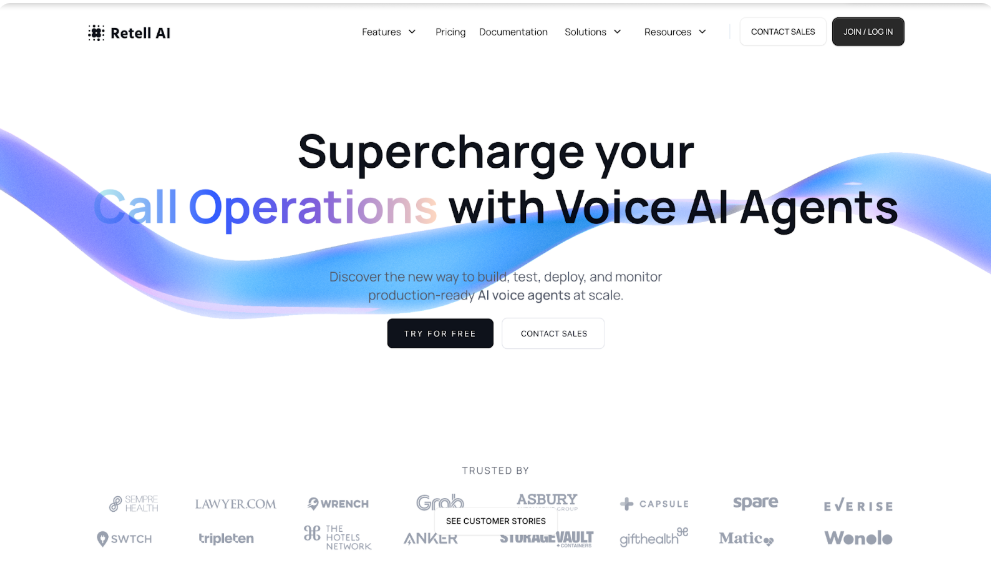
Retell AI is built specifically for deploying AI voice agents that operate on live phone calls in production environments. The platform is designed to support outbound and inbound calling workflows where call behavior, latency, and integration reliability matter more than prebuilt scripts. It is most commonly used by SMBs, developer-led teams, and technical operations groups that require programmatic control over conversation logic, telephony routing, and backend integrations. Retell AI functions as a voice-first system rather than a bundled contact center suite, allowing teams to embed AI voice agents directly into operational phone workflows without adopting a full omnichannel stack.
Based on documented deployments and aggregate user feedback, Retell AI is commonly reported as stable during live outbound calling, including multi-turn qualification and follow-up workflows. Observed patterns suggest low conversational latency and predictable call flow behavior when properly configured. Implementation typically involves upfront setup of call logic, fallback handling, and integrations, which introduces initial friction but improves control in production environments.
Teams running phone-centric outbound workflows such as lead qualification, follow-ups, reminders, or appointment setting, especially where usage-based pricing and programmable call behavior are operational requirements.
Organizations seeking a fully managed, no-code solution or teams without engineering resources to configure and maintain call logic.
Retell AI uses a usage-based pricing model with no platform license fees. Public pricing lists core AI voice usage at approximately $0.07–$0.08 per minute, telephony at around $0.015 per minute, and phone numbers at roughly $2 per month. Costs scale linearly with call volume rather than user seats.
G2 rating: ~4.7 / 5
Aggregate reviews consistently reference production reliability, pricing transparency, and flexibility in configuring call logic. One user notes that Retell AI performs reliably in live outbound campaigns once workflows are properly configured, though initial setup requires technical effort.
PolyAI builds voice-first conversational agents intended for enterprise-grade customer interactions across voice channels. The platform is designed to run multilingual, natural-language phone agents that maintain conversational context and handoffs; typical deployments are in banking, hospitality, and healthcare contact centers where brand-safe conversational quality and low latency matter. Primary users are large enterprises and contact-center operators that require managed onboarding, language coverage, and operational support rather than a self-serve developer stack. PolyAI’s product emphasizes conversational fidelity, turn-taking, and multilingual support over campaign or dialer tooling.
Public case studies and third-party reviews report fast-to-stable go-lives for large deployments when professional services and controlled QA are used; sample claims show high E2E handle-rates in specific vertical pilots. Observed patterns emphasize a structured rollout (simulation → staged live → scale) with PolyAI handling conversational fidelity while integrators manage dialer orchestration and CRM wiring.
Enterprises prioritizing customer-experience fidelity, multilingual support, and brand-safe automated voice interactions (e.g., banks, airlines, hotels) where managed onboarding and quality assurance are acceptable trade-offs for conversational realism.
Small teams seeking quick, low-cost pilots or heavy campaign/dialer features; buyers who need transparent per-minute pricing for predictable SMB budgeting.
PolyAI publishes per-minute commercial models only via vendor engagement; site language indicates per-minute billing that includes ongoing improvements and support but does not list public rates. Prospective buyers must request quotes for exact cost modeling and enterprise SLAs.
G2 rating: ~4.5–4.7 / 5. Reviews praise voice quality and production reliability; common feedback notes pricing opacity and longer implementation cycles. One G2 reviewer reported rapid deflection of routine calls after deployment.
Cognigy (often referenced as NiCE Cognigy) is an enterprise conversational-automation platform that supports voice and digital channels with a low-code flow builder and extensive connector library. It’s built to orchestrate complex, multi-step workflows and integrate deeply with CRM, ERP, and CCaaS systems — a common choice for regulated industries and large contact centers that need governance, auditability, and multi-channel orchestration. Primary users include enterprises and large SMBs with dedicated automation or IT teams; Cognigy emphasizes extensibility and governance over turnkey voice-only solutions.
Documentation and user feedback show Cognigy is highly configurable but requires careful orchestration design and staging. Observed deployment patterns follow sandbox → staged rollout → full production, with monitoring and governance added for regulated environments. Implementation timelines vary by scope; common reports cite longer initial setup but stable operation once governance and connectors are established.
Enterprises or large SMBs that require multi-channel orchestration, strict governance, and deep integration to run conversational automation at scale — for example, banks, insurers, and utilities with complex backend systems.
Teams seeking a simple, low-cost voice agent or rapid pilot without developer support; smaller teams needing transparent starter pricing and out-of-box dialing/campaign tooling.
Cognigy uses a custom, quote-based pricing model; buyers report enterprise contracts structured by deployment scope, channels, and connector usage. Pricing transparency is limited for SMBs, so cost modeling requires vendor engagement and careful scoping of integrations.
G2 rating: ~4.5–4.6 / 5. Review patterns praise extensibility and enterprise suitability; common criticisms reference setup complexity and the need for developer involvement. One G2 reviewer called out Cognigy as “powerful but requiring disciplined implementation.”
Parloa is an enterprise-focused AI voice platform designed to automate complex customer conversations across outbound and inbound contact center environments. The platform is built to support large-scale voice operations where contextual dialogue, governance, and integration with enterprise systems are mandatory. Parloa is most commonly used by banks, insurers, and large service organizations that run regulated, high-volume voice interactions and require strict controls around data access, compliance, and deployment stability. Rather than operating as a lightweight campaign tool, Parloa functions as conversational infrastructure that integrates deeply with CRM, ERP, and contact center platforms, with deployments typically managed through structured implementation projects.
Based on documented deployments and third-party reviews, Parloa is commonly reported as stable once fully configured. Observed patterns suggest that its simulation and testing layers reduce runtime surprises in production. Implementation typically involves staged rollouts and professional services, which increases setup time but improves predictability in regulated environments. Reported issues tend to relate to integration complexity rather than call reliability or latency during live operation.
Enterprises or large SMBs running regulated, high-volume voice workflows that require deep system integration, compliance enforcement, and controlled conversational behavior in production.
Smaller teams seeking transparent pricing, fast deployment, or no-code experimentation for outbound voice automation.
Parloa operates on a custom, quote-based pricing model. Public pricing is not disclosed. Industry disclosures and buyer reports commonly reference high six-figure annual contracts, depending on deployment scope, integrations, and support requirements. Costs scale with usage, environments, and compliance needs rather than seat count.
G2 rating: ~4.6 / 5
Aggregate reviews consistently highlight conversational quality, integration depth, and production reliability. A commonly reported limitation is the time and cost required to implement Parloa fully, particularly for organizations without existing enterprise infrastructure.
Vapi is a developer-first voice-AI infrastructure platform that exposes APIs and SDKs to build, orchestrate, and operate realtime voice agents. The product is positioned as a low-level layer for teams that want programmatic control over telephony, speech models, and call flows rather than a packaged campaign manager. Typical users are engineering teams, startups and product teams that embed voice agents into existing dialers, CRMs, and backend services. Vapi aims to provide model choice, fine-grained orchestration primitives, and production scalability for custom outbound and inbound voice agents.
Public reviews and hands-on writeups describe Vapi as straightforward for teams that build voice infrastructure. Initial setup focuses on telephony routing, concurrency safeguards, and retry logic. Observed patterns recommend staged rollouts (sandbox → pilot → scale) and close monitoring of telephony carriers and retry behavior to avoid throttling or increased drop rates. Implementation is front-loaded but yields high flexibility once wiring and monitoring are in place.
Vapi documents usage-based pricing tied to per-minute voice usage and optional concurrency features. Buyers should model costs based on minute volumes, carrier fees, and model-processing charges. Public starter rates and exact line items require vendor documentation during procurement.
G2 rating: ~4.4 / 5
Reviews highlight API flexibility and developer ergonomics. Common feedback requests better UI tooling and packaged campaign features. Example user note: “Easy integration, needs UI improvements.”
SquadStack is a voice-centric sales execution and outbound operations platform that combines AI voice agents with managed operational support. It targets organizations running sustained outbound programs — sales, collections, or re-engagement — where execution, contact-rate optimization, and human handoffs matter. The platform typically ships as a managed or outcome-oriented service (campaign setup plus operations), with native CRM integrations and reporting. SquadStack is most visible in fast-scaling SMBs and high-volume sales teams that prioritize conversion and operational throughput over low-level conversational programmability.
Documented deployments emphasize process design — campaign setup, data feeds, compliance checks, and human handoff rules. Observed patterns show SquadStack performs best when campaign design and sales operations are mature. Pilot phases often involve operational co-design and close tracking of contact-rate KPIs. Implementation time depends more on data hygiene and CRM mapping than on core voice model configuration.
SquadStack uses custom pricing based on campaign scope, call volume, and managed services. Public rate cards are not published. Prospective buyers must request proposals to model cost per lead or contact.
G2 rating: ~4.4 / 5
Reviews commonly praise execution quality and lead conversion outcomes. Criticisms focus on pricing opacity and limited technical configurability.
When I evaluate a voice AI agent for banking, I start with risk and integration, not the demo.
In banking, the tools that perform best are the ones that connect cleanly to core banking systems, CRMs, KYC tools, fraud engines, and telephony infrastructure without creating compliance headaches.
Use this as a quick filter:
Start with the primary banking use case.
Are you solving call center overflow, balance inquiries, loan qualification, collections, fraud alerts, or branch automation? Voice AI agents built for regulated financial workflows consistently outperform generic “horizontal” voice bots.
Check integration depth, not just API availability.
Look at how the platform connects to your core banking system, CRM, authentication layer, and transaction databases. Can it securely fetch balances? Trigger workflows? Log interactions for audit? Shallow integrations become operational risk quickly.
Match the agent to your internal ownership model.
Some platforms require developers to manage call flows and backend logic. Others offer configurable flows that operations teams can maintain. In banking, you typically need both — engineering oversight plus operations control.
Review compliance and governance before testing voice quality.
Audit logs, encryption standards, role-based access, consent recording, PII masking, data residency, and SOC 2 or ISO certifications are non-negotiable in finance. AI accuracy matters, but regulatory posture matters more.
Model pricing against real call volume.
Voice AI pricing often looks inexpensive at pilot stage. Once you scale to thousands of daily balance checks or collections calls, telephony minutes, AI processing, and verification costs compound fast. Model peak season volume, not average weeks.
The right voice AI agent for banking fits your compliance framework, your core systems, and your operational model — even if another vendor’s demo sounds more human.
When you choose a voice AI platform in financial services, focus less on conversational flair and more on security, auditability, and system alignment.
Treat this list as a starting shortlist. Run a tightly scoped pilot — for example, balance inquiries or branch hours — plug it into real backend systems, and observe how it performs under live authentication and transaction conditions.
The best banking voice AI is the one customers barely notice because their issue is resolved securely, quickly, and without escalation.
You’ve got this.
Voice AI agents in banking are automated systems that handle customer conversations over the phone using speech recognition, natural language understanding, and backend integrations. They can check balances, process payments, route fraud alerts, schedule appointments, and escalate complex cases to human agents while maintaining compliance standards.
Yes, when implemented correctly. Enterprise-grade platforms use encrypted data transmission, secure authentication layers, audit logs, and PII masking. However, security depends heavily on integration design, access control, and governance policies within the bank.
Not fully. Voice AI works best for high-volume, repetitive interactions like balance checks, payment reminders, and simple service requests. Complex lending conversations, dispute resolution, and sensitive fraud cases still require trained human agents.
Watch for per-minute telephony charges, AI model processing fees, authentication API costs, and add-on compliance features. Request a volume-based pricing simulation using your actual call data before signing a contract.
Even “low-code” platforms require technical ownership. Banks typically need engineering for secure integrations, a compliance stakeholder for oversight, and an operations lead to maintain workflows and escalation logic over time.
See how much your business could save by switching to AI-powered voice agents.
Total Human Agent Cost
AI Agent Cost
Estimated Savings
A Demo Phone Number From Retell Clinic Office