Business Process Outsourcing (BPO): What It Is, Types, and How AI Is Changing It
12
MIN READ
August 7, 2026

Business process outsourcing, or BPO, is the practice of hiring an outside company to run a business function for you, things like customer support, payroll, data entry, or accounting, instead of handling them in-house.
The logic is simple. Some work is essential but sits outside what your company is actually great at. Paying a specialist to run it is often cheaper, faster, and better than building the whole operation yourself.
It is a massive industry. Entire economies, from the Philippines to India, have been built on running these functions for companies around the world.
But the model is shifting. A large share of BPO has always been repetitive, high-volume work, and that is exactly the kind of work AI is starting to take on. This guide covers what BPO is, the main types, its pros and cons, and how AI is changing the math.
Business process outsourcing is when a company pays an outside provider to run an entire business function, owning the people, the process, and the technology behind it, and delivering a result.
That distinction matters. Hiring a freelancer to help your team is staff augmentation. Handing your whole support operation to a provider who staffs it, trains it, and answers to a service agreement is BPO. You are outsourcing the outcome, not renting labor.
A quick example. A growing e-commerce brand gets buried in support tickets. It can spend months hiring and training a team itself, or hand the function to a BPO provider who already has trained agents and call software ready. The brand gets a running support operation in weeks and goes back to selling.
What gets outsourced covers a lot of ground. Some runs behind the scenes, payroll, accounting, IT, data entry. Some are customer-facing, like a call center handling support, sales, or collections. The common thread is work that is necessary but sits outside what the company most wants to focus on.
That is the logic of BPO. Keep your people on what the business does best, and pay a specialist to run the rest, ideally cheaper and better than you could alone.
Outsourcing a function is more involved than handing over a task. It runs on a contract, a handover, and an ongoing relationship. Here is the shape of it.
It starts with an agreement that spells out what the provider will deliver and how it gets measured. Service level agreements set the targets, answer times, resolution rates, accuracy, and the penalties if the provider misses them. This is where you define quality before any work moves.
The function moves to the provider in stages. They learn your processes, set up systems, train their team, and run a pilot before taking full volume. A rushed transition is one of the common reasons outsourcing goes wrong early.
Once live, the provider runs the function day to day while you oversee it through reporting and regular reviews. Good governance keeps quality from drifting, since you steer through numbers rather than standing over the team.
BPO is usually billed one of three ways:
Per seat. A flat rate per agent per month. Predictable for steady volume.
Per transaction. You pay by the unit of work, per call, per ticket, per form. This ties cost to output.
Outcome-based. You pay for a result, like a qualified lead or a resolved case, which shifts risk toward the provider.
The model you pick shapes the incentives, so match it to what you want more of.
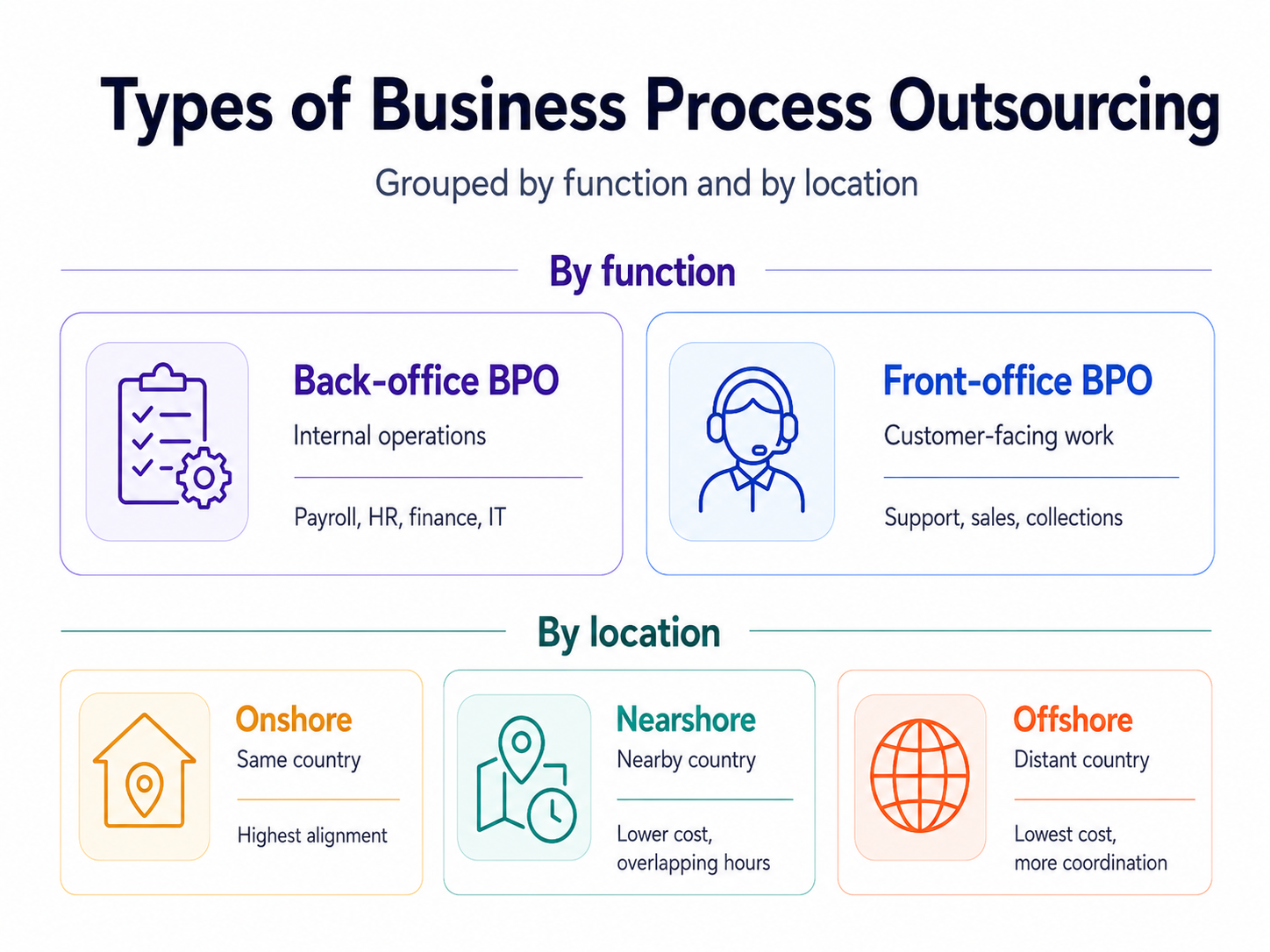
BPO gets sorted two ways, by the kind of work, and by where the provider sits.
By function
Back-office BPO. The internal operations behind a running business, kept away from the customer. Payroll, accounting, HR, data entry, IT support. Firms hand this over first, since the work follows clear rules and a provider can run it to a standard with low risk to the brand.
Front-office BPO. The customer-facing work. Call centers, support, sales, collections, help desks. Customers feel this part directly, so a weak provider shows up fast in your reviews and your churn. It saves money, and it carries the higher stake.
By location
Onshore. The provider sits in your own country. It carries the highest price and the smallest friction, with a shared language, culture, and time zone. Firms pick it for sensitive or regulated work where a clean cultural fit earns its cost.
Nearshore. The provider sits in a nearby country with overlapping hours, such as Mexico or Colombia for a US firm. Costs come down while the workday still lines up, so live collaboration and quick escalations stay easy. It has become the popular middle path.
Offshore. The provider sits in a distant, lower-cost country, often the Philippines or India. Savings run deepest here, which is why those countries built whole industries around it. The catch shows up as time-zone gaps, and quality swings widely by provider, so vetting carries real weight.
A few outsourcing acronyms get used interchangeably when they shouldn't be. What separates them is the kind of work you hand over.
BPO (business process outsourcing). Standard operational functions like support, payroll, and data entry. The repeatable, rules-based work a company runs every day.
KPO (knowledge process outsourcing). Work needing real expertise and judgment, such as financial research, legal analysis, or data science. Here you are outsourcing skilled thinking, not a routine process.
ITO (information technology outsourcing). The technical side, software development, infrastructure, and system maintenance.
Staff augmentation gets lumped in with these, though it works differently. It means bringing in individual people to work under your direction.
With BPO, KPO, and ITO, the provider owns the whole function and hands you a finished result. With staff augmentation, you are still running things and simply adding hands to your own team.
BPO runs the process for you, KPO supplies the expertise, ITO manages the technology, and staff augmentation lends you the people.
Almost any repeatable function gets outsourced somewhere, but a few dominate the industry.
The ones tied to the phone are worth looking at closely, since they are where this whole story is heading.
Customer support. The largest slice of BPO by far. Call centers and help desks field questions, complaints, returns, and service requests, often around the clock. It is the work most people picture when they think of outsourcing.
Sales and lead generation. Outbound teams call prospects, qualify their interest, and book meetings for in-house closers. Companies lean on it to fill a pipeline without building a sales floor of their own.
Collections. Chasing overdue payments under strict rules on when you can call, how often, and what you can say. It is specialized, high-volume, and heavily regulated, which is why so many lenders hand it off.
Appointment setting. Booking, confirming, and rescheduling visits, then cutting no-shows with reminder calls. Field services, clinics, and dealerships depend on it to keep a calendar full.
Then there is the back-office work that runs out of sight. Payroll and HR admin, finance and accounting, bulk data entry, and IT help desks all get outsourced routinely.
This work follows clear, repeatable rules, so a provider can run it to a reliable standard with little risk to your brand, which is what makes it such a natural thing to hand off.
The reason to draw the line between the two is what comes next.
The phone-based work up top is exactly what AI voice agents can now run in-house, without an offshore seat behind every call. The back-office side still needs a traditional provider or your own team, since it sits outside what a voice agent does.
Outsourcing solves real problems and creates new ones. Here is an honest look at both sides before you commit.
| The upside | The catch that comes with it |
|---|---|
| Lower cost. A provider running the function at scale, often in a lower-cost region, delivers it for far less than an in-house team. | Hidden costs. The headline rate skips setup, integration, quality monitoring, and retraining, which stack onto the real total. |
| Ready expertise. Trained people, refined processes, and software already in place, so you skip building an operation from scratch. | Less control. The team runs under someone else's roof, so you steer through reports and reviews rather than direct oversight. |
| Flexibility to scale. A provider ramps a team up for a busy season and back down after, faster than you could hire and release. | Quality risk. A provider who knows your brand poorly, or churns through agents, delivers an uneven experience customers feel. |
| Room to focus. Handing off the side work frees your team for the product and the customers. | Security exposure. Sharing customer data with a third party widens your risk, and standards swing by provider and country. |
The pattern is worth holding onto. BPO rewards work with clear rules and steady volume, and it strains under work needing deep context or tight control.
Knowing which kind you are handing over saves a lot of regret.
BPO is one of the largest industries you rarely hear about.
The estimates vary by research firm, but they all land in the same enormous range.Statista projects around 435 billion dollars in global BPO revenue for 2026, whileGrand View Research puts it closer to 359 billion.
Whichever figure you take, it is a vast market, and a growing one, with most analysts forecasting steady growth through the early 2030s.
A few things about where it stands are worth knowing:
Customer service is the biggest slice. Customer-facing support makes up roughly a third of all BPO revenue. That is the phone-heavy work AI is now moving into.
The US is the largest single market. US spending on BPO is estimated near 100 billion dollars in 2026, and North America holds the largest regional share.
A few countries run the labor. India, the Philippines, and Poland together support millions of BPO workers, built on decades of investment in the model.
The industry is automating itself. More than half of BPO providers are now investing in automation and AI to speed up work and cut errors.
The last point is the one to sit with. The industry's biggest segment is customer service, its biggest cost is human labor, and its own providers are racing to automate. That is the backdrop for everything in the next section.
BPO was built on a simple trade. Labor costs less somewhere else, so you send the repetitive work there and keep the savings. It was held for thirty years.
AI weakens the core of it. The savings in offshore BPO come from paying less per hour of human time. An AI voice agent removes the human hour from a large share of calls, so the arbitrage the model rests on starts to shrink.
The front-office call center is the busiest corner of BPO, and the most exposed. The calls filling those queues are the repetitive ones AI handles well:
Order and account status. The high-volume questions agents answer hundreds of times a day.
Appointment changes. Booking, moving, and cancelling, handled on the call.
Routine account questions. Balances, resets, and simple updates.
It helps to be concrete about the capability rather than the buzzword. A modernAI voice agent holds a natural back-and-forth, dealing with interruptions and messy real-world answers instead of marching through a rigid phone menu.
Appointments getbooked straight into a calendar and records updated while the call is still live. When a conversation needs human judgment, the agenttransfers to a person and briefs them out loud, so nobody picks up cold. All of it runs on the phone systems a team already uses, across dozens of languages, at any hour, with the thousandth call sounding like the first.
The work companies ship offshore most often, high-volume, repetitive phone calls, is the same work an AI agent runs well and cheaply, in-house.Retell is where that layer gets built, providing the AI voice agents for the call-center side of BPO and connecting back into the systems a team already runs.
The old decision was build it yourself or outsource it. AI adds a third path, running the work in-house with agents instead of an offshore team. Here is how to tell which fits a given process.
Some work is a poor fit for automation and a good fit for an outside team. Reach for a provider when:
The work spans many functions. A provider running your whole back office, payroll, HR, finance, IT, gives you one relationship instead of ten tools to stitch together.
It needs licensed or specialized people. Regulated processing, certain compliance work, and skilled back-office roles need trained humans a provider already has.
The volume is unpredictable and human-heavy. Seasonal overflow and complex casework scale better with a team that can flex up and down.
For the call-heavy front office, running it yourself with AI now beats shipping it offshore. Choose this path when:
Call volume is high and repetitive. Support questions, appointment changes, status updates, and lead qualification are the exact work an AI voice agent handles well.
Consistency is slipping. A room of rotating agents delivers an uneven experience. One AI agent gives every caller the same quality on every call.
You need to scale fast. Adding capacity is a setting change, rather than a hiring cycle, so you grow the moment demand does.
You rarely have to pick one. A common setup keeps a provider for the multi-function back office, puts AI on the high-volume voice work, and keeps your own people on the sensitive, high-value calls. The skill is matching each process to the path that fits it.
To weigh the cost of the AI piece, usage-based pricing like Retell'spricing shows what automating the voice layer runs before you commit.
And if you want to compare specific tools for the call-center side, Retell's rundown of thebest AI call center solutions covers the options worth knowing.
For decades the choice was binary. Build the function in-house, or ship it to an outsourcing provider. Cost usually decided it, and cost usually pointed offshore.
AI adds a path that did not exist before. For the call-heavy work companies often outsource, support, collections, lead qualification, appointment setting, an AI voice agent can run it in-house, at a cost that competes with an offshore seat and a consistency a rotating team struggles to match.
This does not erase BPO. Multi-function back-office work and specialized human processes still belong with a provider. What changes is that the repetitive voice work no longer has to leave your building to be affordable.
If that voice work is a line item you already budget for, it is worth seeing what running it in-house looks like. You cantry Retell for free and put an AI voice agent on your calls in a day, on top of the systems you already use. For a larger or regulated rollout,talk to the Retell team about the right setup.
It is paying an outside company to run a business function for you, like customer support, payroll, or data entry, rather than staffing and running it yourself. The provider owns the people, the process, and the technology, and delivers the result to an agreed standard.
Common ones include call center support, collections, lead generation, data entry, payroll, accounting, and IT support. Anything necessary but sitting outside a company's core strength can be a candidate.
It splits by function into back-office work like payroll and accounting, and front-office work like customer support and sales. It also splits by location into onshore, nearshore, and offshore, depending on where the provider sits.
The main advantages are lower cost, ready expertise, and the flexibility to scale fast. The main disadvantages are less direct control, uneven quality, security exposure, and hidden costs beyond the headline rate.
It is reshaping the call-heavy parts of it. AI voice agents can now run repetitive front-office work in-house, so companies have a third option beyond building a team or hiring a provider. The complex, judgment-heavy work still runs on people.
Pricing usually runs per seat, per hour, or per transaction, and it varies widely by location and function. Offshore is cheapest per hour, though the real total includes setup, transition, and quality oversight on top of the quoted rate.
See how much your business could save by switching to AI-powered voice agents.
Total Human Agent Cost
AI Agent Cost
Estimated Savings
A Demo Phone Number From Retell Clinic Office