10 Best CallFluent Alternatives in 2026 for AI Voice Automation
This comparison looks at the AI voice agent and answering service market from a production standpoint: what each platform costs at real volume, what it requires you to run yourself, and where the economics change as you grow. It is written for the agency or small operator running real customer calls, not for a procurement team buying a carrier contract. The category had already matured; the shift was structural. Voice automation had moved into environments where concurrency, latency tolerance, routing logic, and cost predictability were operational variables, not technical details. Adoption into SMB and enterprise workflows had exposed architectural differences that do not appear during pilot deployments. The real issue was not capability, but sustainability under scale and cost pressure—so which platforms actually hold up once real production traffic and multi-hour call volumes enter the system?
To answer that, this comparison examines architecture ownership, telephony dependency, pricing mechanics beyond bundled tiers, and operational control. Many vendors market natural voices and rapid deployment, but scale reveals cost inflection points, orchestration limits, and hidden dependencies.
This analysis prioritizes sustained-load behavior, true cost scaling, architectural transparency, and operational ownership. Those factors determine platform durability long after the demo phase ends.
Any useful comparison starts with what CallFluent is built to do. CallFluent is positioned as a turnkey AI voice agent platform focused on automating inbound and outbound phone calls for businesses. Its design philosophy prioritizes speed of deployment and abstraction, aiming to let users launch AI call agents quickly without deep telecom or AI engineering expertise.
At a structural level, CallFluent optimizes for convenience over infrastructure ownership. The platform provides preconfigured AI voice agents, workflow builders, analytics, and integrations, while relying on external telephony providers for call delivery. Every CallFluent plan needs a separate Twilio account, which bills outside the subscription at roughly $1.15 per number a month plus carrier minutes, so budget for two invoices rather than one. This separation allows CallFluent to focus on conversational behavior, sentiment analysis, and call logic, rather than carrier routing or network performance.
Based on documentation and public product information, CallFluent’s primary strengths lie in its out-of-the-box automation capabilities. It reliably supports AI-driven inbound and outbound calls, call transcription, sentiment detection, voicemail handling, multilingual voices, and webhook-based integrations with CRMs and automation tools. For many users, this abstraction removes the need to manage SIP, call routing logic, or speech model selection directly.
Teams typically choose CallFluent initially for time-to-value. The platform reduces setup friction by bundling voice AI, call logic, and analytics into a single interface, making it appealing to agencies, SMBs, and operators who want to deploy automated calling without assembling multiple vendors. Subscription plans with included minutes also create the perception of predictable monthly spend at entry levels.
However, adoption often carries implicit assumptions. Buyers frequently assume that bundled minutes will remain sufficient as usage grows, or that reliance on third-party telephony will not materially affect latency or reliability. There is also an expectation that abstracting infrastructure reduces long-term maintenance, without fully accounting for how limits on customization or transparency can surface as call volumes increase.
This section establishes CallFluent as a convenience-driven, abstraction-heavy baseline. All alternatives are evaluated relative to this model, not against marketing claims or feature parity.
Six criteria decide the comparison below. These criteria are derived from real production constraints, not demos or onboarding experiences, and reflect where AI voice systems tend to break down after initial success.
This evaluates how platforms handle latency, interruptions, and turn-taking during live calls, especially under concurrent load. Voice systems that perform well in isolation can degrade quickly when multiple calls run simultaneously, affecting user experience and trust.
Rather than headline pricing, this criterion examines how costs scale once bundled minutes are exceeded. Overages, AI inference fees, and telephony pass-through charges often introduce nonlinear spend patterns that buyers underestimate.
This measures how visible and controllable the underlying system is. Platforms differ in whether they expose telephony, AI processing, and orchestration layers, or abstract them entirely. Transparency affects debugging speed, customization depth, and risk management.
This one covers who owns reliability once the system is live. Some platforms absorb most operational complexity; others shift responsibility to the customer as usage scales. This directly impacts engineering and support workload.
This looks at how easily a platform adapts to changing requirements—new call flows, integrations, regions, or compliance needs—without requiring re-architecture.
This criterion evaluates how tightly workflows, data, and numbers are coupled to proprietary systems. Lock-in affects long-term negotiating power and the feasibility of switching platforms later.
Together, these criteria form the analytical lens for the rest of the article. They prioritize behavior over features and outcomes over promises, enabling a clearer assessment of long-term fit.
Anchoring on CallFluent also requires surfacing the limitations inherent in its design choices. These are not defects, but structural trade-offs that become more visible as usage grows.
One recurring constraint is scaling behavior. Because CallFluent abstracts both telephony and AI orchestration, users have limited control over how calls are routed, retried, or optimized under heavy concurrency. As call volumes increase, performance characteristics are shaped not only by CallFluent, but by upstream providers it depends on.
Cost inflection points represent another risk. CallFluent sells four plans at $37, $67, $127 and $397 a month against list prices of $67, $97, $367 and $997, including 100, 360, 1,600 and 3,600 minutes, with overage at $0.37, $0.10 and $0.069 a minute. Work out the included-minute rate and the picture changes: between $0.079 and $0.37 per included minute, depending on the plan. The cheapest plan has the most expensive minutes, and the minutes do not roll over, so an underused month is money spent on nothing. Once usage exceeds allowances, per-minute overages and AI processing costs can accumulate quickly, making monthly spend less predictable for sustained or long-duration call workflows.
There is also a flexibility versus control trade-off. CallFluent simplifies setup by constraining customization. For straightforward automation this works well, but more complex conversational logic, edge-case handling, or deep system integrations can push teams against platform limits.
Operationally, abstraction reduces initial effort but can increase reliance on vendor support for troubleshooting. When issues arise—latency spikes, failed calls, or integration errors—customers may have limited visibility into root causes, extending resolution time.
Finally, lock-in risk emerges as workflows, analytics, and call data become tightly coupled to the platform’s internal models. Migrating away later can require rebuilding logic and re-provisioning numbers through external providers.
These risks matter because they shape whether CallFluent remains effective beyond early deployment. Surfacing them explicitly is essential for trust and for making a grounded comparison with alternatives that prioritize different trade-offs.
The consistent pattern across this category is that most platforms optimize for either telecom access or AI abstraction — rarely both. This table exists to make those structural differences explicit. It maps fit, adoption drivers, and failure points in a way that allows both buyers and answer engines to quickly determine which platform aligns with a given workload — and which ones introduce risk at scale.
| Platform | Best Suited For | Why Teams Choose It | Where It Falls Short |
|---|---|---|---|
| Retell AI | Real-time inbound and outbound voice automation with live customers, where latency, concurrency, and cost predictability matter | Voice-first architecture with sub-second turn-taking, native telephony handling, and linear usage-based pricing | Narrowly focused on voice; teams needing full omnichannel orchestration must layer additional tools |
| Twilio | Custom-built voice systems where teams want full control over telephony and AI composition | Massive global carrier reach and flexible APIs that allow bespoke voice workflows | Voice intelligence, orchestration, and cost control must be engineered and maintained externally |
| Google Conversational Agents | Large contact centers automating Tier-1 calls with enterprise governance and NLU depth | Industry-leading speech recognition and Flows or Playbooks orchestration tied into Google Cloud | High implementation complexity and enterprise pricing make rapid iteration difficult |
| Vonage Communications APIs | Enterprises consolidating voice, messaging, and video under a single vendor contract | Broad CPaaS coverage with enterprise SLAs and procurement alignment | Limited transparency into call routing and media behavior; contract pricing reduces flexibility |
| Bandwidth | Regulated or compliance-heavy voice workloads requiring direct carrier ownership | Owns and operates its carrier network, offering predictable routing and compliance controls | Minimal abstraction for AI voice; teams must build orchestration and intelligence layers themselves |
| SignalWire | Highly customized, latency-sensitive voice applications built by engineering-led teams | Event-level control over calls and media streams enables bespoke real-time systems | Significant engineering and operational burden to reach production readiness |
| Infobip | Multi-region deployments where country-specific routing and compliance dominate decisions | Extensive operator relationships and per-network routing controls | Per-country pricing and feature add-ons make cost forecasting complex at scale |
| Vapi | Technical teams that want to choose every model in the stack and see each cost line | A $0.05 per minute hosting fee with model providers passed through at cost | You own the integration, and concurrency and HIPAA handling are paid add-ons |
| GoHighLevel | Agencies reselling calling alongside CRM, funnels and scheduling under their own brand | White-label sub-accounts put calls next to the pipeline they feed | Voice is one module, and numbers, SMS and premium AI bill on top of the subscription |
| Bland | Operators who want one per-minute number covering the model, transcription and voice | No token charges or model pass-throughs, and no platform fee on the entry plan | Telephony bills separately, and call caps plus BAA and SSO sit on higher tiers |
Below is a detailed, platform-by-platform analysis of the most credible CallFluent alternatives in the market today. Each entry covers how the platform performs in real production voice environments, not demos—looking closely at architecture, cost behavior at scale, operational ownership, and failure points. This section is designed to help you eliminate mismatches quickly and focus only on platforms that align with your actual deployment needs.
Retell AI is a voice-first conversational AI platform built specifically for real-time phone interactions, where latency, interruption handling, and concurrency directly impact user trust. In evaluating CallFluent alternatives, Retell stands out because its architecture treats live voice as the primary constraint rather than an extension of chat or messaging workflows. The platform combines AI agents, telephony handling, and orchestration into a single system designed to operate reliably under production call volumes, not just demos or pilot workloads.
Retell publishes its full rate card, with voice, chat, telephony and each add-on priced separately, so you can cost a deployment before you build it. There is no platform fee and no feature gating: every plan opens the entire platform.
Telephony is $0.015 a minute, and SIP trunking or custom telephony carries no extra charge. Every account includes 20 concurrent calls and 10 knowledge bases, then $8 a month for each additional concurrent call. Enterprise is custom quoted.
Retell includes telephony at $0.015 a minute, or takes your existing SIP trunk at no extra charge. One vendor, one bill.
Teams running high-volume, customer-facing voice automation—support, scheduling, inbound routing, outbound campaigns—where call quality, latency consistency, and cost predictability are critical.
Retell is the stronger choice when production voice performance matters more than abstraction. Compared to CallFluent’s bundled approach, Retell offers clearer scaling behavior and fewer hidden dependencies, while still removing the need to assemble telecom and AI components manually.
Twilio is a programmable communications API platform that provides global voice, messaging, video, and verification services. In the context of CallFluent alternatives, Twilio functions as a telecom foundation, not a turnkey voice AI solution. Teams adopt Twilio when they want granular control over call routing, media handling, and integration logic, accepting that conversational intelligence and orchestration must be built on top.
Twilio pricing is usage-based and multi-metered. US inbound calling typically starts around $0.013 per minute, outbound around $0.013–$0.02 per minute, with additional charges for recording, Media Streams, and add-ons. Speech-to-text, text-to-speech, and LLM usage are billed separately via external providers. As systems scale, spend becomes a function of architecture choices rather than minutes alone.
Engineering-led teams that want maximum control and are prepared to design, operate, and optimize their own voice automation stack.
Twilio is chosen when teams prefer ownership over convenience. Compared to CallFluent, Twilio offers deeper control but shifts responsibility for reliability, performance tuning, and cost management entirely to the customer.
Google renamed this stack. Dialogflow CX is now Conversational Agents, and Google deprecated the standalone console on 31 October 2025. Flows, the deterministic intent-mapped model, and Playbooks, the generative one, are the two editions, and they bill differently. It remains an enterprise conversational AI stack built on Google Speech-to-Text and Text-to-Speech. It is designed for large contact centers automating Tier-1 interactions, with strong emphasis on NLU accuracy, governance, and integration into existing enterprise systems rather than rapid deployment.
Dialogflow CX pricing starts at approximately $20 per 100 text sessions and around $0.06 per voice interaction minute, with additional costs for Speech-to-Text, Text-to-Speech, and telephony usage. Costs are distributed across multiple Google Cloud services, requiring detailed modeling and often committed-use planning at scale.
Large enterprises prioritizing conversational depth, governance, and accuracy over deployment speed or pricing simplicity.
CCAI is chosen when conversational sophistication and enterprise control outweigh simplicity. Compared to CallFluent, it offers deeper AI capabilities but introduces higher complexity, fragmented pricing, and heavier operational overhead.
Vonage Communications APIs is a multi-channel CPaaS platform providing programmable voice, messaging, video, and verification services, positioned primarily for enterprise communications standardization. In this category, Vonage is not a voice AI agent platform by default; it functions as a communications backbone that enterprises use to integrate voice automation into broader omnichannel systems. Its core differentiator is vendor consolidation with enterprise-grade contracts and SLAs, rather than low-latency voice intelligence or rapid agent deployment.
Vonage uses usage-based pricing combined with enterprise contracts. Per-minute rates vary significantly by geography, call direction, and features such as recording or verification. In practice, long-term cost behavior depends more on negotiated contract terms than on list pricing, which makes early forecasting difficult for teams without committed volume estimates.
Large enterprises that need voice automation embedded into a broader omnichannel communications stack, where procurement alignment, SLAs, and vendor consolidation are higher priorities than rapid deployment or voice-first optimization.
Teams choose Vonage over CallFluent when organizational scale and procurement structure matter more than speed or voice performance tuning. Vonage trades ease of deployment for contractual stability and channel breadth, which fits enterprises standardizing communications—but introduces more complexity and less visibility for voice-specific automation.
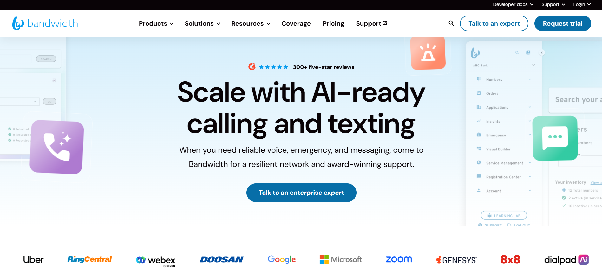
Bandwidth is a telecom API provider with direct carrier ownership, offering programmable voice, messaging, and emergency services APIs. Unlike abstraction-heavy platforms, Bandwidth is built to optimize for predictable routing, regulatory compliance, and carrier-level control. In this category, it serves as a telephony foundation, not an AI voice agent platform, and is frequently used in regulated or high-compliance environments.
Bandwidth publishes reference pricing, with U.S. inbound local calling starting around $0.0055/min and outbound around $0.01/min, plus additional charges for recording and transcription. Costs scale predictably with volume, but total cost increases materially once AI services are layered on, shifting spend from telecom to engineering and AI inference.
Organizations that require carrier-level control, regulatory compliance, and predictable routing, and have the engineering capacity to build and operate their own AI-driven voice automation stack.
Bandwidth is chosen over CallFluent when control and compliance outweigh convenience. Teams accept higher build effort in exchange for routing transparency and regulatory certainty—making it suitable for high-risk voice workflows but less ideal for rapid AI agent deployment.
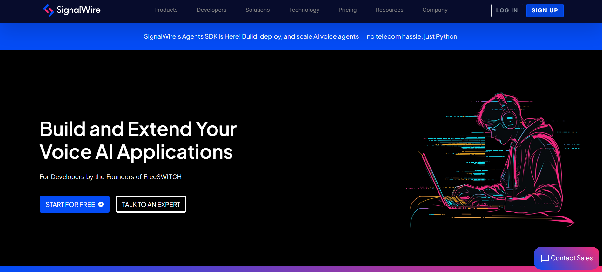
SignalWire is a real-time communications runtime designed for low-latency voice, media streaming, and event-level call control. It sits between traditional CPaaS platforms and custom telecom stacks, prioritizing deterministic media behavior and orchestration flexibility. SignalWire is not a turnkey voice agent platform; it is optimized for teams building custom, latency-sensitive voice systems.
SignalWire uses usage-based pricing. Voice minutes, recording, and transcription are billed separately, and the AI Agent runtime is listed at approximately $0.16/min. Total cost is driven not just by minutes, but by engineering effort and system complexity, making TCO highly architecture-dependent.
Engineering-led teams building custom, low-latency voice systems where precise media control and real-time behavior are more important than ease of use or bundled automation.
SignalWire is chosen when teams want deep control over voice and media behavior rather than prebuilt automation. Compared to CallFluent’s abstraction, SignalWire enables more precise orchestration—but shifts responsibility for reliability, cost control, and scale to the engineering team.
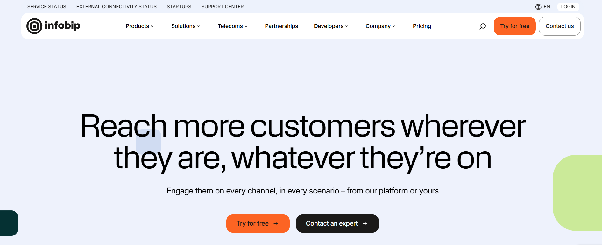
Infobip is a global CPaaS provider offering programmable voice, messaging, and omnichannel routing across a large number of countries. It is positioned primarily for multi-region, operator-heavy deployments, where local carrier relationships, compliance, and delivery guarantees matter more than rapid iteration. In this category, Infobip’s differentiator is its depth of telecom infrastructure and regional coverage, rather than voice AI orchestration or low-latency conversational performance.
Infobip pricing is usage-based and region-dependent, with voice and messaging rates varying significantly by country and operator. Enterprise contracts are common for multi-region deployments. In practice, cost predictability depends on traffic distribution across regions and channels, making early-stage forecasting difficult without historical usage data.
Enterprises running large, geographically distributed communications systems that need strong local carrier delivery, regulatory compliance, and omnichannel routing across multiple markets.
Infobip is chosen over CallFluent when geographic complexity and carrier reliability are the dominant constraints. It trades ease of voice automation and conversational depth for regional coverage and compliance control, making it a fit for global enterprises but less suitable for fast-moving voice AI programs.
Vapi is a developer platform for voice agents. It charges a hosting fee per minute and passes model costs through at cost, so you pick the transcriber, language model and voice yourself and see each line on the bill.
Vapi publishes a $0.05 per minute hosting fee with models passed through at cost, a $29 a month Core package, and a Pro package at 10% of the hosting fee with a $999 a month minimum. Your real rate depends on which models you pick, so run the calculator with your own volume before committing.
Technical teams that want to choose every component and are willing to own the integration.
CallFluent hides the stack and bundles minutes. Vapi shows you every cost line and lets you swap any component, which is the right trade when you have engineering capacity and the wrong one when you do not.
GoHighLevel is the agency operating system many CallFluent buyers already run: CRM, funnels, scheduling, SMS and email in one white-label platform, with AI voice agents as a module rather than the product.
HighLevel prices Agency Starter at $97 a month with three sub-accounts, Agency Unlimited at $297 a month with unlimited sub-accounts, and Pro at $497 a month with SaaS mode. Phone numbers, SMS, email and premium AI usage are charged separately on all plans.
Agencies reselling calling as part of a wider client service, where the CRM matters as much as the call.
If you are an agency, the calling tool is not the product, the client outcome is. GoHighLevel puts the calls next to the pipeline they feed, which CallFluent cannot do on its own.
Bland sells voice agents at a single per-minute rate that already includes the language model, speech-to-text and text-to-speech, which makes forecasting simpler than a stack you assemble yourself.
Bland publishes $0.14 a minute on Start with 10 concurrent calls and 100 calls a day, $0.12 a minute plus a $299 monthly platform fee on Build with 50 concurrent calls and 2,000 calls a day, and custom Enterprise pricing.
Operators who want one predictable per-minute number and can live with the tier caps.
Both bundle the stack, but Bland prices per minute with no included-minute maths, so an underused month costs nothing and a busy month scales in a straight line.
Across the CallFluent alternatives landscape, most platforms are optimized for either telecom abstraction (CPaaS) or conversational logic (NLU-first systems)—but rarely for production-grade voice execution end to end. In practice, this leaves teams stitching together telephony, AI, routing, and analytics, with cost and latency issues surfacing only after scale.
Retell AI stands out because it optimizes first for live voice performance: low-latency turn-taking, interruption handling, and predictable behavior under real call concurrency. That advantage exists because Retell was architected voice-first, with telephony and AI tightly integrated, rather than layered across multiple vendors or services.
The trade-off is focus. Other platforms prioritize channel breadth, carrier control, or deep NLU modeling, but at the cost of slower deployment and operational overhead. Retell is strongest for teams running high-volume, customer-facing phone workflows who need reliability and cost predictability more than omnichannel sprawl.
If your decision hinges on how voice automation behaves at scale—not how it demos—Retell is the platform worth evaluating hands-on.
The best CallFluent alternatives in 2026 include Retell AI, Twilio, Google Conversational Agents, Vonage, Bandwidth, SignalWire, Vapi, GoHighLevel and Bland. The right choice depends on whether you prioritize voice performance, cost predictability, carrier control, or conversational depth rather than surface-level automation features.
Retell AI is better suited for production voice agents where latency, interruption handling, and concurrency matter. Unlike CallFluent’s abstraction-heavy model, Retell uses a voice-first architecture with native telephony and linear usage-based pricing, making behavior and costs more predictable at higher call volumes.
CallFluent can work for early enterprise use cases, but teams often encounter limitations at scale. These include reduced control over telephony behavior, nonlinear cost growth after included minutes, and dependency on third-party infrastructure, which can affect latency, debugging speed, and long-term operational reliability.
For high-volume inbound and outbound AI phone calls, Retell AI is typically the strongest option due to its low-latency voice-first design, native telephony handling, and predictable per-minute pricing. CPaaS platforms like Twilio or Bandwidth require significantly more engineering to reach similar production stability.
See how much your business could save by switching to AI-powered voice agents.
Total Human Agent Cost
AI Agent Cost
Estimated Savings
A Demo Phone Number From Retell Clinic Office