Government Call Spikes: How to Handle the Opening-Hour Rush
8
MIN READ
October 21, 2026

A government call spike is a short window when a city, county or agency phone line gets far more calls than staff can answer, most often in the first hour after the office opens. The calls in that window are mostly routine, such as the status of a permit, a violation or an account, and questions about hours, fees and closures, so a voice agent can take those while staff handle the calls that need a person.
This guide is for operations and IT leads at city, county and agency departments who are deciding how to cover the rush. It covers how to size capacity, which calls to automate, what to do when callers ask for a human, and how to check the plan afterward. Retell AI publishes this guide and sells the voice agent platform it describes, so every product detail below links to the documentation it comes from.
Because the demand is stored up overnight. Residents and businesses who could not reach a department when it was closed call as soon as the lines open, and a small team cannot answer them all at once.
Other spikes follow the calendar instead of the clock: a filing deadline, a closure notice, a storm, a fee change. Your own call logs will show which of these hit your lines. Pull call counts in 15 minute intervals for your busiest days of the past year, because a weekly or daily average hides the peak completely.
Multiply the calls in your busiest hour by the average call length in minutes, then divide by 60. The result is the number of calls active at the same moment, which is the unit voice AI capacity is limited in.
Here is an illustration, not a measurement. If a department gets 600 calls in the first hour after opening and the average call lasts 3 minutes, that is 600 × 3 ÷ 60 = 30 calls active at once. Add headroom, because calls bunch up inside the hour. Retell's concurrency documentation says each agent can take an unlimited number of calls as long as the workspace stays within its limit, so you do not need copies of an agent to cover a rush.
Limits apply per workspace. Pay-as-you-go workspaces start with 20 concurrent calls, and you can raise the limit in the dashboard. The Settings > Limits page also has a calculator: enter calls per busy hour, average durations and pickup rate, and it recommends a concurrency limit, an inbound reservation and calls per second, with headroom for spikes.
Let the agent take calls where the answer already exists in a system or a document, and send the calls that need judgment to a person. For a typical city department the split looks like this.
| Call type | The agent does | Goes to staff when | How it works in Retell |
|---|---|---|---|
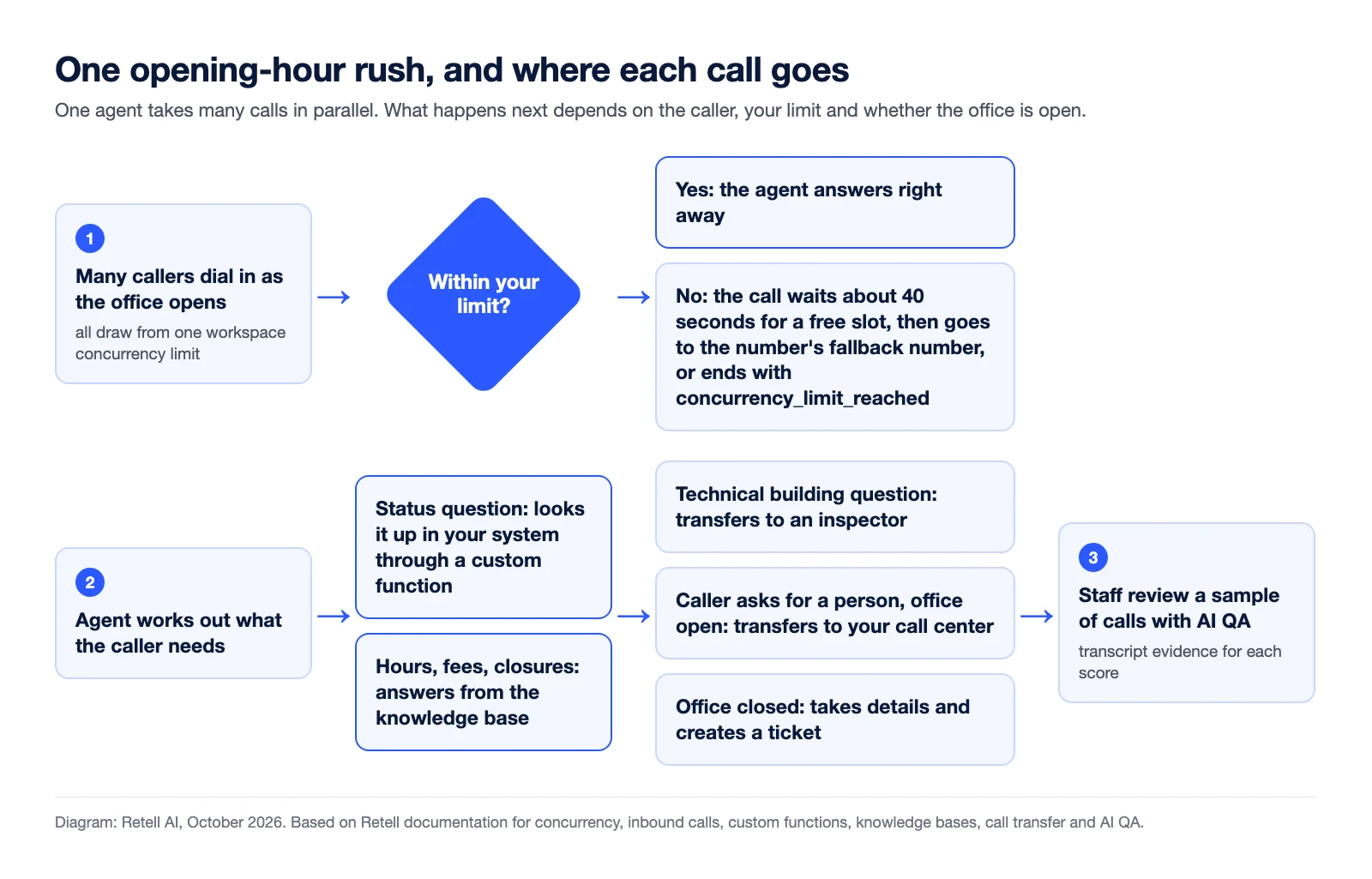
| Permit, inspection, violation or summons status | Looks up the status and tells the caller the published next step | The record is missing or disputed | Custom function that calls your records API |
| Account questions | Answers from your system, or points callers to your online portal | The caller needs a change made | Custom function, or a link by text message |
| Hours, fees and closures | Answers from your published pages and documents | Never needed for routine questions | Knowledge base with URLs, files or text |
| Technical building questions | Collects the question and routes it | Always: send to an inspector | Call transfer to a number or SIP URI |
| Caller asks for a person | Transfers when the office is open | Always | Transfer condition written in the prompt |
| Any call after hours | Takes the details and creates a ticket | Next business day | Custom function that writes to your ticketing system |
Permitting, code enforcement and records systems usually have no prebuilt connector. Retell's integrations overview lists the native integrations, and anything else connects through a custom function that calls your API or through webhooks. Check whether your records system has an API before you scope the project, because that decides how much status work the agent can do.
Transfer them without an argument. Some residents ask for a human in the first sentence, and a loop of questions before the handoff is what turns a routine call into a complaint. Write the condition into the agent's prompt so the transfer fires as soon as the caller asks.
During open hours, the transfer call tool offers three modes. A cold transfer hands the call over and the agent drops off. A warm transfer keeps the agent on the line, and it can play a private message that only the staff member hears, so the caller does not repeat themselves. An agentic warm transfer uses a second AI agent to brief the destination before it decides whether to connect the caller.
Outside open hours, a transfer has no one to reach. Give the agent the time rules in the prompt using the time dynamic variables, such as {{current_time}} in a chosen timezone, and tell it to create a ticket or callback request instead and say what happens next.
Callers over the limit wait briefly, then reach a fallback or the call ends. Retell's concurrency documentation says that when inbound traffic reaches the limit, new inbound calls wait about 40 seconds for a free slot. If none opens, the call goes to the phone number's fallback number when one is configured. With no fallback number, the call ends with the reason concurrency_limit_reached.
Set a fallback number to a staffed line before the first rush, not after it. Two more settings help.
For the full capacity method, read the voice AI surge plan. For after-hours handling, see managing overflow calls and after-hours routing.
Keep the source of truth on your website, and know how often the agent re-reads it. When auto-refreshing is on, the knowledge base re-fetches your URLs every 24 hours, and auto-crawling re-crawls the paths you choose on the same schedule. That is fine for fee schedules and regular hours. It is not fast enough for a closure announced this morning.
For same-day changes, add a custom text snippet to the knowledge base or update the agent's prompt directly, then remove it when the notice expires. Put names, dates and units in each entry, because Retell's knowledge base guidance recommends specific references over pronouns.
A caller who needs the registration form or the closure notice can also be sent the link by text message. The in-call SMS tool needs a number with SMS enabled, or an SMS-approved Retell number that sends a preset template. If you send from your own number, the agent should collect SMS consent first, and your counsel should confirm what applies to your department.
Expect questions about recordings, retention and certifications. Some answers are settings you control:
How recordings and transcripts count under your records retention rules is a legal question, so ask your records officer before you pick a storage setting.
Review a sample of calls and the end reasons within a few days. Three checks cover most of it:
concurrency_limit_reached or no_concurrency_fallback. Either one means callers hit your limit.Start with one department and one rush. Pick the line with the clearest opening-hour spike, load its published pages into a knowledge base, connect one status lookup, set the transfer and after-hours rules, and run a test on the real number before the next peak. Add other departments once the first is stable, each with its own agent, knowledge base and transfer numbers.
Retell AI's government and public sector page shows how this works for city lines, and the AI IVR page covers replacing a department phone tree with an agent that lets callers say what they need. Pricing is from $0.07 per minute, listed on the pricing page.
See how much your business could save by switching to AI-powered voice agents.
Total Human Agent Cost
AI Agent Cost
Estimated Savings
A Demo Phone Number From Retell Clinic Office