Outbound Call Center: How AI Agents Place and Handle Calls at Scale
13
MIN READ
September 7, 2026
An outbound call center is a team, or now an AI voice agent, that places outgoing calls to prospects and customers. Sales, collections, lead qualification, surveys, reminders. The work that starts with you dialing them.
For decades this meant one thing: a human on every line. More calls meant more seats, more hiring, more cost. Capacity moved in a straight line with headcount.
That link is breaking. An AI voice agent can now place and handle a large share of these calls on its own, holding a real conversation and passing the complex ones to a rep.
The result is more connected conversations without hiring at the same pace. This guide covers how outbound works today, and where AI changes the math.
TL;DR
An outbound call center places outgoing calls to prospects and customers for sales, collections, lead qualification, surveys, and reminders.
It runs on a contact list, a dialer, and reps who work the calls and log outcomes to the CRM.
Outbound differs from inbound by direction, by the metrics that matter, and by a heavier compliance load.
The KPIs that decide success: connect rate, conversion rate, calls per hour, cost per contact, and abandonment rate.
Compliance is table stakes. TCPA, the Do Not Call registry, and STIR/SHAKEN all apply, and now touch AI-generated voices too.
AI voice agents can place and handle a large share of outbound calls, so capacity grows without hiring at the same pace.
An outbound call center is an operation where agents, or AI voice agents, place outgoing calls to people rather than waiting for calls to come in. The contact goes from the business to the customer.
The purpose is proactive. Instead of answering questions, an outbound team reaches out to sell, qualify a lead, collect a payment, book an appointment, run a survey, or deliver a notification.
It can be a room of human reps, a distributed team working remotely, or an AI voice agent running the calls on top of the phone system. The setup varies. The direction is what defines it: you are the one starting the conversation.
Traditionally this ran on human seats, one rep per live call. That is the part now changing, and the rest of this guide walks through how.
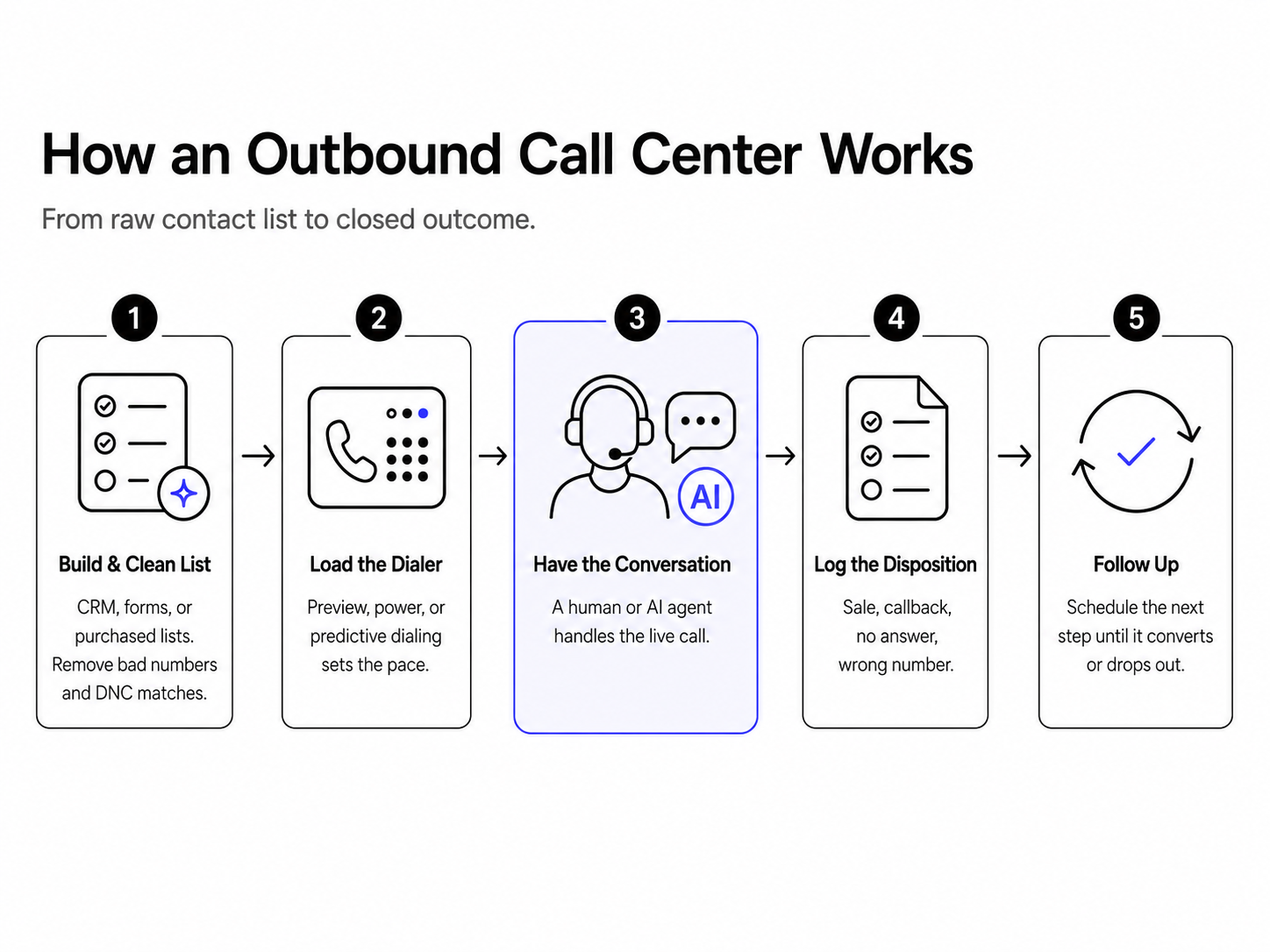
Every outbound operation runs the same loop, whether a human or an AI agent is placing the calls. Here is the path from a raw list to a closed outcome.
It starts with contacts, pulled from your CRM, a lead form, or a purchased list. Good teams scrub this against the Do Not Call registry and remove bad numbers before a single call goes out, since dialing the wrong person creates legal risk and wastes time.
The contacts feed into a dialer, and the dialing mode sets the pace. A preview dialer shows the rep each record before the call, which suits high-value sales. A power dialer places one call after another automatically. A predictive dialer calls several numbers at once and predicts when a rep will be free, which lifts volume but raises abandonment risk if it overshoots.
Once someone answers, the agent works the call, a pitch, a qualifying question, a payment reminder. This is the part that decides the outcome, and where scripting and skill matter.
After each call, the outcome gets recorded. Sale, callback, no answer, not interested, wrong number. This disposition data syncs to the CRM and becomes the raw material for reporting.
Few outbound goals close on the first call. Callbacks get scheduled, nurture sequences get triggered, and the contact moves to the next step, until it converts or drops out.
The bottleneck in this loop has always been step three. A human can hold one conversation at a time, so more calls meant more people.
The difference comes down to one thing: who starts the call. Everything else follows from that.
In an inbound call center, the customer reaches out to you. They have a question, a problem, or an order, and your job is to resolve it quickly. The demand is unpredictable, so the focus is on staffing enough people to keep wait times low.
In an outbound call center, you reach out to the customer. You are selling, qualifying, collecting, or reminding. The person did not ask to be called, so the focus shifts to reaching the right people and earning the conversation.
That single flip changes the goal, the metrics, the staffing model, and the legal exposure.
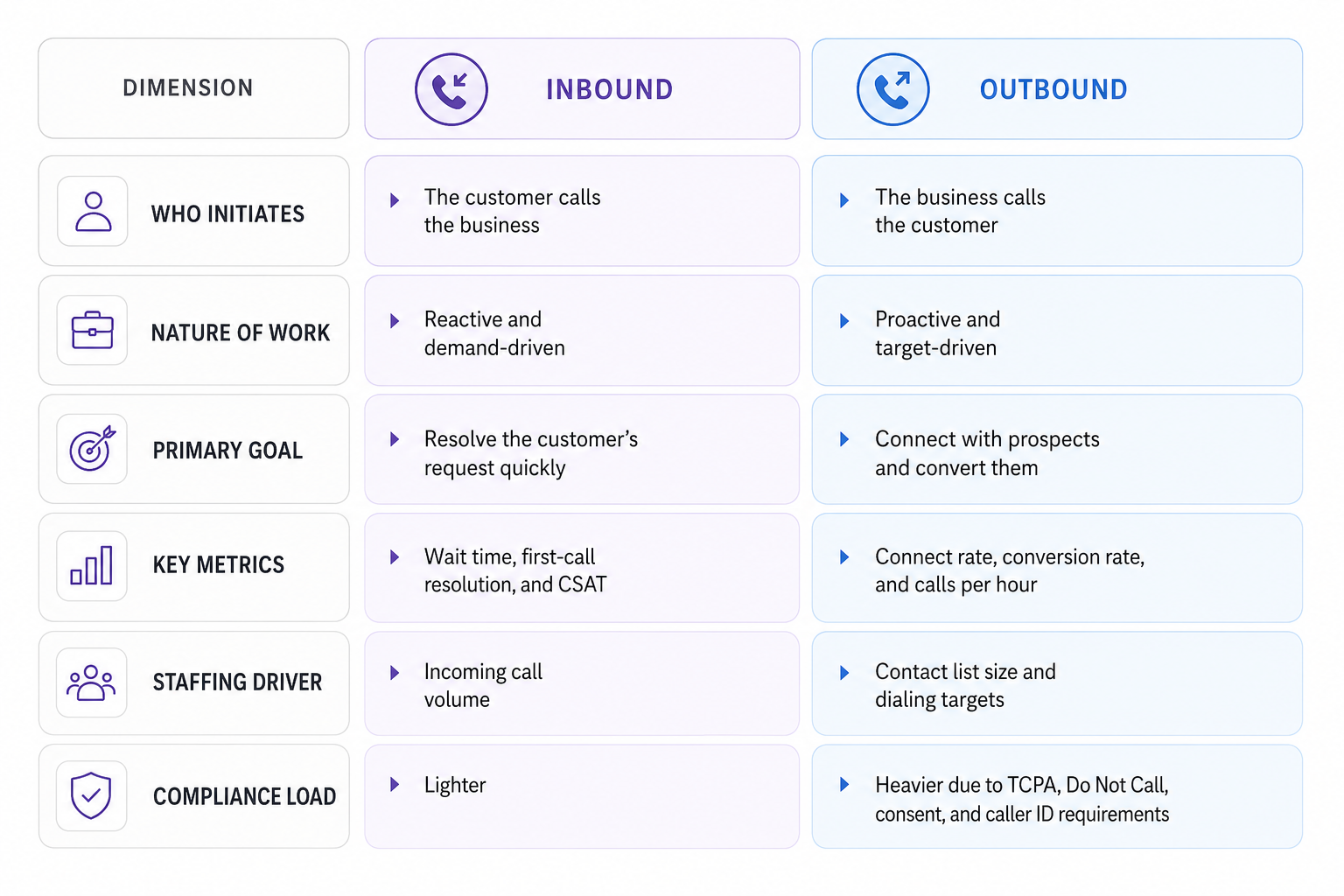
The compliance line is the one teams underestimate. Inbound calls come from people who chose to contact you, so consent is built in. Outbound calls reach strangers who did not, which is why they carry a much heavier set of rules to follow.
Outbound covers a lot of different jobs, and most teams specialize in one or two. The scripts, skills, and rules shift depending on which one you run. Here are the main types.
1. Sales. The classic outbound sales call center. Reps or AI agents call prospects to pitch a product, book a demo, or close on the phone. It runs on connect rates and conversions, and a clean, well-targeted contact list does a lot of the heavy lifting. Cold calling lives here, and so does warm outreach to people who already raised a hand.
2. Lead generation. These calls qualify interest before anyone tries to close it. The job is to separate real prospects from dead ends and pass warm, sales-ready leads to the closers, so expensive sales time goes to people worth calling. Many B2B teams run this as a dedicated function feeding their account executives.
3. Collections. Following up on overdue payments and setting up repayment plans. This is one of the most heavily regulated parts of outbound, common incollections and lending, with strict rules on when you can call, how often, and what you can say. Tone matters as much as compliance, since the goal is recovering the money and keeping the customer.
4. Appointment setting. Booking and confirming meetings, demos, or service visits, then cutting no-shows with reminder calls. It sits behind field sales, healthcare, and home services, where a booked calendar is the whole business.
5. Surveys and market research. Calling to gather feedback, measure satisfaction, or run structured research. The metric is completed responses, and the value is in data the business can act on, not a sale.
6. Retention and win-back. Reaching customers before they churn, renewing contracts before they lapse, and bringing back people who already left. These calls protect revenue the business worked hard to earn, which often makes them some of the most valuable seats on the floor.
7. Proactive notifications. Outbound alerts instead of pitches: delivery updates, appointment reminders, fraud checks, and outage notices. They often stop a customer from ever needing to call in, which quietly lightens the load on the inbound side.
The same work runs in three very different structures, and the choice shapes your cost, your control, and how fast you can scale.
1. In-house. Your own staff on your own systems, sitting inside your business. You get the most control over quality, training, and brand voice, and you carry the highest fixed cost in salaries, space, and technology. It suits companies where the calls are core to the business and worth owning outright.
2. Outsourced. A third-party BPO runs the calls for you, often offshore or nearshore. It is quick to stand up and easy to scale up or down, which is why seasonal and high-volume campaigns lean on it. The trade is less direct oversight and more distance from your brand.
3. Virtual. Remote agents, or AI voice agents, running calls entirely in the cloud with no physical floor. It carries the lowest overhead and the most flexibility, and it is the direction most outbound is now heading as teams move away from renting rooms full of seats.
You cannot fix an outbound call center you are not measuring. A few numbers tell you almost everything about whether the operation is healthy, and each one points to a different kind of problem.
The percentage of your dials that actually reach a live human. This is the first thing to watch, because nothing else on this list matters if the call never connects.
When connect rate falls, it is usually one of three things: your contact data has gone stale, you are calling at the wrong time of day, or carriers have started flagging your numbers as spam. Fix this before you touch anything else.
Of the calls that do connect, how many hit the goal, a sale, a booked meeting, a payment plan. This is the number that ties your outbound call center to actual revenue, so it is the one leadership will ask about first.
A high connect rate with a low conversion rate points at the pitch, the targeting, or the list, not the dialer.
How many calls an agent places in an hour of work. It measures raw throughput, and it is the metric most tightly bound to headcount, since a human can only hold one conversation at a time.
This ceiling is exactly why growing a traditional outbound team has always meant hiring more people.
How long a typical call lasts, including the wrap-up work afterward. It is useful for planning capacity and spotting calls that run long for the wrong reasons.
Be careful using it as a target, though, since pushing agents to rush rarely helps and often costs you the conversion.
What it actually costs to reach one person, once you add up salaries, software, and telecom. This is the figure your finance team uses to judge whether the channel earns its keep.
It is also where AI tends to move the needle hardest, which we will get to.
The share of answered calls that get dropped before an agent picks up, almost always caused by a predictive dialer placing more calls than the team can staff.
This one is a legal issue, not just an efficient one. Regulators cap how high it can go, so a rising abandonment rate is a compliance risk you want to catch early.
The portion of an agent's paid time spent actively on calls rather than waiting between them. High occupancy means a lean, efficient floor.
Push it too high, though, and you trade short-term efficiency for burnout and attrition, which costs far more to fix.
Three of these metrics have always been chained to headcount: connect rate, calls per hour, and cost per contact. In a human outbound call center, the only way to improve them is to hire. An AI voice agent breaks that link.
It can place and hold many conversations at the same time, so throughput climbs and cost per contact drops without adding a single seat.
Outbound is one of the most heavily regulated things a business can do on the phone, since you are contacting people who did not ask to hear from you. Getting this wrong is expensive, so treat it as a design requirement, not an afterthought. Here is what a US outbound call center has to respect.
The Telephone Consumer Protection Act is the big one.
It governs how businesses can call and text consumers, requires prior consent for many types of calls, and sets penalties that run per violation, which adds up fast across a calling list. You can read the FCC's overview of theTCPA for the current rules.
Consumers can list their numbers on the national registry to opt out of telemarketing.
Before a campaign goes out, your list should be scrubbed against it, and you need your own internal do-not-call list for people who ask you directly to stop. The registry is run by the FTC atdonotcall.gov.
Federal rules limit telemarketing to between 8 a.m. and 9 p.m. in the recipient's local time zone, and require you to transmit an accurate caller ID.
Spoofing or hiding your number is both a trust problem and a legal one.
This is the part many teams miss. The FCC has ruled that calls using AI-generated voices are treated as "artificial" under the TCPA, so an AI voice agent placing outbound calls carries the same consent obligations as a prerecorded robocall.
Using AI does not lower the compliance bar. It has to meet the same one.
Behind every outbound call center is a stack of tools working together. You do not need all of it on day one, but a serious operation usually runs these pieces.
The engine of the whole operation. Preview, power, and predictive dialers each set a different pace, and the right one depends on your call volume and how much compliance risk you can absorb. This is what decides how many conversations you can even start.
Where your contacts, call history, and outcomes live. A dialer without a connected CRM is just noise, because the value is in knowing who you called, what was said, and what happens next. It turns a list of numbers into a pipeline.
The reporting layer that turns raw call outcomes into the KPIs from earlier, connect rate, conversion, cost per contact. Without it, you are dialing blind and guessing at what to fix.
DNC scrubbing, consent tracking, and calling-time limits, wired in so the rules enforce themselves instead of relying on each agent to remember them. This is the layer that keeps a bad list from becoming a lawsuit.
The newest addition, and the one changing the model. Instead of only assisting human reps, AI voice agents can place and handle calls themselves, sitting on top of the same phone system the rest of the stack already uses.
Every constraint in this guide traces back to one fact: a human handles one call at a time. Hiring is the only way a traditional outbound call center grows, and hiring is slow and expensive. AI voice agents remove that ceiling.
An AI voice agent places the call, holds a real conversation, and works toward the goal on its own, whether that is qualifying a lead, confirming an appointment, or following up on a payment.
It can run many of these calls at the same time, so volume stops being tied to headcount.
A capableAI voice agent works through a real conversation. On anoutbound call it asks qualifying questions and responds to the answers,books appointments straight into a calendar, and cannavigate an IVR to reach a live person behind a phone tree.
When a call needs a person, ittransfers to a rep with a quick spoken handoff, so the rep arrives with context.
Your dialer, CRM, and telephony stay exactly as they are. The AI layer runs on top of them and takes over the conversations, while the dialer keeps feeding the list and the CRM keeps the record.
This is what makes it practical to roll out on the system you already have.
AI performs well on high-volume, repetitive work: qualifying, confirming, and reminding, which fill most of an outbound day.
Skilled reps stay on the sensitive and high-value conversations, where judgment and rapport decide the outcome. Each side handles the calls it does best.
Once you decide to add AI to your outbound call center, the options start to blur together. A few things separate the ones that hold up in production from the ones that stall after a demo.
Outbound is unforgiving. If the voice feels robotic or lags, people hang up in seconds. Test it on a real call, not a scripted demo, and listen for how it handles interruptions and messy, real-world answers.
An AI agent that cannot reach your systems is a dead end. It should feed outcomes back to your CRM, book into your calendar, and run on the telephony you already use, so it fits the stack instead of forcing a rebuild.
Since outbound carries real legal exposure, check how the tool handles consent, calling windows, and transfer rules. Compliance should be part of how it operates, not something you bolt on afterward.
Per-minute, per-call, and per-seat models add up very differently at volume. Map any quote to your real call load. Retell's usage-basedpricing is one way to see the cost of a call before you commit.
If you want to compare specific tools built for this, Retell's rundown of thebest AI outbound calling solutions breaks down the options worth knowing.
For decades, growing an outbound call center meant one thing: hiring more people. Every extra conversation needed another seat, so capacity and cost moved together in a straight line.
That link is what AI breaks. An AI voice agent places and handles the routine, high-volume calls on its own, running many at once, so your team can put its time into the conversations that actually need a human. You get more connected calls without scaling headcount at the same pace.
The businesses that figure this out early get a real edge, more pipeline worked, more payments recovered, more appointments set, at a cost per contact a human-only floor cannot match.
If you want to see it on your own calls, you canbuild an outbound AI voice agent with Retell and have it placing calls quickly, on top of the phone system you already run. For a larger or regulated rollout,talk to the Retell team about the right setup.
An outbound call center is an operation where agents, or AI voice agents, place outgoing calls to prospects and customers rather than waiting for calls to come in. It handles work like sales, lead qualification, collections, appointment setting, and surveys. The defining trait is direction: the business starts the conversation.
An inbound call center answers calls that customers make to the business, usually for support or service. An outbound call center makes the calls, reaching out to sell, qualify, collect, or remind. They differ in who initiates, what they measure, and how much compliance they carry, with outbound facing the heavier legal load.
An agent places calls from a contact list and works each conversation toward a goal, a sale, a booked meeting, a payment arrangement. After each call they log the outcome to the CRM and schedule any follow-up. The role blends persistence, listening, and staying inside compliance rules.
Yes. An AI voice agent can place outbound calls, hold a natural conversation, qualify leads, book appointments, and transfer to a human when needed. It can run many calls at once, which lets an outbound call center scale without adding headcount. It also has to follow the same rules as human callers, since regulators treat AI voices as artificial under the TCPA.
It depends on the model. In-house teams carry salaries, software, and telecom. Outsourced providers usually charge per hour or per agent, and AI voice solutions are typically usage-based, priced per minute or per call. Mapping any option to your actual call volume is the only way to compare them fairly.
See how much your business could save by switching to AI-powered voice agents.
Total Human Agent Cost
AI Agent Cost
Estimated Savings
A Demo Phone Number From Retell Clinic Office