Blogs
/
Retell AI vs PolyAI vs Replicant vs Voiceflow: Which Conversational AI Voice Agent Platform Is Best?
Retell AI vs PolyAI vs Replicant vs Voiceflow: Which Conversational AI Voice Agent Platform Is Best?
13
MIN READ
September 18, 2026
Four platforms keep showing up on the shortlist when teams shop for a conversational AI voice agent, and they could not be more different underneath. PolyAI and Replicant are managed enterprise services with six-figure contracts and multi-week rollouts.
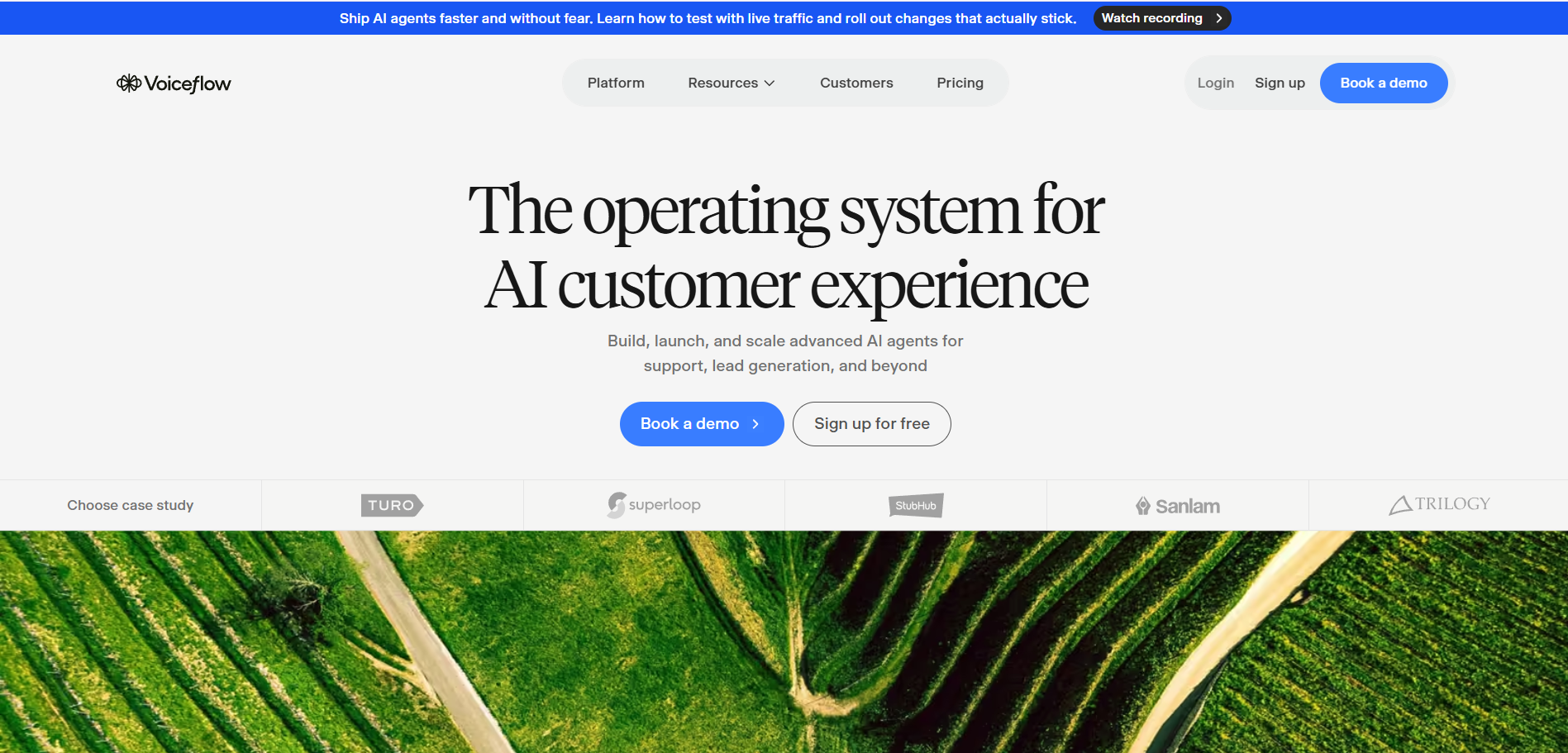
Voiceflow is a visual conversation designer that started life as an Alexa skill builder. Retell AI is a self-serve platform that publishes a full rate card and asks for no contract. Pick the wrong category for your situation and you either overpay for a managed service you did not need or buy a design tool that cannot run production phone traffic.
This is Retell's own comparison, so read it as a vendor making its case with sourced numbers rather than a neutral lab test. We pulled current pricing, G2 and Gartner ratings, latency data, and compliance status for every tool, and we credit each competitor where it genuinely wins.
Retell comes out ahead for most voice-agent buyers, but two of these platforms are the better call for specific situations, and we name them.
Retell AI fits most teams because it runs production phone agents on a published rate card with consistent response times, ships SOC 2 Type II and HIPAA on standard plans, and lets you start the same day with no sales call.
PolyAI is the right call for Fortune 500 contact centers that want the most natural branded voice persona and have six-figure budgets and 10,000+ inbound calls a month.
Replicant works best for large contact centers that want a fully managed, outcome-based service with a single flat annual fee and no in-house engineering.
Voiceflow is the pick for product and design teams that prototype complex chat-first conversation flows and treat voice as a secondary channel.
The table below scores each platform on the dimensions that decide a voice-agent purchase. Values come from each vendor's public pricing and documentation, G2 and Gartner ratings, and published benchmarks. Where a figure is not publicly disclosed, the cell says so rather than guessing.
| Dimension | Retell AI | PolyAI | Replicant | Voiceflow |
|---|---|---|---|---|
| Pricing model | Published rate card, varies by model and voice. | Custom enterprise, per-minute | Flat annual fee (Replicare) | Subscription + usage credits |
| Entry cost | $0 to start, $10 free credits | ~$150K/year (third-party estimate) | Six figures, est. $400K+ for large deployments | $0 free tier, $60/editor/mo Pro |
| Self-serve signup | Yes | No | No | Yes |
| Free trial | 60 free minutes | No | No | Yes, free tier |
| Latency (phone) | Consistent at concurrency, no published benchmark. | Not publicly disclosed | Not publicly disclosed | Varies, third-party dependent |
| No-code builder | Yes | Agent Studio (managed) | Managed by vendor | Yes, visual canvas |
| Full developer API | Yes | No | Limited | Yes |
| Bring-your-own LLM | Yes (GPT, Claude, Gemini, custom) | No, proprietary models | No, proprietary engine | Yes (OpenAI, Anthropic; BYO on Enterprise) |
| Voice channel focus | Phone-first | Phone-first | Phone, chat, SMS | Chat-first, voice secondary |
| Languages | 55+ | 29+ | 30+ | LLM-dependent |
| SOC 2 Type II | Yes | Yes (enterprise) | Yes (enterprise) | Yes |
| HIPAA | Standard plans, self-service BAA | Enterprise contract | Enterprise contract | Not standard |
| GDPR | Yes | Yes | Yes | Yes |
| On-prem deployment | Yes | No | No | Private cloud (Enterprise) |
| Built-in simulation testing | Yes | Limited | Vendor-run | Yes, design-stage |
| Telephony included | Yes (Twilio, SIP, BYO) | Yes (managed) | Yes (CCaaS integration) | No, separate carrier |
| Deployment time | Hours to days | 6 weeks minimum | 6 weeks or less | Hours (design); production needs glue code |
| G2 / Gartner rating | 4.8/5, 1,755 reviews (G2) | 4.6/5 (Gartner Peer Insights) | Positive, small sample (~21 on GetApp) | 4.6/5, ~110 reviews (G2) |
| Concurrent calls | 20 free, $8/mo each extra | Contract-defined | Contract-defined | Plan-defined credits |
| Enterprise discount floor | Negotiated | Negotiated | Negotiated | Negotiated |
Retell leads most rows because it serves the widest range of buyers in one product. PolyAI and Replicant lead on managed delivery and contract-grade compliance handling, and Voiceflow leads on visual design tooling. The detailed comparison below explains why each row landed where it did.
Retell owns the turn-taking model rather than chaining public APIs, so response times stay consistent at concurrency and the agent handles barge-in, pauses and background noise on real telephony. Test it on your own accents and line quality during the pilot.
Retell publishes its full rate card with no platform fee and no feature gating, so every plan opens the entire platform. Where you land depends on the model and voice you pick rather than on a sales conversation. Telephony is $0.015 a minute, SIP trunking carries no extra charge, and every account includes 20 concurrent calls. Teams running customer support at volume move to enterprise terms, and sales negotiates those rates case by case.
Every account starts with $10 in credits, 60 free minutes, 20 concurrent calls, and 10 free knowledge bases, so you can build and test before spending anything. The platform pairs a drag-and-drop builder with a full developer API, which means an operations manager and an engineer can work in the same product without either hitting a ceiling. Warm call transfer carries full conversation context to a human, and real-time calendar sync lets agents book appointments during the call.
Outbound teams use the same platform for lead qualification without bolting on a second tool.
The honest criticism: Retell asks for prompt tuning to sound fully natural out of the box, and combining a specific LLM with a specific voice provider for lowest latency takes a day or two of iteration. German voice quality has come up repeatedly in G2 reviews as a weak spot. None of this blocks production, but teams expecting zero configuration should know the work exists. Retell holds a 4.8/5 rating across 1,755 reviews on G2, with pricing forecasting at scale being the most cited drawback.
PolyAI is the platform where voice quality is the headline, not a feature. The company built its own ASR and conversational models rather than wrapping a third-party LLM, and in back-to-back listening tests its agents are consistently rated the most natural-sounding in the category. The branded persona work, designing an agent to match a brand's specific tone and cadence, produces a caller experience that plug-in voice providers do not match. Founded in 2017 by Cambridge researchers, PolyAI runs production voice for Marriott, Caesars Entertainment, PG&E, and Hopper.
The catch is access. There is no self-serve signup, no free trial, and no public API. Every deployment is a managed engagement that takes six weeks minimum, and pricing is custom-quoted with third-party estimates putting contracts around $150,000 a year and up. Gartner Peer Insights rates PolyAI 4.6, though with only around 37 total reviews across platforms, treat the sentiment as directional. The recurring critique outside the review sites is pricing opacity, and the minimum commitment means lower-volume teams pay for capacity they will not use.
PolyAI earns its place for one buyer: the large enterprise running thousands of phone calls a day in banking, travel, hospitality, or retail, where voice realism ties directly to brand and revenue, and where a six-figure spend on managed delivery is already justified. Below that scale, the contract floor and the deployment timeline tip the math toward a faster, self-serve option.
Replicant automates tier-1 contact center calls end-to-end with what it calls the Thinking Machine, and its design goal is resolution rather than deflection. The platform handles voice, chat, and SMS, supports 55+ languages, and cites containment rates above 80% once an agent is tuned. Its proprietary guardrails are built to prevent hallucinations and keep agents on brand, which matters for regulated buyers who cannot risk an agent improvising. Replicant reports 200+ enterprise deployments and more than half a billion minutes of conversation handled.
The commercial model is the differentiator. Replicare, its all-inclusive delivery model, bundles deployment, maintenance, and ongoing improvement into one flat annual fee with no change orders or per-feature surcharges. That removes the cost-forecasting problem that usage-based platforms create, which is a real advantage for a finance team that wants a single predictable number. The tradeoff is that pricing is enterprise-only and opaque, with third-party modeling putting a large healthcare deployment in the $400,000 to $600,000+ annual range, and containment takes three to four months to reach peak.
Replicant's documented weakness is the lack of self-service configuration, which several reviewers flag as a reason small adjustments move slowly. Implementation is a formal project, not a lightweight trial, so it suits large contact centers that want a partner to own the outcome rather than teams that want to iterate themselves. For that buyer, the flat-fee model is genuinely easier to live with than per-minute billing.
Voiceflow is the best visual conversation designer of the four, and its 4.6/5 rating across roughly 110 reviews on G2 is driven almost entirely by how approachable the drag-and-drop builder is. Product teams, agencies, and designers use it to map complex flows, prototype with GPT and Claude, and present working logic to stakeholders before committing to production. Teams at StubHub, Turo, and Trilogy use it to build chat agents fast, and Trilogy reports automating around 60% of support across 90 products in 12 weeks.
The honest framing is that Voiceflow is chat-first. Voice and phone exist, but they run through external telephony you connect yourself via Twilio or Vonage, and they are an add-on rather than the core product. Pricing combines a subscription, per-editor seats, and usage credits: the free tier gives 100 credits, Pro starts at $60 per editor per month, and Business runs $150 per editor per month, with each additional editor costing $50. Phone calls burn 10 credits per minute, and when credits run out the agent stops responding until the next cycle with no top-up option.
That credit cutoff and the seat-plus-usage stacking make Voiceflow hard to budget for high-volume B2C voice support, and the platform itself does not include latency control, branded caller ID, or production telephony.
Voiceflow wins clearly for the design and prototyping stage, especially for chat. For a team whose primary need is reliable inbound or outbound phone traffic, it is a planning tool rather than the deployment platform.
The four platforms use four different billing models, which is the single biggest source of confusion when buyers compare them. The table below lays out what you actually pay to reach production.
| Cost factor | Retell AI | PolyAI | Replicant | Voiceflow |
|---|---|---|---|---|
| Model | Per-minute, pay-as-you-go | Custom per-minute, annual contract | Flat annual fee | Subscription + credits |
| Headline rate | Published rate card, varies by model and voice. | Not published | Not published | $60/editor/mo (Pro) |
| Realistic all-in | Published rate card, varies by model and voice. | ~$150K+/year (estimate) | $400K+/year for large deployments (estimate) | $250–$500/mo for a small team |
| Platform fee | None | Bundled in contract | Bundled in Replicare | Base subscription |
| Telephony | $0.015/min or BYO SIP | Managed | Managed via CCaaS | Separate carrier, not included |
| Free entry | $10 credits, 60 minutes | None | None | Free tier, 100 credits |
| Enterprise floor | Negotiated | Negotiated | Negotiated | Custom |
Retell's pay-as-you-go model is the cheapest path to a working agent and the easiest to start, though component stacking means you should model your own all-in cost before scaling rather than trusting a single headline number. You can run the numbers against the public pricing page. PolyAI and Replicant both hide pricing behind sales, which suits enterprises with procurement teams but stops mid-market buyers from evaluating quickly.
Voiceflow looks cheap until you add editor seats and discover that voice calls drain credits fast. ContactBabel data puts the average human-handled inbound call at $7.16, so any of these platforms beats live agents on cost once volume is real, especially as the conversational AI market reaches $17.97 billion in 2026 on its way to $82.46 billion by 2034 per Fortune Business Insights. Retell and Voiceflow are the only two you can price-test today without a sales conversation.
For healthcare, financial services, and insurance, compliance is a gate, not a nice-to-have. Retell ships SOC 2 Type I and Type II, HIPAA with a self-service BAA portal, GDPR, and built-in PII redaction on standard plans, with on-premise deployment available for strict data residency.
The self-service BAA matters because it closes in about 24 hours rather than the weeks a sales negotiation adds. Teams in healthcare, financial services, and insurance can stand up a compliant agent without an enterprise contract.
PolyAI and Replicant both carry SOC 2 and support HIPAA, but only inside an enterprise agreement, which is consistent with their managed model and fine if you are already buying at that tier. Voiceflow holds SOC 2 and ISO 27001 and is GDPR compliant, but HIPAA is not part of its standard offering, which rules it out for regulated phone workloads unless you handle the compliance layer elsewhere.
| Certification | Retell AI | PolyAI | Replicant | Voiceflow |
|---|---|---|---|---|
| SOC 2 Type II | Yes | Yes (enterprise) | Yes (enterprise) | Yes |
| HIPAA | Standard, self-service BAA | Enterprise contract | Enterprise contract | Not standard |
| GDPR | Yes | Yes | Yes | Yes |
| On-prem | Yes | No | No | Private cloud only |
| PII redaction | Built in | Managed | Managed | Limited |
If you are running inbound or outbound phone automation and want to be live this week, Retell is the clearest fit. The combination of consistent response times, a no-code builder, a full API, and self-service HIPAA means an operations team and an engineering team can both work in it, and batch call functionality paired with outbound AI telemarketing handles campaigns without a separate tool. Most teams comparing these four end up here.
For a Fortune 500 brand in hospitality, travel, or banking whose callers must hear a voice indistinguishable from a trained brand ambassador, PolyAI is the better choice. Its proprietary voice models genuinely outperform plug-in providers on conversational naturalness, and if you have the call volume and the budget to absorb a six-figure managed contract, that quality is worth paying for. This is the row where a competitor wins outright.
If you run a large contact center, want a partner to own the outcome end-to-end, and value one predictable annual invoice over per-minute optimization, Replicant is the stronger pick. Its flat Replicare fee and managed delivery remove the forecasting headache, and its guardrails suit regulated buyers who cannot tolerate agent improvisation. Teams without engineering capacity who want managed results, not infrastructure, should look here first.
Teams whose immediate job is designing and prototyping conversation flows, especially chat, before anyone commits to a production telephony platform should reach for Voiceflow at that stage. Its visual canvas is the best in the category for mapping logic and getting stakeholder buy-in. When the design is approved and you need to put real calls through it, you can deploy the production agent on a phone-first platform and use Retell's knowledge base to ground the agent in your own content.
Which platform is cheapest to start with?
Retell AI is the cheapest to start. You pay from a published rate card with no platform fee, get $10 in credits and 60 free minutes, and need no contract. Voiceflow has a free tier too, but its voice calls consume credits quickly. PolyAI and Replicant require six-figure annual commitments with no free entry.
Do any of these platforms support HIPAA on a standard plan?
Only Retell AI offers HIPAA on standard plans through a self-service BAA portal that closes in about a day. PolyAI and Replicant support HIPAA but only inside enterprise contracts. Voiceflow does not offer HIPAA as part of its standard product, which excludes it from regulated phone workloads.
Which has the best voice quality?
PolyAI is consistently rated the most natural-sounding in back-to-back listening tests, thanks to its proprietary ASR and conversational models and its branded persona design. Retell is close behind with multi-provider voice including ElevenLabs. For pure conversational realism at enterprise scale, PolyAI leads.
Can I deploy a production phone agent on Voiceflow?
You can, but Voiceflow is chat-first and does not include telephony. Voice runs through external carriers like Twilio or Vonage that you connect and pay for separately, and the platform lacks latency control and branded caller ID. For phone-first workloads such as replacing a legacy phone tree with AI IVR, a purpose-built voice platform fits better; Voiceflow is strongest as a design and prototyping tool.
How long does each platform take to deploy?
Retell AI can produce a working test agent in hours and a production agent with integrations in days. Voiceflow prototypes in hours but needs additional engineering for production voice. PolyAI and Replicant are managed services with deployment timelines of six weeks or more.
Which platform fits a developer team that wants control?
Retell AI gives developers a full API plus bring-your-own LLM, voice provider, and telephony, with no vendor lock-in at any layer. Voiceflow offers an API and reserves bring-your-own LLM for its Enterprise tier. PolyAI and Replicant are managed services with proprietary engines and limited or no direct API access.
Are PolyAI and Replicant worth the six-figure cost?
For large enterprises running tens of thousands of calls a month with high labor costs, the managed model can pay back quickly. PolyAI cites a Forrester study reporting strong multi-year ROI for enterprise clients. For mid-market or smaller teams, the contract minimum and multi-week deployment usually make a self-serve platform like Retell the more practical choice.
See how much your business could save by switching to AI-powered voice agents.
Total Human Agent Cost
AI Agent Cost
Estimated Savings
A Demo Phone Number From Retell Clinic Office