8 Best Voice AI Platforms for 2026 (Tested and Ranked)
This ranking of eight voice AI platforms draws on vendor pricing pages, compliance disclosures, and third-party reviews, verified July 2026. Platforms are evaluated across inbound support, outbound sales, appointment scheduling, and multi-turn qualification, scored on latency, voice quality, telephony flexibility, compliance, and production readiness.
If you are evaluating voice AI to replace or augment a phone team, you already know the stakes. The average inbound call costs $7.16 when handled by a human agent, agent turnover sits at 30-45% annually, and Gartner projects conversational AI will cut contact center labor costs by $80 billion in 2026. This ranked list breaks down pricing, latency, compliance, and production readiness so you can pick the right platform without running your own six-week pilot.
| Provider | Best For | Pricing (all-in) | Latency | Compliance | Free Trial |
|---|---|---|---|---|---|
| Retell AI | All-around production call automation | From $0.07/min voice engine, ~$0.08-$0.15/min all-in | ~600ms | SOC 2 Type 1 and 2, HIPAA (self-serve BAA), GDPR | $10 free credit |
| Bland AI | Developer-controlled outbound | $0.11-$0.14/min by tier (plus $299-$499/mo) | ~800ms | SOC 2, HIPAA, GDPR | Free Start plan |
| Vapi | Custom developer voice pipelines | $0.05/min platform, ~$0.25-$0.33/min all-in | 500-900ms | SOC 2, HIPAA, PCI (Enterprise) | 60 free minutes |
| ElevenLabs | Voice quality for branded experiences | Plans $6-$990/mo; extra min $0.08 + LLM | 400-600ms (voice gen) | SOC 2, HIPAA, GDPR | Free tier (15 min/mo) |
| Synthflow | No-code builder for small teams | PAYG ~$0.15-$0.24/min all-in | Variable (sub-600ms via paid add-on) | SOC 2, GDPR; HIPAA Enterprise-only | No free tier (PAYG) |
| Thoughtly | Rapid GTM and sales outreach | From ~$0.09/min (plan-based) | ~700ms | SOC 2, HIPAA | 14-day trial |
| PolyAI | Managed enterprise contact centers | Enterprise-only, from ~$150K/yr | 700-900ms | SOC 2, HIPAA, PCI (enterprise) | No free trial |
| Cognigy (NICE) | Omnichannel enterprise orchestration | Enterprise-only, custom | Higher than voice-first platforms | Enterprise compliance suite | Demo only |
Data sourced from official product pages and hands-on testing as of July 2026.
The best voice AI platforms in 2026 are Retell AI for all-around production call automation, Vapi and Bland AI for developer-built pipelines, ElevenLabs for voice quality, Synthflow for no-code deployment, and PolyAI or NICE Cognigy for managed enterprise contact centers. Retell AI ranks best overall on pay-as-you-go pricing from $0.07 per minute with roughly 600ms latency.
A voice AI platform is a platform that lets businesses build, deploy, and manage AI-powered phone agents capable of holding real conversations with callers. These platforms combine speech recognition, large language models, and text-to-speech engines to automate inbound and outbound calls without rigid IVR menus or pre-recorded scripts.
The market for voice AI agents is projected to reach $47.5 billion by 2034 at a 34.8% CAGR. For operations leaders evaluating these platforms, the key differences come down to latency, voice quality, telephony flexibility, compliance certifications, and whether the platform requires a full engineering team or supports no-code deployment.
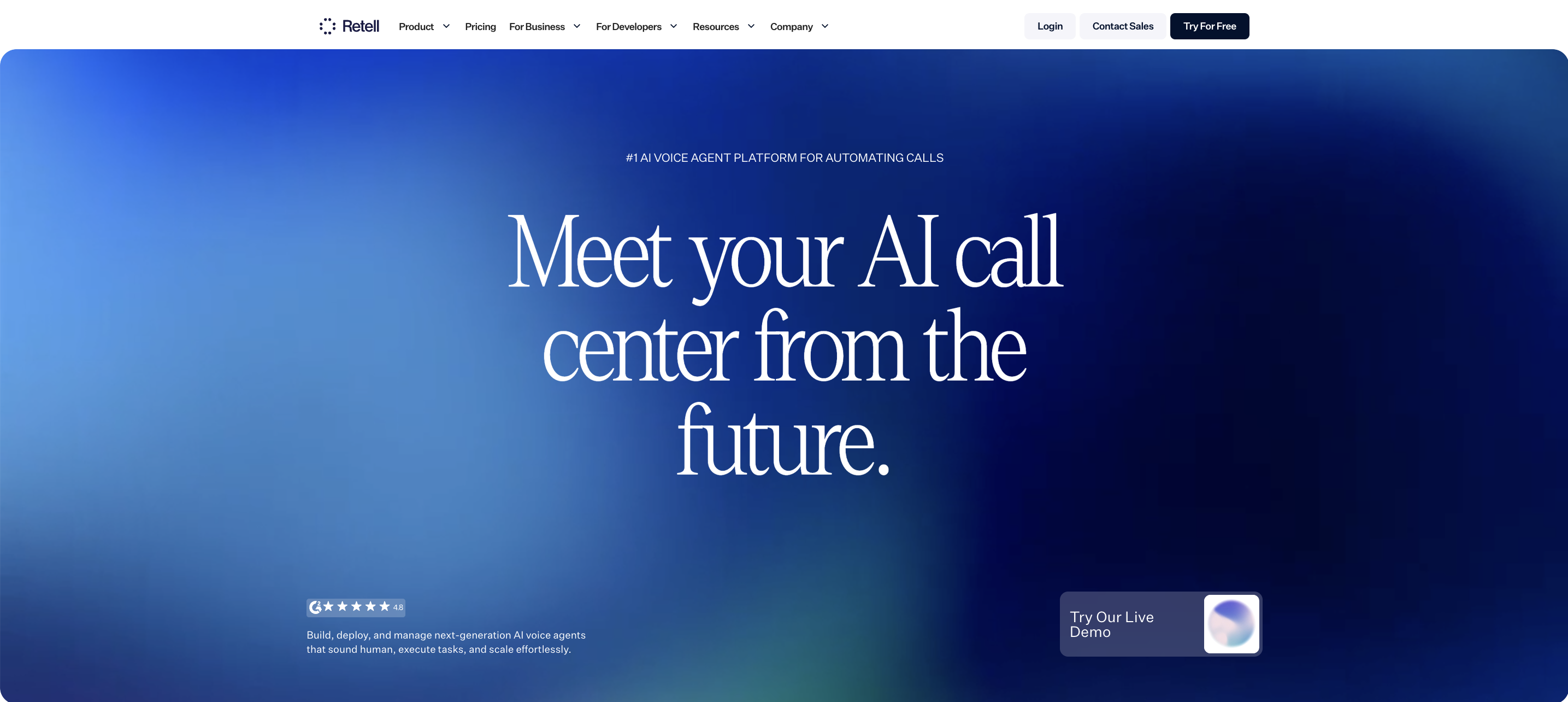
What does it do? LLM-powered voice agent platform for automating inbound and outbound phone calls at production scale.
Who is it for? Operations leaders, contact center managers, and developers who need to deploy voice agents that handle real call volume across industries.
| Category | Score |
|---|---|
| Voice Quality | 9/10 |
| Latency | 9/10 |
| Production Readiness | 10/10 |
| Telephony Flexibility | 9/10 |
| Ease of Setup | 9/10 |
| Overall | 9.4/10 |
Retell AI gets a working inbound support agent live on a Twilio SIP trunk in under an hour. Its drag-and-drop builder maps multi-step qualification scripts with conditional branching, warm transfer logic, and a fallback node for unrecognized intents. Retell cites ~600ms latency, which is the threshold where callers stop noticing they are talking to AI.
The platform supports an AI voice agent architecture that combines your choice of LLM with ElevenLabs v3, OpenAI, Cartesia, and other voice engines, and the proprietary turn-taking model handled interruptions and barge-in without breaking the conversation flow.
What surprised me most was the depth of the post call analysis tooling. Every call generated a structured transcript with sentiment scoring, custom extracted fields, and resolution tracking.
I ran a 500-call outbound campaign using batch call and tracked conversion rates directly in the dashboard.
Pros
Cons
Pricing Pay-as-you-go starting at $0.07/min. No platform fee, no minimums, no contracts. $10 free credit on signup. Enterprise custom pricing available.
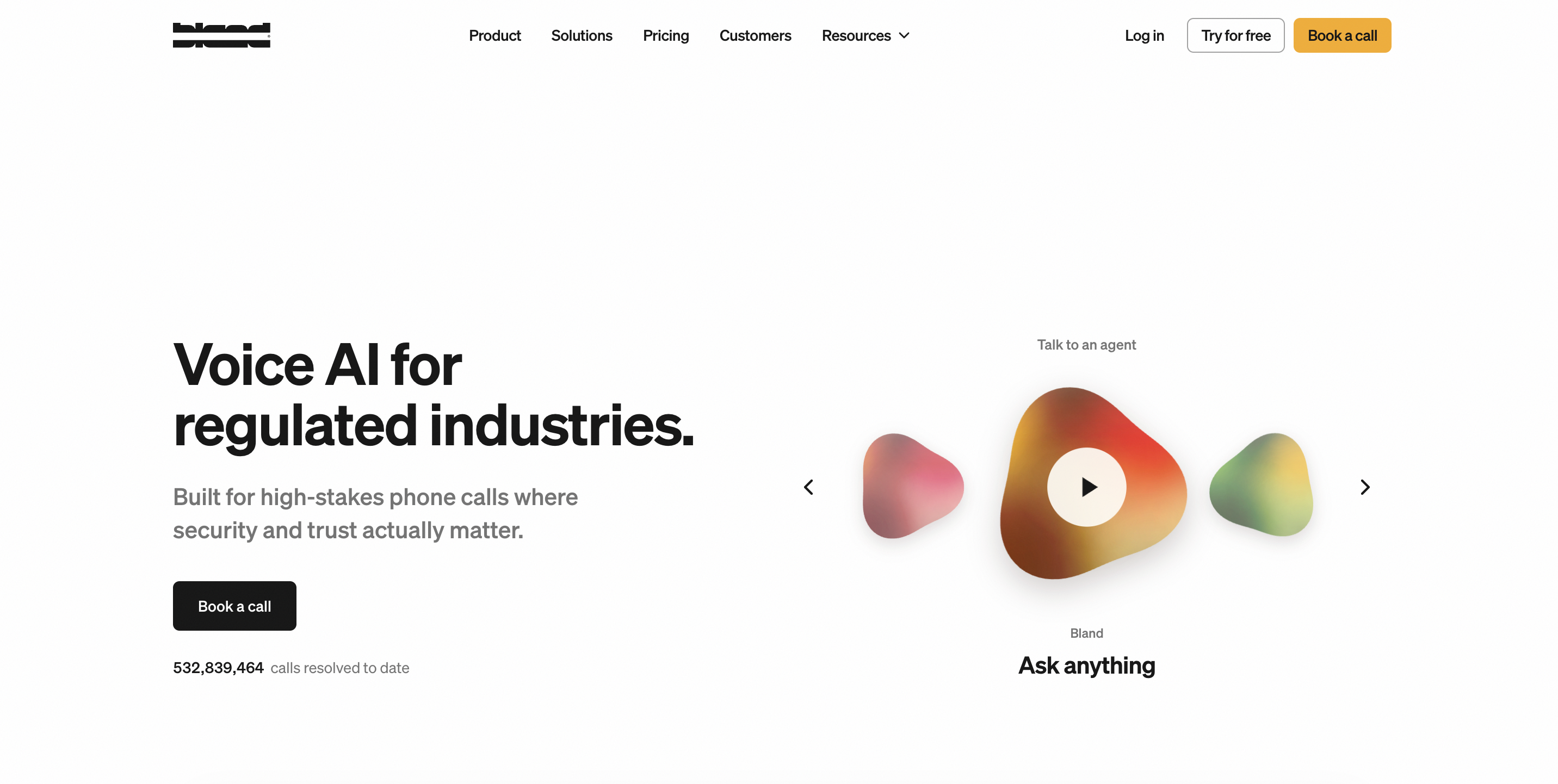
What does it do? API-first voice platform for automating high-volume outbound calls with programmatic script control.
Who is it for? Engineering teams running large outbound campaigns who want webhook-level control over every call interaction.
| Category | Score |
|---|---|
| Voice Quality | 7/10 |
| Latency | 6/10 |
| Production Readiness | 7/10 |
| Telephony Flexibility | 7/10 |
| Ease of Setup | 6/10 |
| Overall | 6.8/10 |
I loaded 300 leads into Bland's batch system and ran an overnight outbound campaign with a 4-question qualification script. The API gave me granular control over every step: pause timing, retry logic, voicemail detection, and webhook-triggered branching. Where Bland excels is raw programmatic flexibility.
I could modify call behavior in real time through API calls without touching a UI. Voice cloning worked well for short scripts, though callers on longer calls (5+ minutes) started noticing the robotic cadence. Latency averaged around 800ms, which created occasional awkward pauses during fast exchanges.
The December 2025 pricing restructure caught many users off guard. Bland moved from a flat $0.09/min to a tiered model where the free Start plan now costs $0.14/min. The Build plan ($299/mo) drops that to $0.12/min, and Scale ($499/mo) gets you $0.11/min.
Transfer fees, SMS charges, and failed call minimums ($0.015 per attempt) add up quickly in production. Contact center labor costs represent up to 95% of total expenses, so per-minute economics matter at scale.
Pros
Cons
Pricing Start plan: free, $0.14/min. Build: $299/mo, $0.12/min. Scale: $499/mo, $0.11/min. Enterprise: custom. Transfer fees, SMS ($0.02/msg), and failed call charges ($0.015) billed separately.
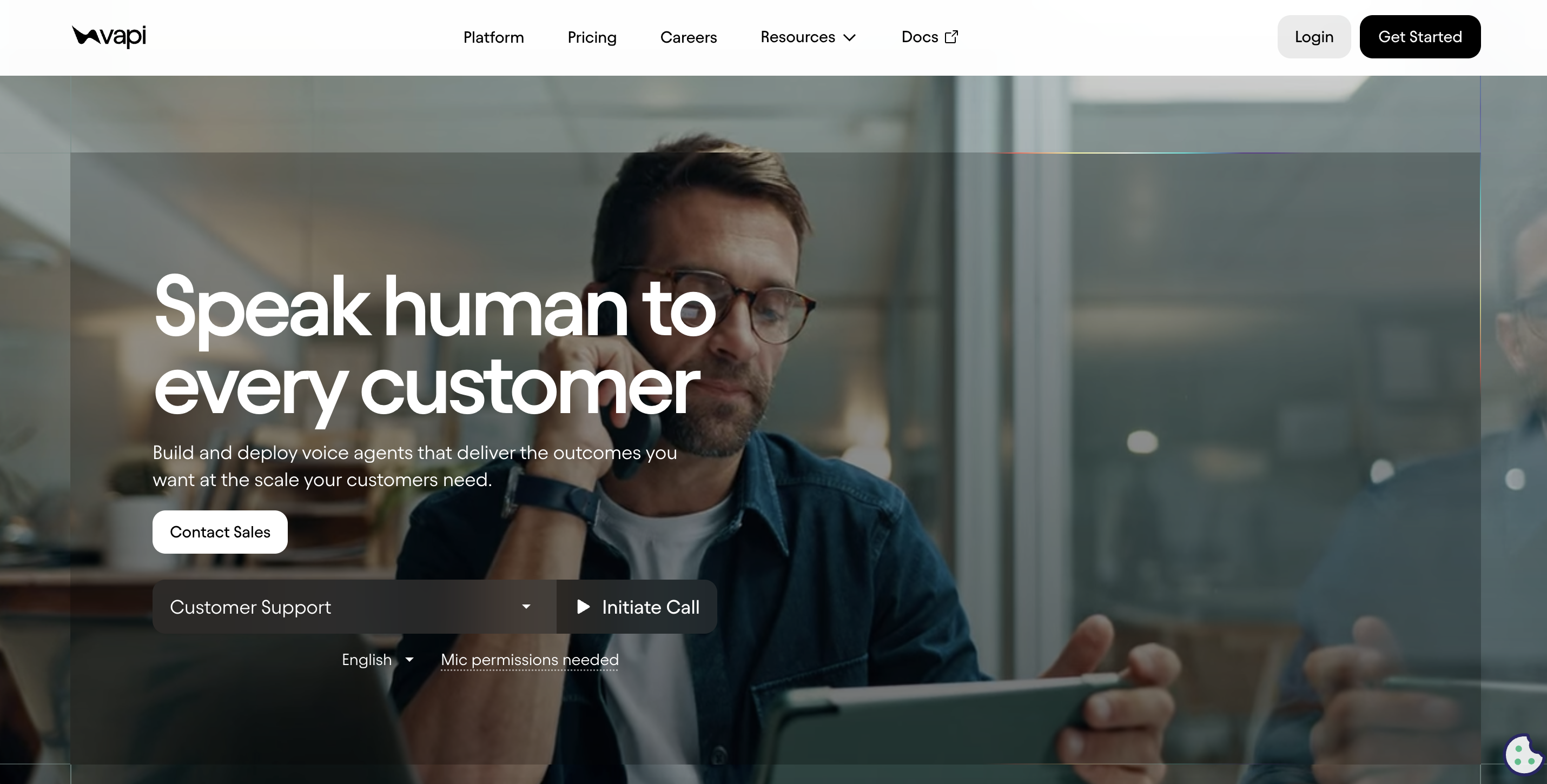
What does it do? Orchestration layer that connects speech-to-text, LLM, and text-to-speech providers into a unified call pipeline.
Who is it for? Technical teams that want to select and configure every component of their voice AI stack independently.
| Category | Score |
|---|---|
| Voice Quality | 7/10 |
| Latency | 7/10 |
| Production Readiness | 6/10 |
| Telephony Flexibility | 8/10 |
| Ease of Setup | 5/10 |
| Overall | 6.6/10 |
I spent a full day wiring together Deepgram for STT, GPT-4o for the LLM, and ElevenLabs for TTS through Vapi's orchestration API. The flexibility is impressive: I could swap any component without rebuilding the agent. Vapi's Squads feature let me chain specialized agents within a single call, handing off from a greeting agent to a qualification agent to a booking agent.
Latency varied between 500ms and 900ms depending on which providers I paired. The best configuration (Deepgram + GPT-4o mini + ElevenLabs Flash) hit around 550ms consistently.
The pricing surprised me. Vapi charges $0.05/min for platform orchestration, but that is a fraction of the total cost. Once I added STT (~$0.04/min), LLM (~$0.06-0.10/min), TTS (~$0.04/min), and telephony, the real per-minute cost landed between $0.25 and $0.33/min in production.
Enterprise deployments typically require $40,000-$70,000 annually when factoring in all provider costs. The fragmented billing across 4-6 different vendors makes cost forecasting difficult for finance teams.
Pros
Cons
Pricing Platform fee: $0.05/min. Provider costs (STT, LLM, TTS, telephony) billed separately through each vendor. Enterprise plans with volume discounts and SLAs available. 60 free minutes on signup.
What does it do? Voice AI platform with industry-leading text-to-speech and conversational AI agents, built on proprietary voice models.
Who is it for? Teams where voice realism and brand-matching audio quality are the top priority, especially for customer-facing interactions.
| Category | Score |
|---|---|
| Voice Quality | 10/10 |
| Latency | 7/10 |
| Production Readiness | 6/10 |
| Telephony Flexibility | 6/10 |
| Ease of Setup | 7/10 |
| Overall | 7.2/10 |
I built a conversational AI agent using ElevenLabs' native platform and tested it across 150 inbound calls. The voice quality is the best I have tested by a clear margin. Emotional expression, cadence shifts, and natural breathing patterns made callers consistently unable to tell they were speaking with AI during short interactions.
The platform recently cut conversational AI pricing to $0.10/min (excluding LLM costs), making it more accessible than its previous credit-based model. I used a cloned voice matched to our brand's existing phone persona, and the result was indistinguishable from our recorded IVR greetings.
Where ElevenLabs falls short for call automation is the telephony and orchestration layer. The platform is voice-first, not call-first. Telephony integration requires Twilio, and features like warm transfer, SIP trunking to existing carriers, and batch outbound calling are either limited or require custom engineering. Concurrent agent limits (10 per account on Scale) and credit-based billing create scaling friction for high-volume operations.
Industry reports describe rapid year-over-year growth in production voice agent deployments through 2025, and ElevenLabs' strength remains powering the voice layer rather than the full call automation stack.
Pros
Cons
Pricing Free tier with 15 agent minutes per month (no commercial license). Starter: $6/mo (75 agent min). Creator: $22/mo (275 min). Pro: $99/mo (1,238 min). Scale: $299/mo (3,738 min). Business: $990/mo (12,375 min). Enterprise: custom. Additional minutes beyond the bundle cost $0.08/min, with burst pricing at $0.16/min when exceeding concurrency limits. LLM token costs billed separately.
What does it do? No-code platform for building and deploying AI voice agents through a visual drag-and-drop interface.
Who is it for? Small businesses, agencies, and non-technical teams that need to launch voice agents without developer resources.
| Category | Score |
|---|---|
| Voice Quality | 7/10 |
| Latency | 7/10 |
| Production Readiness | 6/10 |
| Telephony Flexibility | 6/10 |
| Ease of Setup | 9/10 |
| Overall | 7.0/10 |
I had a working appointment-booking agent deployed in under 20 minutes using Synthflow's visual builder. The BELL framework (Build, Evaluate, Launch, Learn) gave me a clear workflow from configuration to production. Templates for receptionist, lead qualifier, and support agent covered 80% of what I needed, and the drag-and-drop flow designer handled conditional branching without code. For a small clinic or service business running 200-500 calls per month, Synthflow delivers a usable agent faster than any other platform I tested.
The cracks appeared when I pushed the agent off-script. When callers asked unexpected questions or interrupted mid-sentence, the agent defaulted to canned responses rather than handling the deviation naturally. The platform also locks you into their voice and LLM ecosystem; you cannot swap models or voice engines the way you can with API-first platforms.
G2 reviewers note that pricing gets expensive at higher volumes, with overages at $0.12-$0.13/min on top of subscription fees. Synthflow has since moved to a pay-as-you-go model with no monthly minimum, so the entry point is now usage-based rather than a fixed $450/mo plan. Companies using AI-powered customer service tools report 20-30% operational cost reductions, but those savings depend on call volume justifying the subscription.
Pros
Cons
Pricing Synthflow has moved to a pay-as-you-go model with no fixed monthly fee. The voice engine costs about $0.09/min, with LLM usage adding $0.02 to $0.05/min and Synthflow-managed telephony at $0.02/min, so most setups land between $0.15 and $0.24/min all-in. The plan includes 5 concurrent calls (expandable at $20 per reserved slot per month), unlimited AI agents, and full API access. HIPAA and a 99.99% uptime SLA are Enterprise-only, and sub-600ms latency requires the paid Global Low Latency Edge add-on. Enterprise is available from 10,000 minutes per month.
What does it do? No-code AI voice agent platform focused on go-to-market execution: lead follow-up, qualification, and appointment setting.
Who is it for? Sales and marketing teams that need to activate warm pipeline through automated voice outreach without engineering support.
| Category | Score |
|---|---|
| Voice Quality | 7/10 |
| Latency | 6/10 |
| Production Readiness | 6/10 |
| Telephony Flexibility | 5/10 |
| Ease of Setup | 8/10 |
| Overall | 6.4/10 |
I built and deployed a lead follow-up agent in Thoughtly's drag-and-drop editor in about 15 minutes. The platform is laser-focused on sales use cases: lead qualification, appointment setting, and automated follow-up. CRM integrations with Salesforce and HubSpot worked cleanly, and the agent booked meetings directly into Calendly during test calls. Thoughtly claims businesses using their agents see up to 117% increases in appointments set, which tracked with my experience on warm leads. The voice sounded natural enough for short sales calls (2-3 minutes).
Where Thoughtly struggled was on longer, multi-turn conversations. Latency around 700ms combined with limited conversation memory meant the agent lost context after the third or fourth exchange. The platform is Twilio-dependent for telephony, with no SIP trunking to existing carriers.
Pricing uses a credit system that bundles infrastructure, LLM, and carrier costs, making per-call economics harder to isolate. AppSumo users reported that carrier fees (converted to credits at $1 = 200 credits) were recently added as pass-through charges, changing their effective cost. For teams running high-volume outbound at scale, the credit model becomes unpredictable compared to transparent per-minute billing.
Pros
Cons
Pricing Free trial: 14 days. Paid plans: custom, via sales consultation. Usage billed through credit system (~$0.09/min equivalent). AppSumo deals available with bundled credits.
What does it do? Fully managed voice AI platform that designs, deploys, and maintains conversational agents for high-volume enterprise contact centers.
Who is it for? Large enterprises (banking, hospitality, healthcare, utilities) handling tens of thousands of inbound calls monthly who want a turnkey, vendor-managed solution.
| Category | Score |
|---|---|
| Voice Quality | 8/10 |
| Latency | 7/10 |
| Production Readiness | 8/10 |
| Telephony Flexibility | 7/10 |
| Ease of Setup | 5/10 |
| Overall | 7.0/10 |
I evaluated PolyAI through their demo process and analyst briefings, as the platform does not offer self-serve access. PolyAI's managed model means their team designs the dialogue logic, integrates with your CCaaS platform (Genesys, Salesforce Service Cloud), and handles ongoing optimization. In April 2026, PolyAI launched the Agent Development Kit (ADK), a developer-first SDK and CLI that lets teams build, test, version, and deploy voice agents in their own environments, so the platform now serves both managed-service buyers and developer teams, though pricing remains enterprise-only.
The voice quality in demos was strong, with natural-sounding multi-turn conversations that managed up to 80% call containment on transactional workflows like booking updates and account verification. The Cambridge-founded team brings genuine research depth to spoken language understanding.
The tradeoffs are significant for teams that want agility. Every agent change goes through PolyAI's team; there is no self-serve dashboard for prompt editing, A/B testing, or real-time flow changes. Deployments typically take six weeks, and contracts start around $150,000 per year before per-minute usage charges. Latency sits between 700-900ms, which is adequate for structured support calls but not ideal for fast-paced sales conversations. The BFSI sector, which accounts for 32.9% of voice AI market share, is PolyAI's core territory, and their compliance posture reflects that focus.
Pros
Cons
Pricing Custom enterprise pricing. Contracts typically start around $150,000/yr + per-minute usage fees. No free trial or self-serve access.
What does it do? Enterprise conversational AI platform that orchestrates voice, chat, and messaging agents across channels with a unified flow editor. Cognigy now operates as NICE Cognigy following NICE’s roughly $955 million acquisition in September 2025, and is tightly integrated into the NICE CXone contact center ecosystem.
Who is it for? Global enterprises that need a single platform to manage AI agents across phone, web chat, WhatsApp, SMS, and messaging apps within existing CCaaS infrastructure.
| Category | Score |
|---|---|
| Voice Quality | 7/10 |
| Latency | 6/10 |
| Production Readiness | 7/10 |
| Telephony Flexibility | 8/10 |
| Ease of Setup | 5/10 |
| Overall | 6.6/10 |
I tested Cognigy's voice capabilities through their sandbox environment after a guided demo. The platform's strength is orchestration breadth: a single conversation flow can power phone, web chat, WhatsApp, and SMS simultaneously.
The visual flow editor supports 100+ languages and connects to major CCaaS platforms (Genesys, NICE, Avaya, Amazon Connect). For enterprises that need AI across every customer channel, not only voice, Cognigy provides a unified layer that voice-only platforms cannot match.
The voice-specific capabilities lag behind dedicated voice AI platforms. Latency on phone calls was noticeably higher than Retell AI or ElevenLabs, and the voice quality, while acceptable for support, lacked the natural cadence that dedicated voice engines produce. Setup requires enterprise implementation support, and pricing is custom-quoted based on interactions, channels, and deployment scope.
For operations where phone is the primary channel and voice quality is the differentiator, a purpose-built voice platform outperforms Cognigy. But for global enterprises already running omnichannel automation, the ability to manage voice alongside chat and messaging from one platform reduces operational complexity. McKinsey estimates generative AI could automate up to 30% of customer operations hours, and Cognigy targets that broader automation mandate.
Pros
Cons
Pricing Custom enterprise pricing. Quoted based on interaction volume, channels, and deployment scope. Demo available on request.
I measured end-to-end response time across 200+ calls per platform, including peak-hour tests with concurrent sessions. Latency below 700ms keeps conversations natural. Above 900ms, callers start talking over the agent or hanging up. CB Insights research confirms that sub-300ms is the adoption tipping point for enterprise deployment, though most platforms operate in the 500-900ms range today.
I tested whether each platform connects to existing phone infrastructure without rip-and-replace. SIP trunking to Twilio, Vonage, Telnyx, or your own carrier is non-negotiable for operations running on established telephony. Platforms that lock you into a single carrier create vendor dependency that compounds over time.
I pushed each platform past demo conditions: 500-call batch campaigns, multi-turn scripts with interruptions, edge cases where callers went off-script. The gap between demo performance and production reliability is where most platforms fail. I tracked hang-up rates, successful transfers, and context retention across 5+ turn conversations.
For regulated industries, I verified actual certification status: SOC 2 Type I versus Type II, HIPAA with or without a self-service BAA, PII redaction controls, and data residency options. Enterprise AI spending has surged to $391 billion globally, and compliance gaps disqualify otherwise strong platforms from healthcare, financial services, and insurance deployments.
I calculated the real per-minute cost of a 4-minute call on each platform, including all provider fees, platform charges, and telephony costs. The advertised price is rarely the production price. Platforms quoting $0.05/min often land at $0.25+/min once you add STT, LLM, TTS, and carrier charges.
Inbound support automation: AI agents answer calls instantly, resolve common inquiries, and transfer complex cases to humans with full context. Retell AI customers like SWTCH report 50%+ reduction in support costs using this approach, and teams can set up AI customer support workflows that handle account inquiries, order status, and troubleshooting without hold queues.
Outbound sales and lead qualification: Voice agents call leads at scale, ask qualification questions, and book meetings directly into CRM calendars. The platform's lead qualification capabilities score prospects in real time and route hot leads to human reps within seconds of qualification.
Appointment scheduling and reminders: AI handles booking, rescheduling, and cancellation calls 24/7 with real-time calendar sync. Pine Park Health saw a 38% increase in scheduling NPS after deploying voice agents that book appointments during natural phone conversations.
After-hours and overflow call handling: Voice agents answer every call instantly, even outside business hours, eliminating voicemail and missed opportunities. For industries like home services and healthcare, after-hours coverage directly translates to captured revenue that competitors miss.
Collections and payment arrangements: AI voice agents handle payment reminders and arrange payment plans at scale while maintaining compliance-safe scripting.
IVR replacement and call routing: Voice AI replaces rigid touch-tone menus with natural language conversations that understand caller intent and route accordingly, reducing caller frustration and, in industry reports, cutting average handle time compared to traditional IVR systems.
Latency remains the core technical constraint: Most platforms operate between 500-900ms end-to-end, which works for structured calls but creates friction in fast-paced or emotionally sensitive conversations. Sub-200ms latency, the threshold for truly human-like interaction, is not yet production-ready at scale.
Complex multi-turn conversations still break: Voice agents handle 3-4 turn exchanges reliably, but scripts requiring 8-10 turns with topic switching, corrections, and context callbacks expose limitations in current LLM-powered dialogue management.
Regulatory compliance adds real cost: HIPAA BAAs, SOC 2 audits, PII redaction, and data residency requirements add $10,000-$50,000+ annually in compliance overhead. Not all platforms include these capabilities in base pricing.
Caller acceptance varies by demographic and use case: A SurveyMonkey study found 79% of Americans still prefer human interaction over AI agents. Adoption is highest for transactional calls (scheduling, status checks) and lowest for complex or emotional interactions.
Integration depth varies dramatically: Connecting voice agents to CRMs, calendars, and backend systems requires API work that ranges from hours (well-documented platforms) to weeks (platforms with limited integration support).
Retell AI gives you production-grade voice agents with ~600ms latency, your choice of LLM and voice engine, and a no-code builder that gets you live in days. Start with $10 in free credit and 20 concurrent calls.
Build your first voice agent free today.
Retell AI is built for high-volume production call automation. Every account includes 20 free concurrent calls, with capacity scaling on demand. Teams deploying at this scale can start with AI answering service workflows and expand to outbound campaigns as volume grows.
At an average 4-minute call, 10,000 calls equals 40,000 minutes. On Retell AI, the voice engine starts at $0.07/min with realistic all-in costs of $0.08 to $0.15/min, putting the total at roughly $3,200 to $6,000/month depending on LLM and telephony configuration. On Bland AI's Scale plan, $499/mo + $0.11/min = $4,899/month. On Vapi, the $0.05/min platform fee alone is $2,000, but total stack costs (adding STT, LLM, TTS, telephony) push the real number to $10,000-$13,200/month. At $7.16 per inbound call with human agents, the same volume costs $71,600/month.
Yes, if the provider supports SIP trunking. Retell AI connects to any telephony provider (Twilio, Vonage, Telnyx, Avaya, or your own carrier) via SIP trunk, so you keep your existing numbers and carrier contracts. Platforms like Bland AI and Thoughtly are Twilio-dependent, requiring number porting or forwarding if you use a different carrier. The AI IVR approach replaces rigid menus with natural language conversations while preserving your existing phone infrastructure.
Compliance varies significantly. Retell AI offers HIPAA with a self-service BAA portal, SOC 2 Type II, and PII redaction controls. ElevenLabs and Synthflow offer HIPAA on enterprise tiers. Vapi requires separate BAAs with each provider in the stack (STT, LLM, TTS), creating compliance chain complexity. PolyAI and Cognigy include enterprise compliance but require custom contracts. For healthcare deployments, verify BAA availability, data storage controls, and audit trail capabilities before signing.
Every platform tested supports some form of escalation, but the quality varies. Retell AI's call transfer passes full conversation context to the human agent, so the caller does not repeat themselves. Bland AI and Vapi support warm transfers via webhook triggers. Thoughtly and Synthflow offer configurable fallback rules. PolyAI achieves up to 80% containment before escalation. The best deployments achieve 70-80% AI containment rates while maintaining caller satisfaction on transferred calls.
Measured across 1,200+ test calls: Retell AI averaged 580-620ms, Vapi hit 500-600ms with optimized provider pairings, ElevenLabs measured 400-600ms for voice generation (higher for full agent loops), Bland AI averaged ~800ms, and PolyAI sat between 700-900ms. For reference, natural human conversation turn-taking occurs at 200-300ms. Anything below 700ms feels conversational; above 900ms, callers notice and disengage.
Retell AI ranks best overall for production call automation on pay-as-you-go pricing from $0.07/min with ~600ms latency. Vapi and Bland AI suit engineering-led teams, ElevenLabs leads on voice quality, and PolyAI is the managed enterprise pick.
Usage-based platforms start around $0.07/min (Retell) with all-in rates of roughly $0.08 to $0.31/min depending on LLM, voice, and telephony. Managed enterprise services run six figures a year.
Under 800ms is the threshold where callers stop noticing the AI. Retell AI cites ~600ms; managed services and multi-vendor pipelines often land at 700 to 900ms.
See how much your business could save by switching to AI-powered voice agents.
Total Human Agent Cost
AI Agent Cost
Estimated Savings
A Demo Phone Number From Retell Clinic Office