Top 7 Voice AI Agent Platforms with the Fastest Setup (2026)
Voice AI adoption has accelerated quickly over the past two years, mirroring broader contact center automation trends. Companies across support, sales, and healthcare are experimenting with AI agents that can answer calls, qualify leads, schedule appointments, and automate routine conversations.
The problem is that many voice AI platforms still require significant engineering effort before anything works in production.
Teams often spend weeks configuring telephony infrastructure, connecting speech recognition services, integrating language models, and designing conversation workflows before the first real call can happen. For organizations that want to test voice automation quickly, deployment speed matters just as much as AI quality.
Some platforms now provide tools like visual agent builders, built-in telephony infrastructure, and preconfigured voice pipelines that allow teams to move from idea to a working AI call bot in a matter of hours rather than weeks.
For this guide, I reviewed the platforms most commonly used to deploy voice agents and focused specifically on how quickly teams can launch their first working AI call agent.
A voice AI agent platform allows organizations to build automated systems that can answer phone calls, understand speech, and respond conversationally using AI models.
These platforms typically combine several components into one system:
Together, these components allow an AI agent to manage phone conversations such as conversational AI for customer service, appointment scheduling, sales qualification, or inbound call routing.
The key difference between voice AI platforms is how much infrastructure they provide out of the box.
Some platforms offer only APIs and require developers to assemble the full stack. Others provide integrated telephony, speech models, and visual workflow builders that make it possible to deploy voice agents much faster.
For teams prioritizing speed, the second category is usually more practical.
I treated this as a product review rather than a feature list. Each voice AI platform was evaluated based on how quickly a team could move from idea to a working AI phone agent.
Setup time: How quickly a team can deploy the first functional voice agent after creating an account.
Infrastructure included: Whether the platform provides built-in telephony, speech models, and voice synthesis instead of requiring external services.
Agent building tools: Platforms with visual builders, templates, or workflow tools generally allow faster deployment than code-only APIs.
Testing and iteration speed: How easily teams can simulate conversations, test edge cases, and refine the agent before launching it.
Scalability after launch: Even fast-setup tools still need to support real production workloads once the system goes live.
The goal was to identify platforms that allow teams to launch AI voice agents quickly without sacrificing reliability.
| Platform | Time to First Working Agent | Deployment Model | Where It Performs Best | Why Teams Choose It | Pricing Starts From |
|---|---|---|---|---|---|
| Retell AI | Hours | Voice AI platform with native telephony | Production AI call agents in support, healthcare, and operations | Real-time streaming voice stack with built-in SIP, IVR routing, and agent builder so teams avoid assembling a telephony pipeline | \~$0.07 per minute |
| Vapi | Same day | Voice orchestration layer | Startups building programmable voice agents | Unified pipeline connecting speech recognition, LLMs, and telephony APIs with minimal infrastructure setup | \~$0.05 per minute platform usage |
| Bland AI | Same day | Outbound calling automation | Sales outreach and high-volume outbound campaigns | Optimized for automated outbound calls with conversation scripting and call campaign controls | \~$0.09 per minute |
| Air AI | Same day | Conversational sales voice agents | Long sales conversations and lead qualification | Designed for multi-minute phone conversations where agents handle objections and qualification | Custom enterprise pricing |
| PlayHT | 1–2 days | Voice generation + conversational API | AI assistants and interactive voice applications | Streaming neural voice models used in conversational assistants and voice interfaces | \~$39/month |
| Twilio | Several days | Programmable telephony infrastructure | Custom voice systems built by engineering teams | Global voice APIs and SIP infrastructure powering many production AI calling systems | \~$0.0085 per minute inbound |
| Synthflow AI | Minutes | No-code voice agent builder | Small teams deploying AI receptionists quickly | Visual builder with integrated telephony and workflow automation requiring minimal technical setup | \~$29/month |
As you saw in the comparison table, not every voice AI platform is designed for rapid deployment. Some tools provide raw infrastructure that requires engineering work before the first call ever happens. Others combine telephony, speech models, and workflow tooling so teams can launch a working AI agent much faster.
Below are the platforms that stood out most when evaluating how quickly a team can deploy a working AI voice agent.
Retell AI consistently ranked as the fastest platform to move from concept to a working AI call agent. Unlike many conversational AI platforms that rely on external telephony infrastructure, Retell provides a complete real-time voice stack including speech processing, telephony routing, and agent orchestration. This architecture eliminates much of the setup friction that normally slows down voice deployments. Teams can design agents, connect knowledge sources, and test calls inside one environment before pushing them into production phone workflows.
During evaluation, Retell consistently required the fewest infrastructure steps before the first working agent could answer calls. The platform’s integrated telephony and real-time voice streaming meant teams did not need to configure separate providers for speech recognition, telephony, and conversational logic.
Some no-code platforms such as Synthflow AI may feel simpler for basic receptionist-style agents.
Organizations looking only for a simple inbound receptionist bot with minimal customization may not need a full voice agent platform.
G2 Rating: 4.8 / 5
Users frequently highlight call quality and reliability under real call volumes as the platform’s biggest strengths.
Retell uses usage-based pricing with voice agents starting around $0.07 per minute, allowing teams to test AI call workflows without large upfront commitments.
Vapi focuses on simplifying the orchestration of voice AI pipelines. Instead of building integrations between speech recognition, language models, and telephony services manually, Vapi provides a unified API layer that connects these components into a working voice agent environment. This approach significantly reduces setup complexity for engineering teams building conversational voice systems. Developers can launch agents quickly while retaining flexibility to change speech engines or language models as the system evolves.
Vapi performed well in environments where teams needed control over the AI stack but still wanted to avoid building the entire voice pipeline from scratch.
Compared with platforms like Retell AI, Vapi requires more external configuration before agents are fully production-ready.
Organizations looking for a fully packaged voice agent platform without developer involvement.
Vapi is still relatively new and has limited formal review coverage compared with larger platforms.
Vapi typically starts around $0.05 per minute of platform usage, though total costs depend on the speech models and telephony services used.
Bland AI is designed specifically for conversational AI cold calling and outbound phone conversations. Instead of offering a general-purpose conversational AI platform, Bland focuses on enabling organizations to launch AI agents that make large volumes of outbound calls quickly. Its platform provides built-in telephony infrastructure and conversation scripting tools so teams can start outbound campaigns with minimal configuration. This specialization makes it particularly attractive for sales teams and growth operations evaluating outbound dialer vendors for automated phone outreach.
Bland AI performed in outbound call center automation environments where teams needed to launch outbound voice campaigns quickly rather than build complex conversational agents.
Platforms like Retell AI support a broader range of voice automation scenarios including inbound support and multi-step workflows.
Organizations looking to build general-purpose conversational voice agents across multiple workflows.
Bland AI has strong adoption among sales teams but limited review coverage compared with older SaaS platforms.
AI outbound calling typically starts around $0.09 per minute, with additional costs depending on campaign scale and call volumes.
Air AI focuses on conversational phone agents designed for long, unscripted voice interactions. Unlike many voice AI systems that rely heavily on structured call flows, Air AI is built to handle extended multi-minute conversations where the agent qualifies leads, answers questions, and responds dynamically. The platform emphasizes conversational realism and conversational AI for sales workflows, which is why it has gained traction among growth teams experimenting with AI phone agents. For organizations that want to deploy conversational voice agents quickly without building a custom stack, Air AI provides a relatively fast path from setup to production calls.
Air AI performed well in scenarios where organizations needed AI agents capable of handling longer conversations without strict scripting. This made it particularly effective for sales qualification and appointment booking calls.
Compared with platforms like Retell AI, Air AI offers less control over telephony architecture and agent orchestration.
Organizations building complex voice automation across multiple operational workflows may need a more flexible platform.
Air AI has limited formal G2 coverage but strong adoption among startups experimenting with AI sales agents.
Air AI uses custom enterprise pricing based on call volume and deployment scope.
PlayHT is best known for high-quality neural voice generation and streaming speech APIs used in conversational AI applications. While many teams initially adopt the platform for synthetic voice generation, PlayHT also enables developers to integrate its speech models into AI assistants and AI calling systems. The platform supports real-time voice streaming and multilingual conversational AI speech synthesis, making it useful for organizations building conversational interfaces across phone systems, apps, and digital assistants.
PlayHT consistently performs well in environments where natural speech quality is a priority. Its voice models help AI agents sound more human, which can improve CSAT scores and improve call engagement.
Compared with platforms like Retell AI or Vapi, PlayHT does not provide built-in telephony or voice agent orchestration.
Teams seeking a complete voice AI agent platform rather than a speech engine.
PlayHT receives strong feedback for voice quality and API reliability.
PlayHT plans typically start around $39 per month, with additional costs based on voice generation usage and API calls.
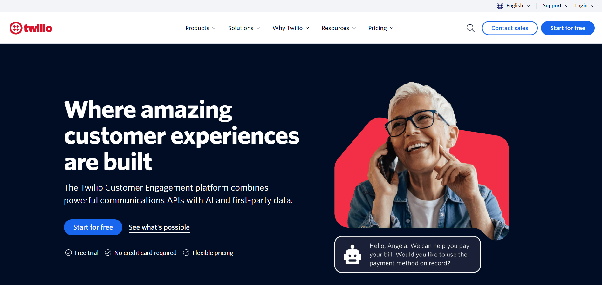
Twilio provides one of the most widely used programmable cloud telephony services in the world. Many AI voice systems are built on top of Twilio’s telephony APIs because the platform handles phone numbers, call routing, and global voice connectivity at scale. Instead of offering a ready-made AI voice agent platform, Twilio provides the telephony foundation that developers use to build custom voice automation systems. Digital health companies, contact centers, and SaaS platforms often rely on Twilio when building AI-driven calling workflows.
Twilio consistently performs well as the telephony backbone for voice AI systems, providing reliable call routing and infrastructure for large-scale deployments.
Platforms like Retell AI provide built-in conversational infrastructure and voice agent tooling, which reduces setup time significantly.
Organizations seeking a turnkey AI voice agent platform without developer involvement.
G2 Rating: 4.2 / 5
Users frequently highlight the platform’s reliability and flexible APIs.
Twilio voice pricing typically starts around $0.0085 per minute for inbound calls and roughly $0.014 per minute for outbound calls, with additional charges for phone numbers and call recording.
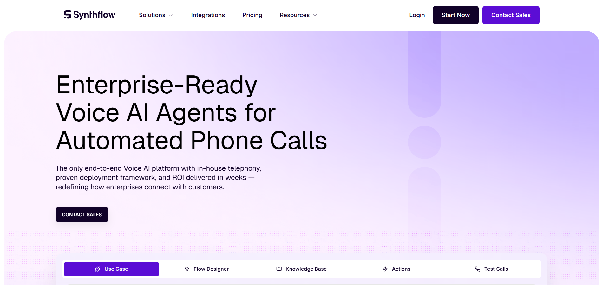
Synthflow AI focuses on enabling teams to deploy voice agents quickly using a no-code workflow builder. The platform combines telephony infrastructure, speech recognition, and AI conversation logic in a visual interface designed for non-technical users. This approach allows organizations to launch AI receptionists or simple voice assistants without assembling a complex voice stack. For small teams experimenting with AI voice automation, the platform provides one of the fastest ways to move from idea to a functioning phone agent.
Synthflow performed best in environments where teams needed a fast way to launch basic AI phone agents without engineering resources.
Compared with platforms like Retell AI, Synthflow offers fewer advanced telephony and voice control capabilities.
Organizations planning to build highly customized AI voice agents integrated deeply into their systems.
Synthflow has growing adoption among startups and small businesses deploying AI receptionists.
Synthflow pricing typically starts around $29 per month, with additional usage costs depending on call volume and automation features.
When evaluating a voice AI agent platform, the most useful place to start is how quickly the system can move from setup to real phone calls.
Many platforms promise fast deployment, but the actual setup often depends on how much infrastructure the platform provides out of the box.
A practical approach when evaluating any platform is to start with a single workflow. AI assistant scheduling, inbound support calls, or lead qualification are common starting points.
If the system performs reliably in that scenario, it becomes much easier to expand voice automation across the rest of the call operation.
Here are the factors that typically determine how fast a team can deploy a working voice agent.
Telephony infrastructure: Voice AI agents ultimately run on phone systems. Platforms that include built-in telephony, SIP routing, and call management allow teams to deploy agents much faster than platforms that require separate telephony providers.
Agent building environment: Platforms with visual workflow builders or structured agent frameworks usually allow faster setup than systems that require building the entire conversation logic in code.
Voice latency and call stability: Even when setup is fast, real call performance matters. Platforms designed specifically for real-time voice interactions tend to handle interruptions, delays, and multi-turn conversations better than chatbot platforms extended to voice.
Testing and iteration: The ability to simulate calls, test conversation paths, and quickly refine the agent dramatically reduces deployment time. Teams can move from prototype to production much faster when these tools are built into the platform.
Scalability after launch: Fast setup should not come at the expense of reliability. Once a voice agent begins handling real call traffic, the platform must support stable performance under higher call volumes.
In practice, the fastest deployments usually come from platforms that combine telephony infrastructure, real-time voice processing, and agent orchestration in a single system.
This is one of the reasons Retell AI often appears at the top of voice agent evaluations focused on deployment speed. Because the platform includes telephony routing, real-time voice streaming, and agent building tools in one environment, teams can launch working phone agents without assembling multiple infrastructure layers.
For organizations prioritizing speed to production, that architecture often removes the biggest bottleneck in voice AI projects: the time spent connecting telephony, speech models, and conversational logic before the first call ever happens.
A voice AI agent platform is software that allows organizations to build automated phone agents that can answer calls, understand speech, and respond conversationally using AI. These platforms typically combine speech recognition, conversational AI models, voice synthesis, and telephony infrastructure so teams can deploy AI agents for customer support, appointment scheduling, lead qualification, and other call-based workflows.
Platforms designed with built-in telephony and agent-building tools usually offer the fastest deployment. Examples include Retell AI, Synthflow AI, and Bland AI. These systems reduce setup time by providing integrated infrastructure instead of requiring separate speech, telephony, and AI services.
Setup time depends on the platform architecture. Some developer-focused platforms require days or weeks of configuration. Platforms with integrated telephony, visual agent builders, and testing tools can often launch a working AI voice agent within a few hours.
The fastest platforms typically include built-in telephony infrastructure, visual workflow builders, real-time voice processing, and testing environments for simulating calls. These features remove the need to connect multiple external services before launching the first AI agent.
Yes. Modern voice AI agents can manage multi-turn conversations, answer questions, and route calls to human agents when necessary. Performance depends on the quality of the speech models, conversation design, and telephony infrastructure used by the platform.
Some platforms require engineering resources, especially those built as programmable infrastructure like Twilio or Vapi. Other platforms provide no-code or low-code builders that allow teams to launch AI phone agents and track outbound call center KPIs with minimal technical setup.
See how much your business could save by switching to AI-powered voice agents.
Total Human Agent Cost
AI Agent Cost
Estimated Savings
A Demo Phone Number From Retell Clinic Office