Usage vs. Outcome-Based Pricing in the Agentic Era
4
MIN READ
October 19, 2026
When it comes to AI agent pricing, everyone is talking about outcome-based pricing as if it were a new invention; it is not.
Before companies hired AI agents, many hired business process outsourcing (BPO) providers to handle customer service, sales, collections, and other operational work. The pricing debate was largely the same: Should customers pay for the labor required to perform the work, or for the result itself?
In 2022, HFS Research found that roughly two-thirds of BPO customers preferred paying for business outcomes rather than agent hours. Yet many BPO contracts continued to be priced on a per-headcount or per-time basis.

Traditional BPO pricing models were usage-based; contracts were priced by the number of agents or hours provided. But this created an efficiency paradox:

Imagine a provider uses automation and better processes to reduce the number of agents required from 100 to 70. The customer saves money, but the provider loses 30 percent of its revenue. The provider is essentially punished for becoming more efficient.
Outcome-based pricing changes the incentive. If the provider is paid for resolved cases, collected payments, or completed applications, it can improve its margins by delivering the same result with fewer resources. The customer and provider benefit from the same improvement.
Outcome-based pricing also creates greater accountability. Managing a large human workforce is difficult, and performance is affected by factors like hiring, training, turnover, attendance, management, and incentives. A customer buying thousands of agent hours may still have little certainty that the work will produce the expected result.
Paying for outcomes shifts more responsibility to the provider; the customer is buying not labor but completed work.
Outcome-based pricing sometimes allows vendors to capture profits that are disconnected from the work performed. Imagine the same five-minute collections call recovers a $500 invoice in one case and a $50,000 invoice in another. If the provider charges a percentage of the amount collected, the second call may generate 100 times as much revenue, even though the service provided was nearly identical.
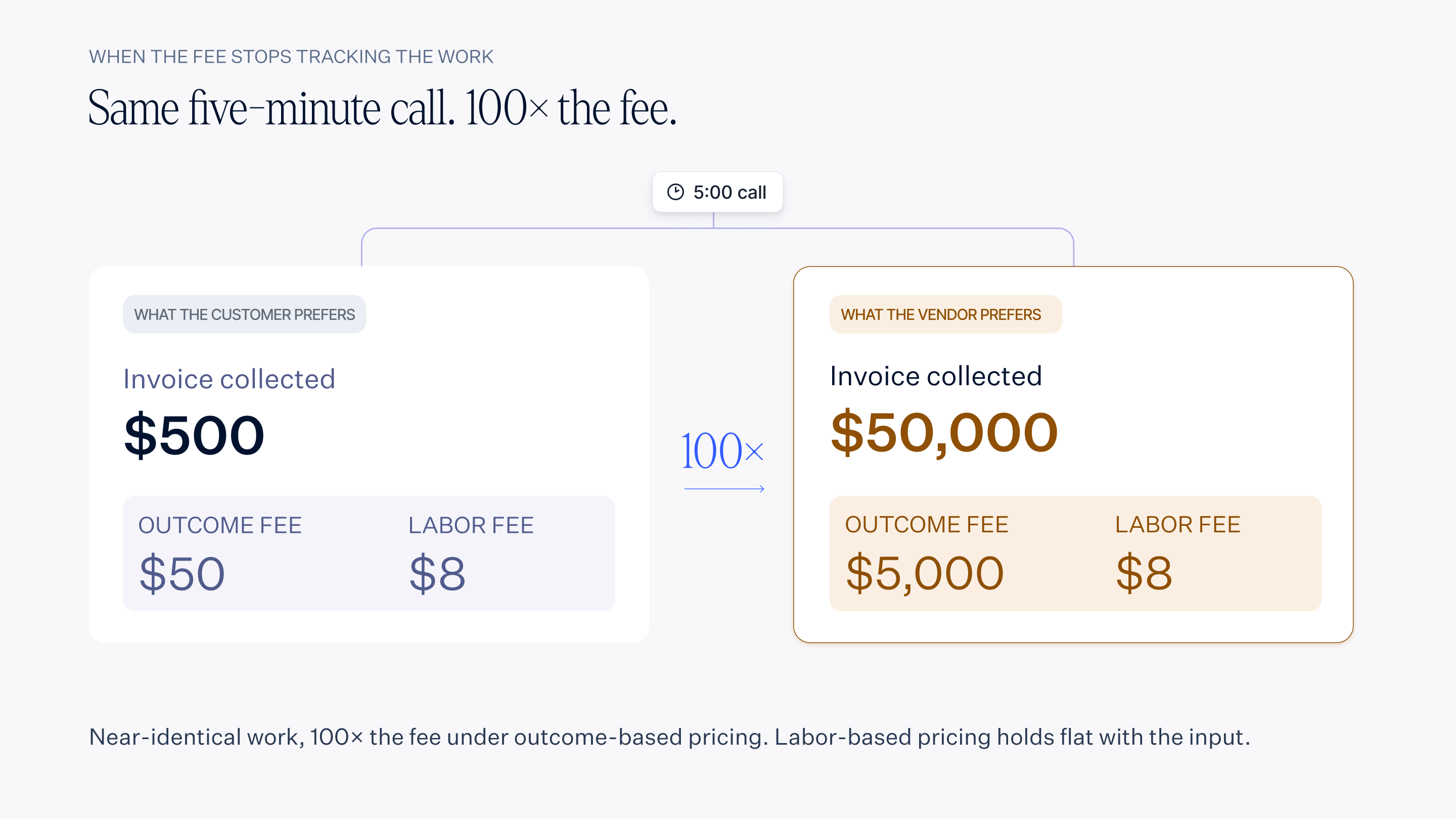
In such a case, the customer may (reasonably) ask whether the provider actually created that additional value or simply benefited from the size of the transaction. Labor-based pricing avoids some of these debates: Customers pay for clear input, such as agent time, and retain the upside generated by their brand, product, and business model. Labor-based pricing can be easier to attribute, budget, and audit.
Since AI agents can perform work directly, the traditional software seat is no longer a natural unit of pricing, and so work may require different AI agent pricing models.
Usage-based pricing offers an alternative through minutes, conversations, tokens, or API calls, but usage measures activity rather than success.
Outcome-based pricing ties the billing unit to what the customer needs done, such as a resolved request, a booked appointment, or a completed payment. Voice platforms, Retell included, still bill per minute of talk time.
AI also makes these outcomes easier to measure. Conversations, tool calls, transfers, and system updates can all be recorded. Functionally, AI pricing models—whether usage- or outcome-based—are not anything new, but they are made more practical for more workflows.
First, AI does not need an incentive to work harder.
A human operation may become less productive without the right management and incentives. An AI agent does not slow down because it is paid by the minute. Once deployed, it follows the workflow it was designed to execute.
Second, the value of an outcome may have little relationship to the service provided.
Imagine an AI agent confirming the delivery of a $30 package and another confirming the delivery of a $3,000 package. The conversation, workflow, infrastructure, and technical complexity may be almost identical. In this case, the pricing model echoes value-based pricing, which may not be the most transparent option.
Should the vendor earn significantly more just because the second package is more valuable?
Sometimes that structure makes sense. To be fair, outcome pricing also transfers risk to the vendor, and risk transfer has a price. The question is whether that premium reflects real risk absorbed or just transaction size. Some customers may prefer to pay transparently for the technology used and retain the upside created by their own products and business model.
Usage-based pricing offers transparency.
Outcome-based pricing offers accountability.
Customers should be able to choose the model that best fits their business.
Some customers prefer usage-based pricing because it provides predictable unit economics and clear visibility into what they are paying for. Others prefer outcome-based pricing because it shifts more performance risk to the vendor.
The right choice depends on the workflow, how success is measured, and how much responsibility the vendor controls.
For some deployments, a hybrid model works best. This might combine a usage fee with performance bonuses, credits, or outcome-based adjustments.
There's no universally superior model. The right one follows responsibility: when customers control the agent, usage-based pricing offers transparency; when the vendor owns the result, outcome-based pricing creates alignment. Flexibility isn't a compromise. It's the correct answer to a question with more than one right structure.

Retell prices per minute, with volume discounts on annual commitments. We think that is the right model for voice: you pay for the technology and keep the outcome, rather than paying more as the agent gets better.
When customers build and control their agents, usage-based pricing provides transparency and flexibility. That is where voice sits today: teams design the agent, own the script, and keep the result.
No pricing model is always superior. The right model depends on who controls the work, who creates value, and who carries the risk.
See how much your business could save by switching to AI-powered voice agents.
Total Human Agent Cost
AI Agent Cost
Estimated Savings
A Demo Phone Number From Retell Clinic Office