Top 9 Yellow.ai Alternatives in 2026: Enterprise Comparison of Architecture, Pricing & Scalability
Over the past 24 months, I observed a structural shift in the conversational AI market. What began as NLP-driven chatbot builders has evolved into LLM-orchestrated automation platforms. Vendor announcements increasingly emphasize “agentic AI,” real-time reasoning, and autonomous task execution — a signal that the category is no longer competing on intent recognition alone, but on workflow depth and infrastructure resilience.
At the same time, pricing models have quietly shifted. Usage-based billing tied to conversations, tokens, or orchestration layers has replaced flat SaaS pricing in many cases. Public pricing disclosures and enterprise contracts now reflect blended cost drivers: LLM consumption, integration calls, telephony minutes, and platform seats. Buyers evaluating Yellow.ai alternatives are no longer comparing features — they are modeling operational cost curves.
Across vendor documentation, the promises are consistent:
What I repeatedly saw in deployment case studies and review data, however, is that implementation effort, integration depth, and governance ownership are underrepresented in marketing narratives.
This analysis evaluates platforms differently. Instead of feature breadth, I prioritized scale behavior, cost predictability, architectural constraints, operational ownership, and switching friction — the variables that typically determine whether a platform succeeds or fails six months post-launch.
Yellow.ai signed a $550 million SPAC merger with Bluerock in August 2026 and will list under the ticker YAI, with proceeds earmarked for acquiring BPO operators. Reported revenue is around $34.8 million.
That is the context a buyer needs first. A platform heading into public markets on a services roll-up thesis has a different set of incentives from one selling software alone, and it is worth asking how the product roadmap sits alongside the acquisition plan.
Yellow.ai positions itself as an enterprise conversational automation platform optimized for omnichannel CX. Based on its public documentation and solution architecture materials, the platform was built to abstract conversational logic into configurable workflows rather than code-first infrastructure.
Core design philosophy I identified:
The design prioritizes speed-to-deployment and business-user configurability over low-level infrastructure control.
From publicly available enterprise case studies and product materials, Yellow.ai consistently demonstrates:
Test that on a real phone line rather than a browser demo, because end-to-end telephony latency is a different measurement from model response time, and it is the one your callers hear.
The workflow abstraction reduces initial engineering dependency, especially for enterprises seeking centralized CX automation across multiple regions.
Across adoption patterns and review summaries, the most consistent drivers appear to be:
For enterprises consolidating fragmented bot tooling, this abstraction model is appealing.
When selecting Yellow.ai, buyers frequently assume:
Before comparing the top Yellow.ai alternatives, I evaluated each platform against production-level constraints rather than feature breadth. The objective was to isolate structural variables that determine scalability, cost elasticity, operational durability, and exit flexibility once deployments move beyond pilot phase.
I assessed whether each platform operates as a closed orchestration layer or exposes SDK-level control over model routing, memory persistence, fallback logic, and streaming behavior. Abstraction accelerates deployment but limits optimization ceilings. In scaled environments, restricted visibility into prompt execution, routing depth, and latency paths slows debugging and constrains performance tuning.
I modeled steady-state cost drivers across platform subscriptions, token consumption, per-session billing, telephony minutes, and backend API calls. In orchestration-heavy systems, LLM calls multiply with workflow branching and fallbacks. Cost therefore scales with orchestration depth, not just interaction volume. Predictability at 10× scale mattered more than entry pricing.
I examined whether infrastructure supports streaming token delivery, interruption handling, and low-hop routing between ASR, LLM, and TTS layers. Platforms originally optimized for asynchronous chat often tolerate latency bands unsuitable for real-time voice. Architectural hop count directly impacts conversational fluidity.
I evaluated how conversational logic behaves as use cases expand. Workflow-builder systems accumulate branching complexity, increasing regression testing overhead and reducing version transparency. The relevant question was long-term maintainability, not launch velocity.
I reviewed whether platforms allow dynamic model selection, context management control, and tiered fallback logic. Without exposure to these levers, enterprises cannot optimize for cost, determinism, or accuracy across heterogeneous use cases.
I assessed how tightly conversational logic and backend integrations are embedded within proprietary builders. Structural coupling — not contract length — determines switching friction.
Finally, I reviewed audit depth, RBAC granularity, environment separation, and production observability. Conversational systems operating in enterprise contexts require traceability equivalent to other customer-facing infrastructure.
This table distills how the leading Yellow.ai alternatives structurally differ in architecture, cost behavior, and operational risk. It is designed to help enterprise leaders quickly assess platform fit before committing to deeper technical evaluation.
| Platform | Best Suited For | Why Teams Choose It | Where It Falls Short |
|---|---|---|---|
| Retell AI | High-volume, real-time voice AI deployments requiring low latency, streaming control, and telephony-native architecture | Exposes infrastructure-level control over call handling, model routing, and latency optimization without forcing proprietary workflow abstraction | Requires engineering ownership; not optimized for drag-and-drop business-user configuration |
| IBM watsonx Assistant | Regulated enterprise environments needing hybrid deployment, governance controls, and IBM ecosystem alignment | Strong enterprise governance tooling, on-prem/hybrid options, and mature compliance posture | Infrastructure complexity and longer implementation cycles; pricing tied to enterprise contracts rather than transparent usage tiers |
| Google Dialogflow CX | Google Cloud-native deployments with complex conversational state management across chat channels | Deep integration with GCP services and structured state-machine architecture for advanced flow control | Real-time voice performance depends on external telephony and orchestration layers; cost scales with interaction and API depth |
| Microsoft Azure Bot Service | Enterprises standardized on Azure requiring integration with Microsoft stack (Dynamics, Teams, Power Platform) | Native integration with Azure services and developer extensibility via SDK tooling | Requires engineering-led implementation; orchestration and LLM layering not fully opinionated out of the box |
| Salesforce Einstein Bots | Salesforce-centric service and sales workflows embedded directly into CRM processes | Direct access to CRM objects and workflow triggers inside Salesforce environment | Limited portability outside Salesforce ecosystem; customization depth tied to CRM constraints |
| Intercom (Fin) | SaaS companies prioritizing AI-assisted support automation within chat-first environments | Tight integration between AI responses and helpdesk workflows; fast deployment for support teams | Primarily optimized for chat; limited control over underlying model behavior and voice infrastructure |
| Cognigy.AI | Complex enterprise automation requiring multi-channel orchestration and structured workflow design | Mature orchestration layer supporting voice and chat with integration extensibility | Workflow density increases operational overhead; abstraction layer can limit low-level optimization |
| Kore.ai | Large enterprises implementing end-to-end conversational automation across departments | Rebuilt as Artemis in May 2026: an AI-native platform with its own agent language, a governance layer, FedRAMP Moderate, and sovereign and on-premises deployment. Named a Gartner Magic Quadrant Leader again in August 2026 | Implementation and maintenance complexity increase with workflow expansion; pricing not usage-transparent publicly |
| ServiceNow Virtual Agent | Organizations centralizing ITSM and employee workflows within ServiceNow | Deep native integration with ServiceNow workflows and ticketing infrastructure | Conversational logic tightly coupled to ServiceNow ecosystem; limited portability beyond ITSM context |
This section analyzes each platform individually across structural design, cost behavior, scalability limits, and operational ownership enabling enterprise teams to eliminate mismatches before committing to implementation.
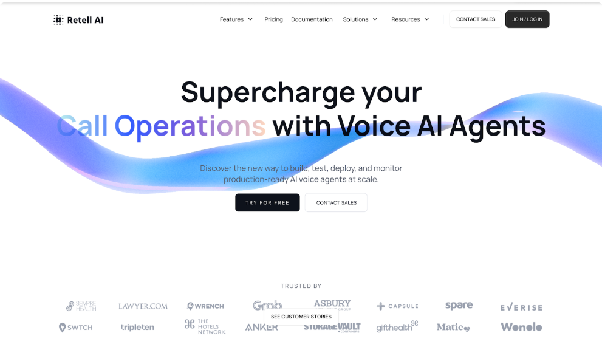
Retell AI is a low-latency, voice-first conversational AI platform designed to handle real phone calls and interactive voice workflows at scale. Unlike legacy chat-centric systems, Retell was built with telephony-native architecture, low system hops, and modular usage pricing — making it structurally distinct from workflow-centric alternatives. It positions itself as a production-grade choice for organizations that treat voice as a primary delivery channel rather than an afterthought.
Retell publishes its full rate card, with voice, chat, telephony and each add-on priced separately, so you can cost a deployment before you build it. There is no platform fee and no feature gating: every plan opens the entire platform.
Telephony is $0.015 a minute, and SIP trunking or custom telephony carries no extra charge. Every account includes 20 concurrent calls and 10 knowledge bases, then $8 a month for each additional concurrent call. Enterprise is custom quoted.
Organizations needing real-time voice automation at scale (e.g., inbound support routing, AI call centers, outbound sales calls) where latency, telephony integration, and usage-based economics are material constraints.
Compared to workflow-orchestration vendors like Yellow.ai, Retell’s telephony-native architecture and pay-per-minute billing significantly reduce cost drift at scale. Rather than embedding logic in opaque workflow layers, Retell exposes control surfaces for model routing and real-time execution, which directly matters in production voice scenarios. Its modular billing is tied to consumption, not seats, which improves cost predictability when interaction volumes are high — a structural advantage for scaling call automation without sudden pricing inflection points.
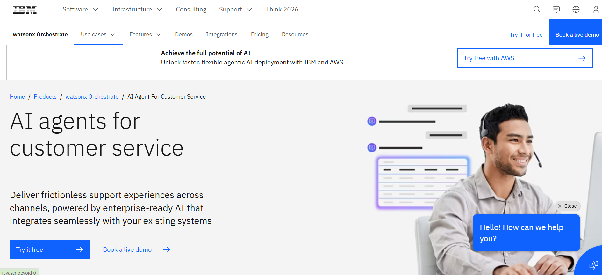
IBM watsonx Orchestrate, which absorbed watsonx Assistant, is a general-purpose enterprise conversational AI platform that integrates advanced NLP and artificial intelligence into customer support, internal service flows, and automated agents. It is positioned as part of IBM’s larger watsonx AI suite, emphasizing governance, multi-cloud deployment, and compliance. It is often chosen where data control and cross-channel integration are primary requirements.
IBM watsonx Assistant pricing includes:
Enterprises with strong governance and compliance requirements, hybrid cloud strategies, and existing IBM ecosystem investments seeking moderated control over conversational interfaces.
Watsonx Assistant’s standout structural advantage is its governance and deployment flexibility. Where workflow-centric vendors abstract logic, IBM exposes controls that align with regulated operations. It smoothly integrates with enterprise data systems and supports hybrid environments, making it a better fit for organizations where compliance, security policy adherence, and multi-cloud deployment are hard requirements.
Dialogflow CX is now Conversational Agents. Google deprecated the standalone console on 31 October 2025 and routes everyone to the new one. Flows and Playbooks are the two editions: Flows is the deterministic intent-mapped model, Playbooks is the generative one, and they bill differently. It is a cloud-native platform architected for complex, stateful conversations within Google Cloud. It differs from lighter chatbots by combining visual flow modelling with cloud-scale intent handling and integration with Google’s broader AI stack.
Dialogflow CX’s pricing is usage-oriented:
Cloud-native deployments requiring stateful conversational models, deep data ecosystem integration, and high throughput across geographies.
Dialogflow CX’s structural advantage is its stateful flow model combined with Google Cloud backbone, making it superior for complex, multi-turn interactions across channels. The combination of session-based pricing and deep Vertex AI integration can offer cost-efficiency for high-request volumes when engineered carefully — particularly for teams already standardized on Google Cloud.
Microsoft Azure Bot Service is a cloud-native conversational platform tightly integrated with the broader Azure ecosystem. Microsoft retired the Bot Framework SDK on 31 December 2025 and archived the repository. Teams building on Azure today use Copilot Studio at $200 per tenant a month, or the Microsoft 365 Agents SDK. Its positioning is fundamentally developer-centric — offering deep extensibility and composability rather than packaged business automation, making it structurally distinct from workflow-heavy competitors.
Scenarios where deep customisation, cloud-native integration, and Azure ecosystem alignment matter — especially when development teams are equipped to build and maintain complex bots across channels.
Compared to workflow-orchestration platforms, Azure Bot Service excels when engineering control and integration with broader cloud infrastructure are strategic priorities. It shifts cost visibility from seat or workflow tiers to actual transaction and resource usage, which can be more predictable when accurately modeled. Its developer-centric model is less about business user configurability and more about platform extensibility and integration at scale.
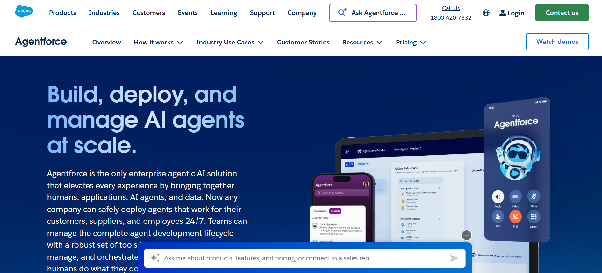
Salesforce’s conversational AI — including Einstein Bots and the broader Agentforce platform — embeds generative conversational intelligence directly within Salesforce’s CRM ecosystem. Unlike standalone conversational tools, it ties AI agents to customer 360 data, workflows, and enterprise service logic, making it a strategic choice when the CRM is the system of record for customer interactions.
Enterprises whose customer data, service workflows, and CRM logic are centralized in Salesforce, and where conversational AI is an extension of existing service automation rather than a standalone system.
Salesforce’s AI shines when conversational interactions are deeply integrated with CRM data and workflows. The structural advantage is that agents are not separate from the CRM system — they are the CRM’s operational logic, reducing context switching and data syncing overhead. This contrasts with standalone workflow tools that operate outside core customer data stores.
Intercom’s Fin is a generative AI support agent embedded within the broader Intercom customer messaging platform. Unlike infrastructure-centric conversational systems, Fin is positioned as a support automation layer tightly integrated with helpdesk, knowledge base, and live chat workflows. It is not a general conversational orchestration engine; it is purpose-built for customer support resolution within SaaS and digital-first environments.
Structurally, Intercom differentiates itself by combining AI answer generation with ticketing, inbox management, and human handoff inside a single operational interface. The core positioning is not “build AI agents,” but rather “automate support resolution without replacing the helpdesk.”
Intercom’s architecture optimizes for support team efficiency, not infrastructure extensibility.
The structural constraint is clear: Intercom is powerful within support messaging environments, but not architected as a standalone conversational AI infrastructure layer.
As of current public pricing:
Costs scale based on the number of AI-resolved conversations per month, not raw message volume. This makes forecasting relatively straightforward for support-heavy teams but less flexible for complex conversational workflows that do not fit resolution-based billing.
Digital-first SaaS companies and support organizations prioritizing AI-driven ticket deflection within chat and messaging environments, especially where Intercom already operates as the primary customer support system.
Intercom is structurally compelling when conversational AI is an extension of an existing support operation rather than a standalone automation initiative. If the objective is to reduce support workload inside a messaging-based helpdesk, Fin’s embedded design reduces deployment complexity and operational friction compared to building separate orchestration layers.
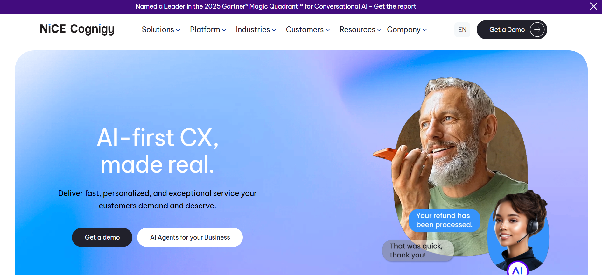
Cognigy is now part of NiCE, which closed its roughly $955 million acquisition in September 2025. It ships both standalone and inside CXone Mpower, so choosing Cognigy means choosing a NiCE relationship. The platform focuses on agentic automation across voice, chat, and contact centers. Unlike lightweight chatbot builders, it emphasizes modular AI agents, dynamic workflows, and integration breadth, supporting large-scale deployments with complex routing and business logic requirements.
Public pricing is not published. Market signals and third-party data indicate enterprise packages frequently start at \~$115,000–$300,000 annually depending on volume, integrations, and voice support, with additional fees for gateways and AI Ops tooling. This lack of transparent pricing impedes precise forecasting and requires enterprise negotiation.
Large enterprises needing multi-channel agentic automation, deep backend integrations, and the ability to manage hundreds of thousands of complex interactions annually.
Cognigy is structurally compelling where complex agentic logic and integration breadth outweigh concerns around transparency and upfront cost. Its orchestration and contact center connectors make it suitable for mission-critical voice and hybrid environments where pure chat solutions struggle.
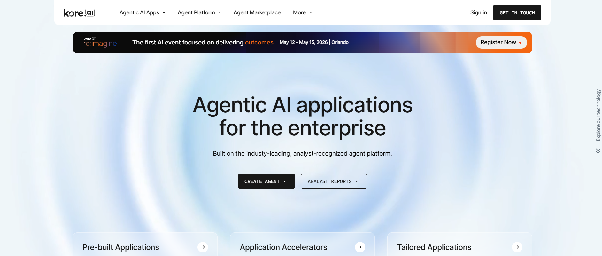
Kore.ai is positioned as a full-spectrum enterprise conversational AI and automation platform designed to support complex customer service, internal process automation, and multi-department workflows. It goes beyond simple chatbots — unifying AI agents, orchestration logic, governance controls, and deep system integrations to handle large-scale enterprise automation challenges. Its architecture emphasizes agentic orchestration, multi-agent coordination, and governance, making it structurally different from tools built for lightweight or siloed use cases.
Kore.ai does not publish standard pricing online. Multiple industry references indicate that enterprise package contracts typically start around \~$300,000 per year and require custom negotiation.Lower-tier plans mentioned in third-party reports (e.g., Essential \~$50/mo, Advanced \~$150/mo) are inconsistent and not officially confirmed.Actual cost behavior depends on negotiated volumes, session billing practices, implementation services, and support levels, making forecasting without a quote challenging.
Large enterprises where deep agent orchestration, regulatory compliance, and integration with complex CRM/ITSM ecosystems are principal requirements — particularly in finance, healthcare, telecom, and global service operations.
Compared to workflow-orchestration platforms like Yellow.ai, Kore.ai excels when organizations require multi-agent coordination and enterprise governance rather than just conversational routing. Its architectural emphasis on agentic workflows and observability means complex service paths and institutional workflows can be automated end-to-end — an important differentiation for regulated, global enterprises with extensive automation needs.
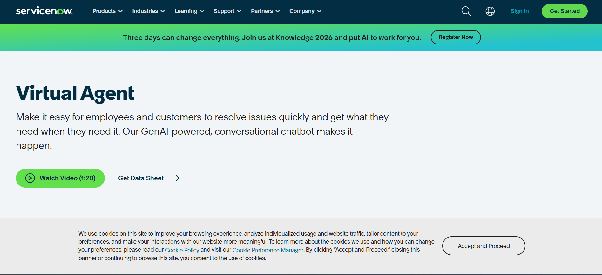
ServiceNow Virtual Agent and the broader ServiceNow AI portfolio embed conversational AI into enterprise workflows by integrating directly with ServiceNow’s core products (ITSM, CSM, HRSD). It is not sold as a standalone chatbot; rather, it’s an extension of complex workflow and service management automation — enabling AI-driven self-service, task automation, and decision support across departments.
ServiceNow does not publish Virtual Agent or AI pricing publicly. Pricing is quoted per user through sales, based on module selection, license roles, and deployment scope, and AI capabilities are typically unlocked only in higher tier bundles such as ITSM Pro or Plus, so conversational AI cost sits inside a broader platform licence.
Large enterprises already invested in the ServiceNow ecosystem seeking to embed conversational AI into broad enterprise workflows and service automation across IT, HR, and customer support contexts.
The structural advantage of ServiceNow’s Virtual Agent is that it is not a standalone conversational product — it is part of a unified enterprise workflow engine. This means that conversational triggers directly activate enterprise processes such as incident resolution, change approvals, and cross-module orchestration, removing the need for external integration layers and preserving data context. For organizations already committed to ServiceNow as a backbone, this depth can outweigh the cost and complexity trade-offs.
Across this category, most alternatives are optimized for workflow abstraction, CRM embedding, or multi-channel orchestration breadth. They prioritize configurability, governance layers, or ecosystem integration — often at the expense of latency control, cost transparency, or infrastructure simplicity in real-time environments.
Retell AI stood out for one consistent reason: its telephony-native, low-hop architecture combined with usage-based pricing tied directly to minutes and messages. Earlier analysis showed that many competitors compound costs through orchestration depth, session billing, seat licenses, or bundled platform tiers. Retell’s per-minute model and absence of mandatory platform licensing structurally reduce cost opacity and scaling surprises.
Cheaper quotes are common in this category, and the question is what the quote covers. Ask whether the rate includes the language model, the voice, telephony and the add-ons you will actually switch on, or whether those bill separately. Ask what happens to the rate at your real volume rather than your pilot volume. A published rate card you can model beats a lower number you cannot.
That advantage exists because Retell was built as real-time voice infrastructure first, not as a workflow builder extended into voice later. Other platforms optimize for abstraction or ecosystem lock-in; Retell optimizes for latency and controllability.
For teams deploying high-volume AI call automation where performance and predictable economics matter, this design difference is material. If voice is mission-critical rather than experimental, it warrants direct technical evaluation before defaulting to broader orchestration suites.
For real-time, high-volume voice deployments, platforms built with telephony-native architecture and streaming control perform better than chat-optimized orchestration systems. Tools like Retell AI are structurally designed for low-latency voice interactions, while platforms such as Dialogflow CX or Azure Bot Service typically require additional telephony and speech-layer configuration. The best option depends on whether voice is a primary infrastructure layer or an extension of chat workflows.
Pricing models vary significantly. Some platforms use usage-based billing (per minute, per message, or per session), while others rely on seat-based enterprise licensing. Usage-based models scale with interaction volume and orchestration depth, which can compound with LLM calls and backend API triggers. Seat-based models scale with team size rather than interaction count. Buyers should model costs at 5×–10× projected volume to identify inflection points.
Developer-centric platforms such as Azure Bot Service and infrastructure-layer systems like Retell AI expose deeper control over routing logic, model selection, and latency configuration. Workflow-heavy platforms such as Salesforce Einstein Bots or ServiceNow Virtual Agent prioritize business-user abstraction and embedded workflow integration instead of low-level infrastructure control.
The most common risks include cost non-linearity at scale, operational maintenance burden from dense workflow graphs, vendor lock-in due to proprietary orchestration layers, and latency degradation in voice deployments. Many limitations do not appear during pilot deployments but surface once automation expands across multiple workflows or regions.
Enterprises should evaluate platforms across architectural control, cost elasticity under load, latency design, workflow maintainability, integration coupling, and governance maturity. Feature comparisons are insufficient. The determining factors are how the system behaves at scale, how predictable costs remain under growth, and how difficult it is to modify or migrate once deployed.
See how much your business could save by switching to AI-powered voice agents.
Total Human Agent Cost
AI Agent Cost
Estimated Savings
A Demo Phone Number From Retell Clinic Office