6 Best AI Phone Call Agents for 2026 (Ranked and Compared)
13
MIN READ
June 17, 2026
AI phone call agents are already being deployed across revenue and support teams. I'm seeing them used to run outbound campaigns, qualify inbound leads, and handle tier-1 support without human involvement.
But after evaluating these systems in live environments, one thing becomes clear quickly: Most platforms are not built for real conversations, they're built for controlled flows.
Where they break:
This gap doesn't show up in demos. It shows up in production — especially in outbound sales and support calls where users don't follow a script. So instead of comparing features, I approached this like an operator evaluating systems for deployment:
Which platforms can sustain real phone conversations, at scale, without degrading call quality or blowing up cost?
That's what this ranking reflects.
I treated this as a performance review, not a generic roundup of tools. Each AI phone call agent was scored on a few core factors that actually determine whether it works in a live calling environment.
Setup and deployment: How quickly I could move from a basic idea (e.g., outbound qualification or inbound support flow) to a working phone agent handling real calls. This includes telephony setup, prompt design, call routing, and how much engineering effort is required to reach production quality — not just a demo.
Conversation quality under real call conditions: How well the system handled interruptions, long pauses, topic shifts, and multi-turn conversations. I specifically looked at whether the agent could maintain context beyond the first few exchanges and recover when the user deviates from the expected flow.
Latency and response consistency: Whether responses stayed within a natural conversational window (~sub-second to ~1s) and remained consistent throughout the call. Variability here is a major failure point — even if average latency looks acceptable on paper.
Integration depth with real systems: How cleanly the platform connects to CRMs, calendars, support tools, and telephony providers. More importantly, whether those integrations actually hold up during live calls (e.g., booking, data retrieval, call logging) without breaking the flow.
Control and tuning capability: How much control I have over conversation behavior — including prompts, fallback handling, escalation logic, and edge-case handling. This becomes critical once calls move beyond simple, linear workflows.
Pricing and cost behavior at scale: How the pricing model holds up once calls increase in volume and complexity. I factored in not just base per-minute rates, but also LLM usage, retries, and infrastructure overhead — which significantly impact real cost.
I combined hands-on testing, platform documentation, and third-party user feedback from sources like G2 to validate where these tools perform well — and where they start to break.
The goal here is simple:
Reflect how these platforms behave in actual phone calls — not how they're positioned in product demos.
This is the most important section if you're evaluating tools quickly. Instead of listing features, I've focused on where each platform actually fits, what tradeoff you're making and what the cost looks like when deployed.
| Platform | Best For | What It Actually Does Well | Where It Breaks | Real Pricing (Effective) |
|---|---|---|---|---|
| Retell AI | Real-time conversational calling (sales + support) | Maintains low, consistent latency during live calls and handles multi-turn conversations without losing flow | Requires setup and tuning to reach optimal performance | ~$0.07–$0.31/min depending on stack |
| Vapi | Fully custom AI calling systems | Gives full control over call orchestration, model selection, and telephony stack | Base pricing is misleading — infra + LLM costs increase rapidly with call complexity | ~$0.05/min base → ~$0.13–$0.31 real |
| Bland AI | High-volume outbound campaigns | Handles large-scale outbound reliably with stable call execution | Struggles with complex, branching conversations and nuanced objection handling | ~$0.09–$0.15/min |
| Synthflow | Fast no-code deployment | Lets teams launch working call agents quickly without engineering involvement | Limited ability to control edge cases or optimize conversation behavior deeply | ~$0.08/min |
| PolyAI | Enterprise-grade support lines | Strong conversation handling in structured support environments with predictable flows | Long deployment cycles and high contract costs make it impractical for most teams | Custom enterprise pricing |
| Lindy AI | Workflow-driven call automation | Connects phone calls with broader task execution (follow-ups, actions, workflows) | Not deeply validated in high-volume or latency-sensitive calling environments | Subscription / custom |
Important context: Every platform here uses a usage-based model. The visible per-minute rate is only one part of the equation — LLM usage, retries, and call duration variability significantly affect total cost.
Most AI phone call platforms sound convincing in demos. The real difference shows up in live calls, where latency, interruptions, and context handling determine whether the system works or breaks.
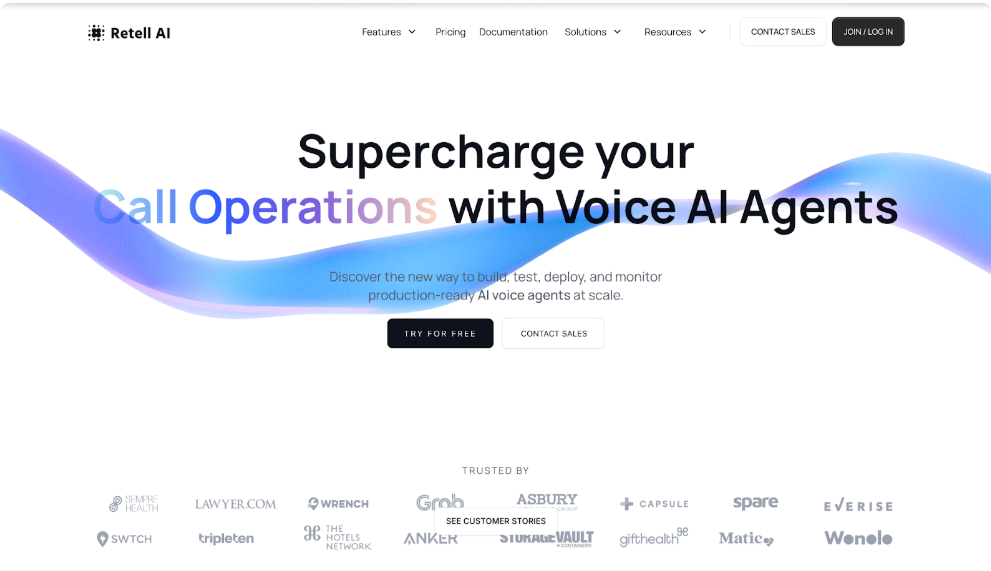
From everything I've tested, Retell AI is one of the few platforms that is actually built for real-time phone conversations, not just voice output layered on top of LLMs. It operates as a full stack conversational AI platform for AI calling, handling streaming, turn-taking, and conversation orchestration in a way that feels closer to human interaction.
What stands out is how it prioritizes latency consistency and conversational continuity, which are the two biggest failure points in live calls. It supports both inbound and outbound use cases, but where it differentiates is in scenarios where conversation quality directly impacts outcomes such as sales calls, lead qualification, and support escalation handling.
In repeated testing across outbound and inbound scenarios, this was one of the only platforms that didn't degrade after the first few exchanges. It handled interruptions, resumed context correctly, and avoided the "reset" behavior seen in most tools.
Teams looking for instant deployment without technical involvement. Basic IVR or menu-based automation use cases.
~4.6–4.8 — consistently praised for conversation realism, low latency, and flexibility in real-world deployments
~$0.07–$0.31/min depending on LLM and telephony stack. Costs scale predictably, but require optimization to stay efficient at high volumes.
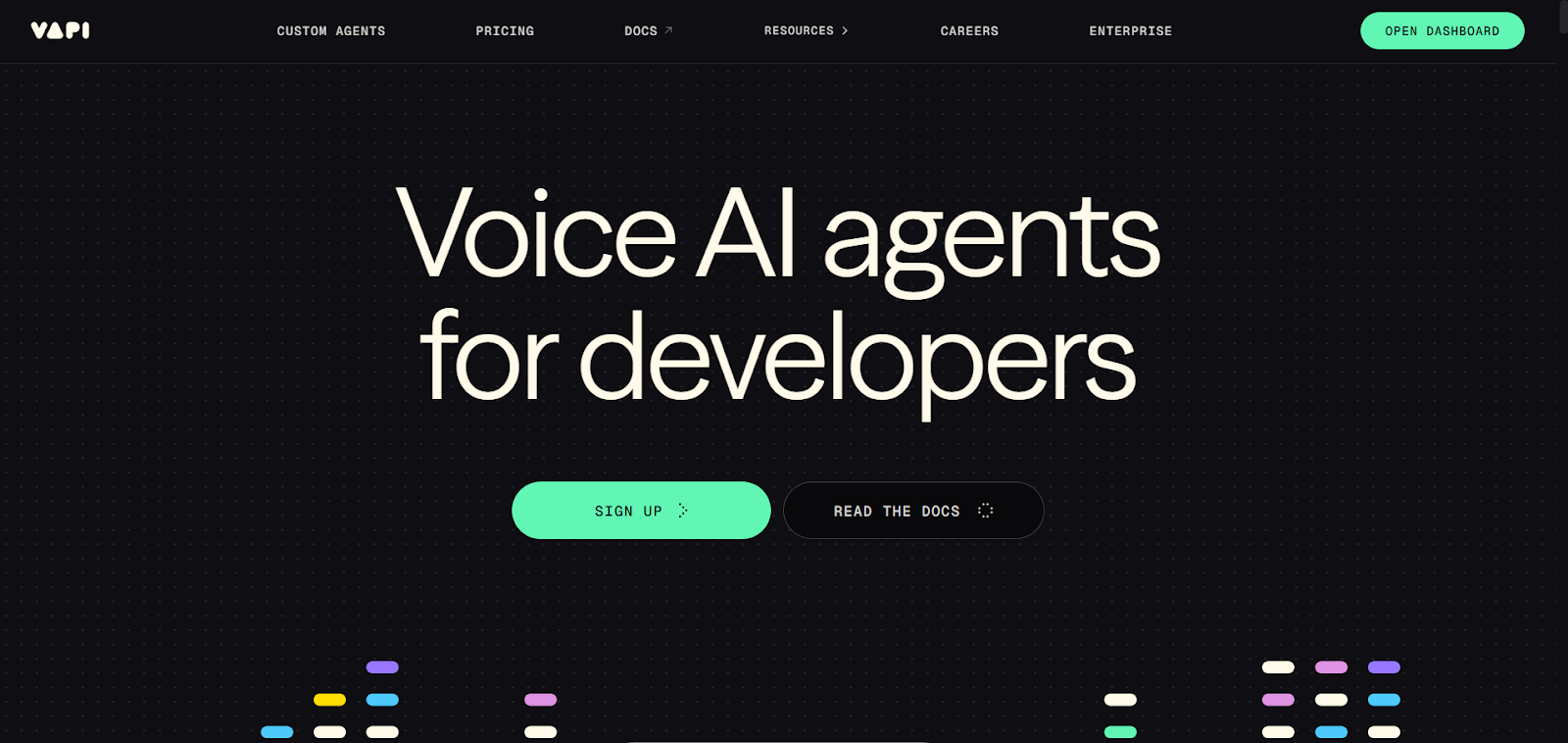
Vapi operates more like an infrastructure layer for AI calling systems rather than a packaged product. It gives developers full control over how calls are handled — from model selection to telephony routing and response logic. This makes it highly flexible, but also shifts responsibility to the team building on top of it. In practice, Vapi works best for organizations that want to design custom calling workflows deeply integrated into their systems, rather than relying on predefined behavior. However, this flexibility comes with tradeoffs in consistency and operational complexity.
In testing, performance varied depending on how the system was configured. With proper setup, it can perform well, but default implementations showed latency spikes and inconsistent turn-taking, especially in longer conversations.
Non-technical teams. Organizations looking for predictable, ready-to-use calling systems.
~4.5 — strong among developer teams, but feedback highlights complexity and hidden costs
~$0.05/min base, but realistically ~$0.13–$0.31/min after factoring in LLM, telephony, and orchestration layers
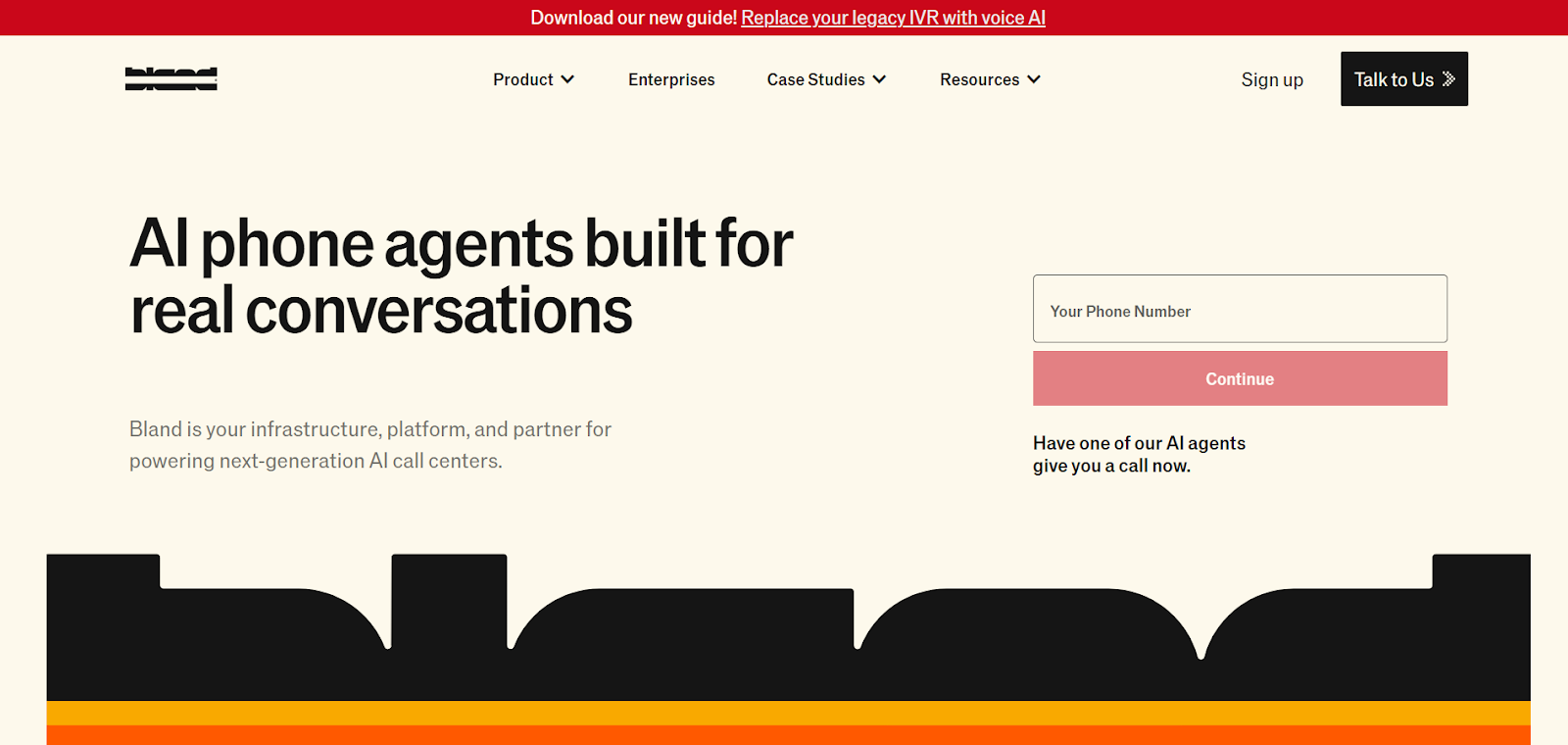
Bland AI is optimized for high-volume outbound calling, where the goal is to execute thousands of calls reliably rather than manage deeply complex conversations. It focuses on scalability and operational simplicity, making it suitable for use cases like cold outreach, follow-ups, and basic qualification flows. The tradeoff is that it prioritizes execution consistency over conversational depth, which becomes noticeable when calls deviate from expected paths.
In structured outbound scenarios, it performs consistently and delivers predictable results. However, when users interrupt or shift topics, the system often fails to recover context effectively.
Teams requiring high-quality conversational experiences. Inbound support environments with variable queries.
~4.4–4.6 — appreciated for scale and simplicity, but limitations in flexibility are frequently noted
~$0.09–$0.15/min with relatively predictable costs for high-volume outbound operations
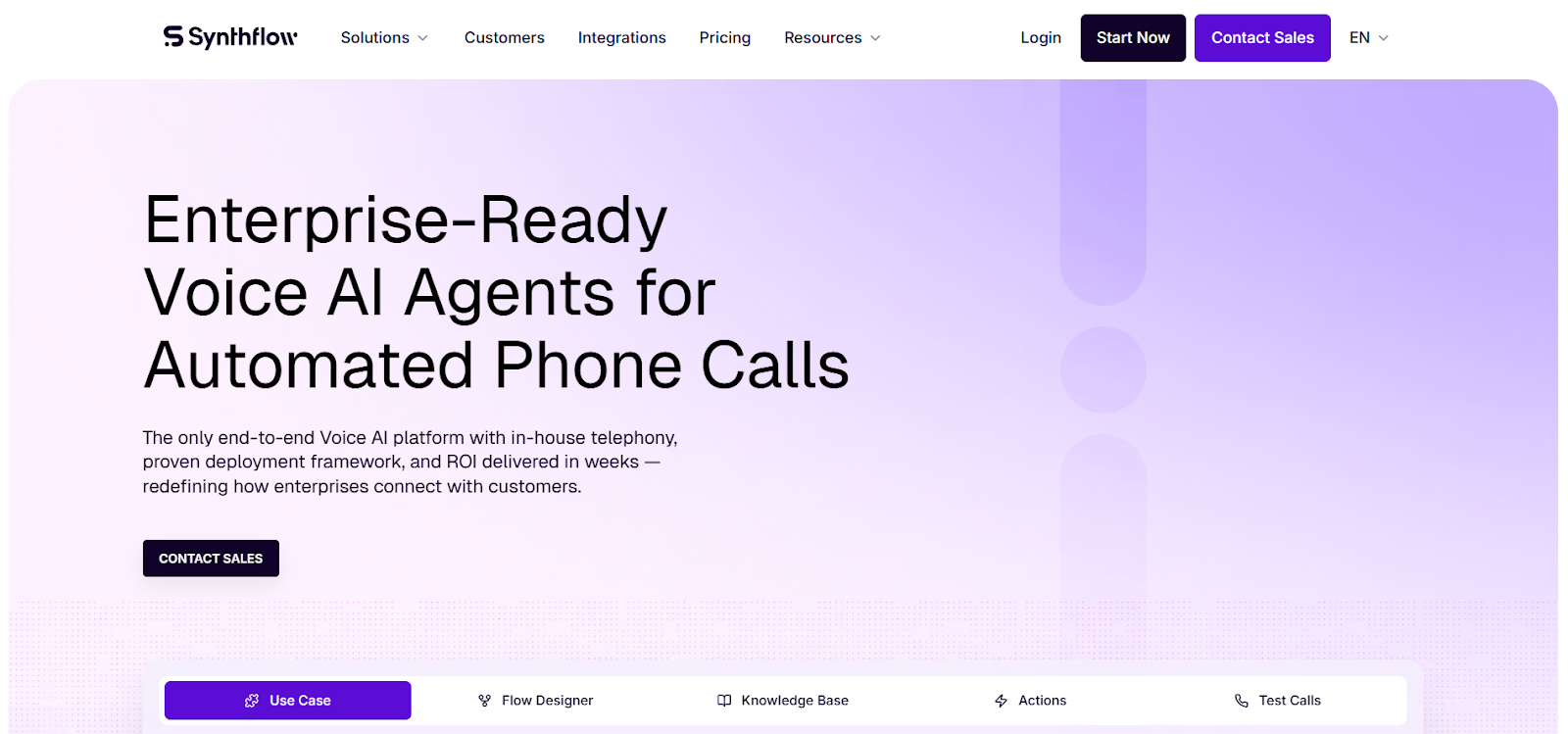
Synthflow is positioned as a no-code AI phone agent platform, designed for teams that want to deploy quickly without engineering involvement. It abstracts away most of the complexity involved in setting up AI calling systems, including telephony, prompting, and flow design. This makes it one of the fastest ways to get a working agent live, especially for straightforward use cases. However, this abstraction comes at the cost of limited control over conversation behavior and edge-case handling.
In simple inbound and outbound flows, performance is acceptable. However, as soon as conversations become less predictable, the system shows limitations in maintaining context and handling deviations.
Teams prioritizing conversation quality over speed of deployment. Complex sales or support workflows.
~4.5 — positive feedback on ease of use, with recurring concerns around flexibility
~$0.08/min, but limited optimization options can make cost efficiency harder at scale
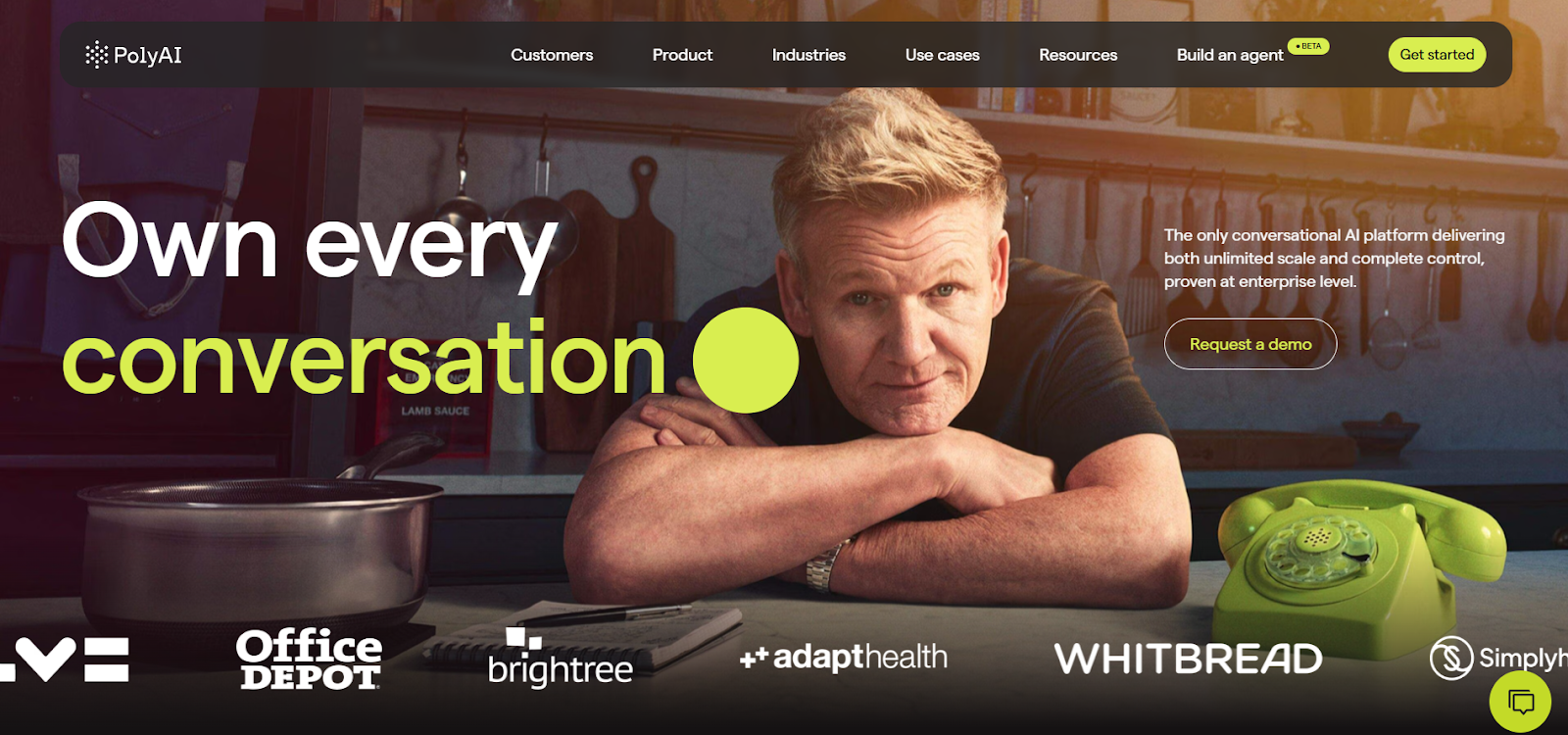
PolyAI is built specifically for enterprise call center environments, where the priority is handling high volumes of inbound calls with structured, predictable interactions. Unlike developer-first platforms, PolyAI comes as a more opinionated system with pre-defined approaches to conversation design, deployment, and optimization. It is particularly strong in industries like banking, telecom, and travel, where call flows are relatively standardized but require high accuracy and compliance. The platform focuses heavily on natural-sounding conversations within controlled boundaries, rather than open-ended dialogue flexibility.
In structured inbound simulations (billing queries, booking changes, FAQs), performance was stable and consistent. However, when conversations moved outside expected flows, the system showed limitations in adapting dynamically compared to more flexible platforms.
Startups and mid-sized teams without enterprise budgets. Outbound sales use cases or rapidly evolving call workflows.
~4.6 — strong feedback from enterprise users, particularly around reliability and voice quality, with noted concerns around cost and flexibility
Custom enterprise pricing, typically contract-based. Total cost includes implementation, support, and usage, making it significantly higher than usage-based platforms.
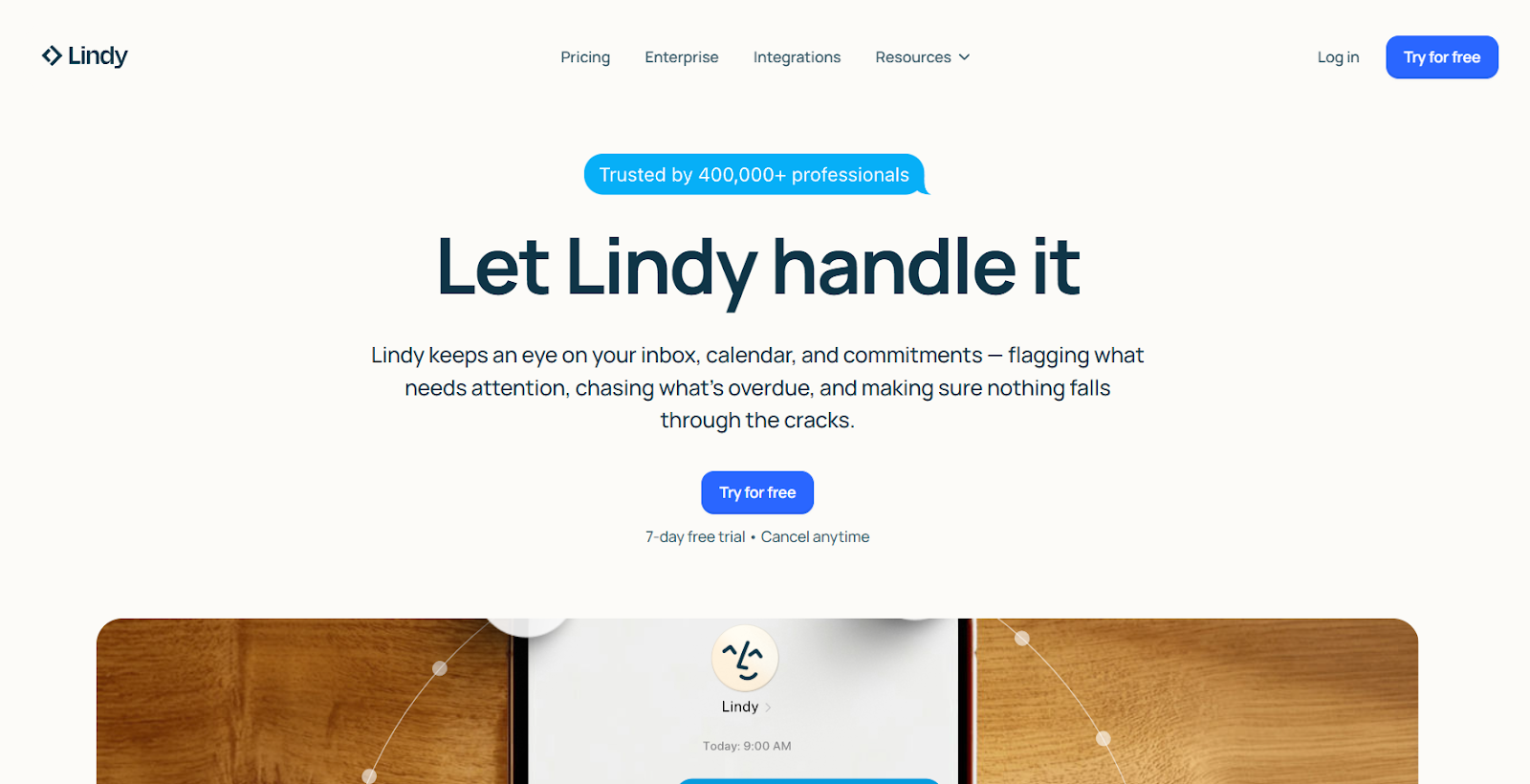
Lindy AI takes a different approach by positioning itself as a workflow automation layer that includes phone calls as one of several execution channels. Instead of focusing purely on conversation quality, it emphasizes task completion — triggering actions, updating systems, and coordinating workflows across tools. This makes it useful for scenarios where calls are part of a broader process (e.g., follow-ups, reminders, or operational tasks). However, this also means that deep conversational performance is not its primary strength, especially in comparison to platforms built specifically for voice interactions.
In task-oriented scenarios (e.g., reminders, simple confirmations), the system performs reliably. However, in longer or more conversational interactions, it struggles to maintain the same level of fluidity and context as dedicated calling platforms.
Teams prioritizing conversational realism and call quality. High-volume outbound or inbound support operations.
~4.4–4.6 — positive feedback on automation capabilities, with mixed reviews on voice interaction quality
Subscription-based with additional usage costs depending on workflows and integrations. Cost predictability varies based on how extensively automation features are used.
When I choose an AI phone call agent, I start with the call environment, not the demo. The platforms that actually work are the ones that handle real conversations, integrate cleanly into existing systems, and maintain performance as volume increases. Most tools look similar at a surface level, but the differences become clear once they are tested inside live calls.
Use this as a practical filter:
Start with the primary call use case: Define where the agent will operate first. Outbound sales, inbound support, or qualification and booking. Platforms built for a specific call type consistently perform better than general-purpose tools. Outbound systems need strong objection handling and flow control. Support agents need accuracy and deep system integration. Choosing the wrong category creates friction later.
Evaluate conversation handling, not just voice quality: A natural voice is expected now. What matters is whether the system can handle real conversations. Look at how it deals with interruptions, topic changes, and longer multi-turn interactions. The key signal is whether the agent maintains context or falls back to scripted responses. In most evaluations, this is where weaker platforms break.
Check latency consistency, not average speed: Latency directly impacts how human the conversation feels. It is not about the lowest number but about consistency. If response timing varies across the call, the experience feels artificial. The best systems maintain stable response timing even as the conversation becomes more complex.
Validate integration depth inside live calls: An AI phone agent is only as useful as the systems it connects to. It needs to pull CRM data, book meetings, update records, and trigger workflows without breaking the conversation. Many platforms claim integrations, but the real test is whether those integrations work reliably during a live call.
Match the platform to your team's operating model: Some platforms require ongoing tuning and technical ownership. Others reduce setup time but limit control. If your team can handle configuration and optimization, more flexible platforms will perform better over time. If not, simpler tools may help you launch faster but will limit what you can achieve.
Model real cost before committing: Pricing pages rarely reflect actual cost. You need to account for call duration, LLM usage, retries, and telephony. The difference between base pricing and real cost becomes significant at scale. I always model expected volume before making a decision.
After evaluating these platforms in real call environments, the decision comes down to one thing: which system continues to perform once the conversation stops being predictable.
Most tools in this space solve for a specific layer. Some prioritize outbound scale, others reduce setup time, and a few focus on structured enterprise use cases. But in practice, phone calls don't stay within clean boundaries. Users interrupt, change context, ask follow-up questions, and expect the system to respond without breaking flow. This is where most platforms start to degrade, even if they perform well in controlled scenarios.
Retell AI stands out because it is built around this exact problem. It maintains consistent response timing throughout the call, handles interruptions without resetting the interaction, and preserves context across multiple turns. More importantly, it gives teams enough control to refine these behaviors as call complexity increases, which is critical once the system is deployed at scale. If the goal is to run real conversations that impact conversion or resolution outcomes, Retell AI is the most reliable choice among the platforms evaluated here.
An AI phone call agent is software that can make and receive phone calls, speak with users in real time, and complete tasks like booking meetings or qualifying leads without human involvement. Unlike IVR systems, it handles natural, multi-turn conversations where users can interrupt, ask follow-ups, and change direction.
AI phone call agents typically cost between $0.08 and $0.30 per minute in real-world usage. While base pricing may start around $0.05 per minute, actual costs increase based on conversation length, LLM usage, telephony charges, and system configuration.
Retell AI is one of the strongest choices for outbound calls where conversation quality directly impacts results, such as sales and lead qualification. It maintains context, handles interruptions smoothly, and keeps response timing consistent during live conversations. For high-volume campaigns with simpler, repetitive flows, tools like Bland AI can work well, but for outbound scenarios that require real conversations, Retell AI performs more reliably.
The most important factors are latency consistency, conversation quality, integration depth, and cost at scale. If the system cannot maintain real-time responses, handle multi-turn conversations, integrate with core tools, and stay cost-efficient as usage grows, it will not perform reliably in production.
See how much your business could save by switching to AI-powered voice agents.
Total Human Agent Cost
AI Agent Cost
Estimated Savings
A Demo Phone Number From Retell Clinic Office