AI Voice Agent Pricing in 2026: What It Actually Costs to Run
13
MIN READ
September 21, 2026
In 2026, AI voice agents are no longer futuristic novelties; they've become essential infrastructure for businesses of all sizes. Whether you’re managing customer support, sales follow-ups, appointment scheduling, or lead qualification, AI-powered voice agents can handle high volumes of calls with responsiveness and consistency that traditional phone systems struggle to achieve. Based on official vendor pricing pages, developer documentation, and published rate cards verified in July 2026, one fact stands out: understanding how these tools are priced and why costs vary is the single most important factor when evaluating whether they deliver real return on investment.
An AI voice agent is a software system that can engage in spoken conversation with humans using artificial intelligence, effectively acting as an automated call responder, virtual receptionist, sales assistant, or support agent. Unlike traditional Interactive Voice Response (IVR) systems that rely on button presses and scripted trees, modern voice agents combine several advanced technologies to understand, reason, respond, and act intelligently in real time.
At its core, a voice agent consists of several interlocking components:
When these layers operate synchronously (ASR → LLM → TTS → telephony), a user can call a business phone number and interact with an AI agent just like a human, except the AI never gets tired, never asks for breaks, never mishears due to fatigue, and scales infinitely across thousands of simultaneous calls.
Voice remains one of the most accessible and ubiquitous interfaces in business. Phones are used across industries and demographics. In 2026, the quality of AI voices has improved beyond simple robotic clarity to near-human expressiveness, making interactions feel natural and trustworthy. This shift has a direct impact on user experience, adoption rates, and overall ROI.
Published industry data and provider documentation point to several reasons voice agents are now strategic investments:
One of the biggest problems buyers face today is confusing and inconsistent pricing across voice AI providers. Some platforms advertise a low per-minute headline rate, but those figures often exclude key cost components like TTS, ASR, and telephony fees. In my own research. Reviewing official price pages and technical documentation from multiple platforms. I observed that the advertised price rarely tells the full story.
Here’s how I structured this guide to ensure depth, credibility, and actionable insight:
For every platform evaluated in this guide, I pulled the latest pricing directly from official sources such as vendor pricing pages, developer documentation, or published rate cards. I did not rely on third-party blogs or unofficial estimates. This ensures the pricing figures you’ll see in Part 2 reflect what real buyers encounter today.
AI voice pricing isn’t just about a single line item. A fully functioning agent involves multiple cost layers:
By breaking costs down this way, you get a much more realistic picture of total expenses.
Where available, I referenced real platform scores and reviews, such as G2 ratings. To reflect user satisfaction and reliability. These scores are both quantitative and qualitative and help differentiate vendors on dimensions that matter beyond pricing.
Rather than just listing numbers, this guide evaluates pricing within real usage patterns. I.e., typical call volumes, average call lengths, and enterprise requirements. This approach helps you understand practical run rates rather than theoretical cost buckets.
Many pricing discussions on voice AI miss a key truth: the pricing model must align with business objectives. For that reason, this guide blends data with real-world evaluation. What I’ve observed in deployments, vendor presentations, pricing changes as of 2026, and comparisons of where hidden costs appear.
After evaluating dozens of AI voice agent platforms, reviewing official pricing documentation, analyzing G2 ratings, and comparing deployment flexibility, I narrowed this guide down to five platforms that consistently stand out in 2026.
| Platform | G2 Rating | Best For | Why It Made the List | Official Pricing |
|---|---|---|---|---|
| Retell AI | 4.8/5 | Scalable real-time voice agents for inbound & outbound automation | Transparent per-minute pricing, strong developer API, built-in telephony, high voice naturalness | $0.07 per minute (usage-based, no base platform fee) |
| Synthflow | 4.5/5 | No-code voice agent building for business teams | Visual workflow builder, multilingual support, strong enterprise adoption | Custom usage-based pricing (quote-based enterprise tiers) |
| Google Dialogflow CX | ~4.4/5 | Structured enterprise conversational design within Google Cloud | Deep customization, enterprise-grade architecture, scalable dialog control | $0.007 per text request + ~$0.001 per audio second |
| Amazon Lex | ~4.2/5 | AWS-native conversational voice & chat systems | Direct AWS integration, predictable request-based billing | $0.004 per speech request |
| ElevenLabs | ~4.5/5 | High-quality neural voice generation (TTS layer) | Industry-leading voice realism used in many AI stacks | Plans from $5/month; Business tiers custom |
Looking at the table alone does not tell the full story pricing models vary significantly between these platforms, and understanding those differences is critical before making a decision.
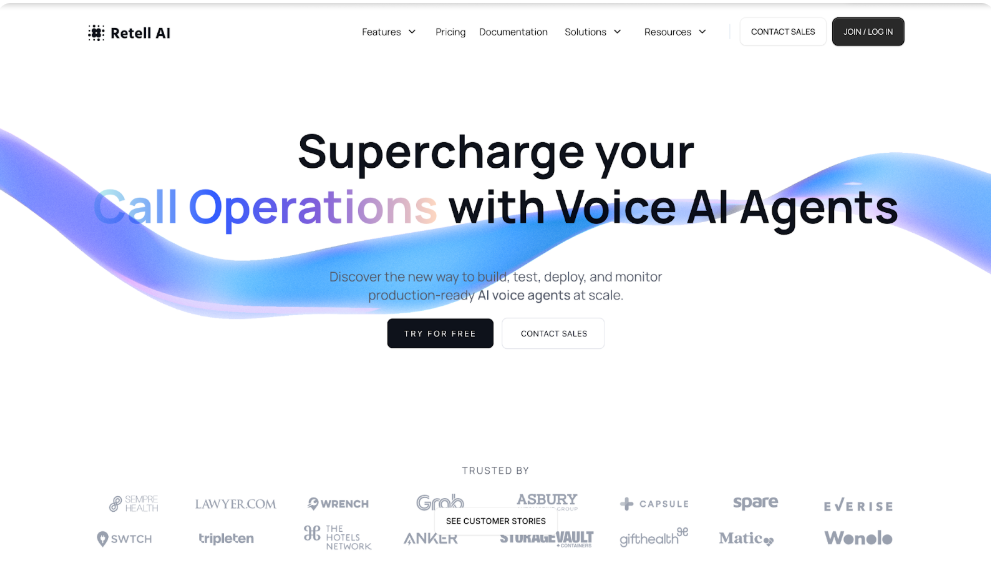
Retell AI positions itself as a purpose-built voice agent infrastructure platform. What stood out in my evaluation is the clarity of its pricing: $0.07 per minute usage-based, without a mandatory base subscription. That simplicity matters. Many competitors advertise low entry prices but require stitching together telephony, TTS, ASR, and LLM components separately.
Retell bundles the core real-time voice pipeline into a single framework, which reduces billing complexity. Its 4.8/5 G2 rating also reflects strong satisfaction among developers building production systems.
From a scalability perspective, this model becomes predictable: cost scales linearly with usage, which makes financial forecasting easier for operations teams.
Synthflow appeals primarily to non-technical teams. Its visual, no-code interface allows businesses to build conversational flows without heavy developer involvement. That accessibility is a major reason it maintains strong mid-4 G2 ratings.
However, pricing is not fully transparent publicly. It typically involves usage-based billing combined with enterprise contracts. This makes it attractive for larger organizations but slightly harder to benchmark for smaller teams looking for straightforward per-minute pricing clarity.
Dialogflow CX is powerful, but it’s infrastructure-first, not out-of-the-box voice agent automation. It charges per text request and per audio second processed. While these micro-costs appear low individually, they stack up across large-scale usage.
For organizations already deeply integrated into Google Cloud, this can be efficient. But it requires more technical orchestration: ASR, TTS, and telephony may involve separate service layers.
It’s a flexible solution, but not necessarily the simplest one to deploy for standalone voice automation.
Amazon Lex follows a request-based model as well, charging per speech request. Its strength lies in AWS integration, especially for companies already using Amazon Connect or Lambda for workflow automation.
From a pricing predictability standpoint, Lex can be economical at scale. But similar to Dialogflow, it often requires assembling additional AWS services for full voice deployment.
ElevenLabs is slightly different from the others. It is primarily a text-to-speech engine, not a complete voice agent platform. However, it is widely integrated into voice AI stacks due to its exceptionally realistic neural voices.
Businesses often pair ElevenLabs with frameworks like Retell or custom infrastructure to enhance conversational realism. Its subscription model is simpler, starting at $5 per month for lower tiers, with higher pricing for business usage.
After comparing pricing transparency, infrastructure integration, user satisfaction, and deployment simplicity, Retell AI stands out because it reduces complexity.
In a market where pricing often becomes fragmented across ASR, TTS, LLM tokens, and telephony routing, clarity becomes a competitive advantage.
This is especially relevant in 2026, where AI cost predictability is becoming just as important as performance.
By this point, we’ve defined what AI voice agents are and compared the top five platforms in terms of pricing and positioning. But the real question most businesses care about is this:
Let’s model a realistic example.
Assume:
• 5,000 minutes of inbound or outbound calls per month
• Average call duration: 3–4 minutes
• Mid-size support or lead qualification use case
If we take a usage-based pricing model like $0.07 per minute:
5,000 minutes × $0.07 = $350 per month
Now compare that to a traditional human agent.
A single customer support agent in the U.S. costs approximately $35,000–$50,000 annually when you factor in salary, benefits, training, and overhead. That breaks down to roughly $3,000–$4,000 per month.
Even accounting for:
• Telephony routing
• LLM token usage
• Premium voice upgrades
• Occasional human handoff escalation
Most AI voice deployments at moderate scale land between $400–$1,200 per month, depending on complexity.
That cost delta is why adoption accelerated significantly in 2025 and continues rising in 2026.
But raw cost savings alone don’t define ROI.
When I carefully analyzed pricing models across major AI voice agent providers, one consistent pattern became clear: the headline price almost never reflects the final monthly invoice. Many platforms advertise an attractive per-minute or per-request rate, but once you begin operating at scale, the hidden costs of using low-fee payment processors and other additional cost layers start surfacing. These incremental components can significantly increase the true total cost of ownership if they are not factored into forecasting from the beginning.
One of the most common add-ons is Speech-to-Text (STT) processing fees. While some vendors bundle this into their base pricing, infrastructure-driven platforms often charge separately for every second of audio transcribed. Similarly, Text-to-Speech (TTS) can introduce unexpected cost escalations, especially when businesses opt for premium or neural voices that deliver more natural human-like conversations. These upgraded voices often carry higher per-character or per-minute rates.
Another cost driver that many teams underestimate is LLM token consumption. Because modern AI voice agents rely on large language models to interpret and generate responses, every conversational turn may incur token-based billing. In high-volume environments, these token charges compound quickly, particularly for longer or more complex interactions. Telephony routing is another area where invoices expand. Carrier markups, call forwarding, international routing, and phone number provisioning can all increase the blended cost per minute beyond what is initially advertised.
Enterprise support tiers also contribute to the final expense. As businesses scale, they often require priority support, SLA guarantees, compliance features, or dedicated account management. All of which typically sit outside entry-level pricing plans. Concurrency scaling fees may apply as well, particularly when multiple calls run simultaneously. Some providers charge more as concurrent call limits increase, which affects businesses handling seasonal spikes or outbound campaigns.
For infrastructure-heavy systems such as Google Dialogflow CX or Amazon Lex, these cost components are frequently separated across services. ASR, language processing, telephony, and orchestration may each be billed independently. While this architecture offers flexibility and deep customization, it also makes financial modeling more complex and sometimes less predictable.
In contrast, platforms like Retell AI aim to reduce billing fragmentation by offering clearer per-minute pricing structures. By consolidating core voice processing layers into a unified pricing model, they reduce the likelihood of unexpected invoice variability. That kind of predictability is not just a financial advantage. It’s an operational one. Finance and operations teams prefer linear cost scaling because it allows them to forecast budgets accurately, manage margins confidently, and avoid end-of-month billing surprises.
In AI voice deployment, cost transparency is just as important as technological capability. Businesses that understand the full pricing architecture upfront are far better positioned to capture ROI without encountering unpleasant surprises later.
Pure labor replacement is only part of the return.
In real-world implementations, voice AI impacts:
AI voice agents answer instantly. No hold times. Faster responses improve customer satisfaction and reduce abandonment rates.
After-hours calls often convert poorly because no one answers. AI agents eliminate that gap, capturing revenue that would otherwise be lost.
Humans vary in tone, accuracy, and performance. AI agents maintain consistent quality and process adherence.
Holiday seasons, campaign launches, or viral demand spikes don’t require hiring temporary staff. The AI scales automatically.
When you combine:
• Lower operational cost
• Higher call coverage
• Improved response consistency
• Revenue retention
After comparing pricing transparency, architectural design, scalability, and real-world usability, the most strategic choice in 2026 depends less on raw features and more on operational clarity. Many platforms offer powerful voice capabilities, but fragmented billing across ASR, TTS, LLM tokens, and telephony can make true cost forecasting difficult. For businesses deploying voice agents at scale, predictability becomes just as important as performance. In that regard, Retell AI stands out for its straightforward per-minute pricing model, integrated telephony support, and infrastructure purpose-built specifically for real-time voice agents rather than adapted chatbot systems.
Pricing transparency, scalability, and real-world ROI modeling matter more than marketing claims. The key is not choosing the cheapest option but choosing the most predictable and strategically aligned one.
Before choosing a voice AI provider, ask:
The businesses that win in 2026 will not be the ones adopting AI blindly, but the ones modeling cost carefully and aligning it with workflow efficiency.
Per-minute rates in this category run wider than most guides admit, because the model and the voice you choose move the number more than the vendor does. Published rate cards show bands for that reason.
The line item that surprises buyers is not the minute. It is the build. Most production deployments carry a one-time implementation, staffed internally or bought as a scoped package, plus a support plan if you need named response times, plus concurrency above the included allowance. A cost model that counts only minutes will land well under what year one costs.
Yes, in most moderate-to-high volume scenarios. A full-time human support agent can cost $3,000–$4,000 per month including overhead. AI voice systems handling similar call volumes typically operate at 10–30% of that cost. However, hybrid models (AI + human escalation) often deliver the best balance.
The biggest cost drivers are:
• Total call minutes
• Average call duration
• Speech-to-text processing volume
• LLM token consumption
• Telephony routing fees
• Concurrency scaling
Understanding these components is crucial for accurate budgeting.
Yes. Many infrastructure-based systems separate ASR, TTS, and telephony billing. Premium voices or higher reasoning models can also increase cost. Always review whether pricing is bundled or layered across services.
High-volume sales or support environments often recover deployment costs faster due to immediate staffing cost reduction and improved coverage.
See how much your business could save by switching to AI-powered voice agents.
Total Human Agent Cost
AI Agent Cost
Estimated Savings
A Demo Phone Number From Retell Clinic Office