Customer Engagement Examples in 2026: Real Strategies That Actually Work
13
MIN READ
September 28, 2026
Meet Alex. Alex loves running, and every few months he invests in a few gears: shoes, socks, moisture-wicking shirts. One brand always comes to mind when Alex is ready to shop because they offer his preferred shoe model, recommend new shoes based on his location, and even remind him when it's time to replace his worn-out pair.
Every interaction feels like it was built just for Alex, because it was.
This is the promise of AI-powered customer engagement: anticipating customer needs, creating consistent experiences, and making customers feel truly understood.
Customer engagement doesn't happen by accident; it requires strategy. This guide covers how the fastest-growing brands are making that happen—and how you can create the same kind of continuous, intelligent customer engagement for your own business.
Customer engagement measures how effectively your business engages with its customers across various touchpoints–from email campaigns and product recommendations to social media ads and loyalty programs. It's a strong predictor of customer loyalty, retention and revenue, along with how invested people are in your brand.
High customer engagement correlates with better business outcomes. Since engaged customers have higher lifetime value, lower churn rates and strong brand loyalty. Low engagement, on the other hand, is an early warning sign: customers who stop interacting are customers who are likely to leave. Businesses often drive this engagement through engaging video content and other interactive experiences.
A successful strategy often includes an understanding of cultural nuances and technological accessibility. Recent studies show that localised engagement effectively increases customer satisfaction and brand loyalty by over 80%, highlighting its undeniable impact on market success.
A successful global customer engagement strategy involves multiple components that foster trust and build stronger relationships.
Customer communication should reflect the values and interests of the local audience. Ultimately, brands that invest in cultural intelligence move from generic outreach to meaningful connection. This not only increases satisfaction and loyalty but also builds long-term credibility in diverse markets.
Customers buy from brands that "speak their language." Harvard research shows consumers are "72 % more likely to purchase when information is provided in their native language."
Multilingual support helps businesses penetrate new regions overnight. For instance, Amazon localized its platform into dozens of languages–Spanish, German, Japanese, and more, allowing users to browse products, read reviews, and complete purchases in their preferred language.
This has significantly increased adoption among non-English-speaking users and helped Amazon penetrate deeper into tier-2 and tier-3 cities.

With customers reporting that their loyalty and likelihood to spend would rise if brands focused on the right things, it's clear that improving experiences through messaging, automation, and AI can help brands attract and retain those spenders.
A new survey from Horowitz Research shows half of all U.S. consumers say social media is their primary way to learn about brands.
Marketers can use multiple features and strategies to get in front of their audience:

Brands that can't support conversational shopping on social platforms will miss an increasingly large portion of purchase intent.
Brands are committing significant resources to AI in 2026 because the ROI is clear and customer expectations are shifting faster than anticipated. For instance:

Trust in AI is a direct result of investment. Teams that commit to a custom tone of voice, testing, and QA processes unlock exponential returns across efficiency, quality, and revenue.
Consumer preferences are evolving, and businesses are struggling to keep up. In fact, the majority (53%) of businesses face difficulty in keeping pace with changing customer preferences as their biggest challenge, up from 44% last year.
At the same time, customer loyalty is fading. Just 44% of global consumers consider themselves "very" or "extremely" loyal to brands, down from 48% last year.
AI is the breakout technology of the moment, which is driving business growth: 96% of organizations using AI for personalization report seeing measurable business benefits.
Beyond personalization, AI is delivering measurable operational improvements. Around 51% of businesses report faster response times, 47% highlight more efficient data organization, and 45% are seeing improved customer satisfaction scores as a direct outcome.
Younger generations show stronger optimism toward AI: 73% of Gen Z and 76% of millennials believe it will enhance their experiences, compared to 69% of Gen X and 61% of baby boomers.

Consumers reward brands that get personalization right, but there's a disparity in just how much.
Seventy-five percent of businesses report that personalization increases customer spending, with purchases rising by an average of 32%. Meanwhile, 64% of consumers cite personalisation as important.
To unlock AI's full potential, companies are prioritizing three key areas:
It's not just about deploying AI, it's about building trust at every step.
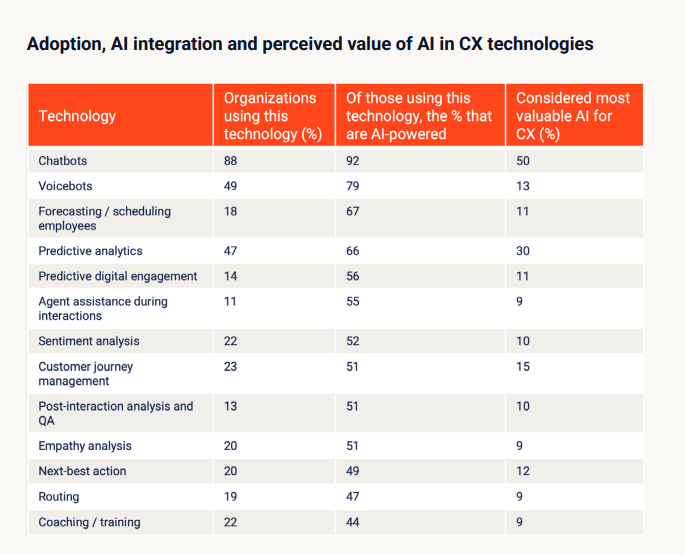
While chatbots are a crucial entry point, let's be clear: They're just one application of what's possible when it comes to AI boosting customer engagement.
For instance, CX leaders are using AI for customer journey management (23%), sentiment analysis (22%) or coaching/training (22%). Fewer are using empathy analysis (20%), forecasting/scheduling for frontline employees (18%) or agent assistance during interactions (11%), but it's most likely to come up in 2026.
Below are some of the examples and models used across different industries to improve customer engagement. Each one highlights opportunity, a concise strategy, and key takeaways you can adapt to your tech stack, audience, and goals.
Even among visitors who do add items, 70% or more abandon their carts without purchasing. These gaps reflect persistent frictions caused by:
Traditional digital support is primarily reactive, they help answer customer queries, but doesn't truly assist with context-aware guidance, which is exactly what AI voice interactions deliver.
Integrated voice systems use speech-to-text (STT) to capture user questions, large language models (LLMs) to interpret intent, and text-to-speech (TTS) to reply naturally, and this is all done with low latency and embedded context.
Compared with text chatbots or search bars, voice assistants offer:
For enterprise commerce teams focused on CX, voice assistants act as conversion-driven experiences that improve outcomes by resolving uncertainty at the precise moment it impacts a purchase decision.
Agentic AI systems are designed to handle complex goals and workflows with limited direct human supervision. It demonstrates genuine problem-solving capabilities and adapts its approach based on context, customer history and real-time data analysis.
When you use Retell AI with tools like Intercom or Zendesk, it can:
For example, a customer asks, "Where's my refund?"
Instead of sending a generic link, the bots pull the order, check the refund progress and reply with the most appropriate next steps and share the current status. If something looks off, the issue is escalated to a human agent. This cuts wait time and boosts satisfaction.
As a result, customers get quick, helpful responses. Your team avoids repetitive work and focuses on issues that need human attention.
When a new user logs into the dashboard but skips the "Upload Data" step, AI recognizes the pattern and gently steps in with a subtle tooltip: "Most users begin by uploading a file. Need a quick hand?" Clicking it opens a short 30-second walkthrough video.
This approach keeps users from feeling stuck or confused. Instead of reaching out to support, they get timely, contextual help right when they need it.
Understanding what customers want is a top infrastructure priority for marketing leaders.
With tools like Retell AI that understand sentiment analysis and intent detection, you can:
For example, if a user says, "My order hasn't arrived yet, and it's been 10 days," the AI classifies this as order tracking with frustrated sentiment. Instead of a plain response, it reacts empathetically and actionably, apologizing first, then asking for the order ID to proceed.
This helps you stop guessing what's wrong. AI surfaces real issues directly from customer language, helping you fix problems before they escalate.
They can:
Imagine a user signs up for your SaaS product but hasn't tried a key feature even after 5 days. AI detects this inactivity and triggers a personalized email like, "Most users begin with this feature, here's how." It includes a quick tip along with a short video walkthrough.
Instead of sending the same message to everyone, you're guiding users based on their actual behavior (or lack of it), leading to more meaningful engagement and higher conversion rates.
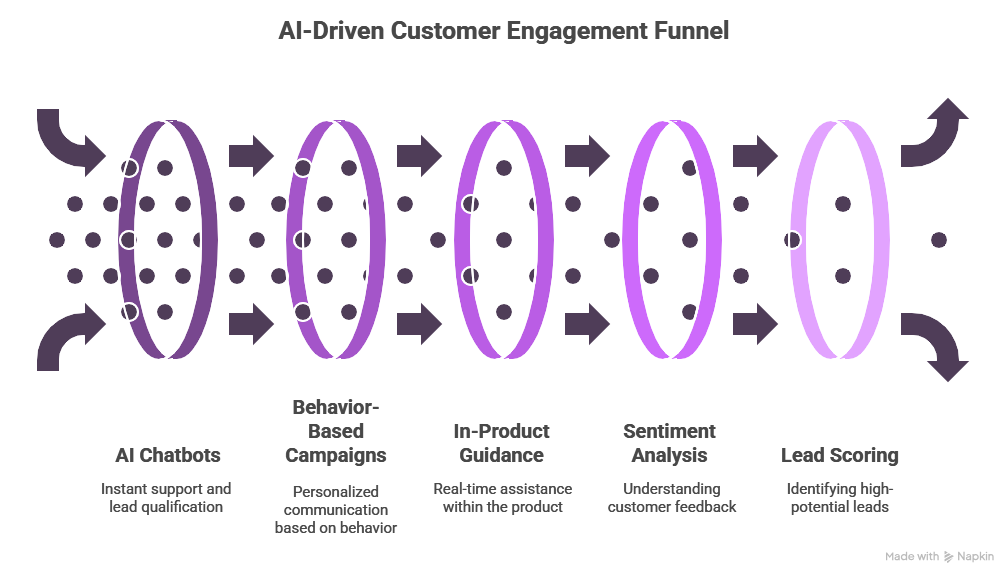
For instance, Retell AI analyses:
For instance, when a lead visits your pricing page, opens your email multiple times, and asks a product-related question via chat, Retell AI flags them as "hot." It then updates their CRM status and routes them to the sales team along with a summary of their key actions.
This ensures your sales team engages the right prospects at the right moment, cuts down on wasted outreach, and accelerates deal closures.
Unified omnichannel customer engagement delivers measurable impact:
For instance, a customer clicks on an Instagram ad and sends a DM. The AI qualifies intent, then follows up on WhatsApp with product details. When the customer visits the website, web chat already knows the context and assists with checkout — no repeated questions.
Retell AI transforms voice interactions into a full-fledged buying experience where users can discover products, ask questions, and complete purchases, all through talking to AI agents.
Here's how over 80% resolution rate and automated at least 40-50% of customer calls with voice agents:
Plus, Retell supports over 50+ languages, so for businesses with global clients, it can save them a lot of money and resources.
As a result, support teams save hours from answering basic, repetitive questions and can focus on complex, high-impact customer issues that truly require human attention.
In 2026, it's not enough to "know" your customers. You have to keep up with them.
What's more important than knowing Alex's shoe size? Learning that he's returning his last pair because they weren't supportive enough for his high arches–something he told your AI chatbot. Contextual data will separate mediocre experiences from outstanding engagement this year.
Strong customer engagement program shares a clear pattern:
When teams connect on these elements, every touchpoint turns into measurable improvements in retention, activation and revenue.
If you are looking to optimize your customer engagement ideas, then opting for a conversational tool like Retell would be an excellent idea. You can automate meaningful conversations, personalize touchpoints, and scale your support and sales without extra headcount.
Try Retell for FREE today.
See how much your business could save by switching to AI-powered voice agents.
Total Human Agent Cost
AI Agent Cost
Estimated Savings
A Demo Phone Number From Retell Clinic Office