Customer Experience Platform: What It Is and How to Choose One
10
MIN READ
August 16, 2026

A customer experience platform is software that pulls every interaction a customer has with your business into one place, so you can see and improve the whole journey instead of scattered pieces of it.
The problem it solves is fragmentation. Your customer talks to sales, gets an email, opens a support ticket, calls the helpline, and to them it is one relationship. To most companies, it is five disconnected systems that never talk to each other.
That gap is where experience breaks down. A customer repeats their problem to three different agents. A sales promise never reaches support. The frustration adds up.
A customer experience platform closes that gap by connecting the data and the channels into a single view. This guide covers what one actually is, what it does, and how to choose the right one for your business.
A customer experience platform, or CXP, is software that brings all of a customer's interactions with your business into one connected system, so every team works from the same view of that person.
Instead of sales, marketing, and support each keeping their own records, a CXP joins them. When a customer calls, the agent sees their recent order, the email they clicked, and the ticket they raised last week, all in one place.
The goal is a single, continuous experience. The customer feels known at every touchpoint, and never has to explain themselves twice or start over because they switched channels.
It usually pulls together a few things: customer data from every source, the channels you engage on, a view of the full journey, and the analytics to see where that journey works and where it breaks.
These three get mixed up all the time, partly because they overlap and partly because vendors blur the lines. Here is the clean version.
A CRM (customer relationship management) manages your relationships and transactions, mostly for sales and service. It tracks deals, contacts, and support tickets, and helps your team act on individual accounts.
A CDP (customer data platform) collects and unifies customer data from every source into one profile, then feeds that data to other tools. It is built for marketers who need a single reliable record of each customer to target and segment.
A CXP (customer experience platform) sits across all of it. It uses the data to orchestrate and improve the experience across every channel, connecting the interactions rather than storing themThe short way to hold it?
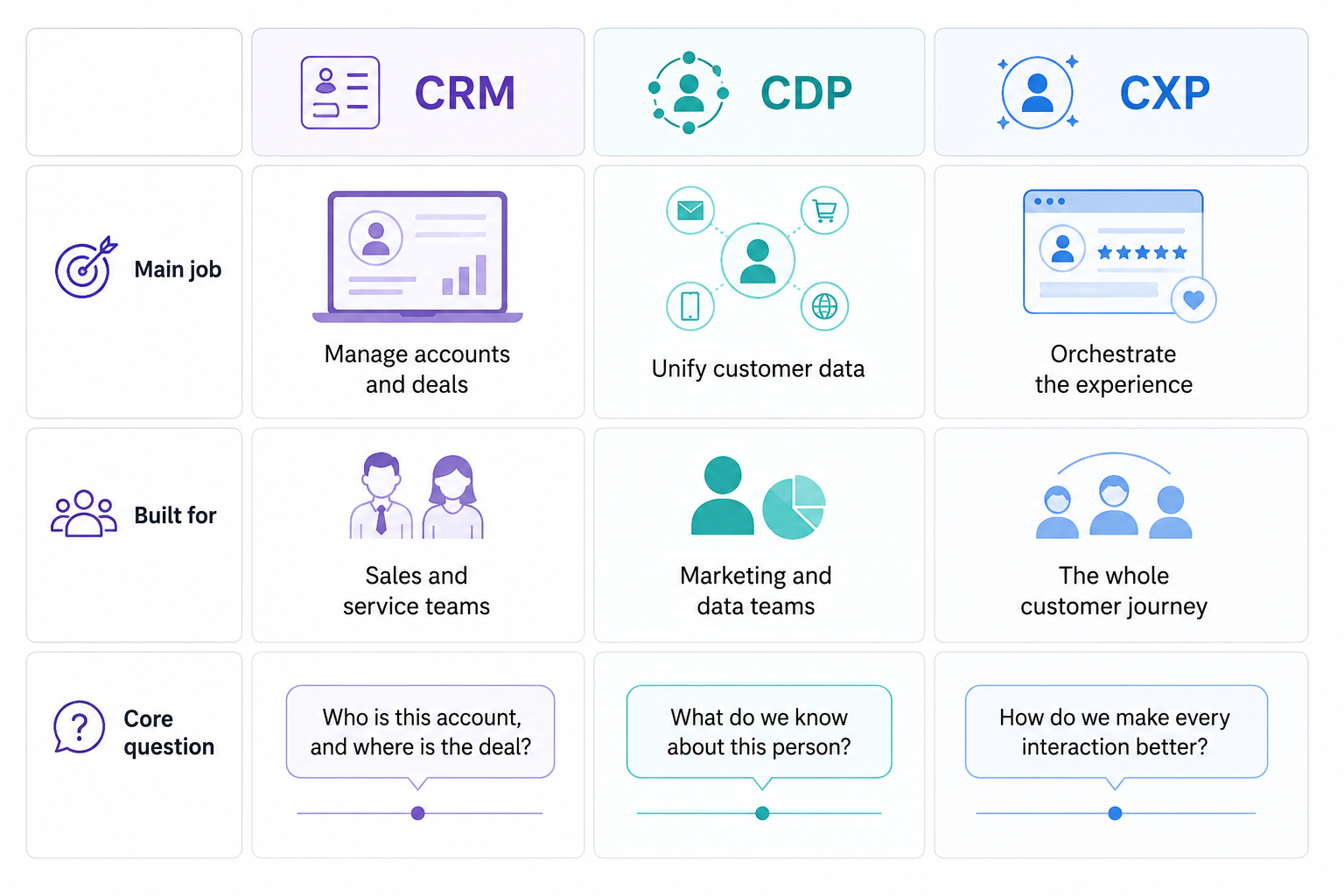
A CRM helps you sell to someone, a CDP helps you understand them, and a CXP helps you deliver a better experience across every touchpoint. Many companies run all three, with the CXP tying them together.
A CXP runs one continuous loop.
Data comes in, it gets tied to the right person, and the platform acts on it.
→ Data flows in as it happens. The platform connects to your existing tools and channels, and activity streams in the moment it occurs, a form filled, a call made, a purchase completed.
→ Each action ties to one person. Incoming activity gets matched to a single profile, so a signup email, a support call, and an order all resolve to the same customer instead of three separate fragments.
→ The platform acts on where they are. Reading that profile, it triggers the next step, a follow-up, a routed call, a flag on an account that looks likely to churn, sent on whatever channel fits.
→ Results feed the next decision. Every outcome loops back in, so the next action is sharper than the last. The cycle runs in the background while the customer just feels looked after.
A customer experience platform earns its place through a handful of core capabilities. Here is what each one does, and why it matters when you compare options.
The platform pulls records from sales, support, marketing, and every channel into a single profile. So when a customer reaches out, whoever picks up sees the same complete history, their last order, the email they clicked, the ticket they raised. No more asking the customer to repeat themselves.
A customer might start on chat, follow up by email, and finish on a call. A CXP connects those channels so the thread carries over instead of resetting each time. The customer feels like they are talking to one company, not five departments.
Beyond storing interactions, the platform shows the entire path a customer takes and lets you act on it. You can trigger the right message or handoff at the right stage, and spot the points where people stall or drop off.
All of this activity becomes reporting you can actually use, showing where the experience works and where it breaks. Voice belongs in that picture too, andcall analytics brings phone conversations into the same view as everything else.
Using what the platform knows about a person, it tailors the messages, offers, and support they get, so the experience fits them rather than treating everyone identically.
A CXP plugs into your CRM, helpdesk, and marketing stack, so it ties your existing systems together instead of forcing you to rebuild from scratch.
The features only matter if they move real business numbers. Here is what a customer experience platform actually delivers when it works.
When people feel understood at every touchpoint, they have far less reason to leave.
A connected experience removes the small frustrations, repeating themselves, being passed around, getting contradictory answers, that quietly push customers toward a competitor.
A CXP gives agents the full context before they respond, so customers get faster, more accurate help.
That shows up directly in satisfaction scores, because most bad experiences trace back to a company that clearly did not have its act together.
Knowing a customer well lets you offer the right thing at the right moment, a relevant upsell, a timely renewal, a product that fits. Generic outreach gets ignored.
Relevant outreach converts, and that difference adds up across a customer base.
Because the platform sees the whole journey, it surfaces the warning signs of churn early, a drop in engagement, a spike in support tickets, a missed renewal.
Catching those in time means saving accounts you would otherwise lose without ever knowing why.
When everyone works from the same customer profile, people stop wasting time hunting across systems or redoing work another team already did. That efficiency frees them to spend time on the customer instead of the tooling.
Every one of these traces back to the same root. A customer experience platform replaces a scattered, disconnected view of the customer with a single one, and almost every gain, loyalty, satisfaction, revenue, efficiency, flows from that.
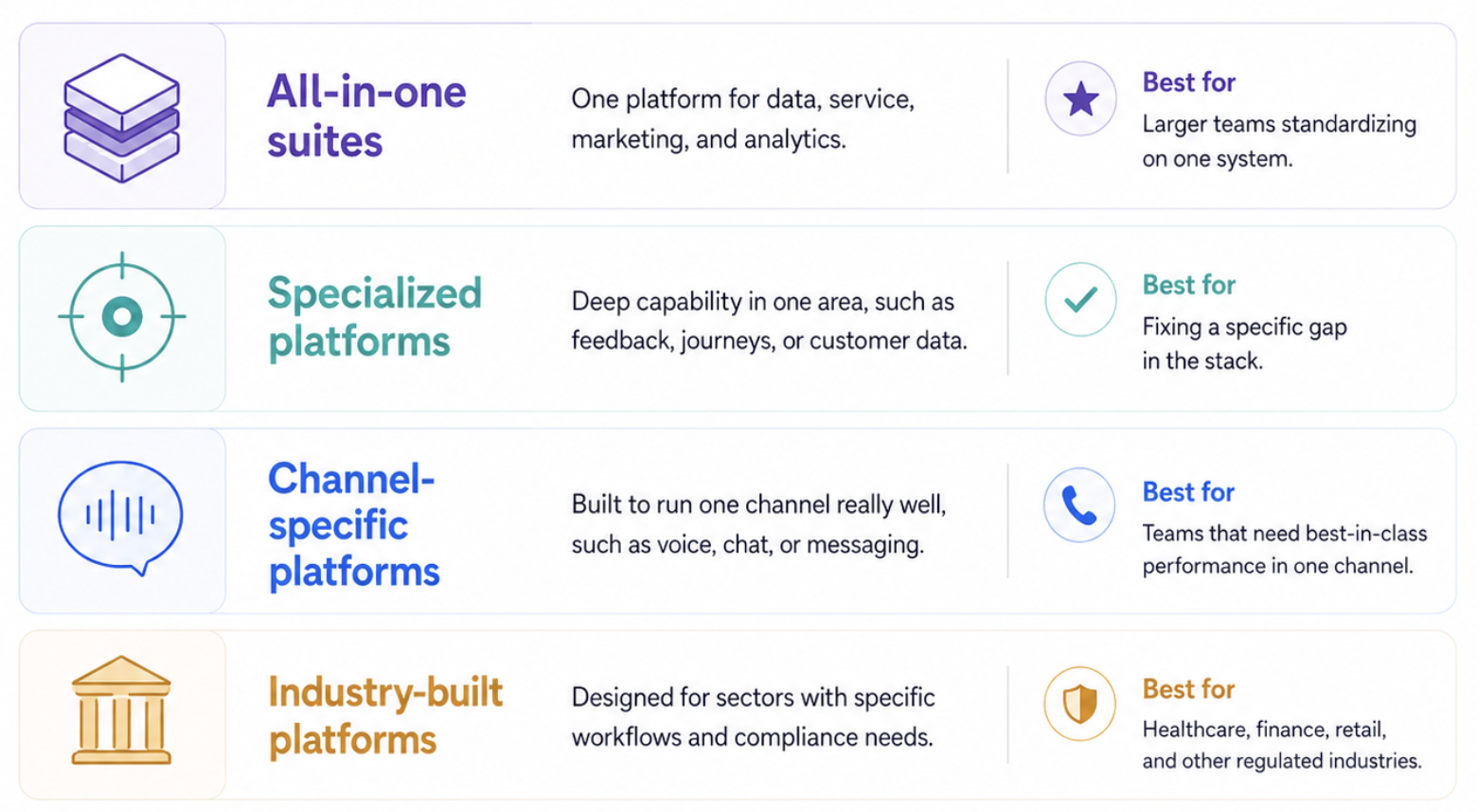
"Customer experience platform" covers a few different kinds of tools. Knowing which one you are looking at makes the decision far clearer.
All-in-one suites. Big platforms that cover the whole experience in one system, data, marketing, service, and analytics together. Salesforce and Genesys sit here. Powerful and integrated, with the price and setup to match. Best for larger companies wanting one vendor for everything.
Specialized platforms. Tools that go deep on one area, journey orchestration, feedback, or customer data, rather than wide across all of it. Companies often run one alongside their existing stack to fix a specific weak spot.
Channel-specific platforms. Tools built around a single channel done well, chat, messaging, or voice. The phone is the clearest example, since the big suites handle it weakly. An AI voice layer like Retell fits here, running the voice channel and feeding it back into the platform a company already uses.
Industry-built platforms. Versions shaped for a specific field, healthcare, finance, retail, with the compliance and templates that industry needs out of the box.
Most companies combine these. A core suite for the foundation, plus specialized or channel-specific tools for the parts it handles poorly.
CX platforms handle email, chat, and social well. The phone is where they tend to fall short, and the phone is the channel people reach for when something has gone wrong.
Someone calls when they are annoyed, confused, or dealing with something they care about. Then they wait on hold, work through a menu, and reach an agent who has none of the history the platform has been collecting everywhere else. The channel carrying the hardest conversations ends up the least connected one.
AI voice agents are starting to fix this. Here is how.
A big share of inbound calls repeat, order status, appointment changes, billing questions. AnAI voice agent answers these right away and works them through from start to finish, holding a normal conversation instead of a rigid menu.
Customers get an answer in the moment, and the hold times that wreck phone experiences go away.
Some calls need a human, an upset customer, a tricky account issue, a big decision.
When a call gets there, the agenttransfers to a person and briefs them out loud on the way in, so the rep arrives knowing who they are talking to and why. Your team spends its hours where judgment and empathy count.
The bigger win comes when the phone stops sitting in its own silo. The voice layer runs on top of the CX platform and phone system you already have, and sends call outcomes back into your analytics and CRM. A call then lands in the same profile as the customer's emails, chats, and orders, and the next agent on any channel can see it.
This is the layerRetell works at. It runs the AI voice agents that handle the phone channel and wire it back into the rest of your customer experience stack, so the platform keeps doing what it does well and the phone stops being the weak spot.
If the phone is the gap in your CX today, you cantry Retell and put an AI voice agent on your calls without changing the systems you already run.
The options start to look alike once you have a few demos behind you. A handful of questions cut through the sameness and tell you which one actually fits.
Map where your customers reach you before you shortlist anything. A platform strong on chat and email but thin on voice is the wrong pick if half your volume is phone calls. Match the tool to your real channel mix, not the vendor's feature grid.
The whole promise of a CXP is one view of the customer. Push on how it pulls data from your existing systems, how clean the merged profile actually is, and whether every team genuinely sees the same record. A platform that leaves gaps here is a CRM with extra steps.
A CXP has to connect to the CRM, helpdesk, and marketing tools you already run. Confirm the integrations you need exist and are properly supported, not listed on a slide and half-built underneath.
Voice is the channel these platforms most often neglect. If the phone matters to your customers, check whether the platform covers it well or leaves you bolting on a separate system later.
Pricing spans a wide range, per seat, per contact, per feature tier, and it climbs fast as you add channels and volume. Map any quote to your actual usage before comparing. Usage-based options like Retell'spricing let you see the cost of the voice piece before you commit.
If you want to compare specific platforms head to head, Retell's rundown of thebest customer experience software breaks down the options worth knowing.
Your customer sees one relationship with your business. Too often, your systems see five, and the gaps between them are where the experience falls apart, the repeated explanations, the lost context, the promise that never carried over.
A customer experience platform closes those gaps by connecting the data and the channels into a single view, so every team works from the same picture and the customer feels known at every step.
Just remember where these platforms tend to be weakest. Voice is usually the channel they neglect, and it is the one people reach for when it matters most. A connected experience everywhere except the phone is still a broken one.
That is the pieceRetell handles. If the phone is the gap in your customer experience, you cantry Retell for free and put an AI voice agent on your calls that ties back into the stack you already run. For a larger or regulated rollout,talk to the Retell team about the right setup.
A customer experience platform, or CXP, is software that connects every interaction a customer has with your business into one view, across sales, marketing, support, and service.
It joins the data and the channels so every team works from the same picture of each customer. The aim is one continuous experience instead of a set of disconnected touchpoints.
A CRM manages accounts, deals, and support tickets, and is built mainly for sales and service teams to act on individual relationships.
A CXP sits across the whole journey and uses customer data to shape the experience on every channel. In short, a CRM helps you manage the relationship, while a CXP helps you improve the experience around it. Many companies run both.
It unifies customer data, connects the channels people use, maps the full customer journey, and turns all of it into reporting you can act on. It also powers personalization, tailoring messages and support to each customer.
The result is a business that can see and improve the entire experience rather than isolated pieces of it.
Any company where customers interact across several channels and teams, retail, financial services, healthcare, SaaS, and more. It tends to matter most once a business grows past the point where one team can track every customer in their head.
At that scale, a CXP keeps the experience consistent as volume climbs.
Pricing varies widely and usually scales with users, contacts, channels, and the feature tier you choose. Enterprise platforms can run into large annual contracts, while more focused tools price per seat or by usage.
Map any quote to your actual volume and the channels you need, since a low headline price can climb quickly once everything is switched on.
See how much your business could save by switching to AI-powered voice agents.
Total Human Agent Cost
AI Agent Cost
Estimated Savings
A Demo Phone Number From Retell Clinic Office