From Contact Center Supervisor to AI Agent Manager
8
MIN READ
An AI agent manager is the person in a contact center who owns how AI voice agents perform on live calls: reviewing their calls, setting the standard for a resolved call, deciding what gets fixed and which calls go to people, and reporting the results. In most contact centers, the people best placed to do that job already have a title. They are supervisors.
The shift is already underway. In a Gartner survey of 321 customer service and support leaders, run in September and October 2025, 85% said they are expanding human agent responsibilities and 75% are moving agents into entirely new roles inside the service organization (Gartner, April 2026). Harvard Business Review now calls the people who oversee AI agents agent managers: leaders responsible for how AI agents learn, collaborate, perform and work safely alongside humans.
A contact center supervisor runs a team of human agents through a shift: watching queues and service levels, keeping people on schedule, coaching on calls, taking escalations, scoring a sample of calls for quality and reporting the team's numbers. The job is built around people.
Those skills still matter when AI voice agents arrive. They just point at a different kind of worker. An AI agent does not need a shift or a break, but it does need someone who listens to its calls, notices when it gets something wrong and makes sure the fix happens. The human team still needs a supervisor too, because transferred calls land with them, and workforce management still decides how many people are on the phones.
For the calls the AI agent handles, the supervisor stops managing attendance and handle time and starts managing outcomes: did the call resolve, was it transferred for the right reason, and if it failed, why. The table maps each core supervisor task to its AI agent manager version.
| Supervisor task | With human agents | With AI voice agents |
|---|---|---|
| Real-time monitoring | Watch the queue, service level and who is on the phones | Watch call success rate, transfer rate and alerts, and listen in on live calls when a number moves |
| Coaching | Side-by-side coaching, calibration sessions, one-to-ones | Turn what you hear into written changes to the agent's instructions or knowledge base, then check the next calls |
| Quality assurance | Score a small sample of calls by hand | Set the criteria for a resolved call, let AI score a sample, read the calls it flags |
| Escalations | Take the call when an agent is stuck | Decide which calls the AI agent transfers and to whom, and take over a live call when needed |
| Scheduling | Build shifts around forecast volume | Decide which call types the AI agent handles and which stay with people |
| Reporting | Handle time, adherence, occupancy | Resolution, transfer rate and reasons, failure causes, load on the human team |
The accountability stays the same: the supervisor still owns the customer's experience on every call in their scope. What changes is the lever. With a human agent, you coach one person. With an AI agent, you change the configuration once and every later call changes with it, so a good fix is worth more, a bad one costs more, and testing becomes part of the job.
An AI agent manager works on a cadence: a short daily check of live performance, a weekly review that turns failed calls into a fix list, and a monthly decision about what the agent should handle next.
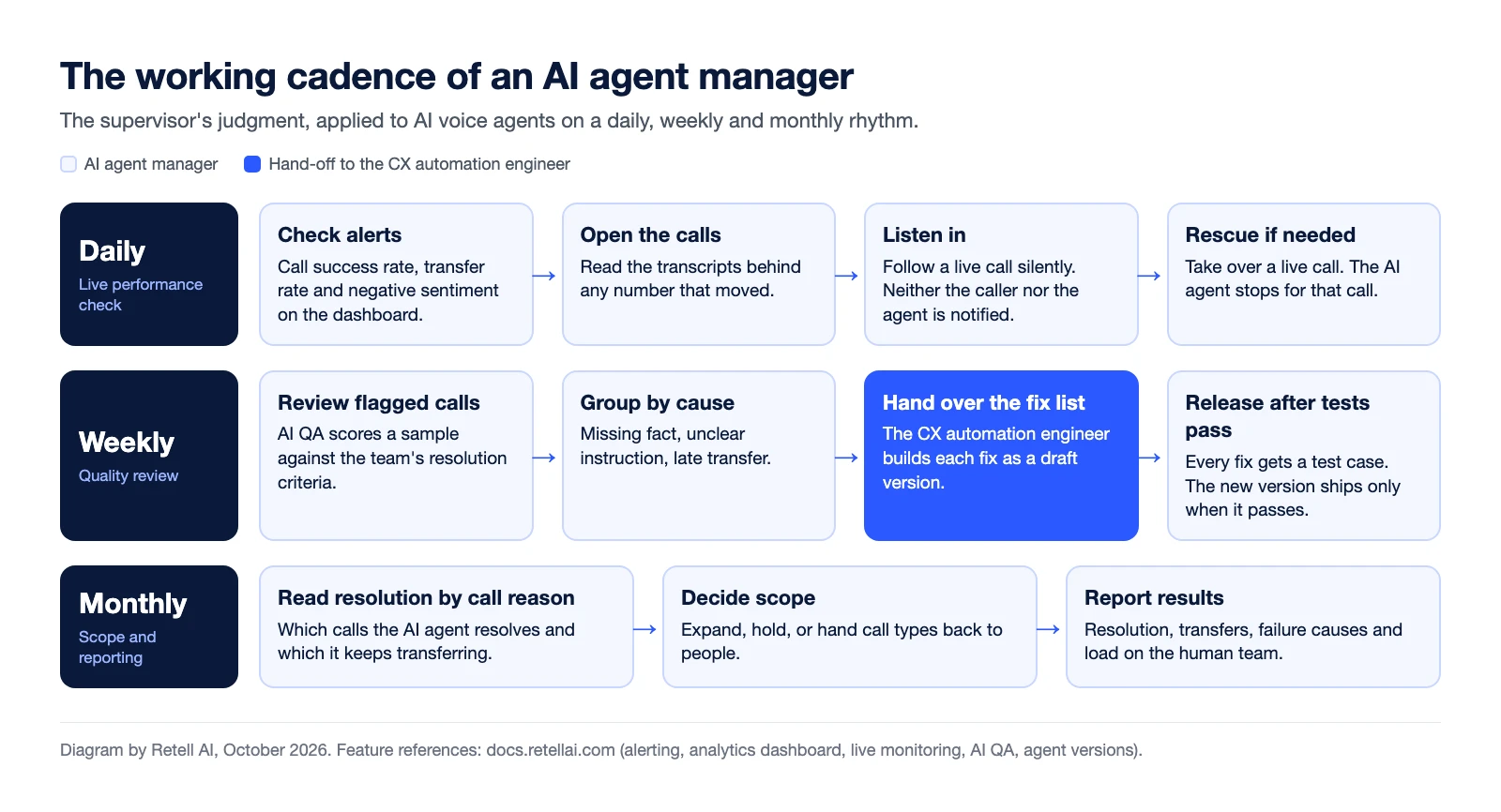
Daily. Start with alerts, not the queue. On Retell, alert rules send an email or a webhook when call success rate drops, negative sentiment rises or more calls fail QA, and the analytics dashboard charts success rate and transfer rate by agent and by agent version. When a number moves, open the calls behind it. Live Monitoring lets you follow a call's transcript as it happens, listen in silently (neither the caller nor the agent is notified) or take over and speak with the caller yourself. Taking over permanently stops the AI agent for that call, so treat it as a rescue, not a coaching tool.
Weekly. Review quality in bulk. AI QA scores a sample of calls against the resolution criteria and metric thresholds your team sets, and flags issues such as hallucinations and knowledge base mistakes with transcript evidence. Read the flagged calls, group failures by cause and write the fix list: a missing knowledge base fact, an unclear instruction, a transfer rule that fires too late. Each fix gets a test case, and a new agent version goes live only after the tests pass (see prompt versioning). Our voice agent QA scorecard is a starting point for the criteria.
Monthly. Decide scope. Look at which call reasons the AI agent resolves and which it keeps transferring, then decide what to expand, hold or hand back to people. Report results with the voice agent KPIs leadership already tracks.
The AI agent manager owns the results, and the CX automation engineer owns the build. In our post on what a CX automation engineer does, that role is the in-house person who oversees continuous improvement of customer-facing AI agents: configuration, knowledge base updates, integrations, pre-release testing, quality review and compliance, the work a vendor's forward deployed engineers usually carry at the start. The AI agent manager is the operations seat next to it, closest to the calls, the customers and the human team.
| Role | Owns | Usually comes from |
|---|---|---|
| Vendor forward deployed engineer | First agents, initial configuration, training the customer's team | The vendor |
| CX automation engineer | Configuration, knowledge base, integrations, test cases, releases, dashboards, alerts and compliance | Operations managers, QA leads, IVR or telephony admins, WFM analysts, senior agents |
| AI agent manager | Day-to-day call performance, what to fix next, which calls stay with people, results | Contact center supervisors and team leads |
| Human agent team | Transferred calls, exceptions, sensitive conversations | Existing agents |
In a large contact center these are often two people working the weekly review together. In a smaller team, one person does both. Either way, the goal from the launch post holds: the company, not the vendor, drives how fast its agents improve.
Carries over:
New:
HBR's list of agent manager capabilities opens with AI operational literacy (how agents work, how prompts shape outcomes, how to diagnose failures) and deep functional expertise. A supervisor already has the second. The first can be taught.
Start small: give one supervisor real ownership of one AI agent before spreading the role across the floor.
For BPOs and agencies running AI voice agents for clients, the same seat exists for each client program, and the AI agent manager is the person the client hears from about results.
Measure the outcomes of the calls in their scope, not activity:
Counting prompt edits or calls reviewed rewards motion, not better calls.
Pick the AI agent with the most call volume, name the supervisor who will own it, and run the first weekly review this month. If you are evaluating platforms, check that supervisors can review, score and step into calls without filing a ticket. Retell's AI QA scores calls against your own criteria, and our team can walk through how enterprise contact centers set up these roles on the enterprise plan.
An AI agent manager owns how AI agents perform in their area. In a contact center, that means reviewing the AI voice agent's calls, setting the standard for a resolved call, deciding what to fix and which calls go to people, and reporting results. The title is not yet standard, but the work is already being done.
The evidence so far points to changed jobs, not removed ones. In Gartner's survey of 321 service leaders, 85% are expanding human agent responsibilities and 75% are moving agents into new roles. Managing AI agents depends on the call judgment supervisors already have.
The core is a supervisor's knowledge of calls, customers and policies. New skills include writing clear instructions for an AI agent, reading transcripts at scale, thinking in test cases and defining success precisely enough for AI to score it.
On Retell, yes. Live Monitoring lets a supervisor follow a live transcript, listen silently without the caller or the agent being notified, take over the call or end it. Taking over permanently stops the AI agent for that call. There is no whisper mode, but a developer can steer a live call in text through the Update Live Call API.
Not quite. The CX automation engineer builds, tests and releases changes to the agents. The AI agent manager owns day-to-day results: what counts as a good call, what to fix next and how the AI agent and the human team work together. In smaller teams one person often does both.
See how much your business could save by switching to AI-powered voice agents.
Total Human Agent Cost
AI Agent Cost
Estimated Savings
A Demo Phone Number From Retell Clinic Office