What a CX Automation Engineer Does (And Why Your Organization Needs One)
6
MIN READ
October 23, 2026

For large organizations with significant voice AI utilization, agent creation and management typically falls to forward-deployed engineers (FDEs). The organization's employees have the customer knowledge, while the FDEs translate that knowledge into working agents.
FDEs learn about the business in order to set up the initial configuration of the agents. Without FDEs, many companies couldn't deploy or fine-tune the AI systems they were trying to adopt. However, that arrangement, when carried on indefinitely, leaves organizations dependent on outside experts for significant changes.
More and more organizations are saying they want the FDE's skill set brought in-house. Their people, who understand the core business, can be trained to translate that business knowledge into the operation and maintenance of the system. Owning the work internally not only lowers costs, but also enables faster and more frequent agent improvements.
Organizations working with a customizable, democratized platform have answered that demand with a new role: the CX automation engineer (sometimes called an internal deployed engineer) who oversees continuous improvement of customer-facing AI agents and automated processes.
The success of such roles depends on an understanding of how it will work in practice. In the article we'll explore:
Why organizations should consider the creation of a dedicated CX automation engineer role
How to identify candidates for this emerging role
What the person in this role will do
What the CX improvement loop is, and why your internal team should drive it
Since Palantir began deploying FDEs in the early 2010s, a host of other technology providers have followed suit. The position attracts some of the industry's best problem solvers. Since January 2025, the number of FDE roles has grown exponentially, rising by over 800%.
Given their widespread use, FDEs will remain a fixture in technology organizations. But the very success of the FDE role presents an opportunity for thoughtful innovation within the internal workforces of the customer organizations they support. A fall 2025 Gartner survey of customer leaders found that, thanks to AI efficiencies, 75% are in the process of moving their human agents into new positions. Gartner also predicted that, by 2027, half of the organizations that had cited AI as a reason for reductions in force will have rehired people for thoroughly reimagined, AI-related work with new job titles.
In other words, many organizations are or will be in a position to add a new position like the CX automation engineer to their organizational charts. Some of Retell's enterprise customers have already made this role official as their platform usage expands. For now, they represent the tip of the spear, but the trend toward internal deployment will only increase.
From the start, we built both our platform and delivery model on the premise that customers should be able to take ownership of their agents and run them on their own. Retell's own FDEs work towards that goal. They help customers get started and solve their most pressing problems. Usually that means building the first agents alongside the customer's team and training its people along the way. From there, our platform lets that team take on more of the work over time, at their own pace, until they're directly improving the agents. The goal is for customers to move from FDEs teaching them the ropes to internal deployed engineers taking care of as much of that work as possible.
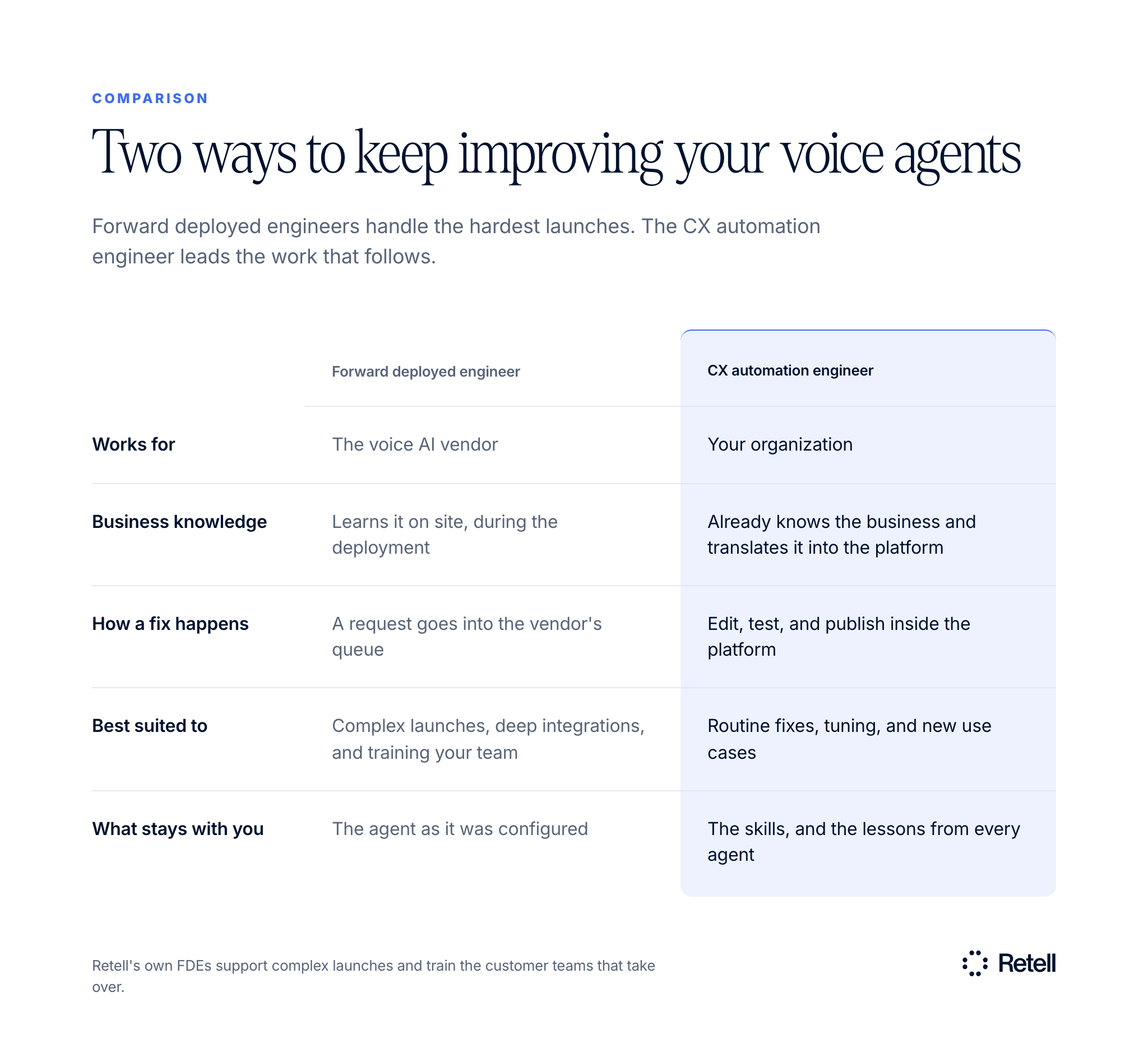
In theory, any employee who touches the underlying technology could shift into this role. For example, at a contact center, an operations manager who has begun mastering prompt engineering to fix mishandled calls has already started functioning as a CX automation engineer. Employees in roles such as telephony or IVR administrator, QA lead, workforce management analyst (people who report on call reasons and volume patterns), and even senior human agents who actually take the calls will interact with aspects of the system.
Employees qualified for the role are likely already:
Rewriting agent prompts to address call quality issues
Reviewing call transcripts and listening to calls to determine where inefficiencies have arisen
Developing escalation rules for transfers to human agents
Of course, the surest sign that someone is qualified for the role may simply be that everyone else is already approaching them with voice AI-related problems.
Duties will vary by organization, but most people dedicated to the CX automation function can expect to oversee tasks such as:
Agent building and configuration, encompassing voice model selection, function calling, and data collection
Use case selection, typically starting with simple, high-volume calls about business hours, order status, or appointments, then deciding which types of calls the agent should take on next
Knowledge base management, updating the documents, web pages, and synced files that the agent draws its answers from whenever a policy or a price changes
Integrations, connecting the agent to the organization's CRM and helpdesk so it can pull up a caller's account or open a support ticket during the call
Pre-release testing, writing test cases that describe a caller's goal and what a successful call looks like, then running them against a simulated caller after every change to the agent
Quality review, setting the criteria for whether a call counts as resolved and reading through the calls that AI QA flags for problems such as hallucinations or wrong answers from the knowledge base
Reporting and alerts, building dashboards that track call success and transfer rates and setting alerts that notify the team when the success rate drops
Compliance, a broad category related to PII redaction, data retention (or lack thereof) that addresses GDPR and HIPAA regulations, plus outbound workflows subject to the Telephone Consumer Protection Act
Once the CX automation engineer is in their seat, the goal is fast, continuous improvement. Although AI already speeds up routine work, dedicating a role to take ownership of improvement cycles can further accelerate it.
The CX improvement loop is the ongoing work of making an agent better once it goes live. For example, someone on the internal team might find the calls the agent handled poorly and determine why. From there, they can build a fix and test it to make sure it works. Once the fix passes testing, they deploy it and watch the next round of production calls for anything else that the agent gets wrong. On Retell, AI QA automatically scores a sample of production calls. Before any fix goes live, simulation testing can run it against an AI caller. If the fix doesn't work, the team can revert to the last published version of the agent.
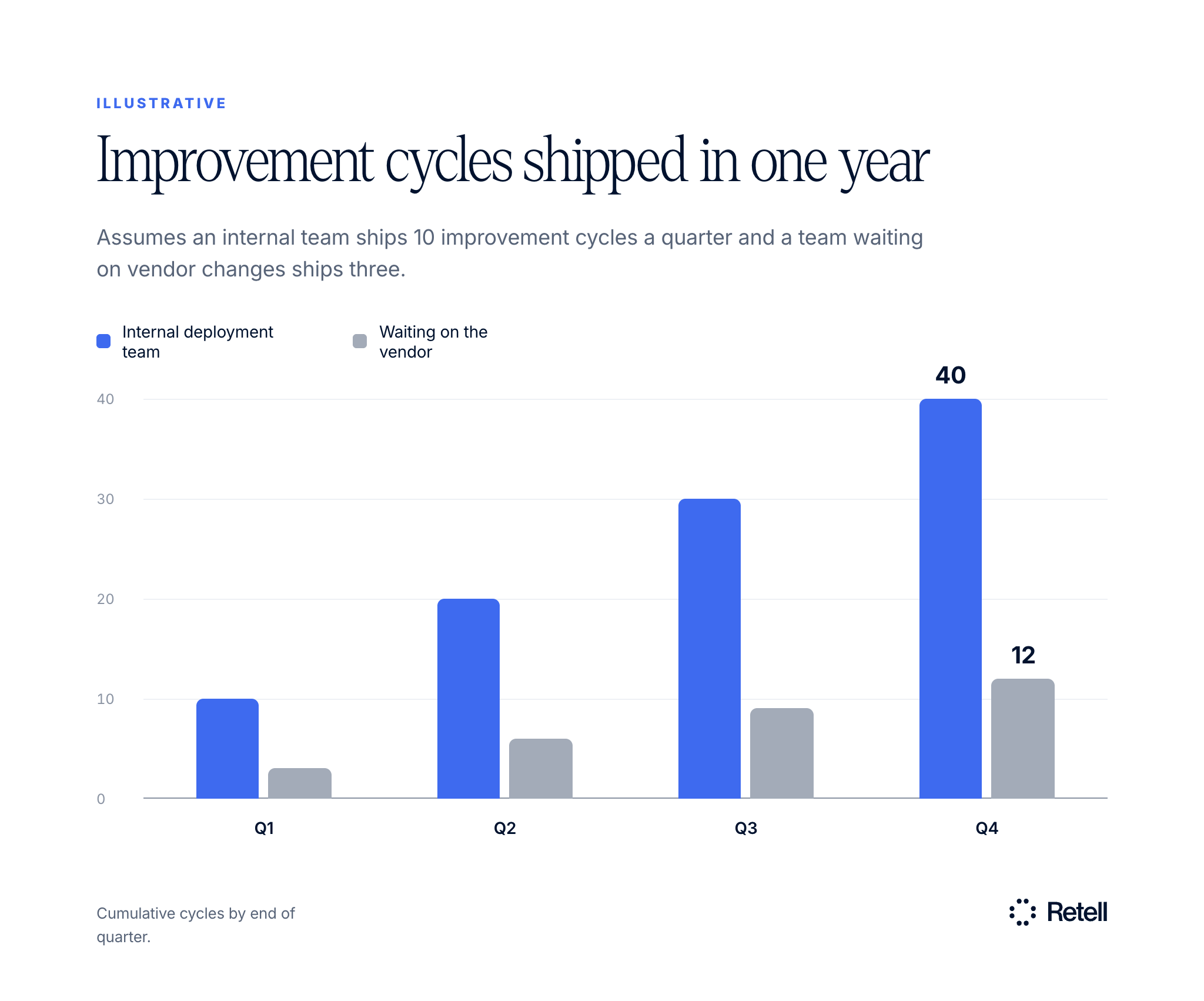
In our view, the organizations that get the most from AI will be the ones that improve their agents fastest after launch and then expand them to new use cases. Each turn of the loop makes an agent better at handling their customers' calls. When a team begins building their second and third agents, they start from what they learned building the first.
To get the full benefit of the loop, an organization has to drive it internally. If most CX automation work remains handled by the vendor, every fix waits in the vendor's queue. The time needed for agent configuration and quick but necessary quality-of-life fixes will also rise with each new agent. Without that kind of immediate attention, even the best rollouts may struggle to gain a foothold.
Internal teams doing CX automation work with their own internal deployed engineers won't have those problems because they will be in control of their own agents. That team is able to move faster, because nobody has to file a request and wait for the vendor to act on it. Its members can apply what they know about the business directly to the agent. When a policy changes or a new product launches, the people who know about the change can update the agent themselves.
Retell supports customer teams as they build their first agents, always with the aim of training them to handle subsequent routine internal deployments. This principle of total operating freedom is built around the idea that the people who work closest to your customers are best suited to direct an agent's growth and development. The contact centers and other enterprise organizations that stand to benefit the most from voice AI will be the ones that can harness platforms like Retell and start making changes from the first day of deployment. Having internally-deployed CX automation engineers who are already part of the organization will speed up that process.
If you're interested in a voice AI solution, try Retell or schedule time with our team to discuss voice AI deployment and how we can help you train not just the agents but also the people who will support them.
See how much your business could save by switching to AI-powered voice agents.
Total Human Agent Cost
AI Agent Cost
Estimated Savings
A Demo Phone Number From Retell Clinic Office