How to Build an Internal Voice AI Team
The roles, skills and first 90 days of an internal voice AI team: who owns the agent, who reviews calls, and where a CX automation engineer fits.
An internal voice AI team is the group of your own employees who own your AI voice agents after launch: one accountable program owner, at least one builder who changes prompts, knowledge and tests (often called a CX automation engineer), and named part-time contacts in QA, IT, telephony and compliance. You can usually start with one or two dedicated people and borrow the rest from teams you already have.
This guide covers the people: which roles you need, which skills to look for, and what the team should do in its first 90 days. It does not cover how agents are built or how voice infrastructure scales. For that, read what it takes to build and scale AI voice agents. The role at the center of the team is described in Retell's post on what a CX automation engineer does.
Why does a voice AI program need its own team?
Because the work does not stop at launch. A live agent needs a steady flow of changes: a policy changes, a product launches, callers ask something nobody planned for, or call review shows the agent giving a wrong answer. Someone has to find those calls, fix the agent, test the fix and release it.
Most enterprise rollouts start with the vendor doing much of that work. A forward deployed engineer (FDE) from the vendor learns the business, sets up the first agents and connects them to your systems. That is a good way to launch. Kept going indefinitely, it leaves you dependent on outside experts for significant changes, and every fix waits in the vendor's queue. An internal team removes the queue, because the people who know about a policy change can update the agent themselves.
This team also looks different from the generic AI team structure that most org-chart guides describe. Those are built around machine learning engineers, data engineers and MLOps, because the company trains and serves its own models. When you run voice agents on a platform, the vendor runs the real-time voice infrastructure that listens, responds and keeps calls connected at scale. Your team owns the business layer: what the agent says, what it knows, which systems it can reach, how its calls are checked and when it hands a caller to a person.
What roles does an internal voice AI team need?
Eight roles cover the work. In a first deployment one person can hold two or three of them, but each role still needs a named owner.
| Role | What they own | Usually comes from | Time at launch | Retell workspace role |
|---|---|---|---|---|
| Executive sponsor | Program targets, budget, which call types are in scope | Head of CX, VP of contact center operations | A few hours a month | Member (read-only), or none |
| Program owner | Outcomes and the roadmap of use cases; decides what ships and when | Contact center or CX operations manager | Part-time to full-time | Admin |
| CX automation engineer | Prompts, knowledge base, test cases, releases and rollbacks | Operations staff already fixing prompts, IVR administrators, QA leads | Full-time | Developer |
| QA and call review lead | Resolution criteria, review of flagged calls, the QA scorecard | QA team, senior human agents | Part-time, weekly | Developer if they need raw recordings, otherwise Member |
| Integration engineer | CRM and helpdesk connections, custom functions, webhooks | IT or the CRM team | Part-time, heaviest at launch | Developer |
| Telephony administrator | Phone numbers and call routing | Telephony or IVR team | Part-time | Admin (only Admins manage telephony settings) |
| Compliance reviewer | Disclosures, PII redaction, data retention, outbound calling rules | Legal, compliance or privacy | Before each new use case | Member |
| Workforce management analyst | Call reason and volume reporting, human staffing as the agent takes more calls | Workforce management team | Part-time, monthly | Member |
The last column maps each role to Retell's workspace access control. Admins manage members, billing and telephony settings. Developers build and test agents and can view raw transcripts and recordings, but cannot manage billing or members. The read-only Member role can view agents, tests, analytics and scrubbed call history without changing anything. Give each person the narrowest role that lets them do their job.
Two roles are easy to miss. Senior human agents are a strong source of edge cases, because transferred calls land with them. And the escalation rules for when a caller moves to a person need an owner, usually the CX automation engineer working with the QA lead. An escalation matrix is a useful place to write them down.
How many people do you need, and when do you add more?
Start with two named people and borrow the rest: a program owner and one CX automation engineer. In a mid-sized operation the same person can do both while the first agent handles one call type. Every other role is a part-time contact with a name next to it.
| Stage | Internal team | What the vendor does |
|---|---|---|
| First agent, one call type | Program owner and one CX automation engineer (can be one person); part-time QA, IT, telephony and compliance contacts | Builds the first agent alongside your team and trains its people |
| Several agents in production | Dedicated program owner, one or two builders, a QA lead with set review time each week | Steps in on the most pressing problems |
| Agents across several business units | A small central group that sets testing, release and compliance standards; builders inside each unit | Platform support and escalations |
Add people when the work says so, not to hit a ratio. Add a second builder when fixes start waiting more than a release cycle, or when you take on a second or third agent, since configuration and fix work grows with each new agent. Make call review someone's main job when flagged calls need daily attention. Bring the integration engineer back each time a new use case needs data from a system the agent cannot reach yet.
Some organizations call a central group like this an AI center of excellence. For voice agents it can stay small. Its job is to keep one release process, one test standard and one compliance review across units, so each unit's builders can move fast without inventing their own rules.
What skills should you look for?
Look for people who already do the job informally. Retell's CX automation engineer post lists the signs: they are already rewriting agent prompts to fix call quality problems, reviewing transcripts and recordings to find where calls go wrong, and drafting escalation rules for transfers to human agents. Often the clearest sign is that colleagues already bring them their voice AI problems.
The skills that matter:
- Clear instruction writing. Prompts are written instructions. People who write good call scripts or knowledge articles tend to write good prompts. See prompt engineering.
- Reading transcripts for the cause. Telling a prompt problem apart from a knowledge base gap, a failed integration or a caller who should have been transferred.
- Test design. A useful test case describes the caller, their goal and what a successful call looks like. That is how simulation test cases are built on Retell.
- Change discipline. Making changes in a draft, comparing versions before release and knowing how to roll back. See prompt versioning.
- Knowledge of the business. Policies, products and the exceptions human agents learn on the job.
- Enough technical literacy to read a webhook payload or a failed function call and describe the problem to IT. A software engineering background is a bonus, not a requirement.
What this team does not need: machine learning research, model training or speech infrastructure engineering. Those sit with the platform.
What should the first 90 days look like?
Plan the first 90 days as a handover. The vendor leads at the start and your team leads by the end.
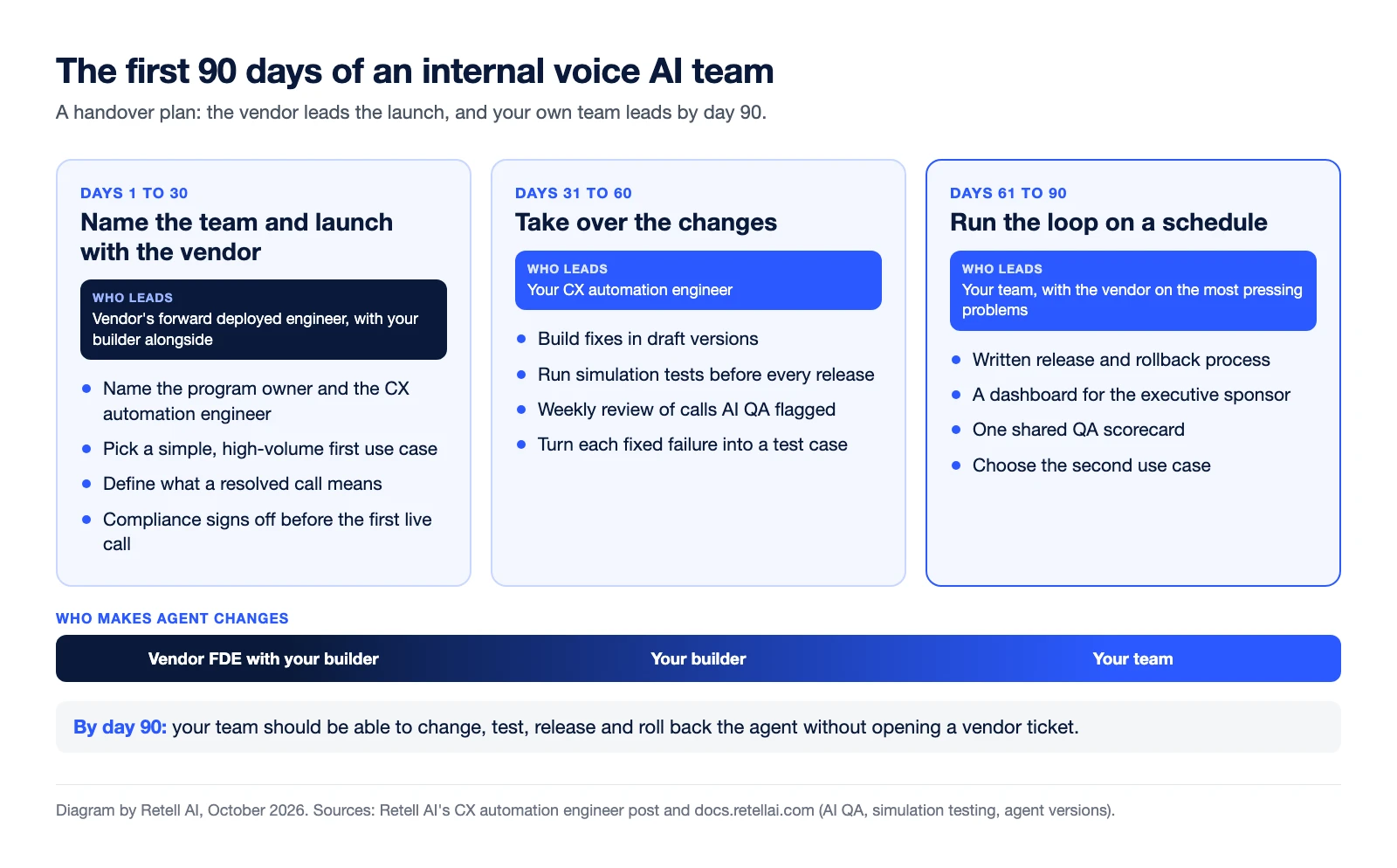
Days 1 to 30: name the team and launch with the vendor
- Name the program owner and the CX automation engineer, and give everyone their workspace role.
- Pick the first use case. Simple, high-volume calls about business hours, order status or appointments are the usual start.
- Write down what a resolved call means for that use case. It becomes the resolution criteria in AI QA and the success criteria in your test cases.
- Have the builder work alongside the vendor's FDE on the first agent, making real changes in draft versions instead of watching.
- Get compliance sign-off on disclosures and data handling before the first live call. The call consent and disclosure checklist is a starting point.
- Set an alert on call success rate, so a drop in resolved calls reaches a named person quickly.
Days 31 to 60: take over the changes
- Your builder ships fixes: change a draft version, run the simulation tests, compare it with the published version, then publish.
- Hold a weekly call review. The QA lead brings the calls AI QA flagged, a senior human agent explains what the caller needed, and the builder decides the fix.
- Turn every failure you fix into a test case, so the test suite grows with the agent.
- Send the vendor only what your team cannot fix in the platform.
Days 61 to 90: run the loop on a schedule
- Write down the release process: who can publish, which tests must pass, and how to roll back. On Retell, if your phone numbers use a production tag, rolling back means moving that tag back to the previous agent version.
- Build a dashboard of the numbers the sponsor cares about. The voice agent KPI dashboard template lists the usual ones.
- Score calls against one shared QA scorecard so reviewers agree on what good looks like.
- Choose the second use case and decide whether the team needs another builder.
By day 90, your team should be able to change, test, release and roll back the agent without opening a vendor ticket. If it cannot, find the step that still needs the vendor and make that the focus of the next month.
Where should the team report?
To the leader who owns the call outcomes, usually customer service or contact center operations, with IT as a close partner. The decisions this team makes every week are customer decisions: what the agent says, when it transfers, what counts as resolved. IT owns the integrations, security and access. A program run entirely from IT can put distance between the builders and the calls they are fixing.
What changes for BPOs, agencies and resellers?
The roles are the same, repeated for each client. If you manage each client's agents directly on Retell, a separate workspace per client keeps each client's agents, phone numbers, API keys, billing and members apart, and you can invite the client's own people into their workspace with the role you choose. Name a program owner on the client side who approves changes, and use one test and release process across every client, so a builder moving between workspaces works the same way in each.
Frequently asked questions
Who should own AI voice agents in a contact center?
One named program owner, usually in customer service or contact center operations, who is accountable for how the agents perform. Day-to-day changes sit with a CX automation engineer, and QA, IT, telephony and compliance each have a named part-time contact.
Do you need machine learning engineers to run AI voice agents?
Not when you run the agents on a voice AI platform. The vendor runs the real-time voice infrastructure and keeps calls connected at scale. Your team needs people who write clear prompts, read transcripts for the cause of a failure, design tests and release changes safely.
What is the difference between a CX automation engineer and a forward deployed engineer?
A forward deployed engineer works for the vendor and leads the launch: learning the business, setting up the first agents and training your team. A CX automation engineer, also called an internal deployed engineer, is your own employee who owns and improves the agents after launch.
How many people does an internal voice AI team need?
Two named people can run a first agent: a program owner and a CX automation engineer, and in a smaller operation they can be the same person. Add a second builder as you add agents or when fixes start to wait, and keep QA, IT, telephony and compliance as part-time roles until their workload says otherwise.
How long does it take an internal team to take over from the vendor?
This guide plans for 90 days: launch with the vendor in the first month, take over changes in the second and run the release loop on a schedule in the third. The real pace depends on how many agents you run and how much time the builder has. Retell's approach is for customer teams to take on more of the work over time, at their own pace.
Build the team alongside your first agent
Retell AI is an AI voice agent platform for contact centers. Its forward deployed engineers usually build your first agents alongside your team and train its people, and AI QA, simulation testing and agent versions give that team what it needs to take over the work. Talk to the Retell team about your rollout and who will run it.