Build, Buy or Managed Service: Who Owns the Voice Agent After Launch?
10
MIN READ
Build vs buy for AI voice agents is a choice between three operating models: build the agent yourself on open-source frameworks and model APIs, buy a voice agent platform that your own team configures, or pay a managed service to build and run it for you. The launch matters less than what comes after it. Every time a policy, a price or a caller habit changes, somebody has to change the agent, and each model puts that work in different hands.
Most build vs buy guides compare two options at the moment of purchase. This one compares all three on what decides whether a phone agent keeps improving: who can find a bad call, fix it, check the fix and ship it, and how many handoffs sit in between.
Retell AI publishes this guide and sells a voice agent platform, which is one of the three models. We say where each model fits, including when building or a managed service is the better call.
The three models differ in who writes the code, who runs the infrastructure and who changes the agent's behavior once it is live.
The models can also be combined. A managed launch can hand over to your team, and your own model logic can sit on a bought phone layer. Both middle paths are covered below.
The table splits the agent into the layers someone has to own on an ordinary Tuesday after go-live. The pattern to look for is the last row.
| Layer | Build | Buy a platform | Managed service |
|---|---|---|---|
| Phone numbers and carrier | Your engineers | Vendor, or your carrier connected over SIP | Provider |
| Speech-to-text, turn-taking, voice | Your engineers | Vendor | Provider, on its chosen platform |
| Model and response logic | Your engineers | Vendor runs it, your team configures it | Provider |
| Prompts, knowledge base, flows | Engineers, unless you build an editor for ops | Your operations team | Provider, on your request |
| Testing before a change ships | A test harness you build | Your team, with the platform's test tools | Provider |
| Call review and alerts | Dashboards you build | Your team, with the platform's QA and alerts | Provider reports to you |
| Uptime and incidents | Your on-call rotation | Vendor | Provider and its platform vendor |
| A fix for a bad call | A code change and a deploy | Your team edits, checks and publishes | A request in the provider's queue |
Building gives you the most control and the most to staff. Buying moves infrastructure to the vendor but keeps behavior with your team. A managed service moves almost everything out, including control over how fast changes ship.
Because a voice agent is never finished. Callers phrase things your scripts did not expect, policies change and new call reasons appear. Retell's post on what a CX automation engineer does calls the response the CX improvement loop: someone on the internal team finds the calls the agent handled poorly, works out why, builds a fix, checks it, deploys it and watches the next calls. The same post names the cost of handing that loop to someone else: "If most CX automation work remains handled by the vendor, every fix waits in the vendor's queue."
The diagram shows one fix moving through each model.
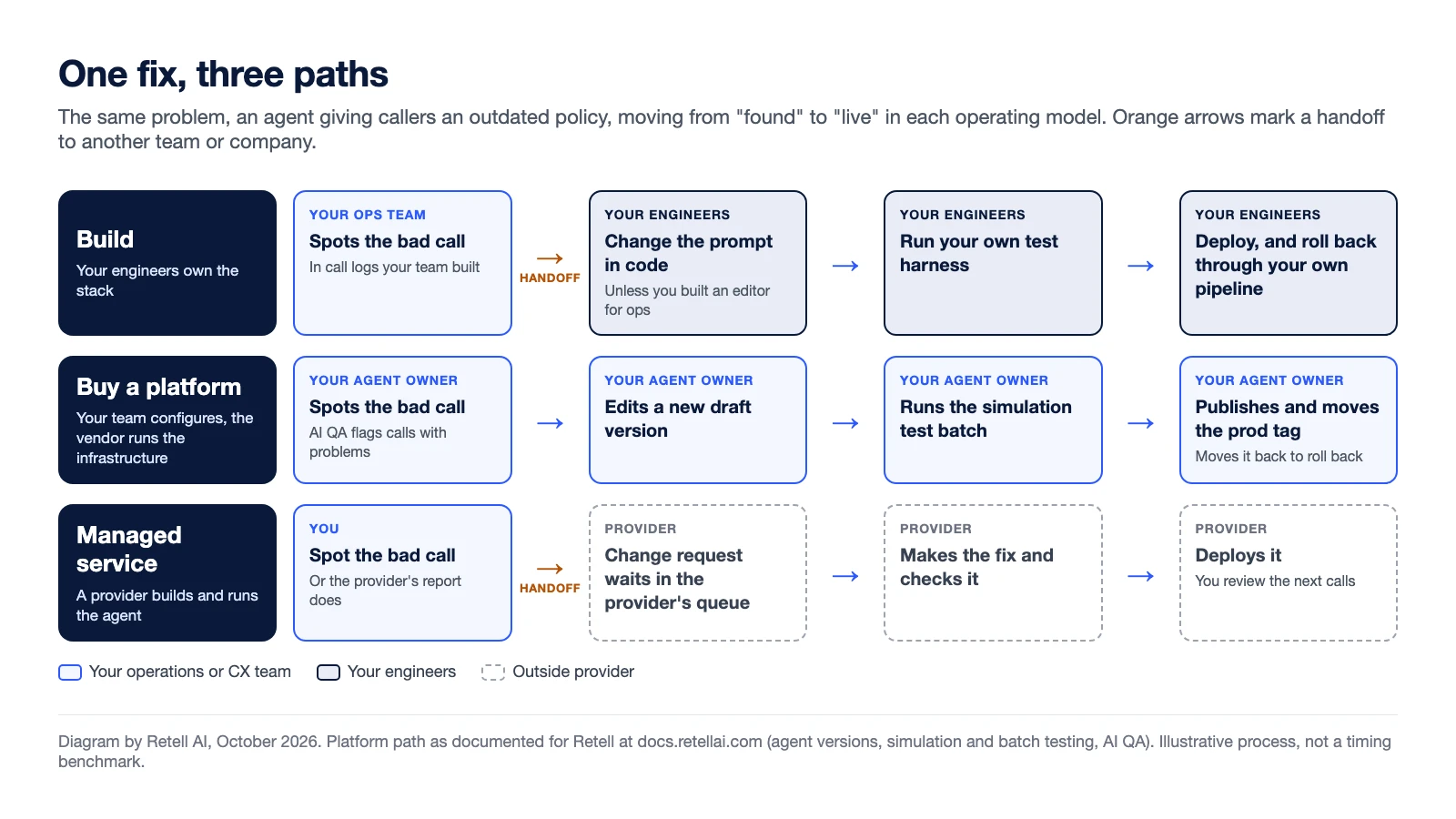
The handoffs are the real difference. In a build, operations often spots the problem but an engineer has to ship it. With a managed service, every change crosses a company boundary. On a platform your operations team can use, the person who found the problem can fix it.
Building commits you to owning a real-time phone system, not just an AI model. The engineering time goes into phone connectivity and transfers, streaming audio that keeps up with interruptions, function calls that fail safely mid-call, searchable call logs, a test harness and release process, and an on-call rotation for when a line breaks.
There is a less obvious cost too. Unless you also build an editor, a test runner and release controls for non-engineers, every prompt change is a code change, and the people who understand the callers queue for engineering time. A build can recreate the vendor queue inside your own company.
Building makes sense when the voice agent is your product, when prompts and transcripts must stay inside your own infrastructure or a model you host, or when you need response logic no platform supports and can staff it for years. Vendors that sell the buy option set a high bar: a 2025 essay on Intercom's Fin blog estimates a self-built support agent needs about one million conversations a month just to break even, assuming a $50,000-a-month engineering team and performance that matches tools you can buy. That is a vendor's estimate for customer service in general, not phone calls, so run your own numbers.
If your engineers want to own the agent code, Retell's comparison with LiveKit sets out what a framework gives you and what a platform handles.
Buying moves the infrastructure to the vendor, not the agent's behavior. Someone on your team still owns the prompts, the knowledge base, the test cases and the review of real calls. What the platform should give that person is a change loop they can run without engineers. On Retell, that loop is documented:
Cost is per minute plus people. Retell is pay as you go from $0.07 per minute, with 20 concurrent calls included, according to its pricing page. The people cost is one dedicated owner, the role Retell's post calls a CX automation engineer, with protected time for the work. A QA scorecard gives that owner a repeatable way to judge calls.
A managed service makes sense when nobody can own the agent yet, the launch date cannot move, or the use case is too narrow to justify an owner. It is also the business model of agencies and BPOs that run voice agents for clients, which puts them on the provider side of this choice.
The risk is speed of change: every fix becomes a request, and the provider decides when it ships. Before you sign, get these in writing:
For the partner side of the same deal, how voice AI vendors and services partners should scope the first deal covers who owns discovery and how to split the work.
Yes, two.
Managed launch, then handover. The vendor or a partner builds the first agents alongside your team and trains your people, then your team takes on more of the improvement work at its own pace. Retell's forward deployed engineers work this way, with the platform letting the customer's team take on more of the work over time. If nobody on your side can own the build at first, the Retell solution partner directory lists certified partners, and the Enterprise plan lists Dedicated Implementation Support as an add-on.
Build the brain, buy the phone layer. If you need your own model or retrieval pipeline, you do not have to build telephony too. With a custom LLM on Retell, Retell handles telephony, transcription, turn-taking and speech synthesis while your WebSocket server generates each reply. The docs spell out the trade: you take on latency, uptime and reconnection handling, and simulation and batch testing reject custom LLM agents, leaving web and phone calls to check them. For most agents, the docs recommend a single prompt or conversation flow agent instead.
Start with who will own the agent a year from now, then pick the model that gives that person the tools.
| If this is true | Lean toward |
|---|---|
| The voice agent is the product you sell | Build |
| Prompts and transcripts must stay in your own infrastructure or model | Build, or buy the phone layer with a custom LLM |
| An operations or CX person can own the agent with protected time | Buy a platform |
| You want to add call types without new engineering projects | Buy a platform |
| Nobody can own the agent yet and the launch date is fixed | Managed service, with a handover plan |
| You run voice agents for clients as an agency or BPO | Buy a platform and provide the managed service yourself |
Whatever you pick, run one check before you sign: during the pilot, ask the person who will own the agent to find a failed call, fix it, check the fix, publish it and roll it back, and time it. How to evaluate a voice agent platform before go-live walks through that pilot, and from demo to production in 30 days covers the first month after it.
It depends on your call volume and who you already employ. Building swaps a per-minute platform price for engineering salaries, model and carrier bills, and an on-call rotation. Buying adds a per-minute price but leaves one owner to staff instead of a team. Compare the engineers you would need against platform minutes at your expected volume.
A vendor's services team or an agency builds the voice agent and keeps running it for you. You describe what it should do and review results, and the provider makes the changes. It launches without in-house staff, but every later change is a request in the provider's queue.
One named person on your side, with protected time to review calls, fix prompts and knowledge, and check changes before they ship. Retell calls this role a CX automation engineer, sometimes called an internal deployed engineer. Good candidates include an operations manager, QA lead or IVR administrator, especially one colleagues already bring voice AI problems to.
Yes, if you plan for it from the start. Ask for access to the agent's configuration, recordings and test cases, and agree a handover period in which your owner makes changes and the provider reviews them. It is easier when the provider builds on a platform your operations team can also use.
The right answer to build vs buy is the model where the people who know your callers can change the agent without waiting on anyone. Retell is an AI voice agent platform for contact centers, built so your operations team owns the agent after launch, with forward deployed engineers and certified partners to help you start. Compare plans on the pricing page and talk to the team about who will run your agents.
See how much your business could save by switching to AI-powered voice agents.
Total Human Agent Cost
AI Agent Cost
Estimated Savings
A Demo Phone Number From Retell Clinic Office