Twilio Alternatives for AI Voice Agents
11
MIN READ
October 26, 2026
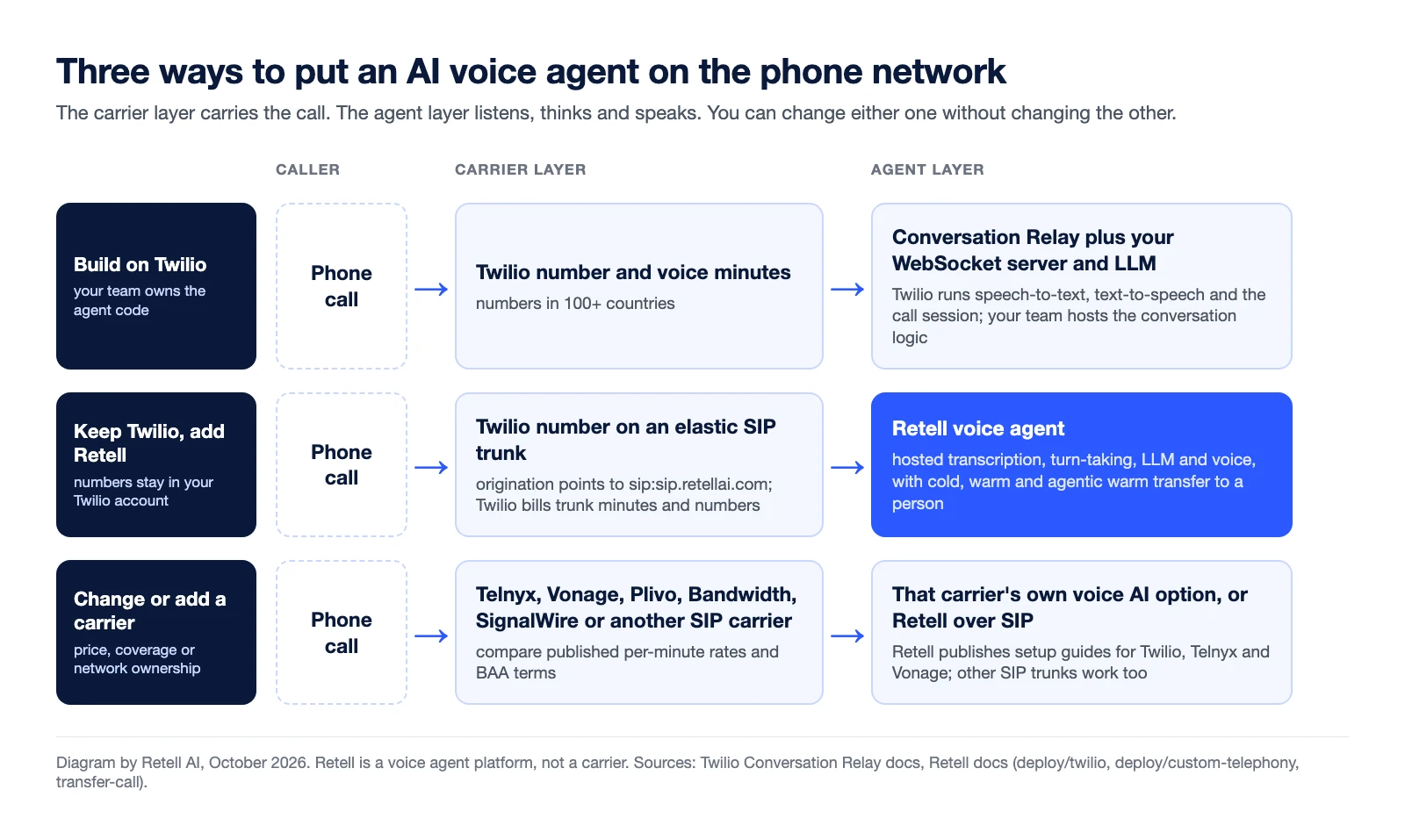
A Twilio alternative for AI voice agents is either another carrier or communications platform (CPaaS) that supplies phone numbers and call minutes, such as Telnyx, Vonage, Plivo, Bandwidth or SignalWire, or a voice agent platform that runs the agent on top of whichever carrier you use, Twilio included.
That distinction matters because the two choices solve different problems. Swapping carriers changes who bills your minutes and numbers. Adding a voice agent platform changes who builds and hosts the agent. Keeping Twilio for the phone network and changing only the agent layer is a valid option, and often the smallest change.
Retell AI publishes this guide and is one of the options compared. Retell is a voice agent platform, not a carrier, and it connects to Twilio numbers as well as other carriers over SIP. Every vendor price and feature below comes from that vendor's own website, read on October 26, 2026, and is linked where it is cited.
Start by naming the layer, because the right shortlist depends on it.
For agencies and BPOs the split is practical: client numbers can stay on the carrier each client already uses, while the agent layer is standardized across clients.
Twilio is a strong default for the carrier layer, and it is fair to say so before comparing alternatives.
If those strengths fit and your team wants to own the agent code, building on Twilio is a reasonable plan. The alternatives below make sense when price, coverage, network ownership, or the work of running the agent layer points elsewhere.
We included carriers and CPaaS providers that sell programmable voice and SIP connectivity in the US and publish product detail on their own sites. Three rules applied:
| Provider | What it offers | US local calls, per minute (out / in), as of Oct 2026 | Voice AI option | HIPAA BAA |
|---|---|---|---|---|
| Twilio | Communications APIs, numbers in 100+ countries | $0.0140 / $0.0085 | Conversation Relay, $0.07 per minute plus voice minutes; you bring the LLM | Requires Security or Enterprise Edition |
| Telnyx | Describes itself as a licensed carrier with its own private global backbone | Voice API $0.002 plus the SIP trunk fee (from $0.005 out / $0.0032 in) | Voice AI Agents, $0.05 per minute for speech-to-text, text-to-speech and orchestration; LLM and telephony extra | Lists HIPAA compliance; ask Telnyx for BAA terms |
| Vonage | Voice API and SIP trunking | Not verified (pricing page could not be read on Oct 26) | AI Studio, a low-code and no-code flow builder | Not verified |
| Plivo | Voice API and Zentrunk SIP trunking, 150+ countries | $0.0115 / $0.0055 | AI Agent Studio, or bring LiveKit, Pipecat or your own stack | Will sign a BAA |
| Bandwidth | Describes an owned-and-operated, nationwide all-IP voice network | $0.0100 / $0.0055, billed in 6-second increments | Bring your own AI, including OpenAI's Realtime API over SIP | BAA for voice and messaging APIs, $3,000 per month list price |
| SignalWire | Founded by the creators of FreeSWITCH | $0.0080 / $0.0066 | AI Agent Runtime, $0.16 per minute; voice transport extra | HIPAA-eligible with a BAA |
Sources: Twilio voice pricing, Telnyx Voice API pricing, Telnyx SIP pricing, Vonage developer docs, Plivo voice pricing, Bandwidth pricing, SignalWire pricing. Per-minute rates are not directly comparable across providers, because some bill an API fee and a trunk fee separately and billing increments differ.
Telnyx calls itself a licensed carrier with its own private global backbone (Telnyx network page). Its Voice API is $0.002 per minute plus the SIP trunking fee, and Elastic SIP Trunking for US local calls starts at $0.005 per minute outbound and $0.0032 inbound. Local numbers start at $1 per month, plus $0.10 a month for SMS and MMS (Telnyx number pricing). Telnyx also sells Voice AI Agents at $0.05 per minute for speech-to-text, text-to-speech and orchestration, with the LLM and telephony billed on top.
Fit: teams that want carrier-level control and an agent product from the same vendor. Retell publishes a Telnyx setup guide and a Telnyx integration page, and numbers bought inside Retell can run on Telnyx in the US.
Vonage offers a Voice API with SIP connectivity and WebSockets that its docs describe as suited to AI-powered voice bots, plus Vonage SIP Trunking and AI Studio, a low-code and no-code builder for conversational flows. We could not read Vonage's pricing or HIPAA pages on October 26, 2026, so this guide prints no Vonage price; check vonage.com directly.
Fit: teams already on Vonage numbers. Retell publishes a Vonage setup guide; see the Vonage integration page.
Plivo's US voice pricing lists local calls at $0.0115 per minute outbound and $0.0055 inbound, with local numbers at $0.50 per month and audio streaming included. Zentrunk SIP trunking starts at $0.0046 per minute outbound for US local numbers, billed in 6-second increments. For AI, Plivo offers AI Agent Studio or a code path that works with LiveKit, Pipecat or your own stack. Plivo says it is willing to sign a BAA for customers handling PHI.
Fit: cost-sensitive teams that want low number fees and a choice between no-code and code.
Bandwidth describes an owned-and-operated network and says it built its own nationwide all-IP voice network. Its published Voice API rates are $0.0100 per minute for US local outbound and $0.0055 inbound, billed in 6-second increments. SIP trunking is priced by quote. Bandwidth positions itself as platform-agnostic for conversational AI, including OpenAI's Realtime API over SIP, rather than selling its own agent builder. A BAA covering its voice and messaging APIs has a list price of $3,000 per month.
Fit: enterprises that want a US network owner as the carrier and plan to bring their own agent layer.
SignalWire was founded by the original creators of FreeSWITCH and remains its primary maintainer. Its pricing page lists US local calls at $0.0080 per minute outbound and $0.0066 inbound, SIP calls at $0.003 per minute, and local numbers at $0.50 per month. Its AI Agent Runtime is $0.16 per minute for speech-to-text, the LLM and standard text-to-speech, with voice transport billed separately. SignalWire says its platform is HIPAA-eligible with a BAA.
Fit: engineering teams with FreeSWITCH experience that want one vendor for transport and the agent runtime.
Build on Twilio if your engineers want to own every layer of the agent and already run an LLM application. Use a voice agent platform if you want to configure an agent rather than build and host one. Both can use the same Twilio numbers.
| Build on Twilio Conversation Relay | Retell on your carrier, Twilio included | |
|---|---|---|
| Agent logic | Your team hosts a WebSocket server that implements the Conversation Relay protocol | Hosted by Retell; prompt-based or conversation flow agents, or connect your own LLM server |
| LLM | Bring your own; Conversation Relay does not integrate directly with LLM providers | GPT, Claude and Gemini models, or your own LLM |
| Speech | Speech-to-text from Google or Deepgram; text-to-speech from Google, Amazon or ElevenLabs | Built into the platform |
| Handoff to a person | Supported: your server ends the session, control returns to Twilio, and your action URL receives the handoff data to route the call | Cold, warm and agentic warm transfer, configured as settings |
| Pricing, as of Oct 2026 | Conversation Relay $0.07 per minute, plus Twilio voice minutes and your LLM provider | See Retell pricing; Retell does not charge for SIP trunking or custom telephony, and your carrier bills its own minutes and numbers |
| HIPAA | HIPAA eligible when configured properly; BAA needs Security or Enterprise Edition | Self-serve BAA with no added fee |
Sources: Twilio's Conversation Relay docs, Studio widget docs and WebSocket messages; Retell's transfer docs, simulation testing docs, custom LLM docs and compliance docs. For the full head-to-head, see Retell vs Twilio.
The trade-off is control versus build time. With Conversation Relay your team picks every component and owns the code that runs the conversation. With a platform, the agent layer is configured rather than coded, and your team spends its time on prompts, flows and integrations. Retell also runs simulated callers against the agent and grades each run pass or fail against your success criteria, so saved cases become a regression suite. If you need your own model but not your own call handling, Retell's custom LLM option keeps telephony, transcription and turn-taking on Retell while your server generates each reply.
You do not have to leave Twilio to change how the agent is built. Retell connects to numbers you own in Twilio over elastic SIP trunking, and the numbers stay in your Twilio account.
Once imported, a Twilio number works like a number bought from Retell: you bind inbound and outbound agents to it and place calls from the dashboard or the API. US Twilio numbers (not toll-free) that pass A2P 10DLC registration can also send SMS during calls, per Retell's SMS docs. Twilio continues to bill the trunking minutes and number fees on your Twilio account.
The same pattern works with other carriers. Retell publishes guides for Twilio, Telnyx and Vonage, says other providers that support SIP trunks work too, and offers a dial-to-SIP-URI method for setups without elastic SIP trunking. Contact centers on Avaya, Genesys Cloud, Five9 or Amazon Connect have their own guides. For a plain-English walkthrough, see how to keep your existing phone number with a SIP connection.
Use this checklist to match the option to the team:
Before you sign, ask any provider four questions: what you pay per minute once API and trunk fees are combined, what the billing increment is, whether the BAA is included or priced separately, and how calls hand off to a person.
It depends on the layer you want to change. For the carrier layer, Telnyx, Vonage, Plivo, Bandwidth and SignalWire all sell programmable voice and SIP connectivity. For the agent layer, a voice agent platform such as Retell runs the agent and can keep using your Twilio numbers.
Yes. Retell connects to numbers you own in Twilio over elastic SIP trunking. You point the trunk's origination at sip:sip.retellai.com, import the numbers into Retell, and Twilio keeps billing the trunk minutes and numbers.
As of October 2026, Twilio lists US local calls at $0.0140 per minute outbound and $0.0085 inbound. Plivo lists $0.0115 and $0.0055, Bandwidth $0.0100 and $0.0055, and SignalWire $0.0080 and $0.0066. Telnyx charges a $0.002 Voice API fee plus SIP trunk rates from $0.005 outbound. Check each vendor's page before budgeting.
Twilio provides the building blocks. Conversation Relay handles speech-to-text, text-to-speech and the call session, while your team brings the LLM and hosts the WebSocket server that runs the agent logic. Twilio describes this as built for bring-your-own-LLM.
Plivo says it will sign a BAA, Bandwidth offers one for its voice and messaging APIs at a $3,000 per month list price, and SignalWire says it is HIPAA-eligible with a BAA. Twilio requires the Security or Enterprise Edition for a BAA. Retell offers a self-serve BAA with no added fee.
Most teams do not need to replace Twilio to get an AI voice agent into production. They need an agent layer that works with the numbers and carrier they already have. Retell is an AI voice agent platform for contact centers that connects to Twilio, Telnyx, Vonage and other SIP carriers. See the Twilio integration, compare carriers in our guide to VoIP and SIP providers for AI voice agents, or read what CPaaS is if you are still mapping the stack.
See how much your business could save by switching to AI-powered voice agents.
Total Human Agent Cost
AI Agent Cost
Estimated Savings
A Demo Phone Number From Retell Clinic Office