Best AI Candidate Screening Software (2026)
11
MIN READ
October 22, 2026
The best candidate screening software in 2026 includes Retell AI, HireVue, Workday Paradox, Humanly, Ribbon, Alex and Sapia.ai, and the right one depends on how your candidates want to be reached: chat and SMS for hourly roles, a structured interview for large employers, or a phone call for candidates who will not finish a form.
Retell AI publishes this list and is one of the options compared. Retell is a voice agent platform you configure, not an off-the-shelf recruiting suite, and the reviews below say where a packaged tool is the better choice.
How these seven were picked. Each one sells AI screening of job applicants and says so on its own site. Every fact about a competitor comes from that vendor's own pages, read on October 22, 2026, and each section links its sources. Where a vendor does not publish a price, the table says "Not published." Retell comes first because this is Retell's page; the other six are grouped by channel, and the order is not a ranking. There is no numeric score.
TL;DR
AI candidate screening software asks applicants a set of qualifying questions, records and scores the answers, and moves qualified candidates to the next step without a recruiter making the first call. The questions are usually knockouts (work authorization, shift availability, licenses) followed by a few job-related questions.
The format changes who finishes. Many hourly hiring programs screen by text because applicants apply from their phones. Roles where speaking matters, or candidates who stall on forms, suit a short phone call. Most tools pass the result to an applicant tracking system (ATS) and offer interview slots straight away. For the wider playbook, see high-volume hiring by phone and conversational AI for hiring.
The biggest difference is the channel each tool screens on and whether you configure the interviewer yourself or buy a packaged one. Prices are as published on each vendor's site on October 22, 2026.
| Tool | Screening channel (vendor-stated) | Published price | Best for |
|---|---|---|---|
| Retell AI | Phone calls, inbound and outbound | From $0.07 per minute (Retell pricing) | Staffing firms, RPOs and HR-tech teams that want to write their own screening questions |
| HireVue | Conversational AI interview with follow-up questions | Not published | Large, regulated enterprises |
| Workday Paradox | Text conversations (SMS and chat) | Not published | Frontline hiring on Workday |
| Humanly | Chat, SMS, voice and video | Not published | High-volume frontline teams |
| Ribbon | AI interviews, including from any phone | From $499 per month, billed annually (100 interviews, then $4 each) | Multi-site employers, staffing agencies and RPOs |
| Alex | Phone, video, SMS and WhatsApp | Not published | Teams that want a packaged AI recruiter |
| Sapia.ai | Untimed text chat interview | Not published | Chat-first volume hiring |
Every review covers the same four questions, so you can compare tools on what decides whether screening saves recruiter time without losing good candidates:
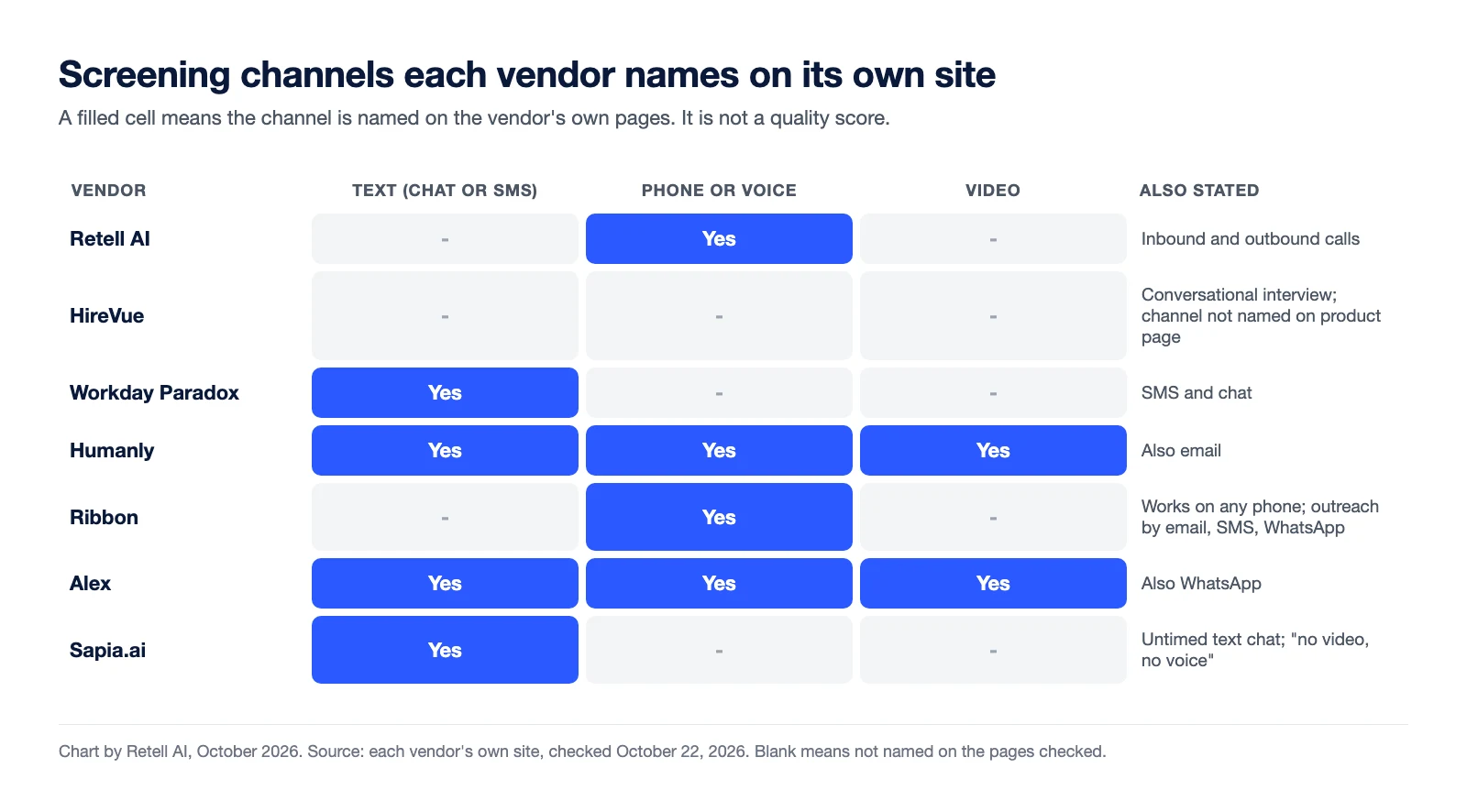
The chart below shows the channels each vendor names on its own site.
Retell AI fits staffing firms and recruiting teams that want AI phone screens on their own questions, for every role and client, without waiting on a vendor to change a script. You build a screening agent once, then copy and adjust it per requisition: a forklift role asks about certifications and shifts, a nursing role asks about licensure and units. This is the phone-screen version of conversational AI for hiring, and it suits the staffing agency workflow of many clients with different questions.
Recruiters own the loop. When a question confuses candidates, the team edits the agent and republishes it, and agent versioning with prod and staging tags keeps a change for one client from touching another.
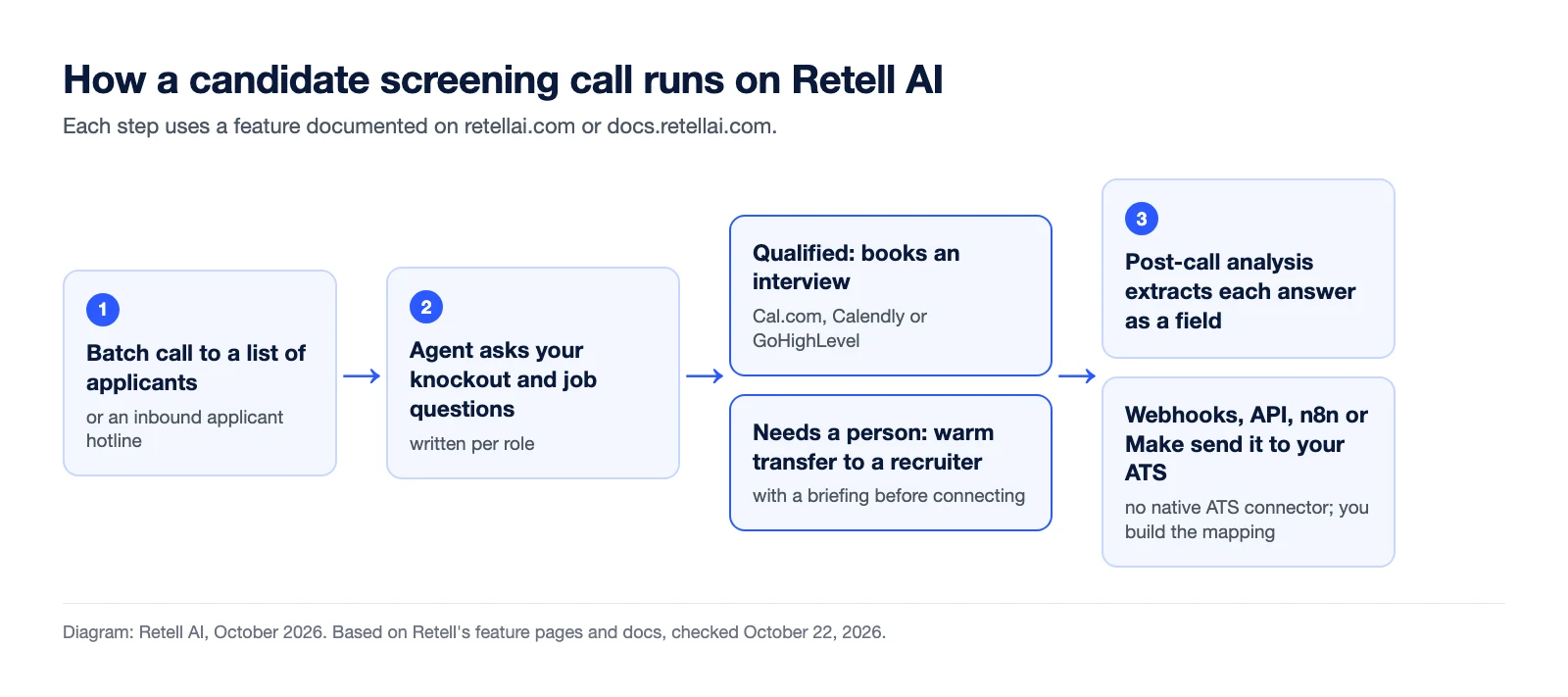
How a screening program runs on Retell:
Pricing: from $0.07 per minute, per the pricing page.
Watch out for: Retell is a platform you configure, not a recruiting suite. Scoring rules, ATS mapping and candidate notices are yours to set up, and you decide what counts as a pass. For a staffing-specific build, see lead qualification for staffing agencies.
HireVue suits large, regulated enterprises that want AI screening from an established hiring-technology vendor. It reports more than 1,150 global customers.
What it does:
Pricing: Not published.
Watch out for: HireVue scores against its own validated rubrics, so confirm how much of the question set and scoring your team can change per role or client before you commit.
Paradox focuses on frontline and high-volume hiring and is now sold through Workday. Its assistant, Olivia, handles applicant-facing work by text, so a candidate can apply and screen from a phone.
What it does:
Pricing: Not published; now sold through Workday.
Watch out for: screening is text-led, so it does not hear how a candidate speaks. If you are a staffing firm with many small clients, confirm rollout and contract terms, since Paradox is sold as an enterprise product.
Humanly fits high-volume frontline teams that want one product to engage, screen, interview and schedule candidates. Its site says it responds across chat, voice and video, and across SMS, email and chat.
What it does:
Pricing: Not published.
Watch out for: it is a broad hiring platform, not a single phone-screen tool, so plan for a real implementation and confirm which channels and languages are included in your plan.
Ribbon is a packaged AI interviewer with public pricing. Its site lists staffing agencies and RPOs among its audiences and says interviews work on any phone, in 10+ languages.
What it does:
Pricing: per the pricing page, billed annually. Growth is $499 a month for 2 seats, 2 active roles and 100 interviews ($4.00 per extra interview). Business is $999 for 5 roles and 400 interviews ($3.00 extra). Scale is $1,999 for 10 roles and 1,000 interviews ($2.50 extra). Annual billing saves 20%, and the three self-serve plans offer a 7-day free trial.
Watch out for: active-role caps (2, 5 or 10) can bite before interview counts do for agencies with many open requisitions, so size the plan on open roles in your busiest month.
Alex (Apriora Inc.) is an AI recruiter that runs first-round interviews. It has raised $20 million, including a $17 million Series A led by Peak XV Partners, with Y Combinator among the investors.
What it does:
Pricing: Not published.
Watch out for: Alex is a packaged recruiter with its own workflows, so check how much of the question flow you can change, and whether you need more than phone screens to justify it.
Sapia.ai runs structured interviews by text for volume hiring. The chat interview page describes five structured questions in an untimed text chat, with no video, no voice and no face.
What it does:
Pricing: Not published.
Watch out for: the chat interview is text only, so you do not hear how a candidate speaks and there is no live phone conversation. Sapia's blog describes a combined chat and video flow, so ask the vendor how the video step works.
AI screening is regulated in several places, and the rules depend on where your candidates are, not where your company is. Confirm the details with counsel before launch; this section is a starting checklist, not legal advice.
Whatever the tool, keep a human decision in the loop, document what each question measures, and give candidates a way to reach a person.
Start from your candidates and your recruiters, then the software:
Candidate screening software asks applicants qualifying questions, records and scores their answers, and moves qualified candidates to an interview without a recruiter making the first call.
Yes. A voice agent can call applicants or take their calls, ask knockout and job questions, capture each answer, and book an interview. On Retell you write the questions per role and decide what counts as a pass.
Voice quality varies by vendor and voice model, so listen to a sample call before you commit. What candidates tend to notice is whether the agent handles interruptions and repeats a question without restarting the script. Pilot it with a few real applicants and ask them.
Good tools route them to a recruiter. On Retell, the agent can warm transfer the call to a recruiter, passing a briefing before it connects.
It replaces the first repetitive call, not the hiring decision. Recruiters spend the time on qualified candidates and clients.
Often yes, with conditions. NYC requires a bias audit and notice, the EU treats hiring AI as high-risk, and US outbound AI calls generally need consent. Check your locations with counsel.
If phone screens are your bottleneck, build the first one around a single requisition. Build a Retell agent free, write the questions your recruiters ask today, and run it on real applicants before you scale it to every client.
See how much your business could save by switching to AI-powered voice agents.
Total Human Agent Cost
AI Agent Cost
Estimated Savings
A Demo Phone Number From Retell Clinic Office