Best Real-Time Speech-to-Speech AI APIs for Phone Calls (2026)
11
MIN READ
October 22, 2026

The best real-time speech-to-speech AI services for phone calls in 2026 are Retell AI, the OpenAI Realtime API, OpenAI GPT-Live-1, the Google Gemini Live API, Amazon Nova 2.5 Sonic, the Deepgram Voice Agent API and the AssemblyAI Voice Agent API.
Retell is the pick when the calls are production phone calls, because it wraps a speech-to-speech model in the telephony, transfers and testing a phone line needs. The other six are model or pipeline APIs. They give you the voice loop and leave most of the phone system, the human handoff and the QA to you.
Retell AI publishes this list and is one of the options compared. Competitor prices and features come from each vendor's public pricing, model or documentation page, read on October 22, 2026, and linked where they are cited.
How we picked and compared the options. We included every API that accepts live audio and returns speech in real time and that a team could put behind a phone number: native speech-to-speech models from OpenAI, Google and Amazon, two bundled voice agent APIs from Deepgram and AssemblyAI, and Retell as the platform layer. We compared them on five criteria (below) using only vendor-published information. We did not place test calls or run a latency test, so the article gives no scores and no latency figures.
TL;DR
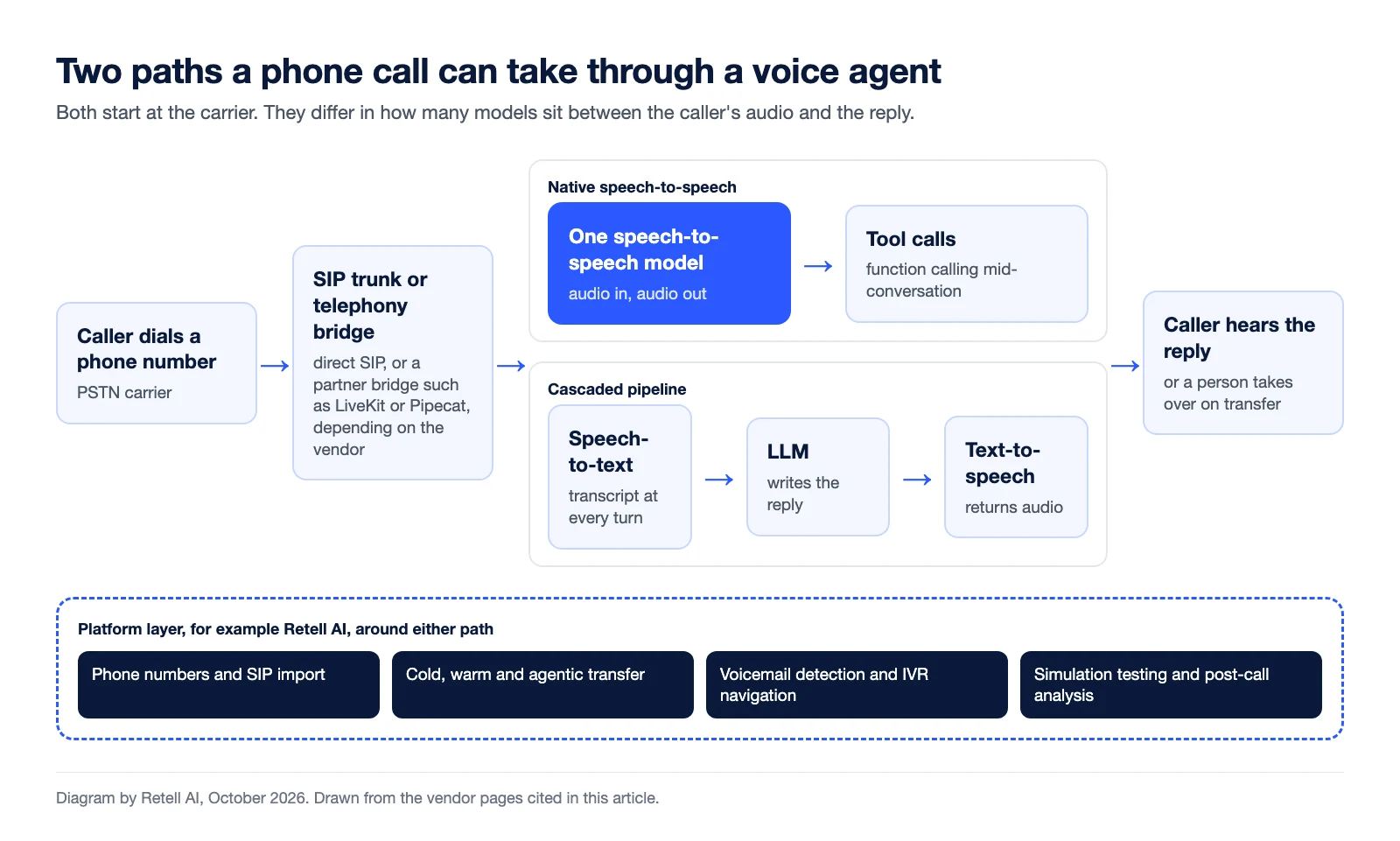
The split that matters is whether you are buying a model or a phone agent. The table shows what each option is, how a phone call reaches it, and its published price on October 22, 2026.
| API | What it is | How a phone call reaches it | Published price | Best for |
|---|---|---|---|---|
| Retell AI | Phone agent platform that runs OpenAI realtime models, Grok Voice or a standard LLM pipeline | Built in: buy US or Canada numbers, or import yours over SIP, Twilio or Vonage | From $0.07 per minute, see Retell pricing | Production inbound and outbound phone agents |
| OpenAI Realtime API | Native speech-to-speech model (gpt-realtime-2.1) with configurable reasoning and function calling | SIP trunk pointed at OpenAI's SIP endpoint | $32 per 1M audio tokens in, $64 out | Teams building their own stack on GPT reasoning |
| OpenAI GPT-Live-1 | Full-duplex voice model that hands reasoning to a backend model | Inbound and outbound SIP on Live sessions (outbound must be enabled for your organization) | $0.05 per minute, plus backend model usage | Natural turn-taking with a separate reasoning model |
| Gemini Live API | Native audio-to-audio models (Gemini 3.8 Live, Gemini 3.8 Live Extended Thinking) | Partner integrations such as LiveKit and Pipecat; no SIP path on the pages we read | $0.005 per minute audio in, $0.018 out | Low published audio cost, Google Search grounding |
| Amazon Nova 2.5 Sonic | Native speech-to-speech model on Amazon Bedrock | Not covered in the AWS announcement | Same as Nova 2 Sonic, per AWS | Teams already on AWS Bedrock |
| Deepgram Voice Agent API | Cascaded STT, LLM and TTS behind one WebSocket | Telephony guides for Twilio and Plivo; you run the connection | $0.075 per minute Standard, pay as you go | Teams that want Deepgram speech with an optional bring-your-own LLM |
| AssemblyAI Voice Agent API | Cascaded STT, LLM and TTS behind one WebSocket | SIP through your own Twilio account | $4.50 per hour ($0.075 per minute), all in | Accuracy-sensitive calls on a flat rate |
We looked at five things a phone call exposes and a browser demo hides:
Vendor latency claims are measured differently and are not comparable, so none appear here.
Retell AI is the best choice when a speech-to-speech model has to survive real phone calls, because it handles the call around the model: numbers, handoff, voicemail and testing.
Retell's API lists speech-to-speech options including OpenAI's gpt-realtime family (gpt-realtime-2.1, gpt-realtime-2 and others) and Grok Voice 3.0, as one choice among its supported models. You can also run an agent on a standard pipeline with the LLM of your choice, and keep the same telephony, transfers and testing either way. See the model options in the API reference.
For evidence on hard calls, Cekura ran a 414-call benchmark of six voice platforms (Retell, ElevenLabs, Pipecat, LiveKit, Synthflow and Vapi) on one regulated Medicare workflow. Retell passed 22 of 23 evaluators and led with 95.7% workflow accuracy, counting only checks that passed on all three runs. The hard cases included a caller who interrupts the disclosure and demands plan details, a family member calling on behalf of a beneficiary, and a caller asking the agent to promise that a plan covers their medication. It is a platform benchmark on one workflow, not a comparison of speech-to-speech models.
What you get on top of the model:
Pricing: from $0.07 per minute on Retell's pricing page.
Watch out for: Retell is a platform, not a raw model endpoint. If you want to own every frame of the audio pipeline yourself, start with a model API instead.
The OpenAI Realtime API is the pick for teams that want a raw speech-to-speech model with GPT reasoning and will build the rest of the phone stack themselves.
gpt-realtime-2.1 takes audio in and returns audio out, supports configurable reasoning effort and function calling, and updates gpt-realtime-2 with better alphanumeric recognition, silence and noise handling, and interruption behavior. OpenAI lists the same prices for both models.
It also answers a phone call without a separate bridge. Per OpenAI's SIP guide, you point a SIP trunk at OpenAI's SIP endpoint, accept or reject each call with its call ID, and can transfer it with a SIP REFER.
Pricing: $32 per 1M audio input tokens and $64 per 1M audio output tokens, plus $4 and $24 per 1M text tokens. Higher reasoning effort can increase latency and output token usage.
Watch out for: token billing grows with conversation length because context accumulates. Recording, QA, retries and human escalation logic are yours to build.
GPT-Live-1 is the best fit when natural turn-taking matters more than having reasoning inside the voice model. It is a full-duplex model that listens and speaks at the same time, and it delegates reasoning and tool use to a backend agent.
It runs on OpenAI's Live sessions endpoint, not the Realtime endpoint, so it is not a drop-in swap for gpt-realtime-2.1. Per OpenAI's voice and SIP guide, inbound calls arrive over SIP and outbound SIP calling is available through the Live API once it is enabled for your organization. Ringing is limited to 3 minutes and a connected call to 2 hours.
Pricing: $0.05 per minute of session, billed per second, with backend model and tool usage billed separately.
Watch out for: concurrency is capped by tier, at 50 sessions on Build, 300 on Launch and 500 on Grow, and inbound SIP needs GPT-Live SIP support enabled for your project.
The Gemini Live API has the lowest per-minute audio figures on published prices. Gemini 3.8 Live and Gemini 3.8 Live Extended Thinking were generally available on September 15, 2026, and both list $0.005 a minute for audio in and $0.018 a minute for audio out on Google's pricing page. Those per-minute figures sit beside $3 and $12 per 1M audio tokens, so they are a conversion, not a separate meter.
The Extended Thinking model supports background reasoning during the call, and Google Search grounding is supported on the paid tier, with 5,000 free search requests a month and then $14 per 1,000.
Watch out for: Google's Live API guide lists partner integrations such as LiveKit and Pipecat and describes no SIP trunk path, so plan on a bridge in front of the Live API. Output pricing includes thinking tokens, so the per-minute figure is a floor.
Amazon Nova 2.5 Sonic is the default choice for teams already building on AWS Bedrock. AWS made it generally available on October 5, 2026, with improved reasoning, instruction following and tool-calling accuracy, lower latency, expressive voices in seven languages, controllable turn-taking, asynchronous tool calling and a 256K context window.
AWS's Strands Bidi Agents framework, now generally available, is its route to building a voice agent in a few lines of code.
Pricing: AWS lists Nova 2.5 Sonic at the same price as Nova 2 Sonic. Check the Amazon Nova pricing page for current per-token rates, which load dynamically.
Watch out for: it is available in four Bedrock regions (N. Virginia, Oregon, Stockholm, Tokyo), and seven languages is narrower than some other options here. The announcement does not describe a phone path, so confirm how calls reach the model before you commit.
Deepgram's Voice Agent API is the pick for teams that want Deepgram's speech recognition with the option to bring their own LLM or voice. It runs speech-to-text, an LLM and text-to-speech behind one WebSocket and one per-minute meter, and Deepgram's docs include inbound and outbound telephony agent guides for Twilio and Plivo.
Pricing: $0.075 a minute on the Standard pay-as-you-go tier and $0.163 on Advanced, with lower rates if you bring your own LLM or TTS.
Watch out for: it is a cascaded pipeline, not a native speech-to-speech model. Pay-as-you-go accounts are limited to 45 concurrent Voice Agent connections (60 on Growth), which matters the first time a campaign dials out.
AssemblyAI's Voice Agent API is the pick when transcription accuracy decides whether the agent works, for example on names, account numbers and addresses. It runs AssemblyAI's Universal-3.6 Pro Realtime speech model, an LLM and TTS behind one WebSocket.
Pricing: a flat $4.50 an hour ($0.075 a minute) covering speech-to-text, the LLM and TTS, billed per session minute, per AssemblyAI's pricing reference. For phone calls, AssemblyAI's docs say Twilio passes calls to AssemblyAI over SIP, so there is no media server or webhook to run. The SIP trunk and number sit in your own Twilio account.
Watch out for: like Deepgram it is cascaded, not native audio-to-audio, so you get a transcript at each turn but not a model that hears tone directly.
Use a native speech-to-speech model when tone and fast turn-taking matter more than control over each step, and a cascaded pipeline when you need to see and correct what the agent heard. A native model takes audio in and returns audio out, with no separate transcription step. A cascaded pipeline gives you a transcript at every turn, which makes it easier to debug a wrong account number or enforce a compliance script.
Either way, a phone line adds work the model does not do: interruption handling, transfer recovery and testing against calls that go off script. For how the two designs differ in more detail, read how real-time voice AI works. If you are picking the reasoning model behind a cascaded agent, see the best LLMs for voice AI agents and the best speech-to-text models.
Start from where the call lands and who owns the failure. Four questions settle it:
A speech-to-speech AI API takes a caller's audio and returns spoken audio from one model, without a separate transcription and voice step. OpenAI gpt-realtime-2.1, GPT-Live-1, Gemini 3.8 Live and Amazon Nova 2.5 Sonic work this way.
Gemini 3.8 Live lists the lowest per-minute audio figures, at $0.005 a minute for audio in and $0.018 a minute for audio out, converted by Google from $3 and $12 per 1M audio tokens. Your real cost adds telephony, any bridge you run, and thinking tokens, which bill as output. AWS lists Nova 2.5 Sonic at the same price as Nova 2 Sonic, and OpenAI bills the Realtime API per token, so compare on your own call length.
Yes. Point a SIP trunk from a carrier such as Twilio at OpenAI's SIP endpoint, then accept each call with its call ID. Transfers use a SIP REFER.
Yes. Retell's API lists speech-to-speech options including OpenAI's gpt-realtime family and Grok Voice 3.0, and a Retell agent can instead run on a standard pipeline with your chosen LLM. The telephony and transfer features are the same either way.
On a model API, you write the escalation logic. On Retell, the agent can do a cold, warm or agentic call transfer to a person, and a warm transfer passes a contextual briefing so the caller does not repeat themselves.
On Retell, yes: you can import an existing number over SIP trunking instead of buying a new one. On the model APIs, it depends on the SIP trunk or bridge you run.
A demo script will not tell these APIs apart; your own calls will. Build a Retell agent free, pick a speech-to-speech or standard model, and run it against the calls your team finds hardest.
See how much your business could save by switching to AI-powered voice agents.
Total Human Agent Cost
AI Agent Cost
Estimated Savings
A Demo Phone Number From Retell Clinic Office