Can Voice AI Survive AI-Aware Call Centers? Design the Refusal and Handoff Path First
10
MIN READ
An AI caller refusal happens when the organization an outbound voice agent calls, such as a health plan, a freight carrier or another company's call center, declines to continue once its representative realizes the caller is an AI. Plan for refusals as one of the ordinary outcomes of an outbound call. The teams that run these calls well design a refusal path before launch: how the agent recognizes a refusal, what it says, which person picks up the call, and what happens to the task afterward.
This post covers outbound calls to other businesses. When your own customer calls in and asks for a person, that is an inbound escalation, covered in how voicebots escalate calls to human agents and how AI voice agents handle the warm transfer. The mechanics overlap. What differs is who is on the line: the person refusing works for someone else, owes you nothing and has a queue of their own.
Often because their representatives work against handle-time targets, and an automated caller that wastes a rep's time costs them directly. A rep who has sat through an AI caller that repeated questions or misread an identifier has a reason to end the next one early. One healthcare AI vendor, Infinitus, argues that payers push back because generic agents drag calls out and, at volume, clog their phone lines. The same vendor says most of the larger payers have dedicated lines or call centers for its AI agents, a reminder that a refusal on the main line is not always a refusal of the task.
Don't count on finding a published rule for automated callers. Expect the answer to differ by counterparty and by department. The design question is the same everywhere: what does your agent do in the moment after someone says no?
There are four kinds, and each needs a different response.
| Kind | What the agent hears | What the agent should do | What to record |
|---|---|---|---|
| Question | "Am I talking to a robot?" | Answer honestly, restate who it calls for and why, ask to continue | Asked, then continued or refused |
| Soft refusal | "I need to speak with a person." | Offer to connect a colleague now, or a callback from a person | Soft refusal, and what happened to the offer |
| Policy refusal | "We don't take automated calls on this line." | Ask whether another line, portal or time works for this request, then offer a person | Policy refusal, and any channel the rep named |
| Hang-up | The line drops right after the agent introduces itself | Nothing on the call. Decide later whether to retry | Early disconnect by the other side |
The first row is not a refusal yet. The answer decides whether it becomes one. A short, honest reply followed by the call reason and the reference the rep needs keeps the conversation on the task. A dodge gives the rep a reason to hang up.
Plan on yes, and on a truthful answer every time it is asked. Rules on AI voice disclosure differ by jurisdiction and call type, and several point the same way:
Which of these applies to a call from your agent to another company's rep depends on where both sides are, what the call is for and the line it reaches. This is a description, not legal advice. Settle the disclosure wording and any consent questions with counsel before launch, then write the approved wording into the prompt so the agent says it the same way on every call.
Write the four kinds into the prompt with one action for each, then record which one happened on every call.
Together these give you a refusal rate per counterparty, the number the rest of the design depends on.
Get a person on the line while the rep is still there if you can, and turn the task into a human callback if you can't. The diagram shows the full path.
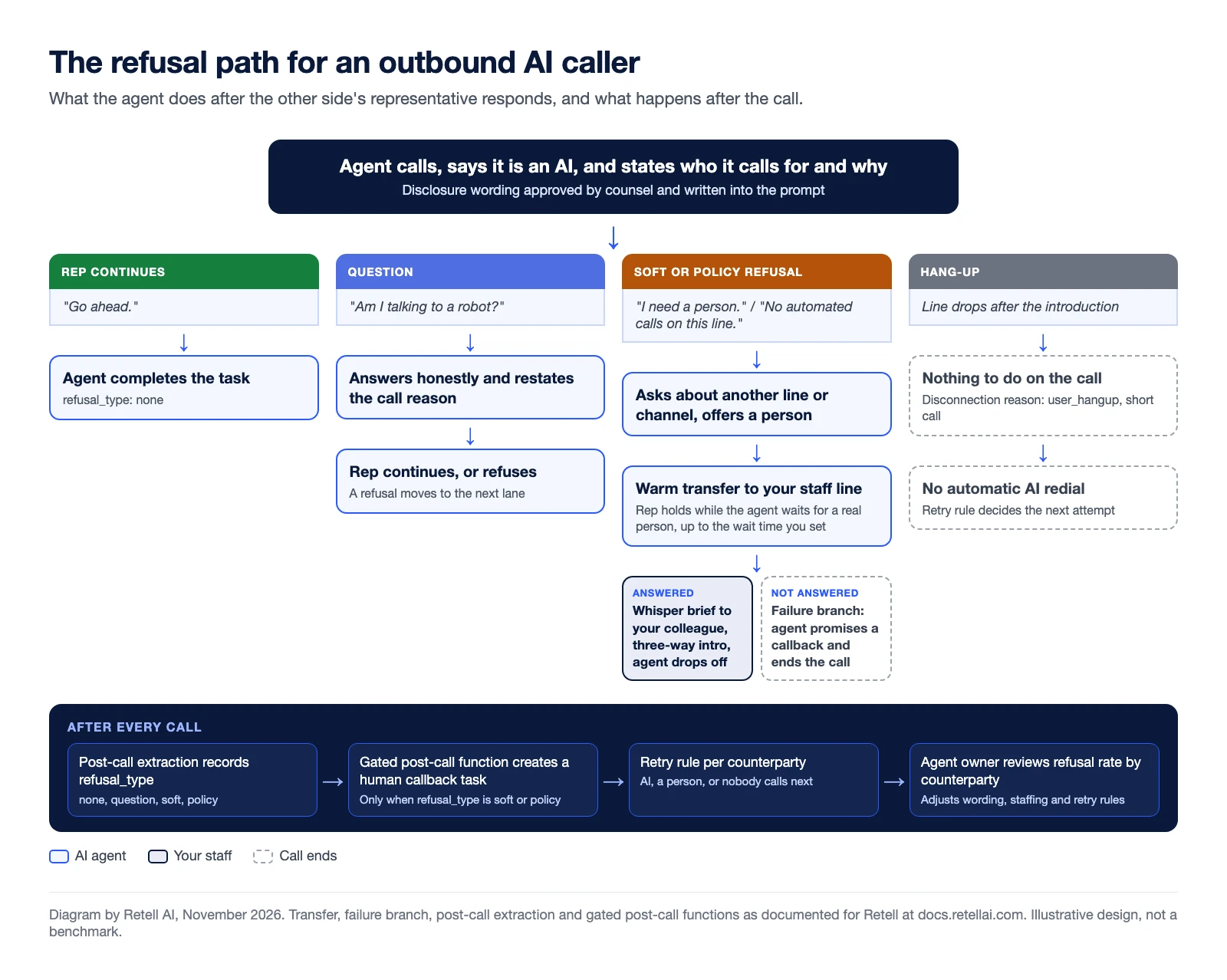
Warm transfer to your own team. With Retell's Transfer Call tool, the agent dials your staff line and stays on while the rep holds. If that line queues calls, the agent waits until a real person speaks, up to a wait time you set (30 seconds by default). It can then play a whisper message that only your colleague hears, such as the task reference and what the rep has said so far, and introduce both sides before it drops off. Your colleague picks up mid-task and the rep does not start over. The AI-to-human handoff guide compares cold, warm and agentic warm transfers in detail.
A failure branch for the transfer. Nobody may answer in time. In a conversation flow, the call transfer node comes with an edge for a failed transfer. Point it at a short close: apologize, say a person will call back, confirm the reference and end the call.
Supervisor takeover during the pilot. Live monitoring lets a supervisor listen to a call in progress and take it over from the agent. Treat it as a manual safety net while you learn how each counterparty reacts. The staffing plan comes below.
A human callback task. A post-call function on the agent's workflow can create a task in your CRM, gated so it runs only when a condition holds, for example when `refusal_type` is soft or policy. The task can carry the call summary, so whoever calls back knows what was already said.
Not on autopilot. A retry schedule built for people who miss a call is the wrong default for an organization that just said no.
Check how your dialer counts a quick hang-up. In Retell's Dialer sequences, a call where the conversation never got going counts as unanswered, so the contact moves on to its next scheduled attempt. Give answered refusals their own outcome instead: a Dialer outcome can write a value such as `needs_human_call` to the contact and end the sequence, so no more AI attempts go out. In the pilot, check how short refusals are classified. If a quick "I don't talk to AI" lands as unanswered, the outcome never runs, so gate a post-call function on your `refusal_type` field as well.
For each counterparty, keep three settings: whether the AI calls at all, which line or channel it uses, and how many refusals in a period move that counterparty to human-only calling. Rules on the other side change without notice, so review the list on a schedule.
Enough to answer a warm transfer inside the wait time you set, during the hours your agent dials. A transfer that rings out is worse than none, because the rep held for nothing.
Size it from your pilot. Refused calls per hour (outbound calls per hour times the refusal rate you measured) times the minutes a person needs to finish one gives the staff time per hour. Work it out by hour rather than by day, because volume follows your dialing schedule, and staff the hours the agent calls rather than your office hours. If the numbers don't support a live queue for a counterparty, skip the warm transfer there and go straight to the callback task.
The person who owns the agent. Refusal handling is part of the improvement loop described in Retell's post on what a CX automation engineer does: find the calls the agent handled poorly, work out why, fix, check and ship. For refusals, that means reviewing refusal rate by counterparty, listening to a sample of refused calls, adjusting the opening within the wording counsel approved, and agreeing staffing with the lead whose team takes the transfers. Add a "counterparty refuses AI" row to your escalation matrix so everyone knows who acts at each level. Alert rules can email or webhook the owner when a metric such as success rate crosses a threshold you set.
Settle these before the first outbound call:
| Decision | What to settle before launch |
|---|---|
| Disclosure wording | Approved by counsel and written into the prompt |
| Refusal kinds | Example phrases and one response per kind in the prompt |
| Transfer | Which staff line, warm or agentic warm, and the wait time |
| Transfer failure | What the agent says and which task it creates |
| Retry rule | When a refusal stops AI calls to that counterparty |
| Staffing | People per dialing hour, from the pilot refusal rate |
| Owner | One named person who reviews refused calls on a schedule |
| Measures | Refusal rate by counterparty, transfers answered in time, callbacks completed |
Run it on purpose. In simulation testing, an AI plays the other side of the call and each run is graded pass or fail, so write cases where the simulated rep asks whether it is a bot, refuses, or cites a policy. Transfers are always faked in a simulation and you choose whether the mocked transfer succeeds or fails, so run both branches. Then place real phone test calls to confirm the warm transfer reaches your staff line, since transfers to a phone number cannot be checked in a web call. How to test and release voice agent changes covers the release side, and voice agent failure modes helps you name what went wrong on the calls that fail anyway.
Yes. A representative can end any call, and an organization can set its own rules for automated callers. Plan for refusals on every counterparty instead of treating them as edge cases, and ask whether the counterparty offers another line or channel for automated requests.
An escalation starts with your own customer asking your agent for a person, usually on an inbound call. A refusal starts with someone at another organization declining to continue with your outbound agent. Both often end in a warm transfer, but a refusal also needs a retry rule and a record per counterparty, because you will call that organization again.
We recommend it doesn't. A rep who catches a dodge has every reason to hang up, and AI voice is regulated in several places, including the FCC's 2024 ruling that brings AI-generated voices under the TCPA's consent and identification rules. Agree the exact wording with counsel.
Nothing on that call. Afterward, the disconnection reason and call length show the early hang-up, and your retry rule decides whether the next attempt goes to the AI, a person or nobody. Do not let the dialer redial with the same agent by default.
Track refusal rate by counterparty, the share of warm transfers a person answers within the wait time, and how many refused tasks a person completes afterward. A rising refusal rate at one counterparty is a cue to ask its provider relations or operations contact what changed.
Retell is an AI voice agent platform for contact centers. The pieces of a refusal path in this post, warm transfer with a whisper message, a transfer failure branch, post-call extraction, gated post-call tasks and Dialer outcomes, are documented features your team configures. For payer work, see AI prior authorization calls, AI claim status calls and where voice fits in the payer call loop. Voice agents are pay as you go from $0.07 per minute, with details on the pricing page.
See how much your business could save by switching to AI-powered voice agents.
Total Human Agent Cost
AI Agent Cost
Estimated Savings
A Demo Phone Number From Retell Clinic Office