Voice Agent Failure Modes and How to Find Them
The common ways voice agents fail on live calls, from misheard intents to bad transfers, and how to find each one in call transcripts before customers do.
A voice agent failure mode is a repeatable way an AI phone agent goes wrong on live calls, such as mishearing a caller's details, calling a tool with the wrong inputs, or transferring a caller to a line nobody answers. Each mode leaves its own trace in the transcript, the tool call log or the call data, so you can name it from evidence instead of guessing.
The AI agent failure mode lists that rank in search today are written for text agents and multi-step workflows; Microsoft's AI Red Team, for example, published a taxonomy of failure modes in agentic AI systems in April 2025, sorted into safety and security. Phone calls add audio, timing and the telephone network. This page covers diagnosis for whoever reads failed calls, often an in-house CX automation engineer. The weekly review routine lives on the voice agent QA scorecard.
What are the most common voice agent failure modes?
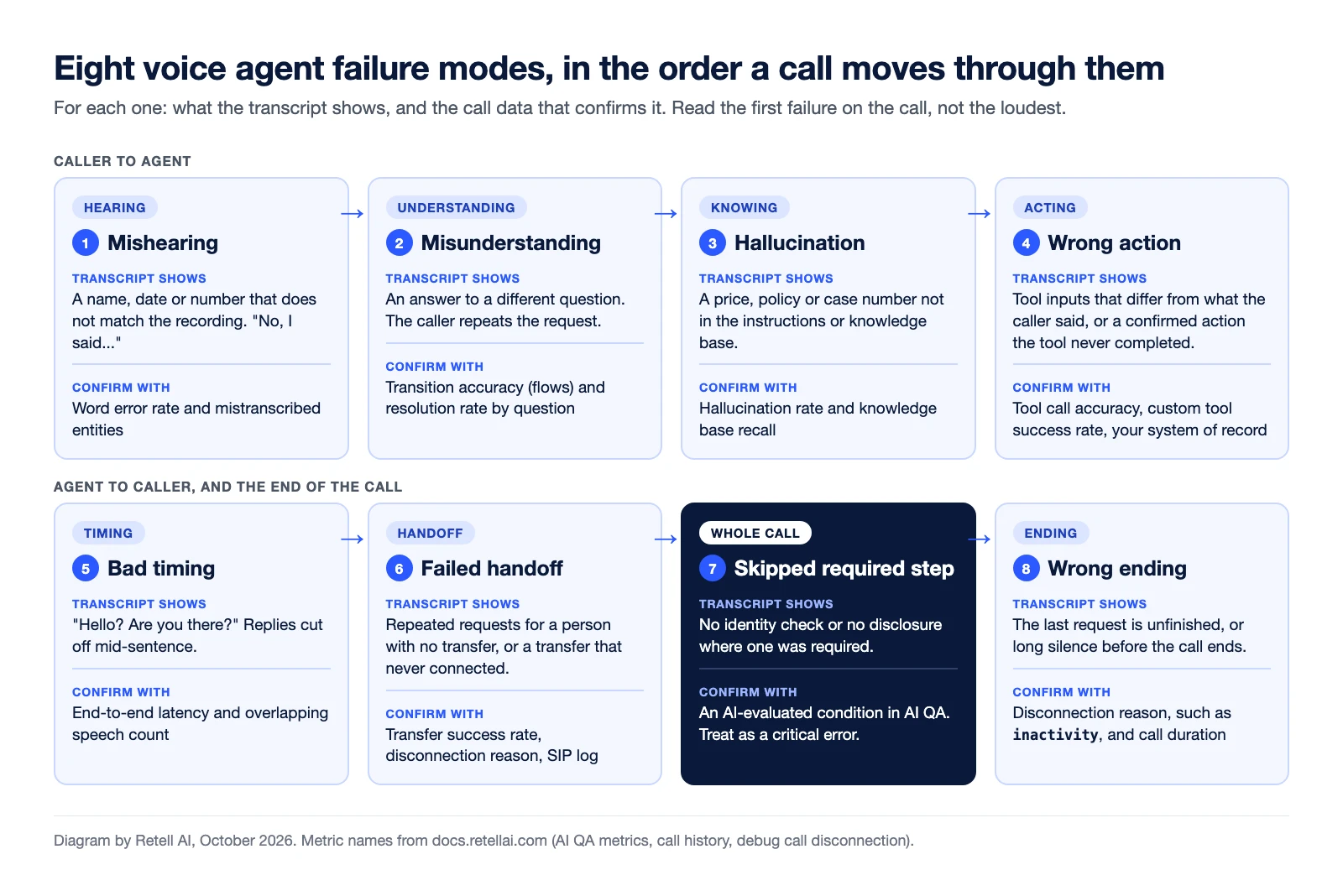
Eight failure modes cover most bad calls, each at a point the call passes through, from hearing the caller to ending the call.
| Failure mode | What the caller experiences | Signature in the transcript | Confirm it in call data |
|---|---|---|---|
| Mishearing | Has to repeat a name, date or number | A detail that does not match the recording; corrections such as "No, I said..." | Word error rate and mistranscribed entities |
| Misunderstanding | Gets an answer to a question they did not ask | A reply that ignores the request; the caller rephrases it; a wrong node in a flow | Transition accuracy for flow agents; resolution rate by caller question |
| Hallucination | Hears a wrong price, policy or case number | A fact that is not in the agent's instructions or knowledge base | Hallucination rate and knowledge base recall |
| Wrong action | A booking, update or lookup fails or uses the wrong details | Tool inputs that differ from what the caller said; a confirmed action the tool never completed | Tool call accuracy, custom tool success rate, your system of record |
| Bad timing | Long pauses, or the agent talks over them | "Hello? Are you there?"; replies cut off mid-sentence | End-to-end latency and overlapping speech count |
| Failed handoff | Cannot reach a person, or reaches dead air | Repeated requests for a person with no transfer, or a transfer that never connected | Transfer success rate, disconnection reason, SIP log |
| Skipped required step | Is never verified, or never hears a required disclosure | The required line is missing | An AI-evaluated condition in AI QA; treat a miss as a critical error |
| Wrong ending | The call drops mid-request, or runs on in silence | The last request is unfinished; long silence before the end | Disconnection reason and call duration |
How do you find a failure mode in a transcript?
Read the transcript as a timeline that includes the tool calls. In Retell AI, the transcription in Call History shows messages, tool calls and results, node transitions and knowledge base retrievals, and selecting a timestamp jumps to that point in the recording. Read in this order:
- Start from the outcome. Check whether the booking, ticket or lead exists in your system of record. An agent saying "you're all set" proves nothing.
- Find the first turn that went wrong. A misheard digit early on can send every later step to the wrong account. Diagnose the first error, not the loudest.
- Check names, numbers and dates against the recording. If the transcript itself is wrong, the failure is hearing, not reasoning.
- Compare every tool call with what the caller said. The inputs the agent sent matter more than what it said it did.
- Judge timing last.
Some phrases are reliable tells. Search for them across transcripts:
- "No, I said..." or the caller spelling a word out: mishearing.
- "That's not what I asked" or the same request said twice: misunderstanding.
- "Hello?" or "Are you still there?": slow responses or a stalled tool call.
- "Can I talk to a person?" more than once: a missing or failed handoff.
- The agent asking the same question twice in a row: a loop in the prompt or flow.
- The agent confirming an action with no matching tool call: a wrong action that a transcript-only review would pass.
Call History exports a filtered set of calls to CSV, and transcripts are one of the export fields, so you can search a large set of calls for these phrases at once.
How do you tell apart failure modes that look the same?
Several modes produce the same symptom but need different fixes.
A wrong answer: hearing, understanding or hallucination? Check the caller's line against the recording. If the transcript is wrong, it is hearing; Retell's docs suggest boosted keywords for names and specialized terms the transcriber misses. If the transcript is right but the reply answers a different question, it is understanding. If the agent understood and then stated something unsupported, it is a hallucination.
A wrong action: decision or execution? Retell's AI QA separates the two. Tool call inaccuracy, measured on single and multi-prompt agents, means the agent picked the wrong tool, skipped a required one or passed wrong inputs. A custom tool failure means the endpoint itself failed, which your endpoint logs will show.
Talking over the caller: latency or settings? Retell's guide to AI QA metric issues splits this by latency. If median end-to-end latency is above 2.5 seconds, callers are talking into the silence, so fix latency first. If latency is normal, look at the response wait time and interruption sensitivity settings. Background noise causes the opposite problem, false interruptions of the agent: the docs suggest a denoising mode, then lower interruption sensitivity. How voice agents handle interruptions explains the turn-taking side.
A failed handoff: never triggered, or triggered and failed? If the transfer never fired, the cause is in the prompt or flow: the transfer conditions or how the tool or node is set up. If it fired and failed, Retell's docs point to telephony issues, visible in the SIP connection log, or to human detection on a warm transfer, which fails when no human answers, such as when voicemail or an IVR picks up. How call transfers work covers the transfer types.
A dropped call: expected or an error? Every Retell call records a disconnection reason. Reasons such as user_hangup and call_transfer are expected endings, inactivity means a silence timeout ended the call, and reasons with an error status, such as those starting with error_ or concurrency_limit_reached, point to a system or account problem rather than the conversation.
Not the agent's fault. A caller who hangs up early or asks for a transfer has not exposed a failure. Keep these calls off the fix list, as Retell's AI QA docs advise.
Where do hallucinations fit?
Hallucination is one failure mode, not the whole list. Retell's AI QA checks each agent turn against the agent's instructions, knowledge base and conversation history, and labels each hallucination as fabrication (an invented fact, such as a made-up case number), contradiction (conflicting with what was provided or said earlier) or confusion (misunderstood instructions). Each label points to a different fix: missing information, conflicting instructions, or instructions that are too complex. For causes and prevention, see the guide to AI hallucinations in voice agents.
How do you find failures without reading every call?
Let call data choose which transcripts you read. In Retell AI:
- AI QA evaluates a sample of calls and sorts them by metrics such as hallucination rate, word error rate and tool call accuracy, so the worst calls for each failure mode rise to the top. Its top user questions table shows which intents resolve least.
- Call History filters by disconnection reason, outcome, sentiment and end-to-end latency, and Conductor can review selected calls and say what they have in common.
- Alert rules send an email or webhook when a metric over a time window, such as failed transfers or calls that fail QA, crosses a threshold, so a rising failure rate does not wait for the next review.
Review several calls with the same failure before calling it a pattern. Data-picked samples read by a person are what call quality monitoring looks like for AI agents.
What do you do after you name the failure mode?
Turn the failed call into a test first. In Retell AI, Conductor can turn a call from Call History or AI QA into a simulation test case drafted from the transcript. Then make one change and ship it through how to test and release voice agent changes.
Expect some modes to appear only after launch: simulation runs as a text conversation, so hearing and timing failures show up only on web or phone test calls and real calls. Plan for that when moving from voice AI demo to production.
Frequently asked questions
What is a failure mode in an AI voice agent?
A failure mode is a repeatable way the agent goes wrong on calls, such as mishearing details, stating wrong facts, calling a tool with wrong inputs or failing a transfer. Naming the mode matters because each one has a different fix.
Why do AI voice agents fail on live calls after passing tests?
Text simulation cannot hear audio, so mishearing and timing problems only show up on calls with real audio. A web test call cannot transfer to a phone number, so transfers need phone call tests. Real callers also bring background noise and requests the test set never covered.
What is the difference between a transcription error and a hallucination?
A transcription error means the agent misheard the caller, so the transcript does not match the audio. A hallucination means the agent stated something its instructions, knowledge base or the conversation do not support. Compare the transcript with the recording to tell them apart.
Which voice agent failure modes are the most serious?
Skipped required steps and wrong actions, because a missed disclosure or a booking with the wrong details can sound like a smooth call. Treat both as critical errors that fail the call outright.
Find voice agent failures with Retell AI
Retell AI is an AI voice agent platform for contact centers. Call History puts each call's tool calls and disconnection reason next to the transcript and recording, and AI QA scores a sample of production calls for hallucinations, knowledge base accuracy, overlapping speech and tool use, so your own team can find each failure mode without waiting on a vendor.