How to Improve a Voice Agent After Launch
How to improve a voice agent after go-live: read transcripts, find the failure patterns, change one thing at a time, and prove each fix with test calls.
Improving a voice agent after launch means running one loop on repeat: find the calls the agent handles badly, group them into patterns, fix the most costly pattern with a single change in a draft version, and prove the fix with test calls before and after it reaches callers.
The loop belongs to whoever owns the agent in-house, often a CX automation engineer, once the vendor's forward deployed engineers hand it over. The weekly call review that feeds it is in the voice agent QA scorecard.
What does the improvement loop look like?
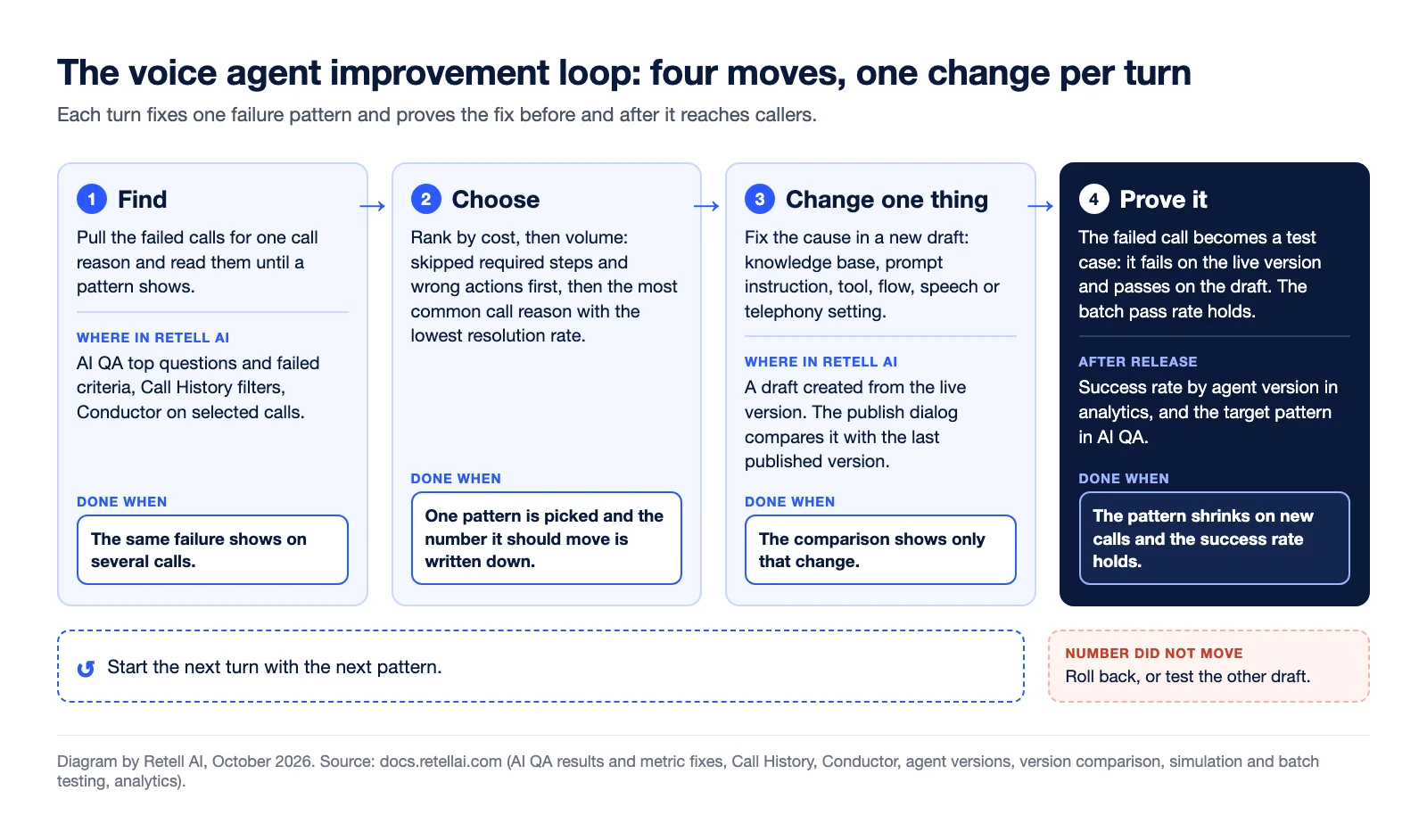
Four moves, in order: find the failed calls and the pattern behind them, choose the one pattern worth fixing next, change one thing in a draft version, and prove it before and after release. Then start again with the next pattern.
Where do you find what to fix?
Start from call outcomes, not the prompt: the prompt says what the agent was asked to do, the calls show what it did. In Retell AI, three places surface the calls worth reading:
- AI QA. The QA results list the questions callers ask most, grouped by meaning, each with a resolution rate. Each scored call also has a QA sheet listing the metrics and checks it failed.
- Call History. Call History filters by agent and version, outcome, sentiment, disconnection reason and your own analysis fields, so you can pull the unsuccessful calls for one call reason.
- Analytics. Break Call Successful Rate down by a Post Call Extraction field, such as issue type, to see which call reasons fail most.
Check what "unsuccessful" means before you trust it. The call_successful field follows a prompt you can edit, and analysis can be rerun on past calls (reruns are billed). If calls are marked successful but nothing happened in your system of record, fix that definition first. The call containment guide explains why a call that ended without a transfer is not always resolved.
Then read the calls. Conductor, Retell's AI copilot in the dashboard, can examine the transcripts, tool calls and node transitions of selected calls and say what they have in common; check its answer against the transcripts. Set aside failures the agent could not have prevented, such as a caller hanging up early or a transfer the caller asked for.
Which problem should you fix first?
Rank by cost first, then by volume.
| Order | Pattern | Why it ranks here |
|---|---|---|
| 1 | A required step skipped, such as identity verification or a disclosure | Compliance exposure on every call it touches |
| 2 | A real action taken with the wrong details, such as a booking on the wrong date | The caller hangs up believing it worked |
| 3 | The most common call reason with the lowest resolution rate | The most callers who did not get what they called for |
| 4 | Failed transfers | Callers who needed a person and did not reach one |
| 5 | Mishearing, mispronunciation, talking over callers | Wears down every call |
Confirm the pattern on several calls before changing anything, as Retell's QA docs advise. One bad call can be noise, and a change made for it can break calls that were working.
How do you match the fix to the cause?
Change the part of the agent that caused the failure, which is often not the prompt. Retell's guide to addressing AI QA metric issues maps symptoms to fixes:
| What you see in the call | What to change |
|---|---|
| The agent states a fact it was never given | Add the correct information to the knowledge base or prompt |
| The agent contradicts its own instructions | Simplify or clarify the conflicting instructions |
| The agent misreads what the caller wants | Break the instruction into simpler steps, or use flow nodes with focused prompts |
| The answer is in the knowledge base but the agent misses it | Lower the similarity threshold or retrieve more chunks, in small steps |
| Wrong tool, a missed tool call or wrong arguments | Say when to call each tool; give tools clear names, descriptions and parameter examples |
| The right tool was called but failed | Fix the endpoint's errors, timeouts or response format |
| A conversation flow agent moves to the wrong node | Clarify the transition conditions and add finetune examples for the transition |
| Names or terms are misheard | Add boosted keywords and check the language setting |
| The agent talks over callers | If median latency is above 2.5 seconds, fix latency first; otherwise raise response wait time or interruption sensitivity |
The first three rows match the three hallucination labels AI QA gives each instance: fabrication, contradiction and confusion. For grounding and guardrails, see the guide to AI hallucinations in voice agents.
Why should you change only one thing at a time?
So you know what worked. If one release changes the prompt, the voice and a tool, you cannot tell which change helped, or which to undo if results fall. Retell's docs give the same advice for knowledge base retrieval: make small changes and watch the effect in later QA runs.
One change does not mean one new line. Retell's prompting principles warn against patching each failure with a new "do not" rule: the rules pile up, and every extra instruction makes the agent a little worse at reasoning and following instructions, and a little slower to respond. Rewrite the missing or unclear instruction behind the failure instead, and test it more widely, since it touches more situations.
Make the change in a new draft from the live version. You can keep several drafts at once, so two candidate fixes can be tested side by side. Before publishing, the Compare button in the publish dialog shows what changed since the last published version; check it holds only the change you meant. See prompt versioning for how drafts and versions work.
How do you prove a fix worked?
Prove it in four places, and write down first which number should move.
- The failed call. Turn it into a simulation test case before changing anything. Conductor can draft the case from a call ID, with a persona, success criteria and function mocks; review the mocks, since a tool call with no mock reaches the real tool. The case should fail on the live version and pass on the draft. A test that passes before the fix proves nothing.
- Repeat runs. Language models vary. In the LLM Playground, Debug can regenerate one turn 10 times and count each distinct result, so you see whether the fix holds.
- Everything else. Run the regression suite as a batch and compare its pass rate with the previous run. Voice changes also need a web call; transfers, keypad input and SMS need a phone call.
- Live traffic. After release, break Call Successful Rate down by agent version, and watch the target pattern in AI QA.
If the number does not move, roll back or test the other draft. Staging numbers, A/B splits and rollback are covered in how to test and release voice agent changes.
When should you stop fixing and expand the agent?
Once fixes stop moving resolution for the calls the agent already takes, the next gain usually comes from a new call reason. Add one at a time and run the same loop on it. The demo to production guide covers what to expand first, and how to build an internal voice AI team covers who runs the loop as the number of agents grows.
Frequently asked questions
What is voice agent optimization?
Voice agent optimization is improving a live voice agent from its own calls: finding where calls fail, fixing the cause one change at a time, and proving each fix with test calls and live results.
How often should you update a voice agent after launch?
Review calls weekly and release a fix once it passes its tests. Review more heavily in the first weeks after launch and after any significant change.
Should you fix a voice agent mistake by adding a rule to the prompt?
Usually not. Retell's prompting guide recommends rewriting the missing or unclear instruction behind the mistake, because a "do not" rule for each failure makes the prompt longer and the agent worse at following it.
How do you know a change made a voice agent better?
The failed call that prompted the change passes as a test case, the regression batch keeps its pass rate, and on live calls the target pattern shrinks while the success rate for the new agent version holds or rises.
Who should improve a voice agent after launch?
One named in-house owner, often a CX automation engineer, who can read calls, change the agent and test the change without waiting on a vendor.
Improve your voice agents with Retell AI
Retell AI is an AI voice agent platform for contact centers. AI QA scores a sample of production calls, Conductor turns failed calls into test cases, and versions, batch testing and analytics by agent version let your own team prove each fix.