8 Best IVR Solutions in 2026, Compared on Transfer and Logging
21
MIN READ
October 21, 2026
The best IVR solutions in 2026 are Retell AI, Five9, Genesys Cloud CX, NICE CXone, Talkdesk, NiCE Cognigy, PolyAI and Dialpad. We compared each one on five things buyers check first: whether a caller can reach a live agent with context, how each call outcome is logged and where it goes, phone number and SIP setup, pricing, and compliance.
If callers hang up after the third "press 1" prompt, this list shows which platforms replace that menu with a conversation, hand hard calls to a person, and record what happened on every call. Pricing and features come from each vendor's own pages and docs, checked in October 2026.
| Platform | Live-agent transfer | Outcome logging | Free Trial/Credits |
|---|---|---|---|
| Retell AI | Warm, cold and agentic warm; a whisper message briefs the agent before the caller joins | Transcript, recording, summary, sentiment and custom fields per call; webhook, API, HubSpot, Salesforce, Zendesk | $10 free credit, no contract |
| Five9 | Warm and cold transfer; call variables travel with the call | Dispositions per call; CRM adapter logs to the CRM record | No free trial |
| Genesys Cloud CX | Consult (warm) and blind transfer | Wrap-up codes per interaction; Salesforce and Zendesk integrations | Limited trial |
| NICE CXone | Consult and transfer to agent, skill or team | Disposition and tags per interaction | 60-day trial |
| Talkdesk | Warm and blind transfer | Not published in the docs we checked | Free trial available |
| NiCE Cognigy | Handover to a human agent; can send the transcript as the first message (NiCE CXone) | Session context stored per contact; handover to Genesys, Salesforce, NiCE CXone and others | No |
| PolyAI | SIP REFER, INVITE or BYE handoff; context passed in SIP headers or a Handoff API | Not published in the docs we checked | No |
| Dialpad | Warm (ask first) and blind transfer | Disposition set by the receiving agent; AI transcript per call leg | 14-day trial |
Data from each vendor's pricing page and docs, checked October 2026.
An IVR (Interactive Voice Response) solution automates inbound phone interactions so callers can get information, route themselves, or complete transactions without waiting for a human agent. Traditional IVR uses rigid touch-tone menus and pre-recorded prompts. AI-powered IVR replaces those menus with natural language conversations driven by LLMs and speech recognition.
For the wording itself, IVR script examples covers ten scripts you can copy and where each one breaks.
The shift matters because caller abandonment rates average 12-20% in most contact centers, and much of that abandonment happens inside the IVR itself. Modern AI IVR solutions aim to resolve calls entirely or route them intelligently, without forcing callers through a phone tree.

What does it do? Replaces traditional IVR with LLM-powered voice agents that hold natural, multi-turn phone conversations and execute tasks in real time.
Who is it for? Contact center leaders, healthcare administrators, and operations teams replacing legacy IVR with conversational AI.
What sets Retell AI apart from the legacy IVRs on this list is the architecture. Instead of scripted menu trees, you build conversation flows with a drag-and-drop AI IVR builder that uses LLMs to understand callers in real time, and the agent recovers when a caller interrupts or changes topic. One medical billing customer completes about 70% of inbound calls end to end and collects about $280,000 a month.
Transfer and logging: Retell supports cold, warm and agentic warm transfer, and a warm transfer can play a private whisper message that briefs the human before the caller joins. After each call it stores the transcript, recording, summary, sentiment and any custom fields you define, and sends them by webhook or API or writes them to HubSpot, Salesforce or Zendesk.
Pros
Cons
Pricing Pay-as-you-go, from $0.07 per minute. $10 free credit to start. No platform fees, minimums or contracts. The rate depends on the LLM and voice engine you choose.
What does it do? Enterprise cloud contact center platform with IVR, ACD, predictive dialing, and AI-powered self-service across voice and digital channels.
Who is it for? Contact centers with 50+ agents in healthcare, financial services, and government verticals needing deep compliance coverage.
Five9's strength is its compliance depth. The platform supports HIPAA, PCI DSS, and SOC 2 certifications, and its 99.999% uptime SLA (five nines, hence the name) is among the highest in the industry. The Genius AI suite provides agent assist, call summaries, and transcription. However, the pricing structure is complex. The base Core plan starts at $159/user/month with a 50-seat minimum, which means a minimum annual commitment exceeding $95,000 before add-ons. IVR with speech recognition, CRM connectors, and advanced AI features all carry separate costs. According to industry data on contact center costs, US-based agents cost $28-$40/hour, making Five9's total cost of ownership competitive only at scale.
Transfer and logging: Five9 documents warm and cold transfers, and call variables travel with the call to the next agent. Agents apply a disposition to every call, and Five9's CRM adapter logs the interaction against the CRM record.
Pros
Cons
Pricing Core plan starts at $159/user/month (voice only). Digital plan at $119/user/month. Premium, Optimum, and Ultimate tiers require custom quotes. 50-seat minimum on all plans. Annual contracts standard.
What does it do? Full-suite cloud contact center with drag-and-drop IVR flow builder, omnichannel routing, workforce engagement, and native AI across voice, chat, email, and social.
Who is it for? Large enterprises (200+ agents) that need unified customer journey orchestration across every channel.
The pricing is tiered from $75/user/month (CX 1, voice only) to $240/user/month (CX 4, full suite with AI). Telecom costs are separate. For a 100-agent contact center on CX 2 ($115/user/month), annual licensing alone runs $138,000 before telecom. Genesys includes AI Experience tokens and Agent Copilot in all tiers, which is more transparent than competitors that charge separately for AI. The IVR market is valued at $6.02 billion in 2026, and Genesys captures a significant share of the enterprise segment. Still, the platform is overkill for teams under 50 agents or those primarily needing AI-powered call handling rather than full contact center infrastructure.
Transfer and logging: Genesys supports consult (warm) and blind transfers. Agents tag each interaction with a wrap-up code, and the Salesforce and Zendesk integrations carry those codes into the CRM or helpdesk.
Pros
Cons
Pricing CX 1 at $75/user/month (voice only). CX 2 at $115/user/month (digital + voice). CX 3 at $155/user/month (adds WFM). CX 4 at $240/user/month (full AI suite). Billed annually. Telecom billed separately.
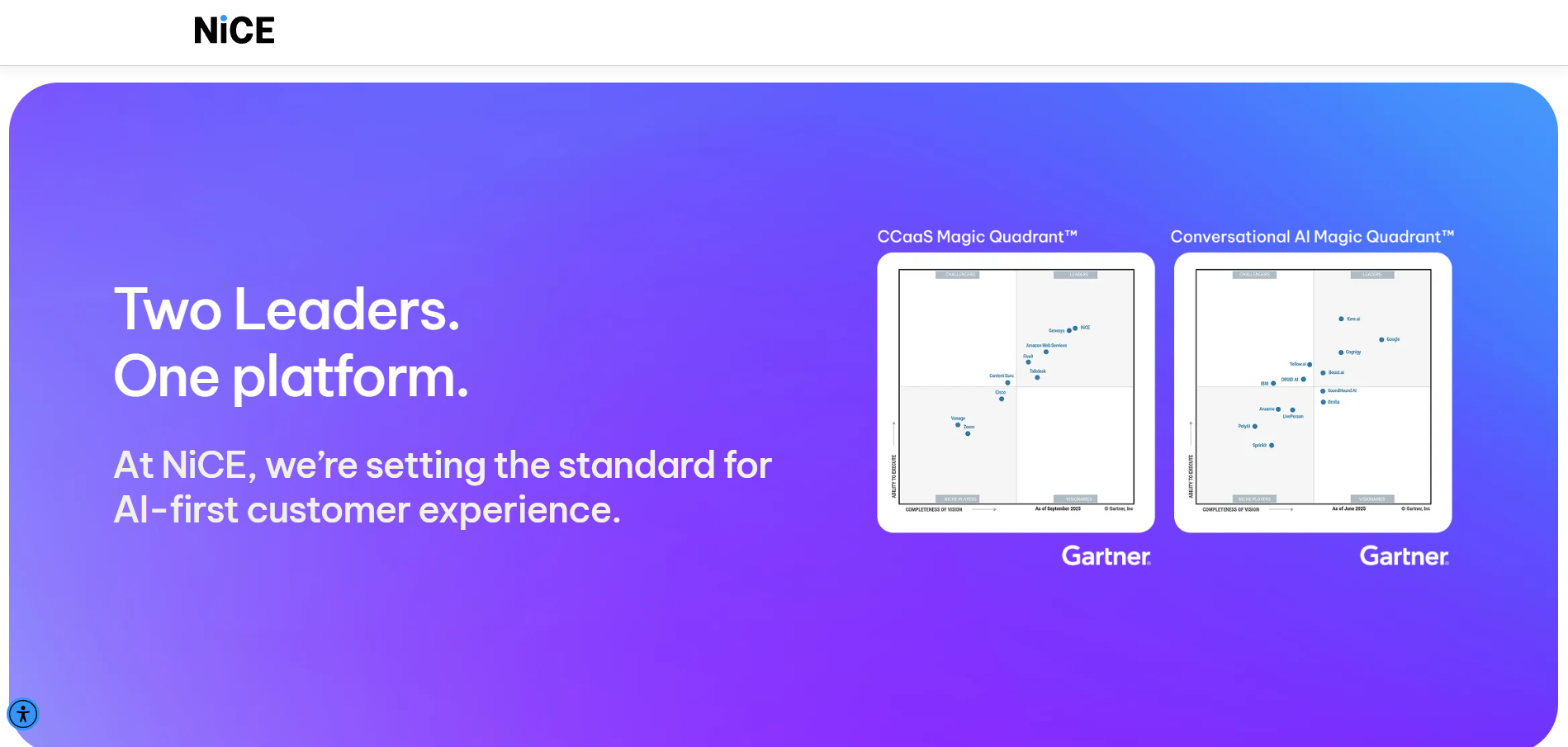
What does it do? Cloud contact center with 30+ communication channels, AI-powered IVR, workforce engagement management, and Enlighten AI analytics.
Who is it for? Operations leaders in 100+ agent environments who need scheduling, forecasting, and quality management tightly integrated with their IVR.
NICE CXone's differentiator is workforce engagement. The Enlighten AI suite scores 100% of calls automatically (compared to the 2-5% that manual QA teams typically review), providing sentiment analysis, compliance scoring, and performance benchmarks. Pricing starts at $71/user/month for digital-only and $94/user/month for voice. The Complete Suite at $209/user/month bundles everything including WFM and quality management. For organizations where agent attrition averages 30-45% annually, the workforce tools can deliver real ROI. But smaller teams will find the pricing steep and the Windows-only scripting tool frustrating.
Transfer and logging: Agents can consult or transfer to another agent, skill or team. Each interaction gets a disposition and optional tags for reporting.
Pros
Cons
Pricing Digital Agent at $71/user/month. Voice Agent at $94/user/month. Omnichannel at $110/user/month. Essential Suite at $135/user/month. Complete Suite at $209/user/month. Custom enterprise pricing available.
What does it do? Cloud contact center with Studio visual IVR builder, AI-powered routing, and industry-specific solutions for healthcare, banking, and retail.
Who is it for? Mid-market contact centers (20-200 agents) that want an intuitive IVR design experience without enterprise complexity.
Talkdesk's Industry Experience Clouds for healthcare and financial services include pre-built integrations (Epic for healthcare, core banking systems) and compliance features that speed deployment in regulated verticals. The platform scored 4.5/5 on Capterra based on 732 reviews, with users praising the interface but noting that the mandatory 3-year contract and add-on pricing structure can make total costs unpredictable. For teams that primarily need intelligent call routing and a clean IVR builder, Talkdesk delivers. But if you need AI-powered call handling that replaces agents rather than routing to them, a conversational AI platform will serve you better.
Transfer and logging: Talkdesk supports warm transfers, where the agent briefs the next person before handing over, and blind transfers. Talkdesk does not publish how call outcomes are logged in the support docs we checked.
Pros
Cons
Pricing Digital Essentials at $85/user/month. Voice Essentials at $105/user/month. CX Cloud Elite at $165/user/month. Industry Experience Clouds priced via custom quote. 3-year contract standard.
What does it do? Enterprise conversational AI platform for building voice and chat agents with a low-code flow builder, LLM orchestration, and native integration with major CCaaS platforms.
Who is it for? Global enterprises (1,000+ agents) with in-house development teams that need multilingual voice bots deployed across multiple contact center platforms.
Cognigy is now NiCE Cognigy, part of NICE, which acquired it in September 2025 and positions itself as the AI layer that sits on top of existing CCaaS infrastructure. This makes it powerful for enterprises that already run Genesys, NICE, Avaya, or Amazon Connect and want to add conversational AI without ripping out their phone system. Clients include Bosch, Lufthansa, Mercedes-Benz, and Toyota. But the platform is not plug-and-play. Building production-grade voice bots typically requires developers familiar with intent design, API integrations, and LLM orchestration. For teams without engineering resources, the time-to-value is measured in months, not days.
Transfer and logging: A Handover to Human Agent node sends the conversation to Genesys, Salesforce, NiCE CXone and other contact centers, and for NiCE CXone it can pass the transcript as the first message. Each contact's context is stored for the session.
Pros
Cons
Pricing Custom enterprise pricing.
What does it do? Managed conversational AI voice assistant purpose-built for phone-based customer service, designed to resolve calls without transferring to agents.
Who is it for? Hospitality, retail, and restaurant brands with high inbound call volume that want maximum call containment through a managed service.
PolyAI has built a strong reputation in hospitality and restaurant chains, where call patterns are repetitive and high-volume. Their proprietary voice models produce some of the most natural-sounding AI speech available. But the managed model means you are dependent on their team for updates, and the platform is not designed for the kind of complex, multi-system workflows that contact centers in healthcare or financial services typically need. Pricing is custom and enterprise-only, with no self-service option or free trial.
Transfer and logging: delete Cons "Managed service model: you cannot modify conversation flows yourself" and "No self-service builder, API, or developer tools". Replace with "Most deployments run with PolyAI's team involved; self-serve editing happens in Agent Studio" and "Handoffs and custom logic need SIP and code-level setup (ADK)". Delete the "Limited to inbound use cases" Con (not confirmed).
Pros
Cons
Pricing Custom enterprise pricing only. Contact sales for a quote. No free trial or self-service tier available.
What does it do? Cloud communications platform with AI-powered call routing, real-time transcription, and basic IVR for small to mid-size businesses.
Who is it for? SMBs and growing teams (5-50 agents) that need smart call handling without deploying a full contact center platform.
Dialpad's pricing is the most accessible on this list, starting at $27/user/month for the business plan and $95/user/month for the AI contact center. There are no seat minimums, and the platform includes real-time coaching, transcription, and sentiment analysis even on lower tiers. For SMBs handling 500-2,000 calls per month that need basic routing intelligence and AI-assisted agent tools, Dialpad is a strong fit. But organizations that need true conversational IVR, outbound campaigns, or enterprise compliance will outgrow it quickly.
Transfer and logging: Dialpad supports warm (ask first) and blind transfers. After a transfer, the receiving agent sets the call disposition, and each call leg gets its own AI transcript.
Pros
Cons
Pricing Business plan at $27/user/month. Pro at $35/user/month. AI Contact Center at $95/user/month. No minimums, monthly or annual billing.
I prioritized platforms that drive real call center automation by resolving calls inside the IVR rather than just routing them. A traditional IVR that sends 80% of callers to an agent is not saving you money. I compared how much of each call a platform can resolve without human intervention, based on its own docs.
A good AI IVR transfers to a person without making the caller repeat themselves. I checked each vendor's docs for three things: whether it supports warm transfer (the agent is briefed before the caller joins) or only cold transfer, whether a summary or transcript moves with the call, and whether a failed transfer falls back to a queue, voicemail or callback.
Outcome logging means each call ends with a record of what happened: the disposition (resolved, transferred, abandoned), the transcript, and any fields the caller gave, such as a policy number. I checked what each platform stores per call and where it sends that record: a CRM like Salesforce or HubSpot, a helpdesk like Zendesk, a webhook, or an export. An IVR that resolves a call but logs nothing leaves your team blind on which flows work.
Callers start to disengage after about 1.5 seconds of silence, so response time decides whether an AI IVR feels like a conversation or a slower phone tree. Latency figures in this list are vendor-stated.
Per-seat pricing looks clean on a sales page but hides the real cost. A fair comparison counts base licensing, IVR add-ons, telephony, AI features, and implementation. Per-minute platforms charge for the calls AI handles; per-seat platforms charge for every licensed agent, whether calls come or not.
For healthcare, financial services, and insurance buyers, compliance is not optional. I verified each platform's certifications (SOC 2 Type I vs. Type II, HIPAA with or without BAA, PCI DSS) and checked whether compliance features like PII redaction and call recording encryption were included or sold as add-ons.
Most AI IVR platforms connect to the numbers you already own through SIP trunking, so you keep your carrier and your published numbers. A cloud based IVR system sits behind the carrier: calls arrive on your number, the carrier routes them over a SIP trunk to the IVR, and transfers go back out the same way.
Bring your own number. Check whether the platform lets you import an existing number or forces you to buy one of theirs. Pointing an existing number at a SIP trunk is usually a smaller change than porting it to a new carrier.
SIP trunk support. Ask which carriers the vendor documents (Twilio, Telnyx, Vonage and others) and whether it supports SIP REFER for transfers, since that decides which caller ID the live agent sees.
DTMF keypad input. Callers still press keys to enter account numbers, dates of birth and PINs, because spoken digits are easy to mishear. An AI IVR should accept keypad input mid-conversation, and for outbound calls it should be able to press digits to get through another company's phone tree.
Retell connects through elastic SIP trunking or by dialing a call to its SIP endpoint, and you can import numbers from Twilio, Telnyx, Vonage or any carrier that supports SIP trunks (docs). Its agents can also navigate IVR menus with keypad presses.
Inbound call triage and routing: An AI voice agent answers every inbound call, understands caller intent through natural language, and routes to the right department or resolves the query, turning IVR into true conversational AI for customer service without human intervention. Organizations replacing DTMF menus with conversational AI report containment rates above 60%.
After-hours call handling: An AI answering service picks up calls 24/7, captures caller information, schedules callbacks, and handles urgent routing. This eliminates the voicemail black hole that costs service businesses an estimated 30% of after-hours leads.
Lead qualification and warm transfer: Inbound leads are qualified through multi-turn conversation, scored, and transferred to sales with full context. Lead qualification via voice AI replaces the manual SDR screen that most call centers run today, at a fraction of the per-lead cost.
Caller trust gap: Even the best AI voice agents face caller skepticism. A percentage of callers will always press zero or ask for a human, regardless of voice quality. Plan for warm transfer as a standard fallback.
Complex multi-system workflows: IVR solutions that need to query EHR systems, payment processors, and CRMs in real time during a call add latency at each integration point. Test end-to-end latency with your actual backend, not just the IVR in isolation.
Regulatory unpredictability: AI voice regulations are evolving. The FTC has increased scrutiny on AI-generated voice calls, and several states have pending legislation on AI disclosure requirements. Build disclosure scripts into your IVR flows now.
Accent and dialect performance: Speech recognition accuracy drops with heavy accents, regional dialects, and background noise. Test with callers from your actual customer base, not just standard American English.
Ongoing tuning requirements: No IVR deploys perfectly on day one. Budget for 2-4 weeks of tuning conversation flows, adjusting thresholds for transfer, and refining intent recognition based on real call data.
If your IVR sends callers through three layers of "press 1" before they reach anyone, Retell AI replaces that menu with a voice agent that resolves the call or hands it to a person with context.
Start building your first AI voice agent at retellai.com.
All eight platforms in this list can send a caller to a human, but they differ in whether the agent gets context. Retell AI documents warm transfer with a private briefing before the caller joins, plus agentic warm transfer. Five9, Genesys Cloud CX, Talkdesk and Dialpad document warm and blind transfers; NiCE Cognigy can pass the transcript at handover; PolyAI passes context in SIP headers. Ask any vendor for its transfer docs and check whether a summary or transcript moves with the call.
AI IVR systems log each call as a record with the transcript, the outcome (resolved, transferred, abandoned) and any details the caller gave. The difference between platforms is where that record goes. Some keep it in their own reporting, some send it to a webhook, and some write it straight to a CRM or helpdesk. Retell AI stores a transcript, recording, summary, sentiment and custom fields for every call and can write them to HubSpot, Salesforce or Zendesk.
Yes, but capacity varies dramatically by platform. Legacy per-seat CCaaS platforms are limited by the number of licensed agents. AI-native IVR solutions like Retell AI offer 20 free concurrent calls with scalability to thousands, handling volume spikes without licensing changes. For healthcare organizations that see 3-5x call spikes during open enrollment, this lets the system absorb a spike without new license.
Most modern IVR platforms and AI call bots connect via SIP trunking, which lets you route calls from your existing phone system (Avaya, Cisco, Mitel) to the AI IVR without replacing hardware. Retell AI supports SIP trunking with any telephony provider, including Twilio, Vonage, and Telnyx. Five9 and Genesys also support BYOC (bring your own carrier). The key question is whether you need a full rip-and-replace or can run the AI IVR alongside your existing system during a transition.
Most organizations see measurable ROI within 60-90 days. The primary savings come from reduced agent handle time (AI resolves calls that previously required agents), lower abandonment (callers stay on the line when they get immediate responses), and 24/7 coverage without overtime. The math depends on how many calls AI resolves without a transfer: every resolved call saves the agent time it would have taken, while transferred calls cost both. Start with one high-volume call type, measure its resolution rate for 30 days, then expand.
Not all of them. HIPAA compliance requires a signed Business Associate Agreement (BAA), encryption in transit and at rest, access controls, and audit trails. Among the platforms in this list, Retell AI offers a self-service BAA portal with HIPAA compliance included at no extra cost. Five9, Genesys, and NICE CXone also support HIPAA, but compliance features may require higher-tier plans. Platforms with knowledge base capabilities can connect to EHR data while maintaining HIPAA-compliant data handling.
Failure handling separates production-grade IVR from demo-quality systems. The best platforms detect confusion signals (repeated questions, silence, explicit requests for help) and escalate gracefully. Retell AI's warm transfer passes full conversation context so the human agent knows exactly what was discussed. Check each vendor's transfer docs: some pass a summary to the agent, others drop the caller into a queue with no history. The comparison table above shows which is which.
Only some. Traditional CCaaS platforms (Five9, Genesys, NICE, Talkdesk) include outbound dialers for AI outbound calling campaigns. Among AI-native platforms, Retell AI offers batch calling with no concurrency limits and detailed outbound call center KPI conversion tracking, plus branded caller ID and verified phone numbers to maintain answer rates. PolyAI and Dialpad are inbound-only. If outbound IVR campaigns are a priority, verify that the platform supports predictive or power dialing before committing.
For the outbound side, outbound IVR calls covers where they still work and where a voice agent beats them.
Language support ranges from 12 to 80+ depending on the platform. Retell AI supports 55 languages across 63 locale variants, each covered by both a speech-recognition and a text-to-speech provider, with multilingual auto-detect. For businesses serving multilingual populations, test multilingual conversational AI accuracy in your target languages specifically, not just menu comprehension.
See how much your business could save by switching to AI-powered voice agents.
Total Human Agent Cost
AI Agent Cost
Estimated Savings
A Demo Phone Number From Retell Clinic Office