California AB 1609 Explained: The New Rules for AI Customer Service Agents




California AB 1609 is a state law that sets rules for how large businesses use AI chatbots and voice agents in customer service. Starting January 1, 2027, companies with more than $500 million in gross annual revenue must not present an AI agent as human, must give California customers a simple way to ask for a person, and must make a good-faith effort to connect them to an agent within 15 minutes or book a callback within one business day.
Governor Newsom signed the bill on September 28, 2026. It is codified as Chapter 733 of the Statutes of 2026 and adds sections 22625 to 22629 to the California Business and Professions Code. Below is what the law requires, who it covers, and how to set up an AI voice agent so that human escalation is reliable and measurable.
This article summarizes the statute for planning purposes and is accurate as of November 2026. It is not legal advice, and Retell AI is not a law firm. Confirm how the law applies to your business with your own counsel.
Who California AB 1609 applies to
AB 1609 applies to a "large private business," which the statute defines as a business with more than $500 million in gross annual revenue nationally that provides goods and services to customers. The threshold counts national revenue, so a company headquartered in Texas or New York can be covered if it serves California customers.
A "customer" is a natural person who lives in California, and residence is determined by the customer's account address. That makes the account record the trigger, not the caller's area code or location at the time of the call.
The law excludes a few groups:
- Telecommunications and water services operating under California Public Utilities Commission General Orders 133 and 103-A, if they comply with any corrective action plan
- Exclusive business lines
- Hospitals, for communications related to health care operations
- Consumer reporting agencies as defined in the federal Fair Credit Reporting Act
AB 1609 requirements at a glance
| Requirement | What the law says | Section |
|---|---|---|
| No posing as human | A covered business shall not represent that a customer service chatbot is a human. | 22626(a) |
| AI disclosure | A clear and conspicuous disclosure is required when a reasonable person is likely to be misled into thinking they are talking to a human, given in the same medium as the chatbot. | 22626(b), (c) |
| Human request feature | During at least regular business hours, every customer service platform must offer a simple way to request a customer service agent. | 22627(a) |
| 15-minute connection or callback | Good-faith effort to connect within 15 minutes of the request, or to set a specific appointment within one business day. | 22627(b) |
| Hold limits | Good-faith effort to keep any single hold under 15 minutes after connection and total hold, wait, or escalation time under one hour. | 22627(c) |
| Phone number on the website | Businesses with a customer service phone line must post the number clearly and conspicuously on their website. | 22627(d) |
| Penalties | Up to $5,000 for an initial violation and $10,000 for each subsequent violation, enforced by a public prosecutor. | 22628 |
Source: AB 1609 bill text, Chapter 733, Statutes of 2026. Section numbers refer to the California Business and Professions Code.
The AB 1609 AI disclosure rule
The statute does two things. First, it bans a covered business from claiming its chatbot is a person. Second, it requires a clear and conspicuous disclosure that the agent is artificially generated whenever a reasonable person is likely to believe they are talking to a human.
Whether a deployment meets that "likely to be misled" test depends on its facts. Voice agents built to sound natural are the obvious case to review with counsel. The disclosure must be delivered in the medium the agent uses. For a phone agent, that means a spoken disclosure on the call, not a line in the website's terms of service.
The law defines a "customer service chatbot" broadly: an AI system with a natural language interface that gives adaptive, human-like responses and is used for customer service or customer support, including technical assistance. The definition is not limited to text, and section 22627 names telephone service alongside online chatbots.
The right to request a human agent under AB 1609
During at least regular business hours, a covered business must offer "a simple customer service feature" that lets customers ask to connect to a customer service agent. It applies on every platform the business uses for customer service, and the statute names online chatbots and telephone service specifically.
The statute also describes how the request can work. A business satisfies the requirement if customers can ask for an agent "through commonly understood commands, prompts, menu selections, or verbal requests during the customer interaction." A plain spoken request such as "I want to talk to a person" or "representative" is the kind of verbal request the statute describes.
The statute also defines regular business hours: the hours a business customarily runs customer service, excluding days it is normally closed and state or federal holidays. It includes a 10-hour day over a five-day week, or 8 hours a day over a seven-day week.
The 15-minute rule and the one-business-day callback
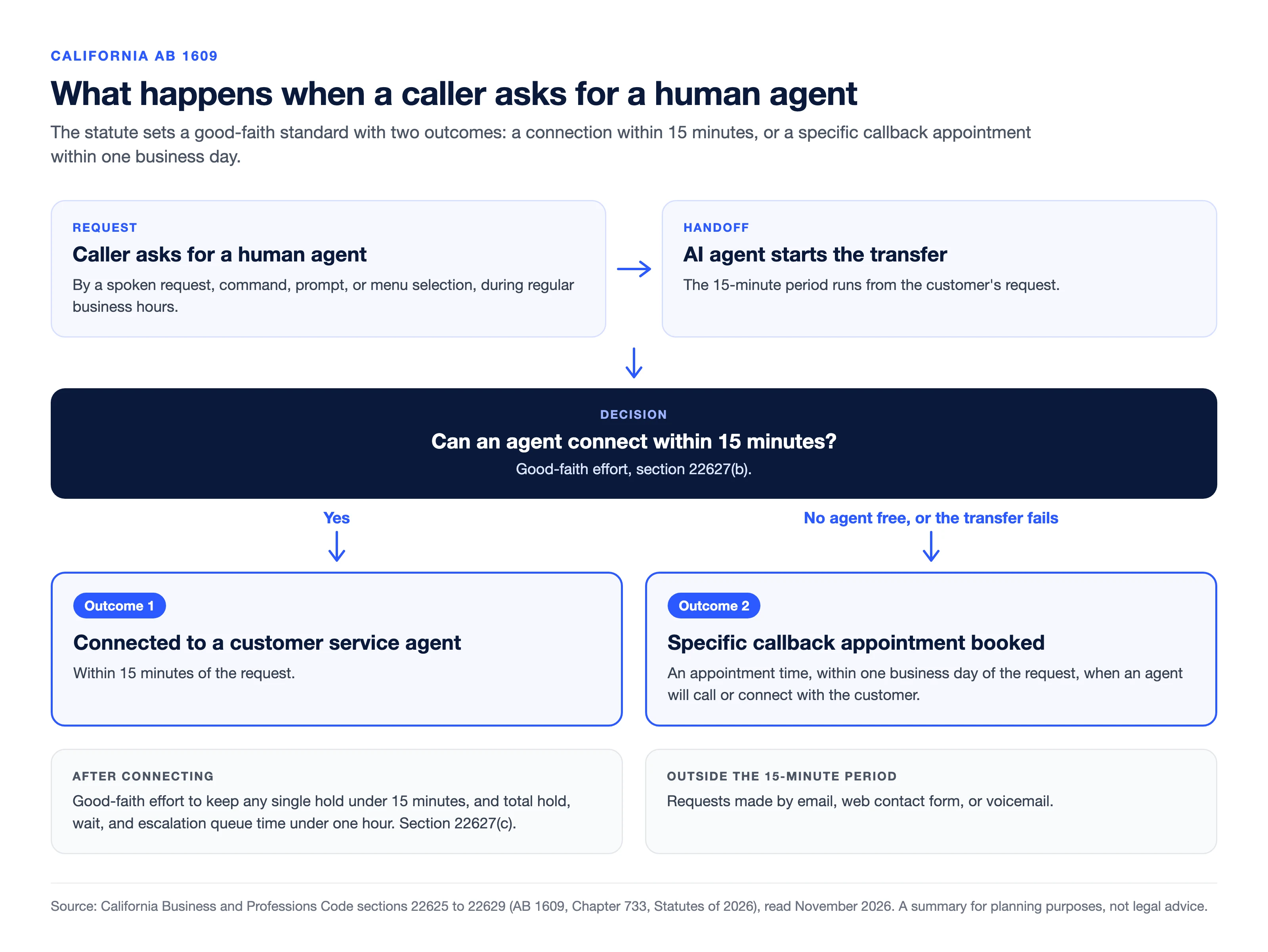
Once a customer asks for a person, the business must make a good-faith effort to provide one of two outcomes:
- A connection to a customer service agent within 15 minutes of the request
- A specific appointment time, within one business day of the request, when an agent will call or connect with the customer
This is a good-faith standard, not a guarantee. Section 22628(c) says that using "commercially reasonable and practicable standards that are designed and intended to achieve compliance" satisfies the good-faith requirement.
The 15-minute clock does not apply to requests made by email, web contact form, or voicemail. Businesses regulated under 16 CCR section 1707.2 may instead meet the rule by returning a call within one business hour.
Failures caused by circumstances outside the business's reasonable control are not violations. The statute lists examples such as local or statewide emergencies, grid emergencies, public safety power shutoffs, and IT or telecommunications outages.
AB 1609 hold time limits
The rules continue after the handoff. A covered business must make a good-faith effort to keep a customer from waiting on hold for more than 15 minutes at any point after connecting with an agent, and to keep cumulative hold, wait, and escalation queue time under one hour in total.
That matters for transfer design. A warm transfer that bounces a caller between three queues can breach the one-hour total even if each single hold stays short.
AB 1609 penalties and enforcement
A public prosecutor can bring an action to enforce the law. Penalties run up to $5,000 for an initial violation and up to $10,000 for each subsequent one. The statute does not create a private right of action. Its duties add to, rather than replace, obligations under other laws.
The statute does not require a business to add a phone line if it had no telephone customer service as of January 1, 2027, provided it offers other ways to reach an agent promptly. Nor does it force a business onto any channel it did not already offer by that date.
What AB 1609 means for enterprise AI voice agents
AB 1609 turns human handoff from a feature into a compliance control. Four changes follow for enterprise contact centers.
Escalation has to work every time. A caller who asks for a person and hits a dead end, a failed transfer, or a loop back to the AI is now a compliance risk, not only a bad experience. Request detection needs to catch plain-language asks, not just a keypad option.
Fallbacks matter as much as transfers. When no agent is free, the queue is long, or the call arrives after hours, the agent needs a defined next step. The statute's alternative to a 15-minute connection is a specific callback time within one business day.
Measurement becomes evidence. The law sets no recordkeeping requirement, but the good-faith standard rewards a business that can show its system was designed to comply. Escalation requests, transfer success rates, time to connect, and callback outcomes are the numbers that show it.
Buying criteria shift. Legal, compliance, and procurement teams will start asking AI vendors how a platform detects a request for a human, what happens when a transfer fails, and what reporting proves it. Because the threshold uses national revenue and the trigger is a California account address, national brands are likely to apply one standard to every customer rather than route California callers differently. Many enterprises already take that approach with outbound calling rules, defaulting to the strictest state.
AB 1609 is one part of a wider compliance picture. See our guide to enterprise voice AI compliance for the rest.
Containment rate alone stops being the right goal. The better measure is containment where the AI resolves the issue, plus fast and reliable escalation where it cannot.
How to configure a voice agent for AB 1609 requirements
The steps below are configuration guidance, not legal advice. Following them does not by itself make a business compliant. Review your setup with your own counsel.
The checklist below maps each requirement to a configuration choice. Feature references are to Retell AI, but the same questions apply to any platform you evaluate.
Disclose the AI up front. Set the agent to speak first and open with a short disclosure. An example to adapt with your counsel: "Hi, this is Ava, an AI assistant for Acme. I can help with most account questions, and you can ask for a person at any time." Retell agents also confirm they are an AI when a caller asks, through the default "AI disclosure when asked" setting in the agent handbook.
Make "talk to a human" a first-class intent. Add a call transfer function and instruct the agent to trigger it on any request for a person, representative, or agent. Do not make the caller repeat the request or argue them out of it. See when an AI agent should hand off for prompt patterns.
Use warm transfer to cut repeat explanations. With a warm transfer, the AI stays on the line, can whisper a private summary to the human agent, and can introduce the caller. Agentic warm transfer goes further: a second AI agent screens the handoff and bridges the caller only when a person is ready, which keeps callers out of dead air.
Define what happens when the transfer fails. Set a transfer ring duration so an unanswered transfer is caught quickly. In agentic warm transfer, a cancelled or timed-out transfer returns the caller to the main agent, which picks the conversation back up. In conversation flows, a failed transfer follows its own path. That path should offer the AB 1609 alternative: a specific callback time.
Route by business hours. Retell exposes the current time, hour, and time zone as dynamic variables, so the agent can transfer during staffed hours and offer a booked callback after hours. Route destinations by team or queue with dynamic transfer numbers or SIP URIs.
Book the callback, do not just promise one. Connect the agent to your scheduling system through a calendar integration or a custom function so it confirms a specific time within one business day while the caller is still on the line.
Track every escalation. Add a post-call analysis field such as a yes or no "requested_human" flag and a "callback_time" field. Retell records transfer outcomes as disconnection reasons (call_transfer, transfer_bridged, transfer_cancelled), sends transfer webhooks (transfer_started, transfer_bridged, transfer_cancelled, transfer_ended), and charts call transfer rate in the analytics dashboard. Export these to your data warehouse to report time to connect and callback completion.
Post the phone number. If you run a customer service phone line, make sure the number is clearly displayed on your website, as section 22627(d) requires.
AB 1609 timeline
- January 20, 2026: introduced by Assemblymember Rick Chavez Zbur
- September 28, 2026: signed by the Governor and chaptered as Chapter 733
- January 1, 2027: in effect
Plan your AB 1609 escalation design now
AB 1609 raises the bar for an enterprise-ready AI agent. The platform has to resolve what it can, disclose that it is an AI, and hand off to a person reliably, with the data to prove it. Retell lets enterprise teams test that full escalation path in a pilot on real calls before signing a contract. Talk to our team about running a pilot for your contact center.
Frequently asked questions about AB 1609
What is California AB 1609?
AB 1609 is a California law, Chapter 733 of the Statutes of 2026, that regulates AI customer service chatbots and voice agents at large businesses. It bans presenting an AI agent as human, requires a simple way to request a human agent, and sets a good-faith 15-minute connection or one-business-day callback standard.
When does AB 1609 take effect?
AB 1609 takes effect on January 1, 2027. Governor Newsom signed it on September 28, 2026.
Which businesses does AB 1609 apply to?
It applies to businesses with more than $500 million in gross annual revenue nationally that provide goods and services to customers living in California. Residence is based on the customer's account address, so companies outside California can be covered if they serve California residents.
Does AB 1609 apply to AI voice agents on the phone?
Yes. The law covers any AI system with a natural language interface used for customer service or support, and it names telephone customer service platforms alongside online chatbots.
Does AB 1609 ban AI customer service agents?
No. Businesses can keep using AI as the first point of contact. They must disclose the AI when a reasonable person could be misled, and they must let customers reach a human agent.
Does a business have to connect a customer to a human within 15 minutes?
The business must make a good-faith effort to either connect the customer to an agent within 15 minutes or give a specific appointment time within one business day. Using commercially reasonable standards designed to achieve compliance satisfies the good-faith requirement.
What are the penalties for violating AB 1609?
A public prosecutor can seek civil penalties of up to $5,000 for an initial violation and up to $10,000 for each subsequent violation. The law does not give individuals a private right of action.
Does the 15-minute rule apply to email or voicemail?
No. The 15-minute connection standard does not apply to requests made by email, web contact form, or voicemail.
Are any businesses exempt from AB 1609?
The law excludes certain PUC-regulated telecommunications and water services, exclusive business lines, hospitals for health care operations communications, and consumer reporting agencies under the Fair Credit Reporting Act.
See how much your business could save by switching to AI-powered voice agents.
ROI Result
Total Human Agent Cost
AI Agent Cost
Estimated Savings
A Demo Phone Number From Retell Clinic Office
What results look like with Retell AI


Estimate your monthly voice AI cost
Read Other Blogs
Revolutionize your call operation with Retell