How to Sell Voice AI When the Buyer Has One Translation Call a Week





Most of the time you should not sell it as translation at all: at one call a week, with bilingual staff already on the team, a translation-only AI voice agent rarely covers its own setup and upkeep. The deal that holds up is either a wider scope the agent can handle end to end, or a clear "not yet" with the cheaper option named. This guide is for resellers, agencies and BPOs scoping that conversation. It gives you a break-even method the buyer can fill in and take to their manager.
The typical request: a small support team takes a few dozen calls a week, and about one needs another language. People on the team already speak it. The team lead wants something to help live agents on that one call, and has to justify the spend upward.
Can an AI voice agent translate between a caller and a live agent?
Not on Retell, and you should say so in the first meeting. Retell's documentation describes no feature that interprets in real time between a caller and a human agent on the same call. An AI voice agent takes the call itself, in the caller's language, and hands off to a person when it cannot finish.
That changes what you are selling. Per the docs:
- The agent speaks the caller's language directly. A multilingual agent works out which of its selected languages the caller is speaking and responds in that language.
- A person joins by transfer, not by interpretation. Retell documents cold, warm and agentic warm call transfer. In a warm transfer the agent can speak a private whisper message to the person receiving the call. That is a briefing before the handoff, not a running translation.
- A supervisor can take over a live call, and the agent stops. Live monitoring lets a team member listen in or take over. After a takeover the agent does not resume, so it cannot stay on the line as an interpreter.
So restate the request before you price anything. "Help my agents when another language calls" becomes "an agent answers those calls in the caller's language, and transfers to your bilingual staff when it cannot resolve them." If the buyer needs a human conversation with an interpreter in the middle, that is a different product category, covered below. The handoff itself is explained in how call transfers work between AI voice agents and human teams.
Why does a translation-only use case rarely pay at low volume?
Because the per-minute cost is not what the buyer has to cover; the fixed cost is. Retell's pricing is usage-based and per-minute, from $0.07 per minute, so four short calls a month cost very little to run. What does not shrink with volume is everything around the minutes:
- The build. Someone writes the prompt or flow, connects the number, sets the transfer path and tests it in both languages.
- The upkeep. Policies, hours and products change. Someone has to own the agent after launch, and that time does not shrink with call volume.
- The accuracy trade-off. Retell's docs say that selecting languages from different families (their example is English and Spanish) routes speech recognition to a multilingual pipeline that is less accurate per language than a single-language model. Adding a second language for one call a week can put the other calls on that pipeline too. The documented way around it is a single-language agent per language, with the language set per call from the dialed number or CRM context through the inbound call webhook. That is more build work.
Then there is the comparison the buyer's manager will make. When a colleague who speaks the language is free, the extra cost of that call is close to zero, and automation cannot beat zero.
What are the cheaper options, and when is each the right answer?
Three options usually cost less than an AI voice agent at this volume. Put them in the proposal yourself, because a buyer who finds them later will trust your other numbers less.
| Option | How it is paid for | Fits when | Stops fitting when |
|---|---|---|---|
| Bilingual staff already on the team | Already in payroll | A speaker of the language is on shift and free for most of these calls | Calls arrive after hours, during peaks, or in a language nobody speaks |
| On-demand phone interpreter line | Per minute of interpreting, from a language services vendor | Calls are rare and need a human conversation with an interpreter | Volume grows enough that per-minute interpreting becomes a real budget line |
| Scheduled callback from a bilingual colleague | Staff time only | The caller's issue can wait a few hours | The call is urgent, or callers do not pick up the return call |
| AI voice agent handling the call | One-time build, ongoing upkeep, and per-minute usage | The same agent can take enough calls end to end to cover its fixed cost | The only job is one call a week that staff can already take |
Ask the buyer to get one quote from an interpreting vendor rather than guessing a rate, because that number becomes an input below. In regulated settings, whether a call needs a qualified human interpreter is a question for the buyer's compliance lead, not for you or the platform.
How do you work out the break-even with the buyer's own numbers?
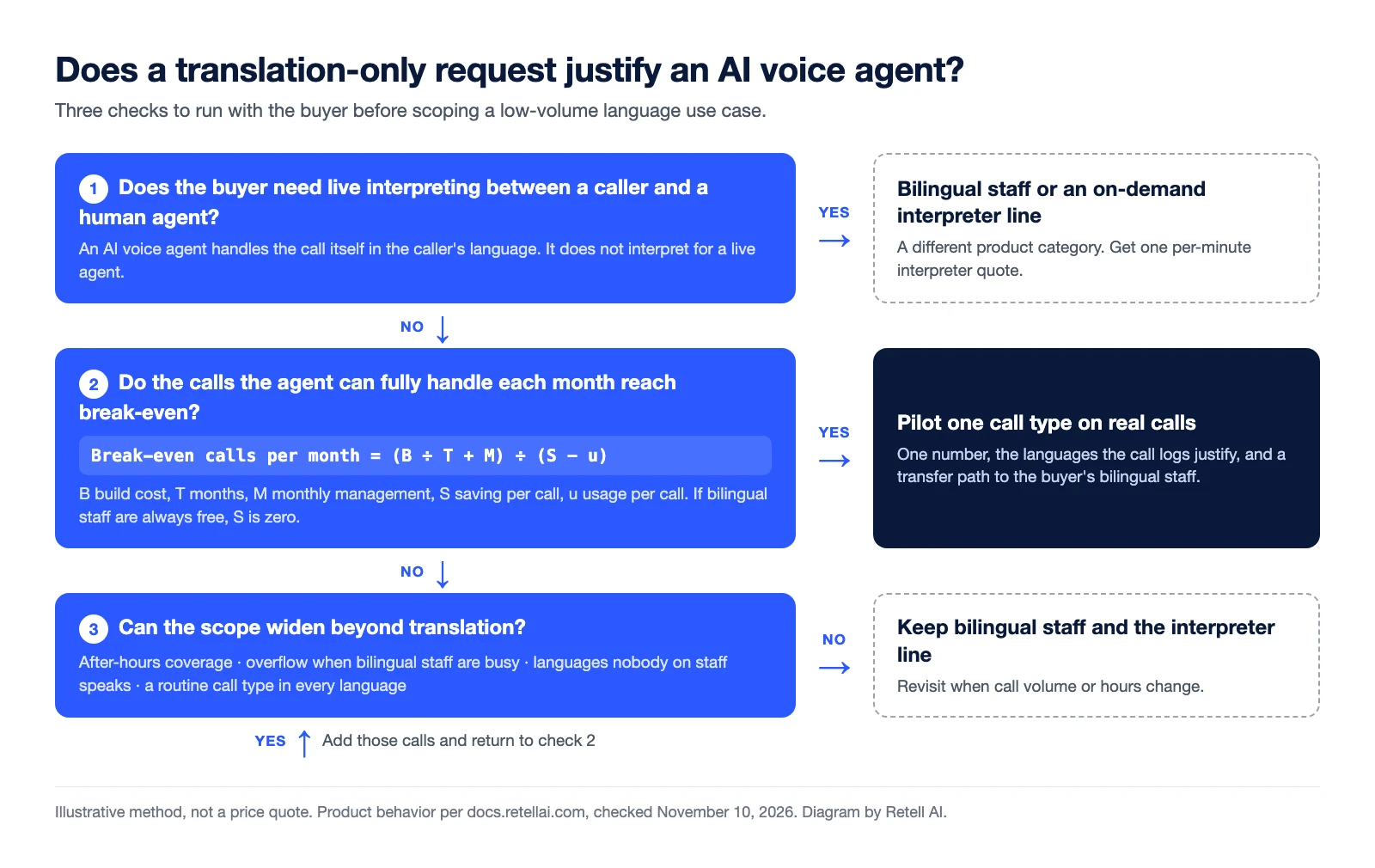
Divide the monthly fixed cost by the saving per call; the result is the number of calls a month the agent must fully handle. Have the buyer fill in five inputs.
| Input | What it means | Where the buyer gets it |
|---|---|---|
| B | One-time build cost | Your quote |
| T | Months to spread the build over | Contract term |
| M | Monthly management cost | Your quote, or internal owner's time |
| S | Saving per call the agent fully handles | What that call costs today: interpreter minutes, callback time, or a missed call |
| u | Usage cost per call | Average minutes per call times the per-minute rate quoted for their configuration |
Break-even calls per month = (B ÷ T + M) ÷ (S − u)
Two rules keep the math straight. First, if a bilingual colleague is free every time, S is zero and no volume breaks even. And a call the agent transfers still costs something: the docs state that once the caller is connected to the destination and the agent drops off, the AI agent fee stops and only the telephony fee continues, so a transferred call is a partial saving at best.
Worked example, illustrative inputs only. These are placeholders, not Retell prices, market rates or a real customer's numbers.
- B = $1,200, T = 12 months, M = $120 a month. Fixed cost is $100 + $120 = $220 a month.
- S = $16 per call, from an assumed 8 minutes at an assumed $2.00 per minute for an interpreter line.
- Set u to zero, as if usage were free. Break-even is 220 ÷ 16 = 13.75, so 14 calls a month.
A buyer with one such call a week has about four a month. The case is ten calls short even with free minutes, and any real usage cost pushes the break-even higher. The gap is in call volume, not in the vendor's rate, so no discount on usage closes it.
What would have to be true for voice AI to make sense?
The agent needs more calls to handle, and four conditions supply them.
- After-hours coverage. Bilingual staff go home. If calls in any language arrive when nobody is on shift, the agent's alternative is a missed call, and S goes up.
- Overflow. When the bilingual speakers are already on calls, the next caller waits or leaves. Per Retell's docs, one agent can handle many calls at once within the workspace's concurrency limit, so it does not queue behind a busy colleague.
- Languages nobody on staff speaks. Bilingual staff cover one language. Retell's language support table lists coverage by provider, and the dashboard's language picker is the live source of truth for which combinations work. Check the buyer's languages there before you promise any.
- A broader set of calls. The strongest case is not about language at all. If the agent can take a routine call type in every language (order status, appointment changes, hours and directions), the language calls ride along on volume that already clears break-even. See choosing voice AI use cases for how to pick it.
If none of the four applies, tell the buyer to keep their bilingual staff, add an interpreter line for the gaps, and revisit when volume or hours change. The partner who says so is the one they call when that day comes.
What should the buyer take to their manager?
One page, with their own numbers on it. The checklist:
- Calls per month that need another language, from call logs, not memory
- How many of those reached a bilingual colleague, and what happened to the rest
- One interpreter-line quote, per minute
- After-hours and abandoned calls per month, in every language
- The routine call types an agent could finish without a person
- Your build and management quote, written as B, T and M
- The break-even number, and the count of calls that would clear it
- The decision: go ahead with a named call type, or revisit on a named date
How should a partner scope it once the numbers work?
Scope one call type on one number, in the languages the logs justify, with a transfer path to the bilingual staff the buyer already has. Splitting the work between you, the vendor and the client is covered in how to scope a first partner-led voice AI deal. Before launch, test each language the way real callers speak it, including mixed-language calls, using the code-switching test.
The greeting deserves its own test. See the first 30 seconds of a multilingual AI voice agent.
Then prove it on the buyer's own calls before anyone signs a long term: run the one call type on real calls, count how many the agent finished without a person, and put that number back into the formula. If you build for clients on Retell, the Solution Partner Program is where to start, and pricing is usage-based with no per-seat licensing. At this volume the minutes are the small number; your build and upkeep are the ones to get right.
See how much your business could save by switching to AI-powered voice agents.
ROI Result
Total Human Agent Cost
AI Agent Cost
Estimated Savings
A Demo Phone Number From Retell Clinic Office
What results look like with Retell AI


Estimate your monthly voice AI cost
Read Other Blogs

Revolutionize your call operation with Retell