Beyond Call Automation: Choosing Voice AI Use Cases by Judgment, Timing, and ROI
8
MIN READ
Choosing voice AI use cases means scoring each call type on four tests: how repeatable the call is, how much judgment or rapport it needs, how much the result depends on when the call happens, and what the call is worth compared with what happens to that work today. Calls that pass all four are where an AI voice agent pays back first.
Most use case lists sort by industry. They show what is possible, not which call to start with. A pattern buyers run into is starting with the call they most want off their team's plate, usually the busiest inbound queue, and missing two better candidates: calls that lose value by the day, and calls nobody on the team has time to make at all.
Retell AI publishes this guide and sells an AI voice agent platform. The four tests work the same on any platform.
Run every candidate through the four tests before anyone builds anything.
| Test | Question to ask | Strong fit | Weak fit |
|---|---|---|---|
| Repeatability | Can you list every outcome the call should end in? | A handful of outcomes covers almost every call | Every call is a new problem |
| Judgment or rapport | Does someone need to decide outside policy, or is the relationship the point of the call? | Policy decides, and the customer wants it done | A person must make an exception, or the customer is paying for the relationship |
| Timing | Does the call lose value if it happens a week later? | An event triggers it, and sooner is better | Any day this month works |
| Economics | What happens to this work today, and what is one good outcome worth? | Nobody makes the call today, or people spend hours on it | Low volume and low value per call |
Score each test from 1 (weak) to 3 (strong). A call that scores 1 on repeatability is not ready for any agent, human or AI, until the process behind it is written down.
Repeatable means the call has the same goal each time and ends in one of a small set of outcomes. It does not mean a word-for-word script. A payment follow-up ends with a payment, a new promised date, a dispute, a request for a person or no answer.
Write the outcome list before you write the prompt. Retell's Post Call Extraction has a Selector field type for this, one value from a fixed list such as issue type or resolution status, so every connected call ends in a result your systems can act on. If your team cannot agree on the list, the call is not ready.
Judgment and rapport are different problems, and they lead to different designs. Judgment is a decision outside written policy: waiving a fee, approving an exception, reading a situation the rules did not foresee. Rapport is when the relationship is the value, and the customer expects a named person who knows their history.
Calls that need judgment can often be split. The agent handles the policy part, such as confirming identity, collecting the facts and stating the options, then hands the decision to a person with the context attached. On Retell, a warm transfer keeps the agent on the line while it dials the destination, and it can play a private message only that person hears. How call transfers work between AI voice agents and human teams covers the design, and an escalation matrix sets which calls go to whom.
Calls where rapport is the product should usually stay with people. Retell's voice AI cost model reaches a similar conclusion from the money side: when the business is built on the phone call being the experience, automating it is the wrong call.
Some calls are worth far more at the right moment than a week later. A team works a queue when it has time. An agent can place the call when the event happens.
Take collections. A follow-up after a customer misses a promised payment date is the same short conversation every time, but its value depends on timing. Soon after the date passes, the commitment is fresh and the call is a reminder. Weeks later it is a different conversation. When these calls sit in a queue behind inbound work, the timing slips.
On Retell, Auto-enroll campaigns in the Dialer are built for event-triggered calls. Retell checks a contact against the campaign's conditions when the contact is created and whenever an update changes a field those conditions use, including edits through the API and CRM sync. A new match enrolls right away, its compliance checks usually run within about 5 minutes, and its first attempt is scheduled inside the calling window you set. Contact fields reach the agent as dynamic variables, so the agent can mention the date that was missed if you store it in a Text field. A contact enrolls in a given campaign only once, so plan how a second missed promise gets its call.
Timing sensitive does not mean calling more often, and the rules are strict. For debt collectors covered by the Fair Debt Collection Practices Act, the CFPB's Regulation F presumes a violation, with some exclusions, when a collector calls a person about a particular debt more than seven times within seven consecutive days, or within seven consecutive days after a phone conversation with them about it. The second limit matters here: if the promise was made on a call, a follow-up soon after the missed date can fall inside that window. Separately, the FCC's February 2024 declaratory ruling confirmed that the TCPA's limits on "artificial or prerecorded voice" calls cover AI-generated voices, so those calls need the called party's prior express consent unless an emergency purpose or an exemption applies. Retell's compliance checks can screen contacts against do-not-call registries before dialing, but Retell does not verify consent or enforce TCPA calling hours. This is a description, not legal advice: check with counsel which rules apply to your calls. Automated collection calls covers the wider workflow.
Every ROI case needs a baseline, and the baseline changes the answer. If a person handles the call today, the return is the cost difference on calls the agent finishes, minus the cost of the calls it hands back. If nobody makes the call today, there is no cost to replace. The return is the value of outcomes from calls that never happened before.
The second baseline is where buyers often find their best first use case. Many businesses have a long tail of smaller accounts that no account manager covers. Nobody calls them about renewals, missed payments or onboarding until something goes wrong. These calls are repeatable, often timing sensitive, and the experience they improve on is silence. Retell's pricing is pay as you go from $0.07 per minute, so you can price coverage for the whole tail before you commit.
Coverage still needs a path to a person when a small account turns out to have a big problem, and count only outcomes you can trace, such as payments received or renewals booked, not calls placed. For the full cost and benefit math once you have picked a use case, see the ROI of AI voice agents for enterprise communications.
Use the tests in order. Repeatability is a gate, judgment or rapport decides the design, and timing and economics set the order. The table shows how five common call types might score. The scores are illustrative; yours depend on your policies, volumes and customers.
| Call type | Repeatable | Low judgment or rapport need | Timing | Economics | Design |
|---|---|---|---|---|---|
| Follow-up after a missed promise to pay | 3 | 3 | 3 | 3 | Event-triggered agent call, a person for disputes |
| Renewal or check-in calls to accounts with no account manager | 3 | 2 | 2 | 3 | Scheduled agent calls, warm transfer for risk or upsell |
| Appointment reminders | 3 | 3 | 2 | 2 | Scheduled agent calls with retries |
| Billing dispute | 2 | 1 | 2 | 2 | The agent collects the facts, a person decides |
| Retention call for a top account | 2 | 1 | 2 | 3 | Keep with the account manager |
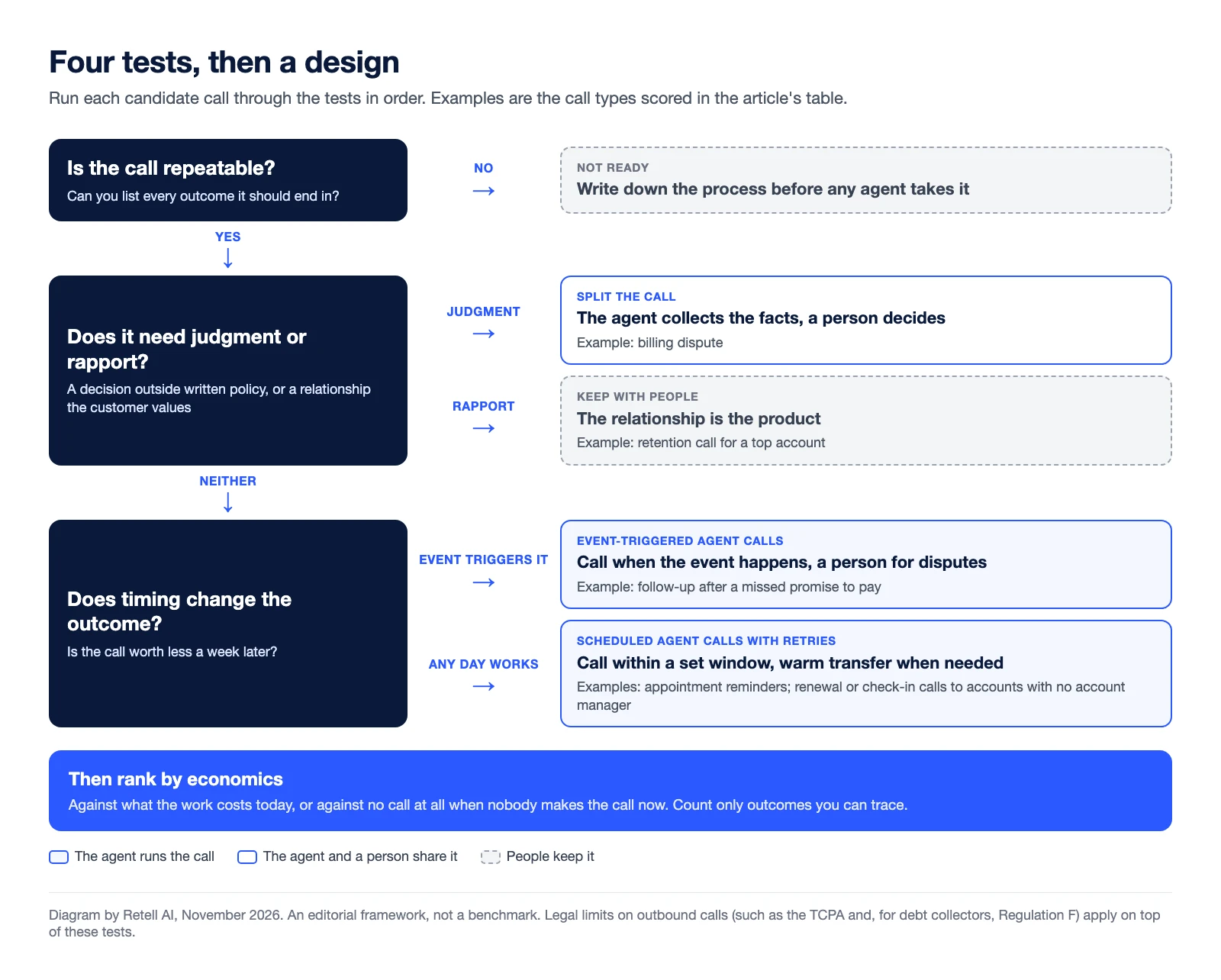
Two call types can score the same and still need opposite designs. A billing dispute and a retention call both score 1 on judgment or rapport, but a dispute needs a decision, which an agent can prepare, while a retention call needs a relationship, which it cannot replace.
Start with one use case that scores 3 on repeatability and at least 2 on everything else, and that has a baseline you can measure. Event-triggered follow-ups and uncovered long-tail accounts often qualify, because there is no human queue to compete with and the outcome is countable. Write the outcome list, agree how you will measure success before the pilot starts, and run it on a slice of real traffic.
From demo to production covers that first pilot, and build vs buy covers who runs the agent once it is live. To judge a platform on how fast and safely your team can change the agent, see the voice AI buying bar. For more candidates to score, the best use cases for AI voice agents collects ideas by industry.
Start with a call that has a short, fixed list of outcomes, needs no decisions outside written policy, and has a clear trigger. Follow-ups after a missed payment date, appointment reminders and check-ins with accounts nobody calls today often fit.
Not on their own. Split the call: the agent confirms identity, gathers the facts and explains the options, then warm transfers to a person who makes the decision with the context in hand. Calls where the customer expects a named person who knows their history should stay with people.
Pick the baseline first. If a person makes the call today, compare what the agent's finished calls cost with what those calls cost now, and count the calls it hands back. If nobody makes the call today, the return is the value of outcomes you can trace, such as payments received or renewals booked, against the per-minute cost.
An event in your system can trigger the call, so the timing is possible. Whether you may place it depends on who is calling and how. Debt collectors under Regulation F face call frequency limits, and the FCC treats AI-generated voices as artificial voices under the TCPA, which requires prior express consent unless an emergency purpose or an exemption applies. Check with counsel before you launch.
A customer too small to have an account manager, so nobody calls about renewals, payments or onboarding unless there is a problem. These accounts are often a strong first use case because there is no human call to replace, so every good outcome is new.
A ranked list of use cases makes the pilot scope easy to agree. Retell is an AI voice agent platform for contact centers. Compare plans on the pricing page and talk to the team about the first call type on your list.
See how much your business could save by switching to AI-powered voice agents.
Total Human Agent Cost
AI Agent Cost
Estimated Savings
A Demo Phone Number From Retell Clinic Office