The Voice AI Buying Bar Has Moved: From Natural Speech to Fast, Safe Iteration
10
MIN READ

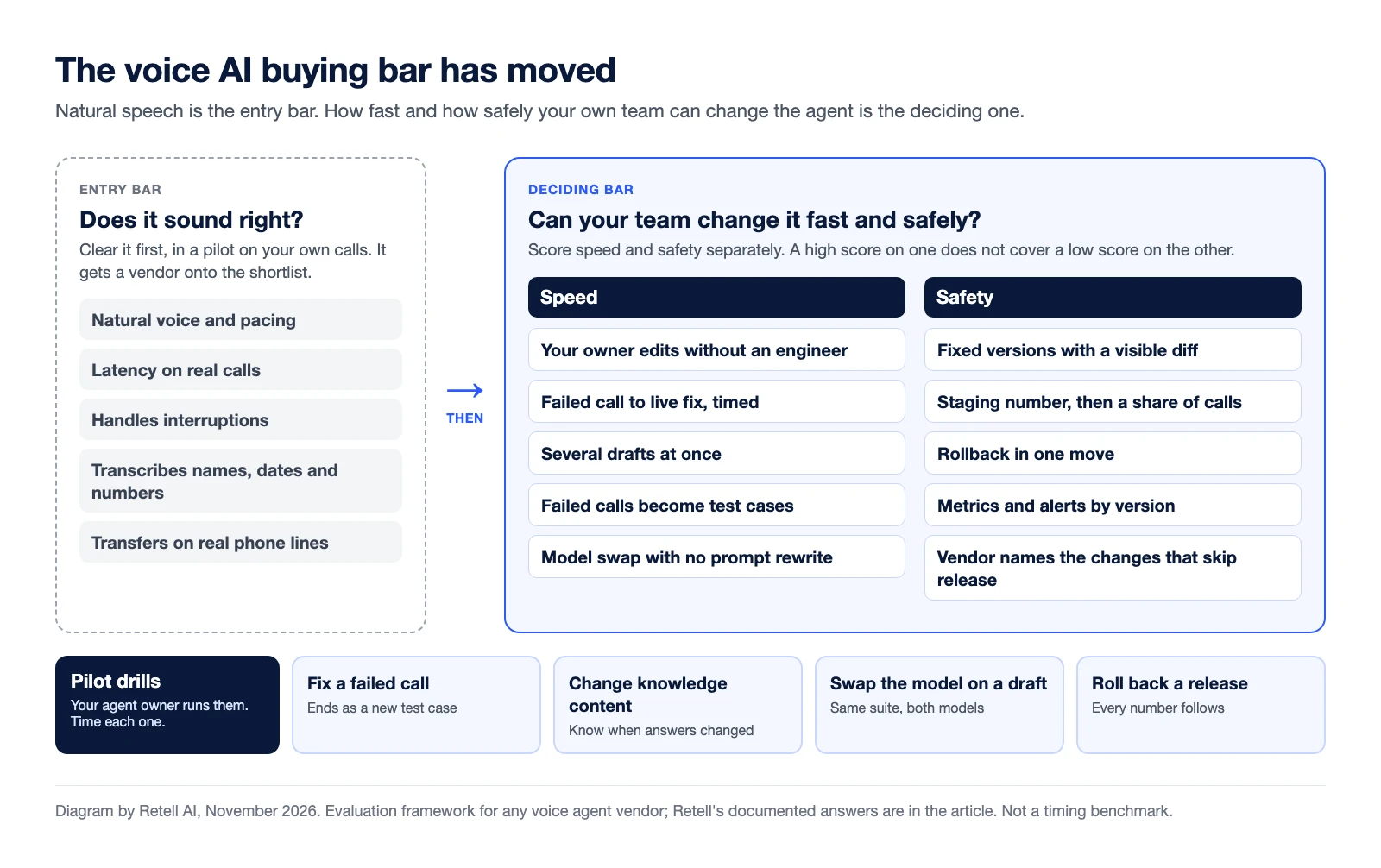
Voice AI evaluation criteria are the tests a buyer uses to decide whether a voice agent platform will hold up on their own phone lines. Natural-sounding speech used to be the deciding test. Now it is the entry bar. Once every vendor on the shortlist sounds good on a call, the deciding question is how fast your team can change the agent, and how safely.
A pattern shows up in buying conversations. The first round of evaluation compares voices, latency and interruptions. The second round asks what happens on day 40, when a policy changes, an outbound campaign needs a new script or a newer model ships. A vendor that cannot answer those questions with a live demo of the change process is selling the launch and leaving the operation to you.
Retell AI publishes this guide and sells a voice agent platform. The questions work for any vendor, including us, and we say where our own documented answers have limits.
Because voice quality decides the first week of an agent's life and change decides the rest. You still have to check that the agent sounds right on your calls: how to evaluate a voice agent platform before go-live covers latency, interruptions, transcription and transfers in a pilot. But a voice agent is never finished. Callers phrase things your scripts did not expect, prices and policies change, and new call types arrive.
Every one of those changes is a production release on a phone line, where a bad sentence reaches a live caller before anyone reads the transcript. That is why the bar has two parts, speed and safety, and why you should score both.
Software teams already measure delivery this way. DORA, a research program run by Google Cloud, splits software delivery performance into throughput and instability: how quickly changes reach production and how often they need a rollback or hotfix. DORA reports that "speed and stability are not tradeoffs" and that the metrics are correlated for most teams. A vendor should not ask you to choose between changing the agent quickly and changing it safely.
Score the changes you will actually make, not a generic "ease of use" rating. Each type of change carries different risk, so ask about each one separately.
| Change | Example | What fast looks like | What safe looks like |
|---|---|---|---|
| Prompt wording | Reword the refund policy | Your agent owner edits it without an engineer | A numbered version, a visible diff and a test run before callers hear it |
| Knowledge content | New price list or opening hours | Update the source once | You know when the update reaches live answers |
| Conversation flow | Add a branch for a new call reason | Edit the flow in the builder | Shared parts do not change other agents by surprise |
| Model | Move to a newer or cheaper LLM | No prompt rewrite | The same test suite runs on both models before the switch |
| Outbound campaign | New script mid-campaign | Swap the agent version the campaign uses | A draft cannot reach live dials by accident |
| Voice or greeting | New voice or opening line | Change it in settings | Someone hears it on a call before release |
The rest of this guide turns that table into questions. For the hands-on release process once you have picked a platform, see how to test and release voice agent changes.
Ask who can make a change and how long a real fix takes, then make the vendor show it.
Ask how a change is contained before release, how it is exposed after release and how fast it can be undone.
Then ask the question most evaluations skip: which changes bypass the release path? Every platform has some. A vendor that names its own is easier to operate safely than one that claims there are none. Here are Retell's, from its docs:
Yes, because both change live calls in ways a prompt edit does not.
Campaigns. A running outbound campaign is many future calls queued against one agent. Ask which version each dial uses and what you can change once the campaign is running. Retell's Dialer resolves the agent version at each dial, not at launch, so a fixed version keeps the agent stable for the whole campaign and Latest Published rolls published changes into it. The sequence and contact list lock at launch, and changing them means duplicating the campaign. A pause stops new dials within about a minute while calls already placed finish.
Models. A model change can alter wording, tool calls and timing at once. Ask whether the same test suite can run on the old and new model, and whether you can run a fast backup model. For voice agents on Retell-managed models, Retell's LLM settings offer a fast fallback model that runs alongside the primary, and the docs say to check that both models follow the instructions and call tools correctly before deploying. They also say to retest instructions and tool calls after changing temperature.
Run the same four drills on every shortlisted platform during the pilot, with the person who will own the agent doing the work, and time each one.
| Drill | What to record | A passing result |
|---|---|---|
| Fix a failed call | Time from finding the call to the fix running on a staging number | Your owner does it without vendor help, and the failed call is now a test case |
| Change knowledge content | When the change reached live answers, and how you confirmed it | You can say which calls heard the old content and which heard the new |
| Swap the model on a draft | Pass rate of the same test suite on both models | The suite reruns with no rewrite, and the result decides the switch |
| Roll back a bad release | Time from the decision to every production number on the previous version | One move, and you can show which numbers followed |
Score speed and safety separately, one to five each, and do not let a high score on one hide a low score on the other. A platform where fixes ship in an hour but cannot be rolled back fails. So does one where every change is safe but needs a vendor ticket. DORA's own advice for improving both at once is to keep each change small: "Smaller changes are also easier to recover from if there's a failure."
Two other pages cover adjacent decisions. Whether to build, buy or use a managed service decides who runs these drills at all; see build vs buy for AI voice agents. The financial case for the program sits in the ROI of AI voice agents. This scorecard assumes both are settled and asks only whether your team can keep the agent improving. Which calls to automate first is its own decision, covered in how to choose voice AI use cases.
Start with whether it completes your workflow on your own calls, fits your phone and data systems, and sounds natural. Once shortlisted vendors pass those, the criterion that separates them is iteration: how fast your team can change prompts, knowledge, flows, campaigns and models, and how safely those changes reach live callers.
Pick a failed call from the pilot and ask the person who will own the agent to fix it, check it, release it to a test number and roll it back while you time it. Repeat with a knowledge change and a model swap on a draft. A recorded demo by the vendor's own staff does not count.
A safe change is a fixed version with a visible diff, passes a saved test suite before release, reaches a small share of calls first, and can be rolled back in one move. You also need to know which changes skip that path, such as shared components or auto-refreshing knowledge.
The person who will own the agent after launch, not the vendor's team. Some teams give that job to a CX automation engineer, the in-house owner who finds poorly handled calls, builds fixes, checks them and deploys them.
Many platforms let you, but you should not switch blind. Run the same test suite on both models, compare results, and release the new model to a share of calls first. On Retell's single- and multi-prompt agents, the docs say you can switch models later without rewriting your prompt, and they say to check that a fallback model follows your instructions and to retest tool calls after changing temperature.
The buying bar for voice AI has moved from "does it sound human" to "can we change it quickly without breaking calls." Retell is an AI voice agent platform for contact centers, with draft versions, version comparison, environment tags, simulation and batch testing, A/B traffic splits and AI QA, so the person who owns the agent can test, release and roll back a change without waiting on a vendor. Pricing is pay as you go from $0.07 per minute on the pricing page. Bring your hardest change to the pilot and time it.
See how much your business could save by switching to AI-powered voice agents.
Total Human Agent Cost
AI Agent Cost
Estimated Savings
A Demo Phone Number From Retell Clinic Office