The First 30 Seconds of a Multilingual AI Voice Agent Decide Whether Callers Trust It




A multilingual AI voice agent earns or loses trust in its opening, because the greeting is the one part of the call every caller hears and the one part the caller did nothing to cause. If the agent starts in a language nobody asked for, or speaks the right language with the wrong accent, the listener starts doubting everything behind the greeting: the booking, the transfer, the data capture.
This guide is for contact center and CX leaders deploying AI voice agents for callers in more than one language. It covers what causes a wrong-language start, how to make the opening language a decision instead of a guess, and how to test it before a buyer or a caller hears it.
Why do the first 30 seconds carry the trust decision?
The opening carries the decision because it is the only evidence a first-time listener has. A buyer on a trial call cannot see your language settings, routing or prompt. They hear one greeting and generalize from it.
Three things make a bad opening cost more on a multilingual line:
- Language is the reason the line exists. A wrong-language greeting fails the headline requirement in the first sentence.
- The caller cannot fix it. At the greeting they have said nothing yet, so the error reads as the system's judgment, not a misunderstanding.
- An accent error sounds like a comprehension error. A Spanish greeting with English pronunciation makes callers assume the agent will not understand them either.
A wrong opening is usually a setup problem, and setup problems can be designed out.
What makes a multilingual voice agent open in the wrong language or accent?
Most wrong openings trace to one of five mismatches between the language setting, the voice, the greeting text and what the caller says first. The setting names below come from Retell's documentation; on another platform, ask your vendor for the equivalent.
| What the caller hears | Likely cause | What the docs say |
|---|---|---|
| The right language, pronounced with a foreign accent | The voice was picked for a different language | "The voice you select is still the primary determinant of accent." The language setting only refines pronunciation (agent language). |
| A greeting in the right language that sounds mispronounced | The greeting text is written in one language and the agent's language setting is another | The language setting controls "the language the voice uses to pronounce words and shape its accent," so the text and the setting have to match. |
| A greeting in a language the caller did not expect | A multilingual agent with nothing telling it which language to open in | A multilingual agent "chooses based on what the caller speaks (and any instructions you give in the prompt)." Before the caller speaks, only the prompt or a fixed message can decide (multilingual agent). |
| The agent switches to the wrong language after the caller says "hello" | Detection across language families on a short first utterance | Crossing language families uses a multilingual speech pipeline that is "less accurate per language than single-language models." |
| An unexpected language or pronunciation on some calls only | Too many languages selected, or the wrong one listed first | If pronunciation detection fails, the voice "falls back to the first language you selected." The legacy Multilingual setting covers a fixed list of ten languages whether you need them or not. |
Two more details. An agent with no language selected defaults to English (US). And the same docs warn that speech recognition "often confuses closely related languages," with Cantonese and Mandarin as the example, and recommend routing each caller to a single-language agent instead of relying on auto-detect.
One caution on the fourth row: the documentation states the accuracy trade-off but does not describe how detection behaves on a one-word utterance. Treat a short "hello," "sí" or "aló" as the hardest case and test it directly.
Can you control the language, accent and tone of an AI voice agent?
Yes for language and tone, and mostly through voice choice for accent.
| What you want to control | Documented control | Limit to know |
|---|---|---|
| Language and regional variant | A single language per agent, or Multiselect with an exact set. A single-language agent involves "no language detection." The picker exposes dialect codes where supported, such as Spanish (Spain) and Spanish (Latin America). | Every language must be supported by both the voice and a speech recognition provider. The dashboard greys out combinations that are not. |
| Accent of the agent | The voice. Voice cards in the Select Voice dialog show accent, and the list filters by Accent. | The docs note that "not all voice providers handle accents" on multilingual agents. There is no separate accent dial documented, so audition voices with native listeners. |
| Tone | The prompt, a Voice Speed slider from 0.5x to 2.0x, and Expressive Mode on platform voices. | Expressive Mode tags apply in 13 listed languages, and on a multi-language agent every language must be on that list. |
| Understanding accented callers | Language and variant selection, transcription mode and boosted keywords. | The docs describe no setting that tunes recognition to one caller's accent. Ask how accuracy is measured for your callers' regions, and test with real speakers. |
For what tone settings can and cannot do on sales calls, see how human an AI voice agent needs to sound before it can sell.
How do you design the opening so the language is a deliberate choice?
Decide the language before the agent speaks whenever you can, and ask an explicit question when you cannot. Retell's docs rank a single-language agent as the most accurate setup, so the goal is single-language handling from the first word.
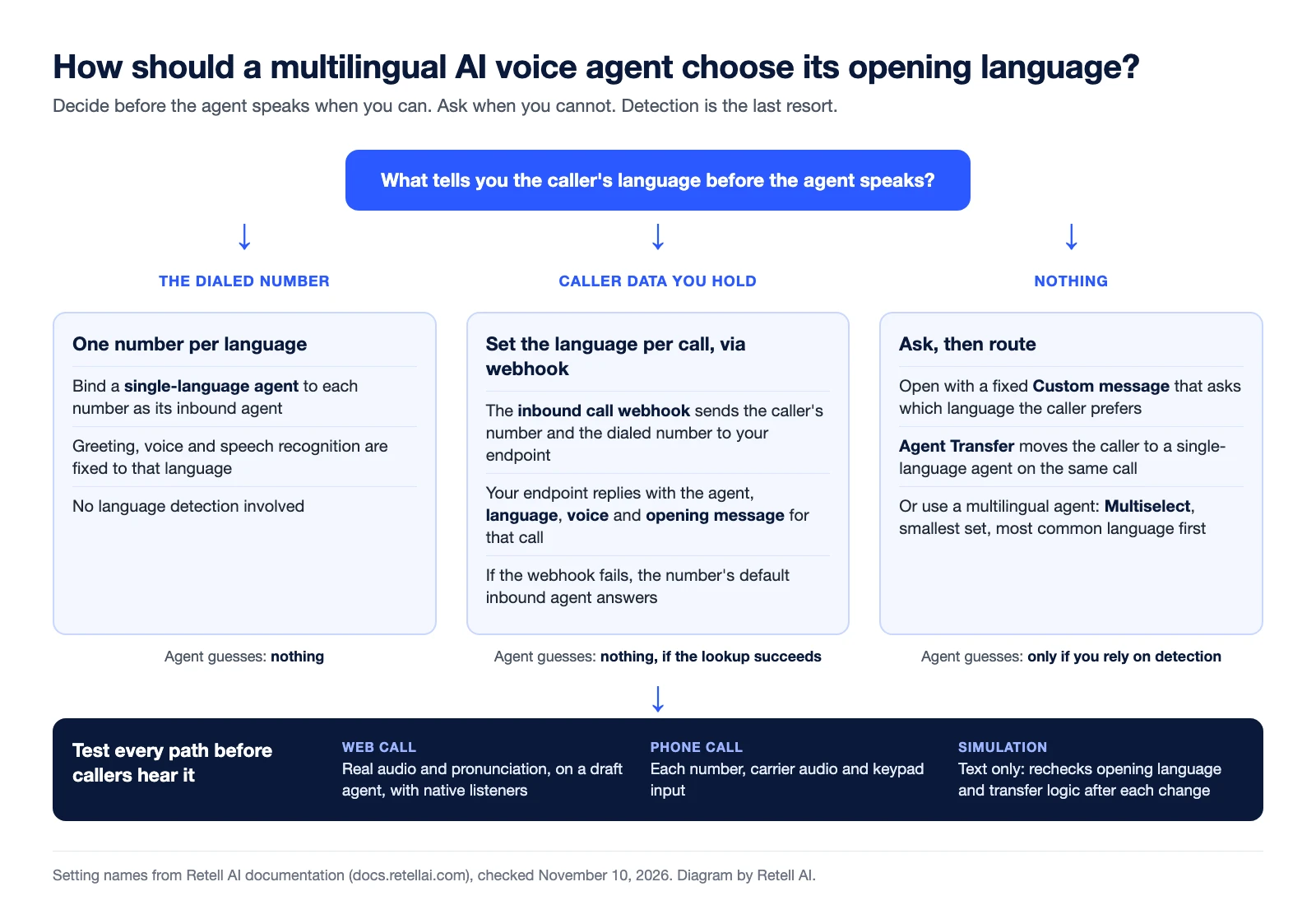
The dialed number tells you the language. Publish one number per language and bind a single-language agent to each as its inbound agent. The greeting, voice and speech recognition are all fixed to that language, which also makes it the easiest design to test.
Caller data tells you the language. Use the inbound call webhook, which is configured per phone number. Retell posts the caller's number and the dialed number to your endpoint before the call connects, and your endpoint looks up the caller's preferred language. The response can swap the agent (override_agent_id) or override settings for that call only, including language, voice_id and begin_message. For outbound calls, the same per-call agent_override is available when you create the call. Plan the failure path too: if the webhook fails after three attempts, the call goes to the number's default inbound agent when one is set, so give that default agent an opening that is safe for every caller.
Nothing tells you the language. Ask. Set the Welcome Message to AI speaks first with a Custom message, which is fixed text the agent reads on every call, and have it ask the caller which language they prefer. Then use Agent Transfer to move the caller to an agent built for that language. The docs list language switching as a common use: the swap stays on the same call, the destination agent receives the full conversation history, and its own language and voice apply. Keypad input is captured by default, so the question can also accept a key press.
If you would rather let one agent detect the language, use Multiselect with the smallest set you need, list your most common language first, and write the opening language into the prompt. Avoid the Dynamic message opener on a multilingual agent unless the prompt names the language to open in, because the agent generates that opener itself on each call.
Whichever path you choose, decide who speaks first. With User speaks first, the agent stays silent until the caller says something, so the caller's first word is all it has to go on.
If only a handful of calls a month need a second language, first check whether that volume justifies an agent at all.
How do you test the opening before buyers or callers hear it?
Test the opening as its own item, on real audio, with native speakers, on every path a call can take. Reading the script is not enough, because the failure is in how the greeting sounds.
- List every entry path. Each number, each webhook branch, the webhook failure fallback and each outbound language.
- Listen on a web call first. A web call test plays real audio, including "pacing, pronunciation, and filler," and works on a draft agent before you publish. Agent Transfer works there too.
- Then dial each number. A phone call test covers carrier audio and keypad input, which a browser call cannot.
- Use native listeners. Ask a native speaker from your callers' region: would a local agent greet me this way?
- Try the short answers. Say only "hello," "sí," or nothing at all, and confirm the agent stays in the intended language.
- Try the wrong-language caller. Answer the Spanish line in English and the reverse, and confirm the agent offers a way across.
- Add a regression check. Simulation testing "runs as a text conversation," so it cannot hear an accent, but it can recheck the opening language and the transfer logic after every change to the prompt, voice or language set.
For what happens after the greeting, when bilingual callers mix languages inside one sentence, see the code-switching test for multilingual voice AI. For the release process around these checks, see how to test and release voice agent changes.
What should you ask a vendor about the opening before a pilot?
Ask how the opening language is decided, and ask to hear it in your languages before anything else is evaluated. Four questions cover it:
- Is the opening language set by number, by caller data, by a question, or by detection?
- Which voice speaks each language, and can our native speakers audition it?
- What happens when the caller's first word is too short to identify, or the lookup fails?
- Can the caller change language after the greeting, and does the conversation carry over?
Answers that name settings you can inspect show control. "The model figures it out" asks you to trust a guess. The same discipline applies to the rest of the rollout, covered in from voice AI demo to production.
Prove the opening on your own calls
Retell AI is the AI voice agent platform for contact centers. It supports single-language agents, multilingual agents limited to an exact set of languages, per-call language and voice overrides via the inbound call webhook, and one agent per language joined by Agent Transfer, all testable by web call and phone call. See multilingual AI voice agents on Retell for the supported languages, then run a pilot on real calls, in your callers' languages, and judge the first 30 seconds for yourself before you sign anything.
See how much your business could save by switching to AI-powered voice agents.
ROI Result
Total Human Agent Cost
AI Agent Cost
Estimated Savings
A Demo Phone Number From Retell Clinic Office
What results look like with Retell AI


Estimate your monthly voice AI cost
Read Other Blogs

Revolutionize your call operation with Retell