Why Multilingual Voice AI Fails at the Accent Handoff
8
MIN READ
Code-switching is when a speaker moves between two languages inside one conversation, often inside one sentence, and it is the case a language-by-language test never covers. An agent can pass a Spanish test and an English test and still sound wrong the first time a caller says "Quiero cambiar mi appointment para el viernes." The giveaway is the accent handoff: the moment the agent hears or says an English word inside the other language and handles it the way no local speaker would.
This guide is for contact center teams, and the agencies and BPOs that build for them, putting voice agents in front of bilingual callers. It covers where code-switched calls break, the test to run before launch and the settings that fix what it finds.
Code-switching is ordinary bilingual speech. A caller speaks mostly in one language and drops in words or phrases from another: a product name, "email", "link", "appointment", an account number read out in English. Those English words tend to carry the speaker's own accent, not an American one.
The callers who do this are not a niche. The U.S. Census Bureau counted 67.8 million people in the United States who spoke a language other than English at home in 2019, almost 1 in 5, and Spanish was 62% of them. Of those Spanish speakers, 39% said they spoke English less than "very well", which means most of them also speak English very well. Bilingual callers are the ones able to mix the two, and an agent built for them should expect it.
It breaks in four places, and each one only shows up where the two languages meet, so testing each language on its own misses all four.
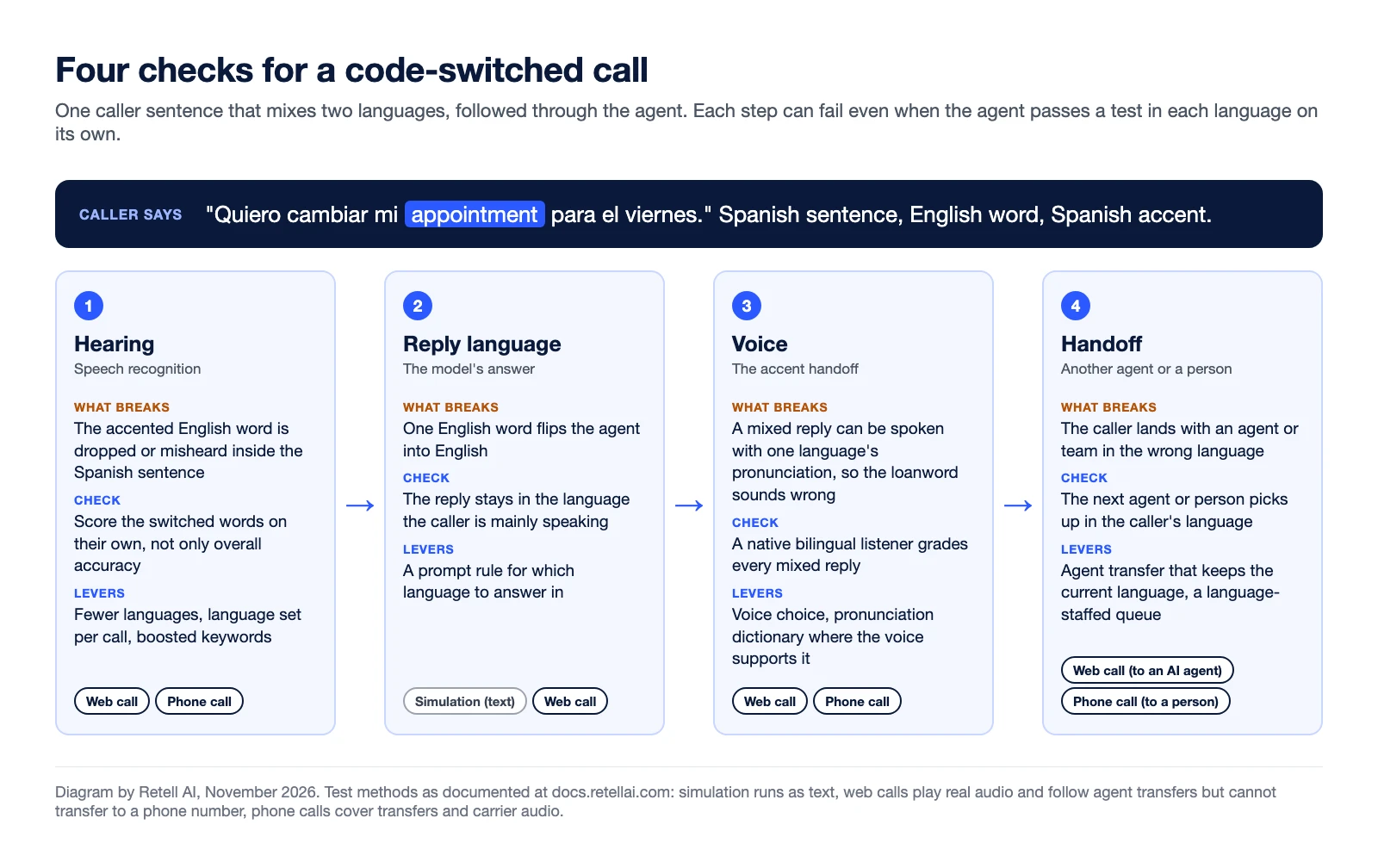
Closely related languages add one more risk. Retell's docs say speech recognition "struggles most on languages that share vocabulary, phonemes, or a writing system", with Cantonese and Mandarin as the example, and that "callers routinely get transcribed as the wrong Chinese variant, which then makes the agent respond in the wrong language."
Build a small test set from how your callers actually talk, have native bilingual speakers say it, and score the switch points separately from everything else.
| What the caller does | Example | What to check | How to test |
|---|---|---|---|
| Speaks only one language | A full sentence in Spanish, then one in English | Baseline transcript, reply and voice in each language | Web call |
| Drops an English word into the other language | "Quiero cambiar mi appointment para el viernes." | The transcript keeps "appointment", the reply stays in Spanish, and the agent says the word the way a local speaker would | Web call with a native speaker |
| Says an English term the agent must act on | "Mera email update kar do", then spells the address | The transcript captures the term exactly and the agent reads it back correctly | Web call, then phone call |
| Switches language partway through | Starts in English, moves to Spanish after the greeting | The agent follows the switch and stays in the new language | Web call |
| Asks for a person | "¿Me pasa con alguien?" | The transfer reaches someone who speaks the caller's language, with context | Phone call |
| Tests reply logic only | A simulated caller written as bilingual | Which language the agent answers in and which path it takes | Simulation test |
Each Retell test method covers part of this. Simulation testing "runs as a text conversation", so it checks reply language and flow and can rerun as a batch after every change, but it cannot hear an accent. A web call test plays real audio ("pacing, pronunciation, and filler") and follows transfers to another agent, but transfers to a phone number fail there, so use a phone call test for those and for carrier audio. For the release process around these checks, see how to test and release voice agent changes.
Start with the narrowest language setup that serves your callers, then fix individual words. Retell's docs rank a single language most accurate, variants of one base language such as en-US and en-GB the same, and languages across families lower.
| What the test found | Fix to try | Source |
|---|---|---|
| Mishearing on calls where you already knew the language | Keep the agent single-language and set the language per call through the inbound call webhook, using the dialed number or CRM data | Multilingual agent |
| Close languages confused, such as Cantonese and Mandarin | One agent per language, routed by number, CRM data or a language-selection step, instead of auto-detect | Multilingual agent |
| Caller changes language partway through | Agent transfer to an agent built for that language, which sees the full conversation history; set "keep the current language" when the language should carry over instead | Agent transfer |
| Names, brands or English terms missing from the transcript | Boosted keywords, up to 100 per list as of October 2026, with overrides for a single node | Transcription accuracy |
| A loanword or name mispronounced | A pronunciation dictionary entry in IPA or CMU, checked with Test Pronunciation | Custom pronunciation |
| The accent sounds wrong overall | Try other voices with native listeners, since the voice "is still the primary determinant of accent" | Agent language |
| The reply flips to English | A prompt rule: answer in the language the caller is mainly using, and keep their English terms as they said them | Multilingual agent |
Two caveats. Pronunciation dictionaries depend on the voice model: Retell platform voices support IPA and CMU, Cartesia and Inworld voices IPA, while ElevenLabs eleven_multilingual_v2, eleven_flash_v2_5 and eleven_v3 do not. An ElevenLabs voice set to Auto on a non-English agent resolves to a model without dictionary support, so a bilingual agent on that setting cannot use one. The docs also warn that overriding common words "can produce unnatural speech." And speech recognition providers differ: Retell's provider page lists Deepgram (for supported language combinations), Soniox and AssemblyAI with code-switching support and Azure as single-language only.
Live calls will show switch patterns your test set missed. Add a post call extraction field, such as a selector for the language the caller used, to pull out the bilingual calls, then run AI QA on a sample and read each transcript at the switch points. The voice agent failure modes guide helps separate a transcription error from a wrong answer, and the QA scorecard template gives the review a fixed shape.
Every mixed phrase that trips the agent goes into the test set before the next change ships. If two voices both pass with native listeners, A/B testing can split live traffic between two agents by percentage.
Code-switching is when a caller moves between two languages in one call or one sentence, such as a Spanish sentence with an English word in it. The agent has to transcribe both, answer in the right one and pronounce the mixed words like a local speaker.
Use one agent per language, or set the language per call, whenever the dialed number, CRM data or a language-selection step tells you the caller's language; Retell's docs rank a single language most accurate. Use a multilingual agent when you cannot know the language ahead of time, with only the languages your callers use.
Part of it. Retell's simulation tests run as text, so they check which language the agent answers in, but not accent or pronunciation. Use web calls with native bilingual speakers for the voice and phone calls for transfers to a person.
The switch points fail while each language works on its own. The transcriber can miss an accented English word, the agent can reply in the wrong language, and the docs describe the voice detecting language per response, so mixed replies are the ones to check. Score switched words and mixed replies separately.
Add a pronunciation dictionary entry in IPA or CMU and use Test Pronunciation to hear it in the agent's voice. Check first that your voice model supports dictionaries, since some multilingual models do not.
Retell supports single-language agents, multilingual agents with an exact set of languages, and one agent per language joined by agent transfer, testable with simulation (except custom LLM agents), web calls and phone calls before callers hear it. See Retell's multilingual AI voice agents and the bilingual virtual receptionist, compare vendors in the 8 best multilingual AI voice agents, or start with multilingual setup basics.
See how much your business could save by switching to AI-powered voice agents.
Total Human Agent Cost
AI Agent Cost
Estimated Savings
A Demo Phone Number From Retell Clinic Office