Hotel Phone Systems: PBX, Cloud and AI Options




A hotel phone system is the PBX (private branch exchange) that connects guest room phones, the front desk, back-of-house departments and outside callers, and that exchanges data with the property management system (PMS). It comes in two forms, on-premises or cloud, and an AI voice agent can sit in front of either to answer front desk and reservation calls.
Retell AI publishes this guide and sells one of the options covered. Retell is an AI voice agent platform, not a PBX, so it appears only in the AI layer section. Vendors named here are examples, in no order, chosen because each has its own hospitality page. Every vendor fact comes from that vendor's website, read on November 13, 2026, and is linked where cited. The emergency calling section describes what the FCC publishes and is not legal advice.
What does a hotel phone system do that an office system does not?
An office phone system gives each employee an extension. A hotel system gives each room an extension, and the person using it changes every few nights. That creates five jobs an office system rarely has.
- PMS integration. The PBX and the PMS exchange check-in and check-out events so a room phone is switched on, named and reset at the right time. Phonesuite, for example, describes its Cloud PMS Interface as synchronizing guest check-in and check-out information and call billing.
- Guest room phones. Many properties keep analog room phones on existing wiring. The system has to support them, often through gateways, next to SIP phones at the desk.
- Wake-up calls. Scheduled from the front desk or from the room phone.
- Call accounting. Billable calls are priced and posted to the guest folio through the PMS link.
- Emergency calling. A guest must reach 911 from the room phone without a prefix, staff must be told a 911 call was made, and the call must carry a location a responder can use. This one is set by federal rules, covered next.
What do Kari's Law and RAY BAUM's Act require of a hotel phone system?
Two federal laws cover 911 calls from multi-line telephone systems (MLTS), which the FCC says are "typically found in enterprises such as office buildings, campuses, and hotels." The FCC adopted rules for both in August 2019 and summarizes them on its MLTS 911 requirements page. The rules cover three things.
Direct dialing. Kari's Law is named for Kari Hunt, who was killed in a motel room in Marshall, Texas in 2013; her daughter's 911 calls from the room phone never went through because the system required dialing 9 first. Under the law and the FCC's rules, a user must be able to dial 911 from any station without any additional digit, code, prefix or post-fix. The duty reaches manufacturers and vendors as well as installers, managers and operators.
Notification. When a 911 call is placed, the system must be configured to notify a central location, on-site or off-site, where someone is likely to see or hear it. The notification must include the fact that a 911 call was made, a valid callback number and the location information sent to the 911 center, with the last two required unless technically infeasible.
Dispatchable location. Under Section 506 of RAY BAUM's Act, a 911 call must carry a dispatchable location: the validated street address plus additional information such as suite, apartment or similar detail needed to find the caller. The FCC's dispatchable location page gives room or floor number as examples. For MLTS, on-premises fixed devices, such as wired telephones that the user cannot readily move, had a compliance date of January 6, 2021 and must provide the location automatically. Non-fixed and off-premises devices had a date of January 6, 2022, with alternatives where automatic location is not technically feasible.
Which systems are covered. The FCC states that Kari's Law and its rules are forward-looking. They apply to MLTS manufactured, imported, offered for first sale or lease, first sold or leased, or installed after February 16, 2020, and the dispatchable location rules for MLTS apply to the same set of systems.
This section restates the FCC's summary. How the rules apply to a specific property, and whether state law adds to them, is a question for your vendor and your counsel.
On-premises PBX: when does it still make sense?
An on-premises PBX is a server or appliance in the hotel's equipment room. Room phones, trunks and the PMS link all terminate on site.
Who it fits. Properties where the internet connection is the weak point, and properties with a large base of analog room phones and wiring they do not plan to replace.
Named examples. Phonesuite, founded in Colorado in 1988 and focused on hotels, sells an on-premise PBX called Voiceware. Phonesuite says it keeps a hotel connected in remote areas without internet connectivity, includes wake-up calls, stays compliant with Kari's Law and RAY BAUM's Act, and can check guests in and out even without a PMS. Mitel says it supports on-premises, hybrid and Mitel Secure Cloud for Hospitality deployments, offers on-prem resilience for ships and remote properties, and lists support for emergency calling such as Kari's Law in the U.S.
How it is priced. Neither vendor publishes a price on the pages we read, so pricing is quote-based. Expect an upfront purchase plus a support contract, and ask what PMS interface licenses and analog gateways add.
Limits. The hotel owns the hardware, the upgrades and the maintenance.
Hosted or cloud PBX built for hospitality: what changes?
A cloud PBX runs in the vendor's data centers. The hotel keeps phones and, where rooms are analog, gateways on site, and pays a subscription.
Who it fits. Properties with reliable connectivity, multi-property groups, and teams without telecom staff.
Named examples. Phonesuite's cloud phone system is managed off-site, and Phonesuite says it can interface with almost any existing handset. The company says it integrates directly with over 60 PMS systems using its own technology over Serial, TCP/IP or APIs, and that its Cloud PMS Interface supports both SIP and analog phones, with a serial-to-IP conversion box for legacy systems. Sangoma offers cloud, hybrid and on-premises UC. It says its systems integrate with leading PMS platforms to sync guest data, wake-up calls, room status and service requests. Its hybrid option keeps on-site survivability through a device called StarBox: with a secondary internet, 4G/5G or POTS line, failover supports internal calls, emergency services and room-to-room dialing.
How it is priced. Neither page shows a dollar figure, so pricing is quote-based. Cloud systems are normally sold as a recurring subscription. Ask whether the quote counts rooms, users or lines.
Limits. Calls depend on the internet connection unless there is a failover path, so ask exactly what keeps working in an outage, including 911 from room phones. General business cloud phone systems may not include a PMS interface or wake-up calls, so confirm both.
Hotel phone systems compared: PBX, cloud and the AI layer
| On-premises PBX | Cloud PBX for hospitality | AI voice agent layer | |
|---|---|---|---|
| What it is | PBX hardware in the hotel | PBX hosted by the vendor | Software that answers calls in front of the PBX |
| Replaces the PBX? | It is the PBX | It is the PBX | No. It needs a PBX or carrier behind it |
| Guest room phones and wake-up calls | Yes, vendor-stated (Phonesuite Voiceware) | Yes, vendor-stated (Sangoma) | Not its job. These stay on the PBX |
| PMS connection | PMS interface from the PBX vendor | PMS interface from the PBX vendor | Only what the vendor documents. Retell documents no PMS connector; data comes through your own API |
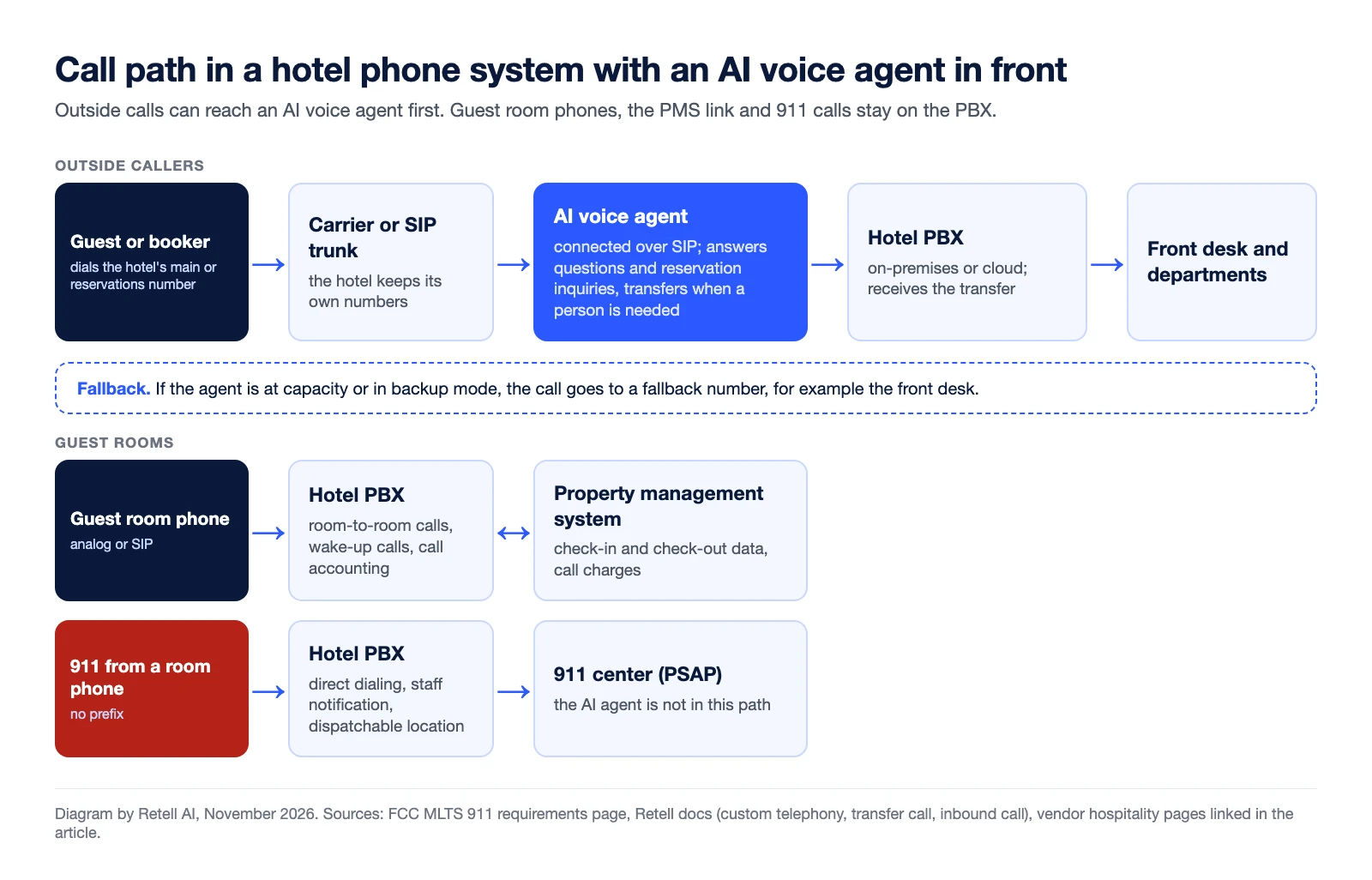
| 911 from room phones | Handled by the PBX | Handled by the PBX. Check outage behavior | Not in the path |
| If the internet fails | Keeps operating locally, vendor-stated | Depends on the failover design | Outside callers fall back to the PBX or a fallback number |
| Published pricing | Quote-based (Phonesuite, Mitel) | Quote-based (Phonesuite, Sangoma) | Usage-based. Retell is from $0.07 per minute |
| Best fit | Weak connectivity, large analog estates | Reliable connectivity, multi-property groups | Busy front desks, after-hours and reservation calls |
Where does an AI voice agent fit in a hotel phone system?
An AI voice agent is a layer, not a replacement. It answers calls that arrive from outside on the hotel's main or reservations number, handles the ones it can, and transfers the rest to a person. Room phones, wake-up calls, call accounting and 911 stay on the PBX.
What it handles. Questions with a known answer (parking, check-in time, pet policy), reservation inquiries, and routing callers to the right department. PolyAI, which sells voice assistants to hotel groups, says it has worked with over 200 hotels, and reports in its own case studies that 87% of calls to Golden Nugget's hotel PBX operators are fully automated and that Golden Nugget's assistant averaged over 300 completed reservations a week within two months of launch. Those are PolyAI's own figures for its own deployments.
How Retell connects. Retell's custom telephony docs describe two ways to connect an existing phone provider: elastic SIP trunking, which Retell recommends, or dialing to a SIP URI. Either way the hotel keeps its own numbers (see keeping your existing phone number over SIP). When a caller needs a person, the Transfer Call tool sends the call to a phone number or SIP URI, with an optional extension, as a cold, warm or agentic warm transfer. Answers come from a knowledge base built from website URLs, documents and custom text.
What Retell does not have. Retell's docs and integrations page do not list a connector for any hotel PMS. To read or change a reservation during a call, the agent uses a custom function that calls your own API, so the hotel or its integrator has to provide an endpoint that talks to the PMS or booking engine. Without that, the agent can answer questions and route calls but cannot book.
Capacity and fallback. Pay-as-you-go workspaces get 20 concurrent calls by default. If every slot is in use, Retell waits about 40 seconds and then transfers the call to the fallback number when one is configured, and a Backup mode sends new inbound calls straight to that number (inbound call docs).
How it is priced. Retell is usage-based, from $0.07 per minute, with no platform fees and $10 in free credits on the pay-as-you-go plan, per its pricing page.
For the Retell offer itself, see the hotel answering service page, the AI hotel receptionist use case and the travel and hospitality overview. For handoff design, see how call transfers work between AI voice agents and human teams.
How do you choose a hotel phone system?
Start with what cannot change: your PMS, brand standards if you are flagged, the number of analog room phones and the quality of your internet connection.
- Pick the PBX form. Weak connectivity or a large analog estate points to on-premises or hybrid. Reliable connectivity and several properties point to cloud.
- Get the PMS interface in writing. The vendor should name your PMS, the interface type and the events supported: check-in, check-out, room move, wake-up, call charges.
- Get the 911 configuration in writing. Direct dialing, who receives the notification, what location each room phone sends, and what happens in a power, internet or carrier outage.
- Decide on the AI layer last. Count how many outside calls are repeat questions or reservation inquiries and when they arrive. If the desk misses calls at check-in time or overnight, pilot an agent on one number with a fallback to the desk, and judge it on your own calls.
Frequently asked questions
What is a hotel PBX?
A hotel PBX is the private branch exchange that connects guest room phones, staff extensions and outside lines. Unlike an office PBX it links to the property management system, so rooms are activated at check-in and reset at check-out, and it supports wake-up calls and call accounting.
Is a cloud phone system reliable enough for a hotel?
It depends on the connection and the failover design. A cloud PBX needs the internet to place calls unless the vendor provides a backup path. Sangoma, for example, says its hybrid option uses an on-site device with a secondary internet, 4G/5G or POTS line so internal calls, emergency services and room-to-room dialing keep working. Ask any vendor what still works in an outage.
Do hotels have to allow 911 calls without dialing 9?
The FCC says Kari's Law requires multi-line telephone systems to let a user dial 911 directly, with no prefix, and to send a notification when a 911 call is made. The FCC also says the rules apply to systems manufactured, imported, first sold or leased, or installed after February 16, 2020. This is a summary of the FCC's page, not legal advice.
How much does a hotel phone system cost?
The hospitality PBX vendors named in this guide (Phonesuite, Mitel and Sangoma) do not publish prices on the pages we read, so costs come by quote. On-premises systems usually mean an upfront purchase plus support, and cloud systems a recurring subscription. AI voice agents are usually billed by usage. Retell is from $0.07 per minute.
Does Retell AI integrate with hotel property management systems?
Retell does not document a prebuilt connector for any hotel PMS. An agent can call your own API during a call through a custom function, so reservation lookups and bookings depend on an endpoint that the hotel or its integrator provides.
See how much your business could save by switching to AI-powered voice agents.
ROI Result
Total Human Agent Cost
AI Agent Cost
Estimated Savings
Estimate your monthly voice AI cost


Revolutionize your call operation with Retell