What Product Teams Look For in a Voice AI Platform





A voice AI platform is the software a product team uses to build, connect, test and run AI voice agents on phone and web calls. Product and engineering leads rarely pick one from a demo. They build the same agent on each shortlisted platform and check four things with their own hands: how fast the first working agent comes together, how far the API and workflow tools go, how long callers wait for a reply, and what changes when a pilot becomes production traffic.
This guide is a plan for that hands-on comparison. Retell AI publishes this guide and is one of the platforms product teams compare, alongside Vapi, ElevenLabs and Bland. What we say about the other three comes from each vendor's own documentation, read on November 10, 2026 and linked. We placed no test calls for this guide, so it has no scores and no ranking. What we say about Retell comes from Retell's public docs, including the limits those docs state.
What does a product team check that a demo does not show?
A demo shows one good call. A hands-on comparison shows what your own engineers can build, connect and measure. Give one engineer the same call type on every platform, a real one such as booking an appointment against your scheduling API, and record the same four results on each.
| What to check | What your team does | What to write down |
|---|---|---|
| Ease of build | Build the agent from an empty account to a first call, with no vendor help | Hours to a first working call, and every point where you got stuck |
| API and workflow depth | Call your own API during a call, receive call events, create the agent from code | Which steps needed a workaround |
| Response latency | Place at least 20 calls and pull the timing for each turn | Median and 95th percentile, with the definition the vendor uses |
| Pilot to scale | Read the limits, failure behavior and release controls before you need them | Default limits, what happens when you reach them, and what drives cost |
How fast can your team build the first working agent?
Measure the time from an empty account to a call your engineer would show a colleague, and note every point where they had to ask the vendor for help. An answer found in the docs counts as self-serve.
Two things decide that time on most platforms. The first is how much structure you must design before the agent can talk. Retell's docs recommend starting with a single prompt agent and moving to a conversation flow, which splits the task into nodes with their own instructions, only when a single prompt can no longer meet your requirements. The same page is plain about the tradeoff: "Conversation flow is not automatically more reliable."
The second is how soon you can hear the agent and catch its mistakes. Retell's testing overview lists four methods: text chat in the LLM Playground, saved simulation test cases, browser calls "without a phone number", and real phone calls. Budget for the test calls. On Retell, testing bills at the same rates as production. For a full walkthrough of a first build, see how to build an AI voice agent.
Ease of build also depends on what the platform runs for you. Retell's docs say it "runs the telephony, speech, and language model layers, so you configure the agent instead of connecting providers." Your team owns the agent's behavior without maintaining the infrastructure under it. Whether that trade suits you is a separate decision, covered in build vs buy for AI voice agents.
How deep do the API and workflow tools go?
Deep enough means two things: your engineers can do from code what they did in the dashboard, and the agent can reach your systems during a call without a middleware project. Check five areas on every platform.
- SDKs and API coverage. Ask whether every dashboard action has an endpoint. Retell publishes official SDKs for Node.js and Python, described as typed clients with full voice and chat endpoint coverage.
- Calling your API during a call. A Retell custom function sends a GET, POST, PUT, PATCH or DELETE request to your endpoint and waits for the response. The timeout is 1 to 600 seconds and defaults to 120. Requests are not retried unless you set a retry count. Ask each vendor what the caller hears while a slow request runs.
- Call events. Retell webhooks post call_started, call_ended and call_analyzed events to your server. Each has a 10-second timeout and is retried up to 3 times. A signature header lets you verify the sender.
- MCP in both directions. A Retell agent can call a remote MCP server's tools during a live call. Retell's own MCP server lets clients such as Cursor and Claude Code build and manage agents through the API.
- Your own model and your own carrier. With a custom LLM, Retell handles the call and opens a WebSocket to your server for each call. The docs recommend the built-in agent types for most agents and say that with a custom LLM you take on latency, uptime and reconnection handling. For phone lines, custom telephony connects through elastic SIP trunking or by dialing a SIP URI.
Check prebuilt connections too. Retell's integrations overview lists 11 providers across CRM, support, calendar and knowledge base. Anything outside that list goes through a custom function, MCP or a webhook.
How should you measure response latency?
Measure it on your own calls, turn by turn, and report percentiles with the definition attached. A latency figure with no start and stop point cannot be compared with another vendor's figure.
Retell's docs define end-to-end latency as the time from when the user stops speaking to when the agent begins responding. On that definition, the docs state that the platform "achieves latency as low as 600ms." Read "as low as" as a floor. Your figure depends on the model, the prompt and the settings you choose.
To get your own numbers, pull them per call. Retell's Get Call API returns a latency object with the 50th, 90th, 95th and 99th percentile for the end-to-end figure and for transcription, the LLM, text to speech and knowledge base retrieval. The same page states a limit: the end-to-end figure does not include the network trip from Retell's server to the user's device. For web and in-app calls, time the reply on the client as well.
When a number is high, look at configuration before you blame the platform. Retell's latency troubleshooting guide names LLM model choice and prompt length as the two most common causes, says prompts beyond roughly 8,000 tokens become noticeably slower, and advises keeping estimated latency under 1.5 seconds. Ask every vendor for the same component breakdown.
Speed is one input to a good call. Voice AI latency: causes, measurement and caller impact explains where the delay comes from and when a faster reply makes a call worse. For published benchmark results across these four platforms, see Retell AI vs Bland AI vs Vapi vs ElevenLabs.
What changes between a pilot and production scale?
Three things change: the limits you run into, what callers experience when something fails, and how changes reach live calls. Read each vendor's answers before the pilot ends.
- Concurrency. Ask for the default limit and what happens at the limit. On Retell, a pay-as-you-go workspace gets 20 concurrent calls by default, and you can raise the limit from the dashboard. At the limit, a new inbound call waits for a slot. After about 40 seconds it transfers to a fallback number if you set one, and otherwise the call ends. An outbound call over the limit is rejected unless you turn on concurrency burst, which adds a per-minute surcharge.
- Uptime and fallbacks. Retell's reliability overview states a guarantee of more than 99.9% uptime and links a public status page. It lists LLM fallback and retries as built in, and a Backup mode that diverts new inbound calls to a fallback number while you investigate a problem.
- Release control. Versions, staging tags, batch runs from your CI pipeline and percentage traffic splits decide how safely a change ships. That subject has its own guide: the voice AI buying bar.
- Security review. Start it during the pilot. Retell's security and compliance page says it is HIPAA compliant, GDPR compliant and SOC 2 Type 1 and Type 2 certified, and it offers a self-service BAA.
- Cost drivers. Retell pricing is usage-based, from $0.07 per minute on the pricing page. The rate depends on the voice, model and telephony you pick, and some latency options cost more than the standard model rate. How usage-based pricing works explains the parts.
For pilot design, how to evaluate a voice agent platform before going live covers which calls to include and what to measure, and from voice AI demo to production covers the first 30 days.
How do Vapi, ElevenLabs, Bland and Retell describe themselves?
Each vendor's documentation describes a platform for building, deploying and monitoring voice agents, with a prompt-based way to start and a more structured option. The table quotes each vendor's own docs, read on November 10, 2026.
| Platform | How its own docs describe it | Build options the docs name |
|---|---|---|
| Retell AI | "A platform to build, test, deploy, and monitor AI voice and chat agents with telephony, prompts, tools, and analytics built in" (Retell docs) | Single prompt agents and conversation flow agents |
| Vapi | "The developer platform for building voice AI agents" (Vapi docs) | Assistants, which use a single system prompt plus tools and structured outputs, and Squads, which run multiple assistants with context-preserving transfers. You choose the speech-to-text, LLM and text-to-speech providers |
| ElevenLabs | ElevenAgents offers "voice-rich, expressive models, developer tools for building multimodal agents, and tools to monitor and evaluate agent performance at scale" (ElevenLabs docs) | A developer toolkit, a dashboard or a visual workflow builder, with SDKs for React, Swift, Kotlin, React Native and Unity |
| Bland | "Everything you need to build, monitor, and improve voice AI agents in Bland" (Bland docs) | An agent builder where "most agents start as a single prompt" and pathways add structure where the conversation needs it |
The descriptions are close, so reading them will not make the choice for you. The four checks run on your call type and your systems. For side-by-side detail, Retell publishes comparisons with Vapi, ElevenLabs and Bland, and a guide to Vapi alternatives.
How do you run the comparison fairly?
Hold everything constant except the platform. Use one call type, one engineer, one script of caller behavior and one scorecard, and fill in the same fields for every vendor.
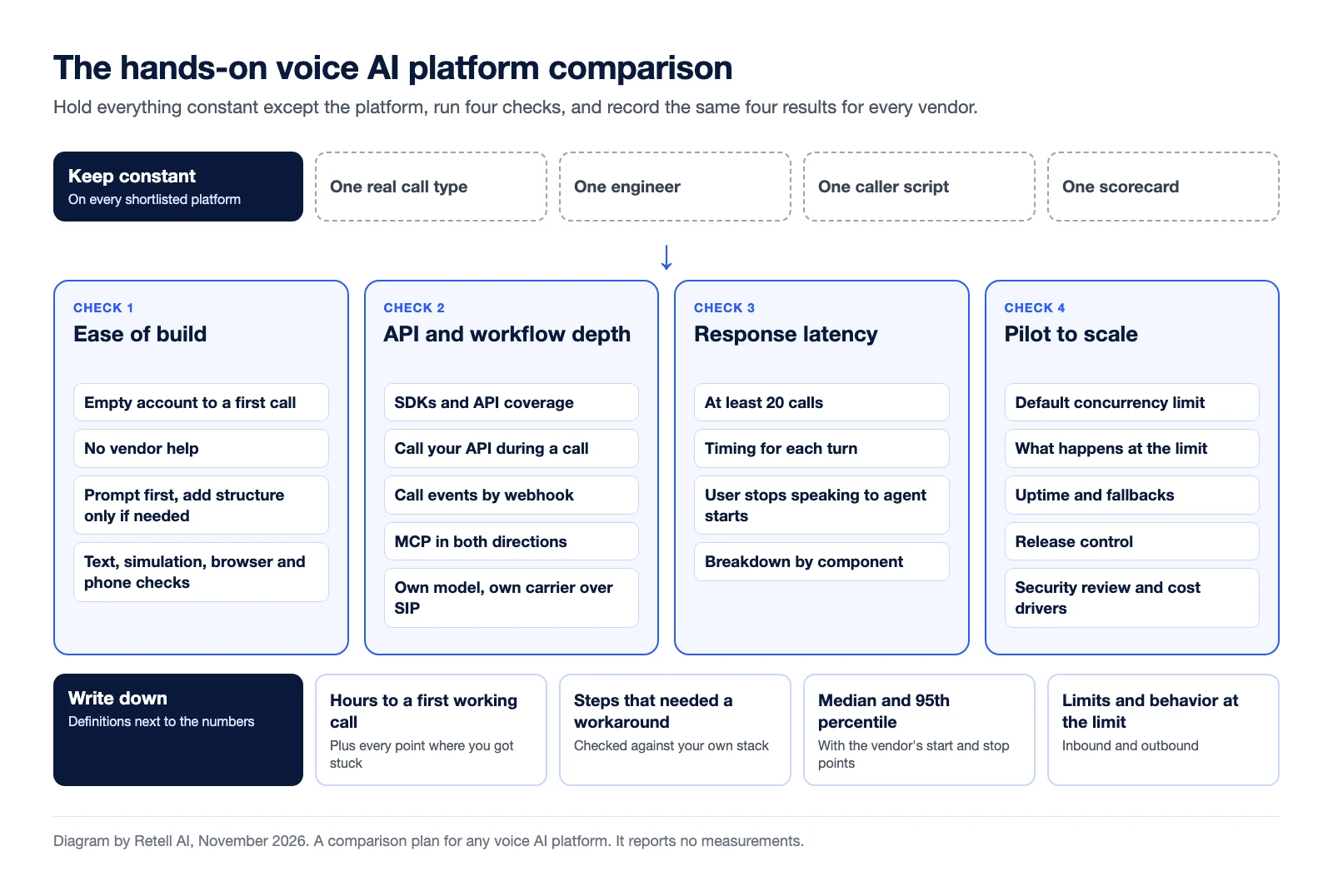
Write the caller script before anyone builds. Include an interruption, a correction, a question the agent should refuse and one request that needs your API. Then compare the four results side by side, with each vendor's definitions next to its numbers.
Someone has to own the agent after the choice is made. Many teams give that job to a CX engineer, also called a CX automation engineer or an internal deployed engineer: the in-house owner who finds poorly handled calls, builds fixes, checks them and deploys them. If you already have that person, bring them into the comparison. What the executive sponsor needs from the platform and the vendor is covered in what CX leaders need from AI voice agents.
Frequently asked questions
What should a product team look for in a voice AI platform?
Four things, all checked hands-on: how fast your own engineer can build a first working agent, how far the API, webhooks and workflow tools go, how long callers wait for a reply on your own calls, and what the limits and failure behavior look like at production volume. Run the same checks on every shortlisted platform.
How do you compare voice AI platforms hands-on?
Pick one real call type, give one engineer the same build on each platform, and place the same scripted calls on each. Record hours to a first working call, the steps that needed a workaround, median and 95th percentile response time, and the default limits. Keep each vendor's definitions next to its numbers.
What is a good response latency for an AI voice agent?
It depends on the model, the prompt and the settings, so measure it on your own calls. Retell's docs state latency as low as 600ms, measured from when the user stops speaking to when the agent begins responding, and advise keeping estimated latency under 1.5 seconds. Compare percentiles across vendors only when the start and stop points match.
Do you need engineers to build an AI voice agent?
Not for a first agent. Retell's quick start goes from a template to a phone call in the dashboard. Engineers come in when the agent has to call your API during a call, send call events to your systems, or connect to your own phone carrier over SIP. Those are the parts a product team should build during the comparison.
How many concurrent calls can a voice AI platform handle?
It depends on the plan and the vendor. On Retell, a pay-as-you-go workspace gets 20 concurrent calls by default, and the limit can be raised from the dashboard. Ask every vendor what happens to an inbound call and an outbound call once the limit is reached.
Run the four checks on your own calls
Retell is an AI voice agent platform for contact centers, with single prompt and conversation flow agents, typed SDKs, custom functions, webhooks, MCP, custom telephony and per-call latency data. More than 4,000 customers run 100 million-plus calls a month on Retell, which reached $100M in annualized run rate in November 2026. Pricing is usage-based, from $0.07 per minute on the pricing page. Build the same agent you built elsewhere, run it on your own calls, and compare the numbers before you sign anything.
See how much your business could save by switching to AI-powered voice agents.
ROI Result
Total Human Agent Cost
AI Agent Cost
Estimated Savings
Estimate your monthly voice AI cost
Read Other Blogs

Revolutionize your call operation with Retell