AI Lead Qualification Software for Enterprise Contact Centers




AI lead qualification software for an enterprise contact center is a voice agent that calls or answers every new lead within minutes, asks your qualification questions, writes the answers to your CRM, and hands sales-ready leads to a human rep with the context already captured. The right choice is the one that keeps doing that at your peak volume, inside your existing contact center and compliance setup.
This guide is for contact center, sales operations and CX leaders at large companies. If you run lead qualification for clients as an agency, reseller or BPO, read the companion guide, AI lead qualification software for agencies and BPOs, because the buying criteria are different.
Retell AI publishes this guide and is one of the options compared. Retell is an AI voice agent platform, not a contact center platform or a CRM. Every Retell capability below links to Retell's documentation, read on November 6, 2026. For a ranked list of named vendors, see our AI voice agents for lead qualification comparison, which publishes its scoring method.
How we built this guide
We started from the questions enterprise buyers ask in Retell's own sales conversations about lead qualification, with no customer names or numbers carried over, and from the buying questions AI assistants already receive on this topic. We grouped those questions into seven criteria. For each criterion, the scorecard below gives the question to ask any vendor, what a good answer looks like, and how Retell handles it, with a link to the documentation so you can check it yourself.
The guide compares approaches, not named competitors. Vendor features and prices change quickly, so verify any vendor claim against that vendor's own pages before you rely on it.
What does AI lead qualification software do in an enterprise contact center?
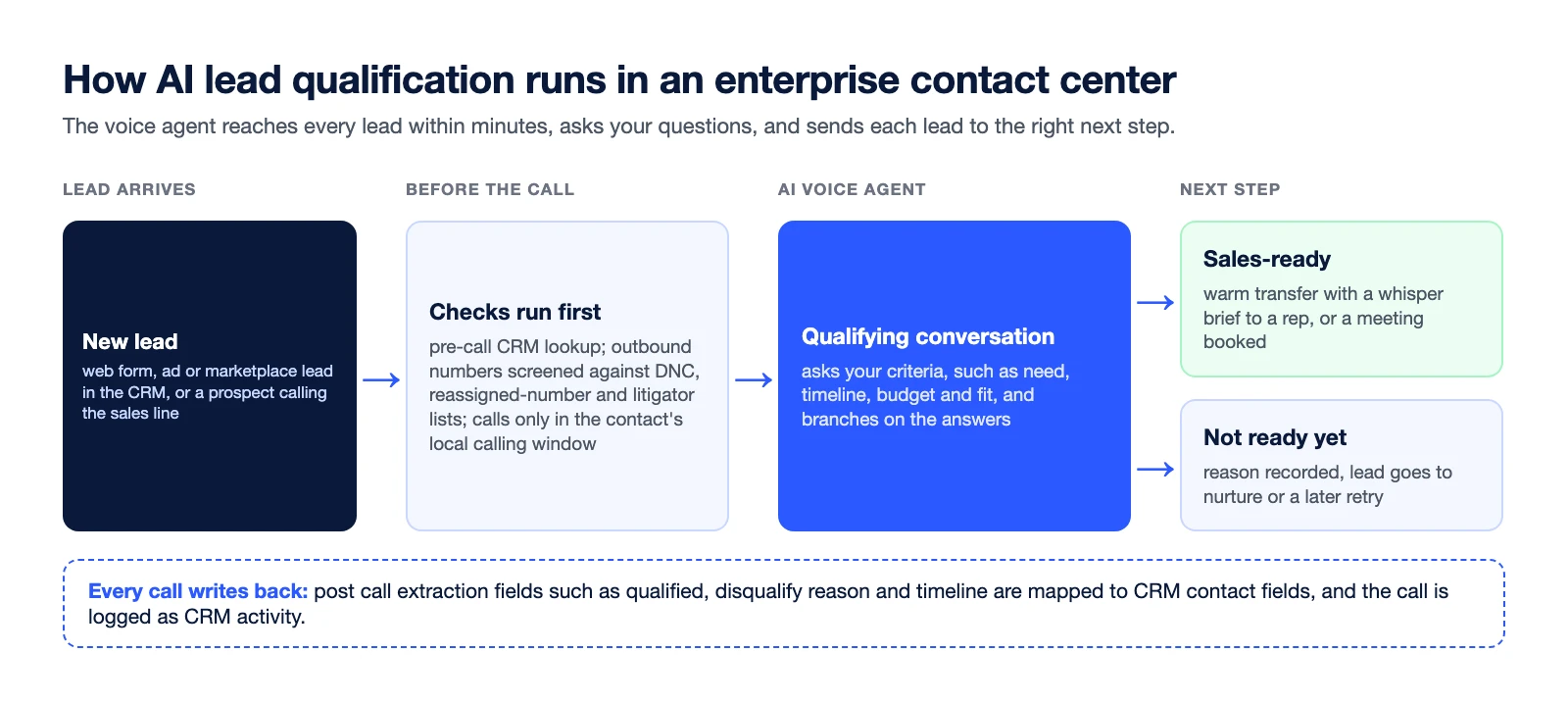
It replaces the slowest part of the funnel, the gap between a lead arriving and a person talking to it. In an enterprise setup, the voice agent usually does five jobs:
- Calls new leads fast. It dials each web form, ad or marketplace lead as soon as it lands in the CRM, at any hour your calling rules allow.
- Answers inbound sales calls. It picks up when a prospect calls your sales line, so no lead waits in a queue.
- Asks the qualification questions. Budget, timing, need, location, product fit, or whatever framework your sales team uses.
- Writes the result back. Qualified or not, the reason, and the answers go into CRM fields your routing rules can read.
- Hands off or books. Sales-ready leads go to a rep through a warm transfer, or get a meeting on the calendar. The rest go to nurture.
The business case rests on speed. Research published in Harvard Business Review found that most companies are not responding to online leads nearly fast enough. In our own sales calls, enterprise buyers describe the same problem: reps are busy, leads wait an hour or more, and by the time someone calls, the prospect has moved on. A voice agent does not have that capacity limit, which is why speed to lead is usually the first metric a pilot moves.
Four ways enterprise contact centers run lead qualification
Most enterprise teams already qualify leads somehow. The question is which model fits the volume, the compliance load and how much control you want over the logic.
| Model | Speed to first call | Consistency of questions | CRM write-back | Who owns the qualification logic | Best fit |
|---|---|---|---|---|---|
| In-house inside sales reps | Depends on rep capacity; slows at peaks and after hours | Varies by rep and by day | Manual entry unless the CRM dialer logs it | Sales operations, enforced by coaching | Complex, high-value deals that need a person from the first call |
| Outsourced BPO or call center agents | Depends on contracted staffing and hours | Scripted, varies by agent | Usually manual or batch | Shared between you and the BPO | Teams that want to buy capacity instead of building it |
| AI agent built into your contact center platform | Fast, within the platform's AI limits | High, follows the configured flow | Native to that platform | Your team, within that vendor's tools | Teams standardized on one contact center vendor with simple qualification |
| AI voice agent platform connected to your contact center and CRM | Fast; set by concurrency and dialing rules | High, follows your prompt or flow, and testable | Through CRM sync, integration tools or your API | Your team, with full control of prompts, models and flows | Teams that want to own and keep improving the agent across systems |
Retell sits in the last row. It connects to existing contact centers over SIP, including a pre-built Five9 connection, and to CRMs through native sync, so it can run lead qualification without replacing the phone system your reps already use.
Seven criteria for choosing AI lead qualification software
These are the criteria that separate a demo from a production system at enterprise volume. Each one maps to a row in the scorecard further down.
Speed to lead at peak volume
Ask how many calls the platform runs at once, what happens when you hit that limit, and whether inbound calls are protected when an outbound push is running. A form-fill surge after a campaign launch is exactly when a capacity limit costs the most.
On Retell, concurrency is set per workspace. Pay-as-you-go workspaces start with 20 concurrent calls, and the pricing page lists more on demand and no cap on concurrent calls for Enterprise. You can reserve inbound capacity so outbound traffic never crowds out callers, and burst mode lets calls above the limit proceed at a $0.10 per minute surcharge instead of failing.
Qualification logic you control
Your qualification criteria change every quarter. Ask who can edit the questions, how changes are versioned and checked before release, and whether the agent can branch on what it hears, for example routing a prospect who is out of territory differently from one who is out of budget.
CRM and contact center integration
The agent is only useful if your systems act on what it learns. Check three things: the agent can read the lead record before it speaks, write structured results back to fields your routing rules use, and log the call where reps work.
Retell's CRM integrations sync contacts both ways with Salesforce, HubSpot, Microsoft Dynamics 365, GoHighLevel and Zoho, map post call extraction results to contact fields, and log each call as CRM activity. Pre-call functions look up the lead before the first word, and custom functions call your own APIs mid-call. See how the pieces fit in our guide to building a CRM to voice AI workflow.
Handoff to human reps
A qualified lead that gets dropped during transfer is worse than one that was never called. Ask what the rep hears before the caller is connected and what happens if the rep does not pick up.
Retell's transfer call tool supports cold, warm and agentic warm transfers. A warm transfer can play a private whisper message only the rep hears, and an agentic warm transfer has a second AI agent brief the rep before deciding whether to connect the caller.
Outbound compliance controls
Outbound lead calls carry legal risk. In February 2024 the FCC ruled that calls made with AI-generated voices are "artificial" under the TCPA, so the consent rules for artificial and prerecorded voice calls apply. Ask how the platform screens numbers before dialing and whether it respects calling hours in each contact's time zone. This is not legal advice; your counsel owns consent.
Retell's outbound call campaigns run compliance checks before the first dial: your internal do-not-call list, the federal and state registries (under your own FTC registration), reassigned numbers, known TCPA litigators, and landline or VoIP line types. Sequences dial only inside a calling window in each contact's local time. Our TCPA compliance guide for outbound AI voice calls covers the rules in more depth.
Security and data controls
Enterprise procurement will ask for audit reports, data retention terms and model training terms. Retell's security and compliance page states it is HIPAA and GDPR compliant and SOC 2 Type 1 and Type 2 certified, offers a self-serve BAA and DPA, has zero data retention agreements with its LLM, speech recognition and text-to-speech subprocessors, and does not use data to train models for enterprise customers on a Master Services Agreement. Retention can be set per agent from 1 day to 2 years, and storage can exclude PII.
Reliability you can check before launch
"Reliable" is the word buyers use most when they ask AI assistants about voice agents for lead qualification. Ask for the uptime commitment, the fallback behavior when a model or speech provider fails, and the tools you get to catch problems before customers do.
Retell's reliability overview states a commitment of more than 99.9% uptime, automatic LLM and text-to-speech fallback and retries, and 24/7 monitoring. Enterprise customers can opt in to a stable server cluster that receives feature releases later, for a $0.02 per minute surcharge.
Enterprise lead qualification scorecard
Use this table in vendor calls. The last column is what Retell's documentation says today; ask every other vendor the same question.
| Criterion | Question to ask | What a good answer looks like | How Retell handles it |
|---|---|---|---|
| Speed to lead | How fast is the first call, and what caps it? | Calls within minutes of the lead landing, with a stated concurrency limit you can raise | Per-workspace concurrency, reserved inbound capacity, burst mode |
| Qualification logic | Who edits the questions, and how are changes checked? | Your team edits, with versioned changes and a test step before release | Prompt or conversation flow agents, simulation tests and A/B tests |
| CRM write-back | Which fields does the agent write, and when? | Structured fields your routing rules can read, written automatically after each call | Post call extraction mapped to CRM fields through CRM sync |
| Contact center fit | Do we have to replace our phone system? | No; connects to your existing contact center | SIP connections, including Five9 |
| Handoff | What does the rep hear before connecting? | A short brief on who the lead is and why they qualified | Warm and agentic warm transfers with a whisper message |
| Compliance | How are numbers screened before dialing? | DNC, reassigned-number and litigator checks, plus local calling windows | Campaign compliance checks and calling windows |
| Security | What audits and data terms do you offer? | Current audit reports, BAA and DPA, retention controls, no training on your data | SOC 2 Type 1 and 2, HIPAA, GDPR, ZDR with subprocessors (details) |
| Reliability | What is the uptime commitment and the failover? | A stated uptime figure, automatic fallbacks, alerting you can configure | More than 99.9% uptime, LLM and TTS fallback, alert rules |
How to prove reliability in a lead qualification pilot
A pilot on your real leads is the only test that counts. Keep it narrow, measure it the same way you measure your reps, and decide the pass mark before it starts.
- Pick one lead source. One form, one campaign or one inbound sales number, so results are not mixed with other traffic.
- Write the qualification rubric as fields. For example `qualified` (yes or no), `disqualify_reason` (a fixed list), `timeline` and `budget_band`. These become post call extraction fields and CRM fields.
- Build a regression suite before launch. Simulation tests let an AI play the lead, including the difficult ones: the prospect who is not the decision maker, the one who wants a price on the spot, the one who asks if they are talking to a bot. Rerun the suite after every change.
- Run a load check. Make sure calls connect, transfer and close cleanly at your expected peak, not just in a demo. Our posts on load testing the real call path and call closure under load list what to check.
- Split traffic. An A/B split sends a share of leads to the AI agent and the rest to your current process, so the comparison is fair.
- Review calls weekly. AI QA scores calls for hallucinations, latency and tool errors, and alert rules flag a drop in success rate before it shows up in pipeline.
Measure speed to first call, contact rate, qualification rate, transfer completion, meetings booked and, later, pipeline from AI-qualified leads compared with the control group.
Pricing and ROI for enterprise lead qualification
AI voice agents are usually priced per minute of conversation, which makes cost easy to model against what you pay per lead today. Retell's pay-as-you-go pricing starts from $0.07 per minute, with $10 in free credits, and Enterprise pricing is custom (see the pricing page for the per-component breakdown). Telephony, number screening and premium voices or models add to the per-minute figure, so price the exact setup you plan to run.
A simple way to frame ROI is cost per qualified lead:
- AI cost per qualified lead = (calls placed × average minutes per call × cost per minute) ÷ qualified leads
- Current cost per qualified lead = (rep or BPO hours spent qualifying × loaded hourly cost) ÷ qualified leads
Then add the revenue side: leads that convert because they were reached in minutes instead of hours. That number comes from your pilot's control group, not from a vendor's case study.
When AI lead qualification is the wrong fit
AI voice agents qualify well when the questions are structured and the next step is clear. Keep a human on the first call when the deal is complex, the buying group is large, or the conversation turns on negotiation from the start. AI also does not fix a broken handoff: if reps do not act on qualified leads, the agent only moves the bottleneck. Start where speed matters most and the qualification rules are already written down, such as inbound web leads, missed calls and aged leads that were never contacted.
For outbound follow-up at volume, Retell's outbound call campaigns retry unanswered leads on a schedule, call from local numbers, and stop calling a lead once it converts. Our lead qualification use case shows the agent setup.
Frequently asked questions
What is AI lead qualification software?
AI lead qualification software uses a voice or chat agent to contact new leads, ask qualifying questions, record the answers in your CRM and route sales-ready leads to a rep. In a contact center, it usually calls web and ad leads within minutes and answers inbound sales calls, so no lead waits for a person to be free.
Are AI voice agents reliable enough for enterprise lead qualification?
They can be, if you check reliability before launch rather than after. Ask for a stated uptime commitment and fallback behavior, run simulation tests on the hard cases, load-check your peak volume, and pilot on one lead source with a control group. Retell, for example, documents more than 99.9% uptime with automatic LLM and text-to-speech fallback.
Do we need to replace our contact center platform to use AI lead qualification?
No. A voice AI platform can connect to your existing contact center over SIP and to your CRM through native sync or APIs. Retell connects to custom telephony over SIP, offers a pre-built Five9 connection, and syncs with Salesforce, HubSpot, Microsoft Dynamics 365, GoHighLevel and Zoho.
Is it legal to use AI voice agents to call leads?
It can be, with the right consent. In February 2024 the FCC ruled that AI-generated voices count as "artificial" under the TCPA, so the same consent rules apply as for prerecorded calls. Screen numbers against do-not-call registries before dialing and call only within permitted hours. This is not legal advice; check your consent process with counsel.
How should we measure an AI lead qualification pilot?
Compare the AI agent against your current process on the same lead source: speed to first call, contact rate, qualification rate, completed transfers, meetings booked and pipeline created. Decide the pass mark before the pilot starts, and split traffic so both groups see the same mix of leads.
See how much your business could save by switching to AI-powered voice agents.
ROI Result
Total Human Agent Cost
AI Agent Cost
Estimated Savings
A Demo Phone Number From Retell Clinic Office
What results look like with Retell AI


Estimate your monthly voice AI cost
Revolutionize your call operation with Retell