Best Voice Bot Platforms for High Call Volume in 2026




The best voice bot platform for high call volume is the one whose concurrency limit, overflow behavior and pricing still work at your busiest hour. Retell AI, Vapi, Bland AI and ElevenLabs Agents publish their limits and per-minute prices. PolyAI and Synthflow size capacity in an enterprise contract. Google Conversational Agents and Amazon Lex are cloud bot engines billed per second or per request, with phone capacity set by service quotas.
Retell AI publishes this guide and is one of the options compared. Every vendor fact below comes from that vendor's own pricing page or documentation, read on November 7, 2026, and is linked where it is cited.
What makes a voice bot platform hold up at high call volume?
Voice quality gets the attention in demos, but call volume problems show up somewhere else. Four numbers decide whether a voice bot keeps answering when calls spike:
- Concurrency. How many calls the platform will run at the same moment on your account, and what it costs to raise that number.
- Overflow behavior. What happens to call number 21 when your limit is 20. Some platforms block it, some queue it, some let it through at a surcharge, and some send it to a fallback number.
- Rate caps. Limits on calls started per second, per hour or per day, which matter most for outbound campaigns.
- Uptime terms. Whether an uptime commitment is published, and on which plan.
Price per minute matters too, but it only compares fairly once you know what each rate includes. Some rates cover the language model, speech recognition and the voice. Others cover only the platform, and the model and phone carrier bill separately.
How we picked and compared these platforms
We started from the platforms that appear in AI answers and search results for "voice bot platform" and high-volume call handling, and kept the eight that sell a voice bot for phone calls and publish enough about capacity or pricing to compare. The list mixes developer platforms, enterprise contract platforms and cloud bot engines, because buyers at high volume shortlist all three.
Each platform is described on the same points: published concurrency and how to raise it, what happens at the limit, rate caps, uptime terms, and pricing basis. All figures are vendor-stated. We did not run load tests, so nothing here is a measured result, and a vendor's claim about its own scale is labeled as such. The platforms are listed in alphabetical order, not ranked, because the right pick depends on your call pattern and how much of the stack you want to own.
Voice bot platforms compared: concurrency, overflow and pricing
| Platform | Concurrent calls published | At or above the limit | Uptime terms published | Pricing basis |
|---|---|---|---|---|
| Amazon Lex | Default quota of 400 concurrent streaming voice conversations, adjustable | Quota increase request | Not on the Lex pricing page | $0.004 per speech request (request and response); streaming priced separately; phone through Amazon Connect |
| Bland AI | 10 (Start), 50 (Build), custom (Enterprise) | Hourly caps of 100 and 1,000 calls and daily caps of 100 and 2,000 calls on Start and Build | 99.9% uptime SLA on every plan | $0.14 per minute (Start) or $0.12 per minute plus $299 a month (Build), including the LLM, speech recognition and voice; telephony separate |
| ElevenLabs Agents | 4 to 40 by plan; higher limits on Enterprise | Burst up to 3 times the limit at $0.16 per minute | Custom SLA terms on Enterprise | $0.08 per additional call minute plus LLM usage; telephony provider bills separately |
| Google Conversational Agents | Phone Gateway default of 100 phone minutes per minute; 600 audio requests per minute | Quota increase request | Not on the pricing page | $0.001 per second (Flows) or $0.002 per second (Playbooks) of billed audio |
| PolyAI | Vendor-stated 10,000 concurrent calls | Sized by contract | Vendor-stated 99.994% uptime over the trailing twelve months | Per-minute pricing through sales |
| Retell AI | 20 included; $8 per extra concurrent call per month; Enterprise from 50 | Optional burst at a $0.10 per minute surcharge; inbound calls wait about 40 seconds, then go to a fallback number | Not on the pricing page | From $0.07 per minute; the total depends on the LLM, voice and telephony |
| Synthflow | Custom concurrency planning in the contract | Fallback logic scoped in the contract | Set in the agreement | Annual enterprise agreement, no per-minute rate |
| Vapi | 4 (usage only), 10 (Core), 30 (Pro), custom (Premier) | No new outbound or inbound call until a slot frees; extra lines $10 each per month | 99% on Pro, 99.9% on Premier | $50 per 1,000 minutes hosting plus model, transcriber, voice and telephony costs |
Amazon Lex: best for teams already running Amazon Connect
Amazon Lex is the AWS bot engine for voice and text. On its own it has no phone numbers. AWS says Lex is natively integrated with Amazon Connect, its cloud contact center, which is how most teams put a Lex bot on a phone line.
- Capacity. The Lex V2 service quotas allow 400 concurrent voice-mode streaming conversations by default, and 125 for request-and-response voice calls. Both are adjustable.
- Pricing. Request-and-response pricing is $0.004 per speech request. Streaming conversations are priced on a separate model on the same page.
- Watch for. You are assembling a stack: Lex for the bot, Connect for telephony and routing, and your own work on prompts, flows and testing.
Best for: contact centers already on Amazon Connect that want the bot inside the same AWS account.
Bland AI: best for one bundled per-minute rate
Bland AI bundles the language model, speech recognition and voice into one per-minute rate, with no token charges.
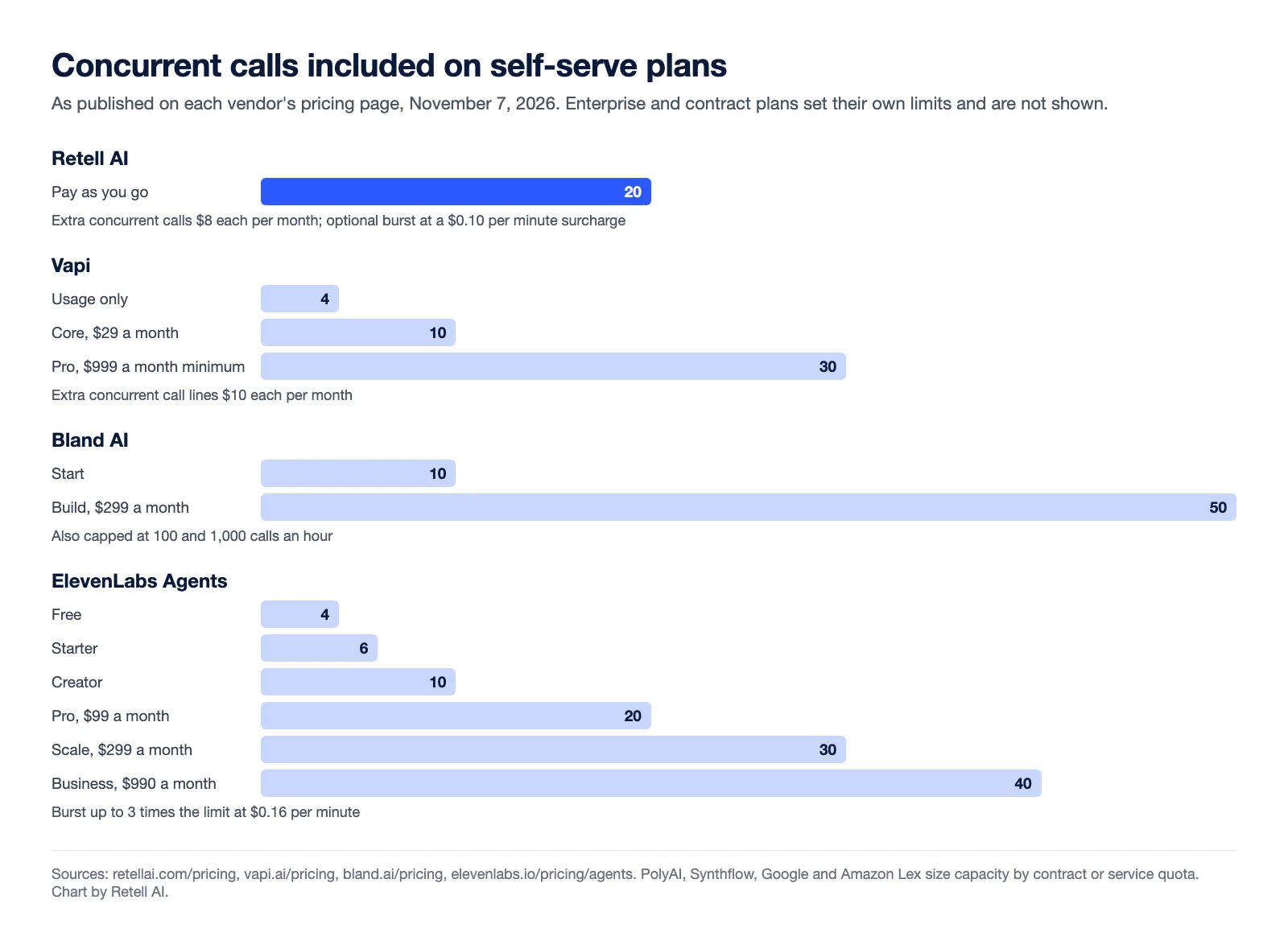
- Capacity. Start allows 10 concurrent calls, Build allows 50, and Enterprise concurrency is sized to your volume. Start and Build also cap calls at 100 and 1,000 an hour and 100 and 2,000 a day.
- Pricing. $0.14 per minute on Start and $0.12 per minute on Build, plus a $299 monthly platform fee on Build. Telephony is billed separately, on your carrier or Bland's at pass-through cost.
- Reliability terms. Bland lists a 99.9% uptime SLA on every plan.
- Watch for. The hourly and daily caps matter more than concurrency for outbound campaigns on the self-serve plans. BAA, SSO and data residency are Enterprise features.
Best for: teams that want predictable per-minute costs, with the model, speech recognition and voice in one rate. See how it compares in Retell vs Bland.
ElevenLabs Agents: best for voice quality with plan-based scale
ElevenLabs Agents is the voice agent product from ElevenLabs, with plans priced by included call minutes.
- Capacity. Concurrent calls step up with the plan: 4 on Free, 6 on Starter, 10 on Creator, 20 on Pro ($99 a month), 30 on Scale ($299) and 40 on Business ($990). Enterprise lists higher concurrency limits.
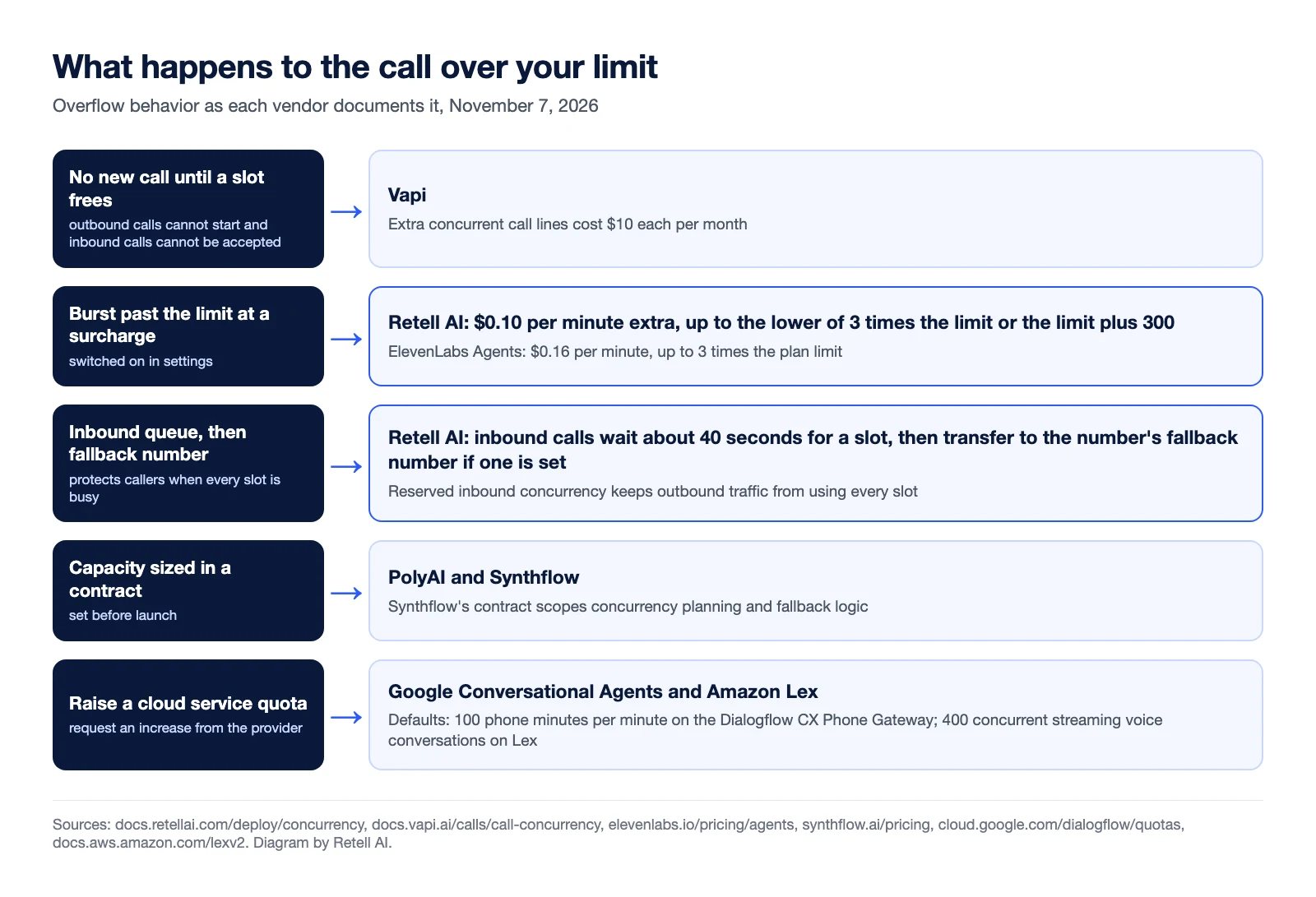
- Overflow. With burst pricing on, agents can take up to 3 times the plan's concurrency limit, and calls over the limit cost $0.16 per minute, double the standard rate.
- Pricing. Additional call minutes cost $0.08 per minute. LLM usage is billed separately, and an external telephony provider such as Twilio or a SIP trunk bills you directly.
- Watch for. Self-serve plans top out at 40 concurrent calls, so steady high volume points to an Enterprise contract. Custom DPA and SLA terms and BAAs are Enterprise items.
Best for: teams that already use ElevenLabs voices and run moderate concurrency. See Retell vs ElevenLabs.
Google Conversational Agents: best for teams building on Google Cloud
Google Conversational Agents, builds voice and chat agents with Flows (deterministic agents, also known as Dialogflow CX) and Playbooks (generative).
- Capacity. Default quotas allow 600 audio requests per minute and 100 total phone minutes per minute through the Dialogflow CX Phone Gateway, which works out to roughly 100 callers on the line at once. You can request quota increases. Above 25 requests per minute, Chirp 3 HD voices may fall back to Neural or Standard voices.
- Pricing. Voice agents bill per second of audio: $0.001 per second for Flows and $0.002 per second for Playbooks. Billed time per turn is the time the agent spends listening plus the full length of its spoken reply, even if the caller interrupts it.
- Watch for. The Phone Gateway default is low for a contact center, so plan a quota increase or connect the agent through your contact center platform.
Best for: engineering teams already on Google Cloud that want per-second billing.
PolyAI: best for large enterprise contact centers
PolyAI sells enterprise voice agents on its own models, with ongoing improvements and maintenance included in the per-minute price.
- Capacity. PolyAI states 99.994% uptime over the trailing twelve months, hundreds of millions of calls a year and 10,000 concurrent calls. These are vendor claims about its own platform.
- Pricing. The pricing page says ongoing use is priced per minute, including performance improvements, maintenance and 24/7 support, quoted through sales. A separate model-only API costs 2 cents per connected minute, billed per second, with 10 concurrent calls included and telephony and orchestration not included.
- Compliance. PolyAI lists SOC 2 Type 2, ISO 27001, PCI DSS and GDPR, with data residency in the US, UK, EU and APAC.
- Watch for. No self-serve platform plan, so capacity and price come from a sales process.
Best for: large contact centers that want a managed deployment and published scale claims.
Retell AI: best for self-serve teams that need to scale past a spike
Retell AI is a voice agent platform with self-serve pricing and published controls for running at volume.
- Capacity. Every account includes 20 concurrent calls. Extra capacity costs $8 per concurrent call per month and can be added or removed as volume changes. Enterprise plans offer custom concurrency starting at 50 calls.
- Overflow. Per Retell's concurrency docs, optional concurrency burst lets calls run past the limit at a $0.10 per minute surcharge, up to the lower of 3 times the limit or the limit plus 300. Reserved inbound concurrency keeps outbound traffic from crowding out inbound calls. When inbound calls hit the limit, Retell holds them for about 40 seconds, then transfers them to the number's fallback number if one is set.
- Rate controls and monitoring. Calls-per-second limits are set per telephony path, and a calculator recommends concurrency, an inbound reservation and CPS from your busy-hour traffic. Each call reports P50, P90 and P99 end-to-end latency, and alert rules can email or call a webhook when concurrency approaches the limit.
- Pricing. From $0.07 per minute. The total depends on the LLM, voice and telephony you choose.
- Watch for. Retell's pricing page does not list an uptime SLA. Ask for one in an Enterprise agreement if you need it in writing.
Best for: teams that want to start self-serve and add capacity by the call. For a call center rollout, see voice bot for call centers.
Synthflow: best for a scoped enterprise contract with launch support
Synthflow now sells only through an annual enterprise agreement.
- Capacity. The contract scopes custom concurrency planning, routing, escalation, handoffs and fallback logic. Synthflow states it powers 1M+ calls daily in 30+ countries.
- Pricing. No free plan, no trial and no per-minute rate. Price is set by call volume, phone system, integrations, security needs and launch support.
- Telephony and compliance. Synthflow Native Telephony, SIP trunking or approved enterprise telephony. Its Trust Center lists SOC 2 Type 2, ISO/IEC 27001, GDPR, HIPAA (self-attested) and PCI DSS.
- Watch for. You cannot test capacity before signing, so ask for concurrency and fallback terms in writing.
Best for: mid-market and enterprise teams that want the vendor's engineers to build and launch the bot. See Retell vs Synthflow.
Vapi: best for developers who want to pick every provider
Vapi is a developer platform where you choose the transcriber, model and voice, and Vapi lists provider costs with no markup.
- Capacity. Usage-only accounts get 4 concurrent calls, Core ($29 a month) gets 10, Pro ($999 a month minimum) gets 30, and Premier is custom. Extra concurrent call lines cost $10 each per month on any package.
- Overflow. Per Vapi's concurrency docs, when all slots are busy you cannot start an outbound call or accept an inbound call until a slot frees up.
- Pricing. A $50 hosting fee per 1,000 minutes, plus transcriber, model, voice and telephony. Vapi's own calculator estimates $82 to $129 for 1,000 minutes with Deepgram, OpenAI and ElevenLabs.
- Reliability terms. 99% uptime SLA on Pro and 99.9% on Premier. HIPAA is a $2,000 a month add-on.
Best for: engineering teams that want to assemble their own stack. See Retell vs Vapi.
How many concurrent calls does your voice bot need?
A quick estimate uses two numbers you already have: calls in your busiest hour and average call length.
Concurrent calls needed ≈ calls in the busiest hour × average call length in minutes ÷ 60
For example, 1,200 calls in the peak hour at 4 minutes each is 1,200 × 4 ÷ 60 = 80 calls on the line at once, on average across that hour. Calls bunch up inside the hour, so plan headroom above the average, and plan more if a marketing send or an outage can push a spike. Outbound campaigns also need the calls-per-second and hourly caps to fit the list size, not only the concurrency.
For the staffing side of the same problem, see how to handle high call volume.
What to check before you sign
- Included concurrency and the price of more. Per line per month, per plan step, or by contract.
- Overflow in writing. Blocked, queued, burst at a surcharge, or sent to a fallback number. A caller who hears nothing is the worst case.
- Rate caps. Calls per second, per hour and per day, especially for outbound.
- Latency you can monitor. Per-call percentiles, not one average, so slow calls show up.
- Uptime terms. Which plan carries the SLA and what it covers.
- What the per-minute rate includes. Model, speech recognition, voice and telephony can each be separate lines.
- Compliance costs. BAAs and SSO are often plan- or contract-gated, and HIPAA can be a priced add-on.
If you are comparing more general AI voice agents rather than call volume specifically, our roundups of AI call bots and voice agents for call centers cover the wider field.
Frequently asked questions
What is a voice bot platform?
A voice bot platform is software for building and running automated agents that talk with callers over the phone or in the browser. It handles speech recognition, the language model that decides what to say, the synthesized voice, and the connection to phone numbers. Many vendors now call these AI voice agents.
Which voice bot platform handles the most concurrent calls?
Among published figures, PolyAI states 10,000 concurrent calls, which is a vendor claim about its own platform. Retell, Vapi, Bland and ElevenLabs publish self-serve limits from 4 to 50 included calls and raise them by add-on, plan or contract. Retell's burst mode can run up to the lower of 3 times the limit or the limit plus 300 at a surcharge.
How many concurrent calls do I need?
Multiply the calls in your busiest hour by the average call length in minutes and divide by 60. For example, 1,200 calls at 4 minutes each needs about 80 concurrent calls on average in that hour. Add headroom for spikes inside the hour.
What happens when a voice bot hits its concurrency limit?
It depends on the platform. Vapi blocks new calls until a slot frees. ElevenLabs and Retell offer burst capacity at a higher per-minute rate. Retell also holds inbound calls for about 40 seconds and then sends them to a fallback number if one is set.
How are voice bot platforms priced?
Most charge per minute, but rates cover different things. Bland's rate includes the model, speech recognition and voice. Vapi, ElevenLabs and Retell bill the platform and add model, voice or telephony costs. Google bills per second of audio, Amazon Lex per request, and PolyAI and Synthflow quote through contracts.
See how much your business could save by switching to AI-powered voice agents.
ROI Result
Total Human Agent Cost
AI Agent Cost
Estimated Savings
A Demo Phone Number From Retell Clinic Office
What results look like with Retell AI


Estimate your monthly voice AI cost
Revolutionize your call operation with Retell