How to Handle High Call Volume
How to handle high call volume: find what drives it, staff to the busiest interval with Erlang C, then use callbacks, overflow, self-service and AI agents.
Handling high call volume means keeping callers' wait inside a target you set when more calls arrive than your agents can answer at once. It takes three moves: find out what is driving the extra calls, staff to the busiest 15 or 30 minutes rather than the daily total, and decide in advance where the calls above capacity go, whether that is a callback, an overflow team, self-service or an AI voice agent.
This guide is vendor-neutral and written for contact center and operations leads. For capacity planning when AI voice agents answer the calls (concurrency, burst and fallback numbers), see how to design a voice AI surge plan. For growing support across every channel without growing headcount, see scaling customer support.
What counts as high call volume?
There is no fixed number. Call volume is high when the calls arriving in an interval exceed what the agents on shift can answer within your service level target, so 300 calls an hour is a quiet hour for one team and a crisis for another.
Watch these signals by interval, not by day: service level misses that cluster at the same times, a rising average speed of answer, a climbing call abandonment rate, agent occupancy near 100%, and more repeat calls. Each is defined in call center metrics and KPIs.
Why is call volume high?
Find the cause before you change anything. Pull 8 to 12 weeks of call data by 15 or 30 minute interval and by call reason; most problems fit one of five patterns, each with a different first fix.
| Pattern | What it looks like in the data | First fix |
|---|---|---|
| Predictable peaks | The same intervals spike every week or month: opening hours, billing dates, seasonal weeks | Forecast and schedule to the interval |
| Event spikes | A sudden jump tied to an outage, a product launch, a mailing or the weather | A short message at the front of the call, then overflow |
| Avoidable contacts | A few reasons, such as order status or password resets, make up a large share | Self-service, proactive notifications, automation |
| Self-made volume | The same callers again within days, or redials after abandoned calls | Better first-contact resolution and callbacks |
| Longer calls | Call count is flat but handle time rises after a new product, new hires or a slow system | Fix the handle time drivers |
Self-made volume deserves extra attention, because a congested queue can generate its own calls when callers who could not get through try again. The Wikipedia entry on the erlang calls this re-entrant traffic and notes that in extremely high congestion it makes Erlang's equations fail to predict the capacity needed.
How many agents do you need for your call volume?
Size staff for each interval with the Erlang C formula, which call centers use to work out how many agents they need. It starts from workload in erlangs: calls per hour multiplied by average handle time in hours. Two hundred calls an hour at 3 minutes each is 600 call minutes, or 10 erlangs, the same as 10 agents talking without a break.
From the workload (A) and the number of agents (N), Erlang C gives the probability that a caller has to wait. Two more formulas follow from it, as laid out in Call Centre Helper's worked example:
- Service level (share of calls answered within the target time) = 1 minus (probability of waiting × e^(−(N − A) × target time ÷ average handle time))
- Average speed of answer = probability of waiting × average handle time ÷ (N − A)
That worked example, 200 calls an hour, 3 minute calls and a target of 80% answered in 20 seconds, needs 14 agents on the phones and reaches 88.8% with an average speed of answer of 7.8 seconds. Then add shrinkage, the time lost to holidays, sickness, training and meetings: with 30% shrinkage, divide 14 by 0.7 and roster 20 people.
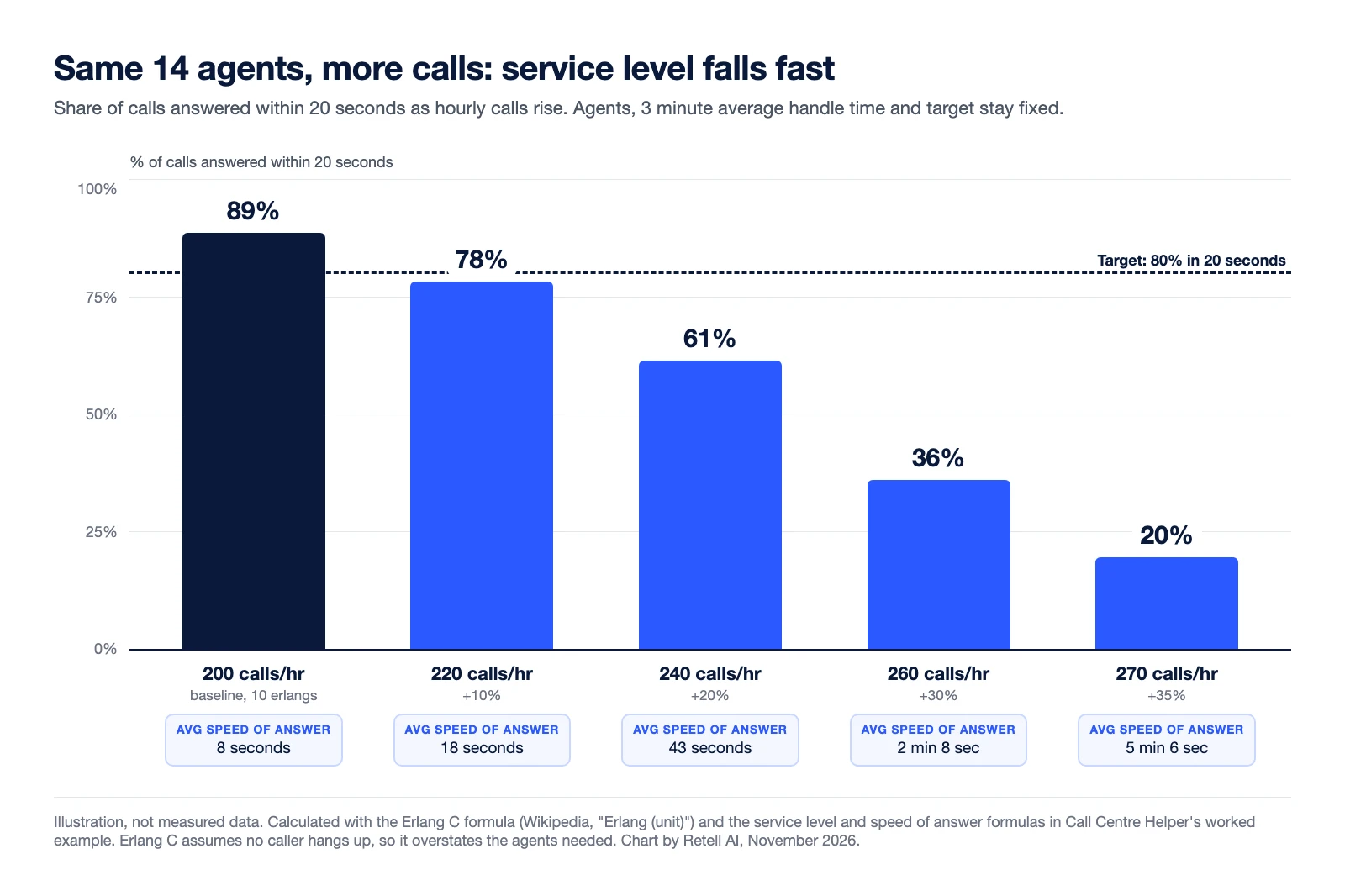
The chart shows why a spike feels sudden. With the same 14 agents, 10% more calls takes service level just under 80%, 20% more takes it to 61%, and 30% more leaves the average caller waiting over 2 minutes. At 280 calls an hour the workload equals the 14 agents, and Erlang C has no answer: in the model, the average wait grows without limit.
The same curve works in your favor. In the same illustration, 300 calls an hour needs 19 agents. Taking 20 seconds off average handle time, or removing 15% of the calls, brings that down to 17 for the same target.
Two cautions. Erlang C assumes callers never hang up while they wait, so it asks for more agents than you really need, and it assumes calls arrive at random. It also stops working under extreme congestion, such as when a TV advertisement announces your number and many people call at once. Use it to understand the shape of the problem; build the roster in your workforce management tool.
What can you do while the queue is long?
These tactics move or remove waiting time during a spike. Pick the ones that fit your cause.
| Tactic | Best for | Trade-off |
|---|---|---|
| Front-of-call message about a known issue | Outages and event spikes | Must be removed the moment the issue is fixed |
| Callback in place of hold | Peaks followed by a lull | Each callback still needs an agent later, so promise a time you can keep |
| Priority and skills routing | Urgent or high-value calls stuck behind routine ones | Lower-priority callers wait longer |
| Overflow to another team, site or partner | Peaks that exceed one team | The receiving team needs scripts, access and its own capacity |
| Pause outbound campaigns on shared agents | Inbound peaks | Outbound targets slip |
| AI voice agent on the routine reasons | Repetitive calls at any hour | Needs a clear transfer path for everything else |
With a callback, the caller keeps their place in line, hangs up and gets a call when an agent is free, which turns time on hold into work for the next quiet interval. Priority and skills rules live in your automatic call distribution (ACD) system. For where overflow should go, see overflow call answering and after-hours routing.
How do you reduce calls before they happen?
Every call removed and every second cut from handle time lowers the agents needed at peak:
- Remove the reason. Rank your top call reasons monthly and send those caused by product or billing problems to the teams that own them.
- Contact customers first. Reminders and outage notices answer the question before it becomes a call; see proactive customer service.
- Resolve the top reasons in self-service. A conversational IVR lets callers say what they need and finish simple requests without an agent.
- Cut handle time without cutting resolution. See how to calculate and improve average handle time.
- Solve it the first time. Every unresolved call is a future repeat call; see first call resolution benchmarks.
Where do AI voice agents fit?
An AI voice agent adds capacity limited by concurrent calls rather than agents on shift. It is one option among the tactics above, not a replacement for the diagnosis. Teams use it to answer every call and transfer the exceptions, to take overflow when the human queue passes a threshold, or to cover after hours.
In Retell AI, for example:
- Concurrency is set per workspace, and one agent can take any number of calls within it. Pay-As-You-Go includes 20 concurrent calls; more cost $8 per concurrent call per month (pricing, November 6, 2026).
- Inbound calls over the limit wait about 40 seconds for a slot, then go to the number's fallback number if one is set; without one, the call ends (concurrency docs).
- Existing platforms can hand calls over: in the Five9 guide's example, the Five9 IVR routes callers to live agents in business hours and to a Retell agent after hours.
- Callbacks can start from the website widget, which takes a visitor's number and has the voice agent call them.
Check that the AI resolves the calls it keeps; see how to measure call containment and how AI voice agents reduce call abandonment.
Frequently asked questions
What does "experiencing higher than normal call volume" mean?
Calls in the current interval exceed the agents available to answer them. If callers hear it every day at the same times, the volume is normal and staffing does not match the forecast.
How many calls a day is considered high volume?
No daily number defines it. Volume is high when calls in an interval exceed what the agents on shift can answer within your service level target, which depends on headcount, handle time and arrival times.
How do you handle high call volume without hiring?
Remove avoidable calls, cut handle time without hurting resolution, offer callbacks, and send overflow to another team, a partner or an AI voice agent. In this page's Erlang C example, removing 15% of 300 calls an hour saves 2 of 19 agents.
What is the Erlang C formula used for?
It gives the probability that a caller has to wait, from the workload in erlangs and the number of agents, and contact centers use it to staff each interval. It assumes callers never hang up, so it overstates the agents needed.
Should you offer callbacks during high call volume?
Yes, if you can keep the promised time. A callback moves work from the peak to a quieter interval, but each one still needs an agent or a voice agent to make it.
Handle call volume peaks with Retell AI
Retell AI is an AI voice agent platform for contact centers. Its voice agents answer routine calls in parallel, take overflow from your existing queue or cover after hours, and transfer the calls that need a person. To size capacity for your busiest hour, read the voice AI surge plan guide.