What Is Call Abandonment Rate?
How to calculate call abandonment rate (abandoned call rate) with a worked example, inbound vs outbound benchmarks, and the 3% telemarketing limit.
Call abandonment rate, also called abandoned call rate, is the percentage of calls that end before the caller reaches an agent. On inbound lines it counts callers who hang up while waiting; on outbound campaigns it counts answered calls that no agent picks up in time.
An automatic call distribution (ACD) system reports abandoned calls alongside queue length and wait times. For ways to lower it, read how AI voice agents reduce call abandonment.
How do you calculate call abandonment rate?
Divide abandoned calls by the calls that could have been answered.
- Inbound: abandoned calls ÷ calls offered × 100
- Outbound (US telemarketing rule): abandoned calls ÷ calls answered by a person × 100, per campaign and per 30 days
Many teams exclude short abandons, hang-ups in the first few seconds. SQM Group, a contact center benchmarking firm, notes that 5 or 10 seconds is the common threshold. Remove them from both sides of the fraction and keep the threshold fixed.
Worked example (illustrative numbers). A queue is offered 4,000 calls in a day; 260 callers hang up before reaching an agent, 60 within 5 seconds. The raw rate is 260 ÷ 4,000 = 6.5%. Without short abandons it is 200 ÷ 3,940 = 5.1%.
An outbound campaign places 20,000 dials over 30 days. 6,000 are answered by a person, and 150 of those wait more than 2 seconds after the greeting for a representative. The rate is 150 ÷ 6,000 = 2.5%. Dividing by all dials (0.75%) would understate it.
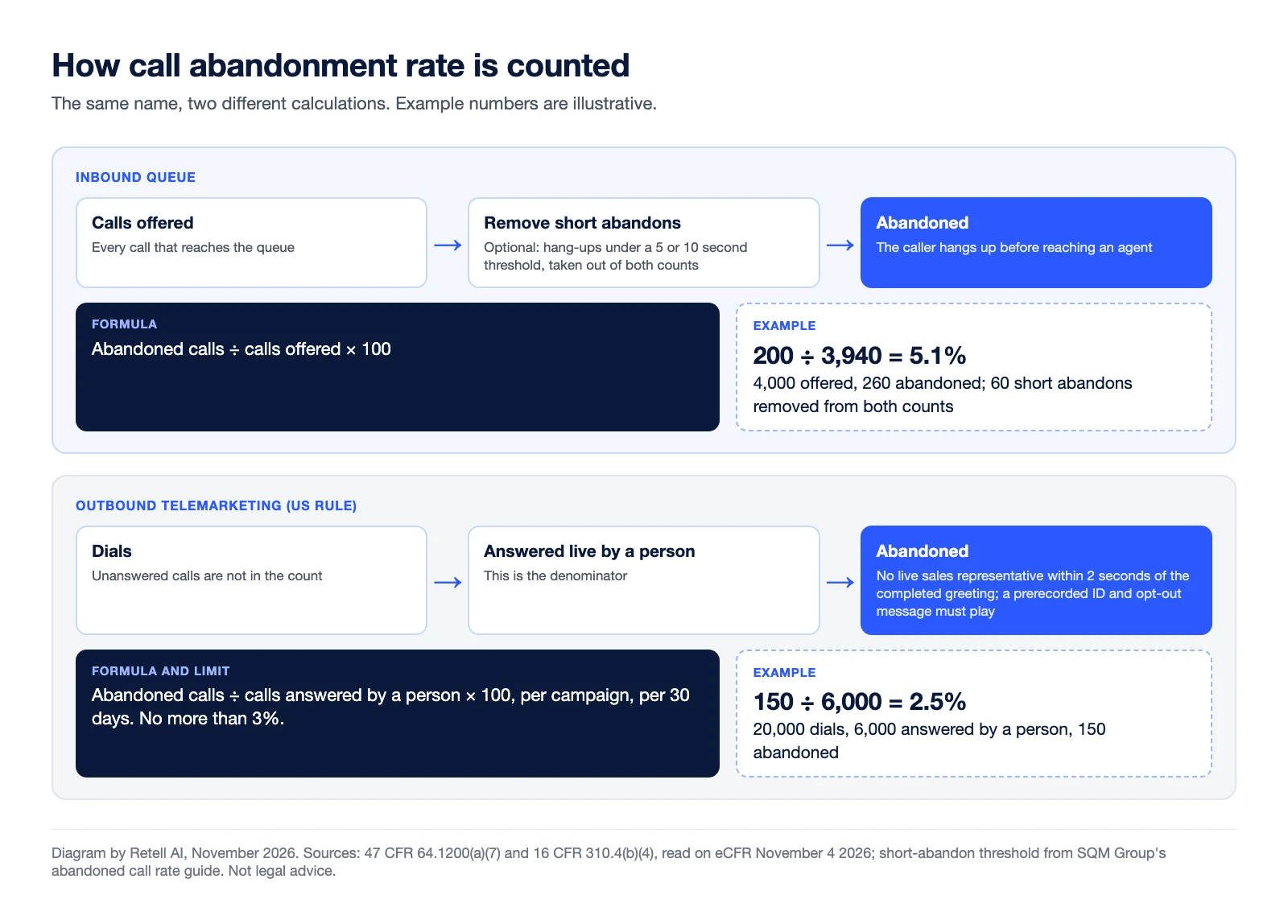
Inbound vs outbound call abandonment
| Inbound queue | Outbound telemarketing (US) | |
|---|---|---|
| Abandoned when | The caller hangs up before reaching an agent | No live sales representative within 2 seconds of the completed greeting |
| Denominator | Calls offered, minus short abandons if excluded | Calls answered live by a person |
| Window | Your reporting interval | Each 30-day period of a campaign |
| Benchmark or limit | About 5% industry average | No more than 3%, a legal ceiling |
| Source | SQM Group, 2022 | 47 CFR 64.1200(a)(7) |
What is a good call abandonment rate?
For inbound, SQM Group's guide puts the call center benchmark average at 5% and says most centers with great customer satisfaction run at 3% or less. It publishes no sample, so compare against your own history first. See call center metrics and KPIs for how abandonment relates to service level.
The 3% abandonment limit for outbound dialers
Under the FCC's TCPA rules, 47 CFR 64.1200(a)(7) bars abandoning more than 3% of telemarketing calls answered live by a person, measured over each 30-day period of a single campaign. When no representative is free within 2 seconds of the greeting, a prerecorded message must say the call was for telemarketing purposes, name the business, give a do-not-call number and offer an automated opt-out. The seller or telemarketer must keep records; tax-exempt nonprofits are exempt. The FTC's Telemarketing Sales Rule has a 3% safe harbor with similar conditions in 16 CFR 310.4(b)(4).
The limit matters most for predictive dialers, which dial more numbers than there are free agents. A preview dialer rarely abandons calls because a rep is waiting on every dial, while a parallel dialer can drop extra answers when several people pick up at once. AI voice agent telemarketing calls are not outside these rules, and the FCC ruled in February 2024 that AI-generated voices are "artificial" under the TCPA. Ask counsel how the rules apply to your campaign; this entry is not legal advice. Retell's TCPA playbook for AI outbound calls covers consent.
Where AI voice agents fit
Inbound abandonment tracks capacity. Per Retell's concurrency docs, one agent can take any number of simultaneous calls within the workspace's concurrency limit, and reserved inbound concurrency keeps outbound traffic out of slots held for inbound. At the limit, Retell holds a new inbound call for about 40 seconds, then transfers it to a fallback number if one is set; otherwise the call ends. Outbound Dialer campaign calls wait for a free slot rather than dialing without one.
Frequently asked questions about call abandonment rate
Is abandoned call rate the same as call abandonment rate?
Yes. Abandoned call rate, call abandonment rate and abandon rate name the same metric.
Do short abandons count toward the abandonment rate?
Only if you choose. SQM Group suggests excluding calls abandoned within 5 or 10 seconds, because these false abandons can be up to 2% of call volume. Remove them from both counts.
What is the 3% rule for abandoned calls?
US telemarketers may not abandon more than 3% of calls answered live by a person, per campaign over each 30-day period, under 47 CFR 64.1200(a)(7).
Does the 3% limit apply to inbound calls?
No. Both rules cover outbound telemarketing. Inbound teams set their own target, subject to any industry service standards.
Do AI voice agent calls count as abandoned calls?
They can. AI-generated voices count as artificial under the TCPA, and under 47 CFR 64.1200(a)(7)(ii) an artificial or prerecorded voice telemarketing call to a residential or wireless line, made with the subscriber's prior express written consent, is not counted as abandoned if the message begins within 2 seconds of the completed greeting. Ask counsel whether your campaign meets that test.
Answer every call your queue would lose
Retell AI is an AI voice agent platform for contact centers. Its agents answer inbound calls up to your concurrency limit and transfer callers to a human when needed. Talk to the Retell team.