Telephony
What telephony is, how calls move over PSTN, VoIP and SIP, and what an AI voice agent needs from your telephony stack to answer calls.
Telephony is the technology that carries voice calls between people or systems over a distance, whether across the public phone network, the internet, or both. Today most business telephony runs on internet protocols, and an AI voice agent connects to it the same way a phone system does.
What is the difference between telephony, PSTN, VoIP and SIP?
Telephony is the whole field. PSTN, VoIP and SIP are pieces of it that people often use as if they meant the same thing.
| Term | What it is | Where an AI voice agent meets it |
|---|---|---|
| Telephony | Any technology that carries voice calls | The overall stack your calls run on |
| PSTN | The public switched telephone network, the interconnected circuit-switched voice networks that phone numbers belong to | Callers reach you through it; your carrier bridges it to the internet |
| VoIP | Voice over IP, voice communications carried over a data network using internet protocols | The agent talks to your stack over IP, not copper lines |
| SIP | Session Initiation Protocol, the signaling protocol that creates, changes and ends calls | Retell connects to carriers and phone systems over SIP |
| RTP | Real-time Transport Protocol, which carries the audio itself | The live audio between caller and agent |
| SIP trunk | A SIP connection between your phone system and a carrier | How you point your numbers at an AI voice agent |
The PSTN is described in RFC 5486 as the collection of interconnected, circuit-switched, voice-oriented public telephone networks, and NIST defines VoIP as voice communications over a data network using internet protocols. SIP is defined in RFC 3261 as a signaling protocol for creating, modifying and terminating sessions, including Internet telephone calls. RTP, defined in RFC 3550, moves the real-time audio. Keeping signaling and audio apart in your head makes most telephony problems easier to diagnose: signaling decides whether a call connects, media decides whether anyone can hear it.
How does a phone call move through a telephony system?
A call first travels over the PSTN or the carrier's network to the carrier that owns the number. The carrier then hands it to your side over a SIP trunk. SIP sets up the call, and RTP carries the voice once it is connected.
For a call answered by Retell, the last hops look like this:
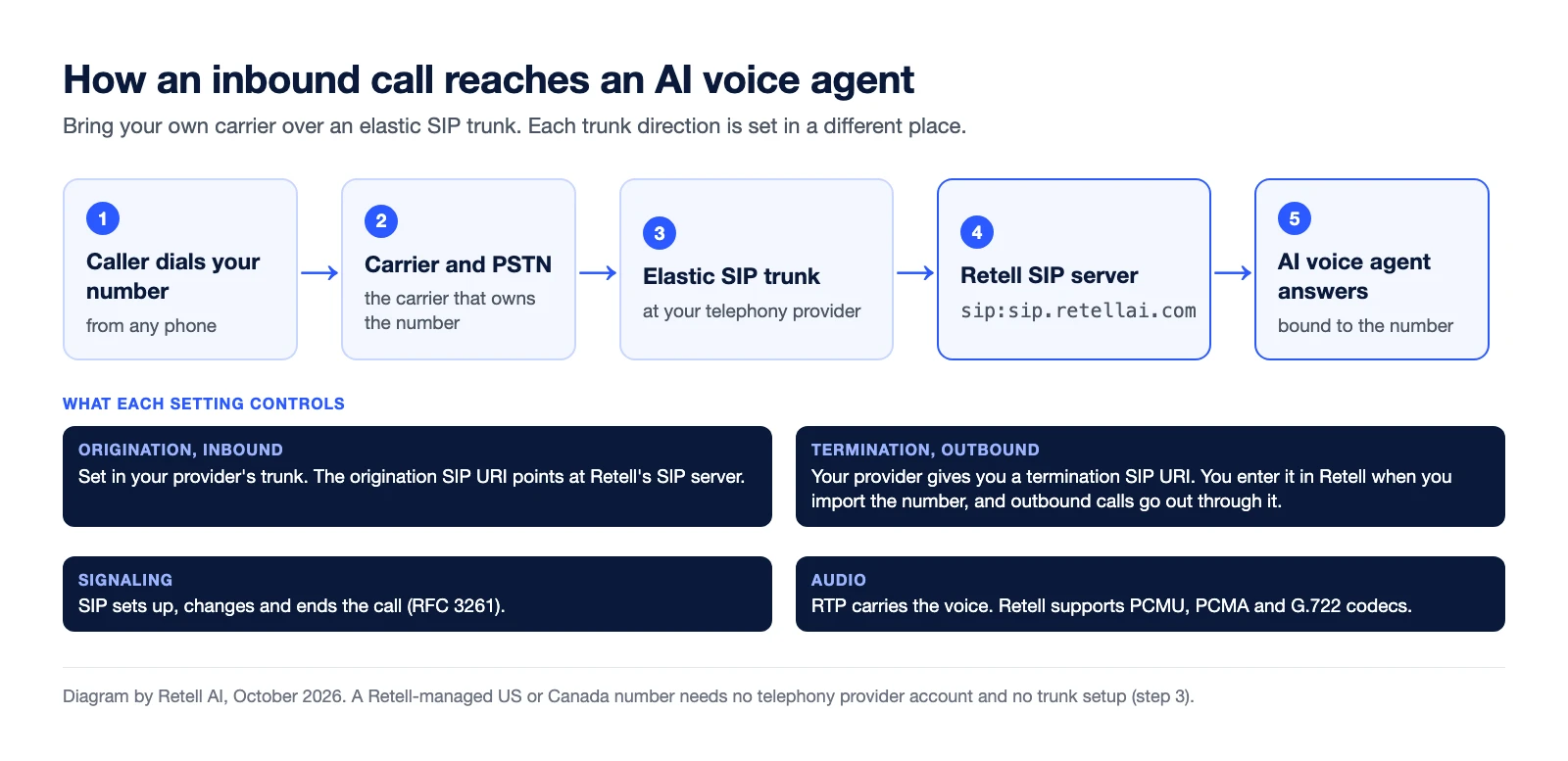
Each trunk has two directions, and each is configured in a different place. Origination covers calls flowing from your provider into Retell: you set the origination SIP URI to sip:sip.retellai.com in your provider's trunk settings. Termination covers calls flowing out of Retell through your provider: your provider gives you a termination SIP URI, and you supply it to Retell when you import the number.
What are the parts of a telephony stack?
A business telephony stack usually has five parts, and an AI voice agent slots in as one more endpoint.
- Carrier or number provider. Owns your phone numbers and connects calls to the PSTN.
- SIP trunk. The connection between your phone system and the carrier.
- Phone system. A PBX or cloud telephony platform that routes calls, handles voicemail and runs menus. See cloud telephony for how to choose one.
- Contact center platform. Queues and routes calls to agents. Retell has setup guides for Avaya, Genesys Cloud, Five9 and Amazon Connect.
- Endpoints. Desk phones, softphones, and AI voice agents.
How does an AI voice agent connect to telephony?
There are three ways to connect, depending on who owns the numbers.
- Use a Retell-managed number. You buy a US or Canada number in the dashboard or through the API, with no telephony provider account and no trunk to set up. Retell numbers can call 15 countries.
- Bring your own carrier with elastic SIP trunking. This is the option Retell recommends if your provider supports it. Retell has guides for Twilio, Telnyx and Vonage, and any provider that supports SIP trunks works.
- Dial to a SIP URI. If your provider cannot do elastic SIP trunking, or your setup is complex, your own system registers the call through the Register Phone Call API and dials it to a SIP URI within 5 minutes. With this method Retell's transfer call feature is not available, so you write your own transfer logic as a custom function.
For security, Retell supports TCP, UDP, TLS and mTLS for signaling. SRTP media encryption requires TLS transport. Supported audio codecs are PCMU, PCMA and G.722. mTLS is configured on request through Retell support. Before routing live calls, you can run Test SIP Connection when importing a number, which sends a SIP OPTIONS request to your termination URI without placing a call. A passing test does not prove routing or audio, so place real inbound and outbound test calls afterward.
For a deeper walkthrough of the SIP side, read integrating AI with SIP trunking, and see how a Twilio connection fits in.
What should you check about your telephony before adding an AI voice agent?
Ask these questions of your provider or IT team first. Each one prevents a common launch delay.
- Does our carrier support elastic SIP trunking, and can we set an origination URI and get a termination URI?
- Can we allow Retell's SIP server addresses through our firewall or session border controller? Many providers require an allowlist.
- Do we need TLS, SRTP or mTLS, and does our provider support them?
- Do our numbers need to stay with the current carrier, or can some move to Retell-managed numbers?
- Does our provider allow SIP REFER and PSTN transfer, so the agent can hand calls to a person?
- Which call details do we need to pass along, such as an account ID, in SIP headers?
For a vendor-side checklist, see how to choose a conversational AI vendor for your telephony infrastructure.
Related terms
An AI voice agent is the software that answers and places calls on top of your telephony stack. Pricing starts from $0.07 per minute; see Retell pricing for current details.
Put your telephony to work with Retell AI
Retell AI connects to the carrier and phone system you already run, or gives you numbers to start with, so an AI voice agent can answer and place calls without replacing your stack. Talk to the team about your telephony setup and which connection method fits.