What Is a CX Automation Engineer?
A CX automation engineer owns a company's AI voice agents in-house: what the role does each week, who it reports to, and how it differs from an FDE.
A CX automation engineer is the employee who owns a company's customer-facing AI agents, such as its AI voice agents, after launch: they change the prompts and knowledge base, test each change, release it and review the calls that follow. The role is also called an internal deployed engineer, the in-house counterpart to a vendor's forward deployed engineer.
The title is new. Retell AI's post on what a CX automation engineer does describes it as the person who "oversees continuous improvement of customer-facing AI agents and automated processes," and says some of Retell's enterprise customers have already made the role official.
What does a CX automation engineer do each week?
They run the improvement loop: find the calls the agent handled poorly, work out why, fix it, test the fix and release it.
| Weekly task | What it looks like | Where in Retell AI |
|---|---|---|
| Check alerts | Find out why each alert fired, such as a drop in call success rate | Alert rules |
| Review flagged calls | Read the calls AI QA flagged for problems such as hallucinations or wrong knowledge base answers, and find the cause | AI QA |
| Fix the agent | Rewrite the prompt or update the knowledge base in a new draft version | Agent versions |
| Test the fix | Run test cases that describe a caller's goal and what a successful call looks like against a simulated caller | Simulation testing |
| Release and watch | Publish, watch the next production calls and, if the fix fails, move the prod tag (which your phone numbers follow) back to the previous version | Versions and tags |
| Grow the test suite | Add a test case for each new failure | Simulation test cases |
Beyond the weekly loop, the job also covers building and configuring new agents, choosing the next use case, connecting agents to the CRM and helpdesk, and compliance settings such as PII redaction and data retention. The recurring tasks are listed in the voice agent maintenance checklist, the call review in the voice agent QA scorecard, and the release routine in how to test and release voice agent changes.
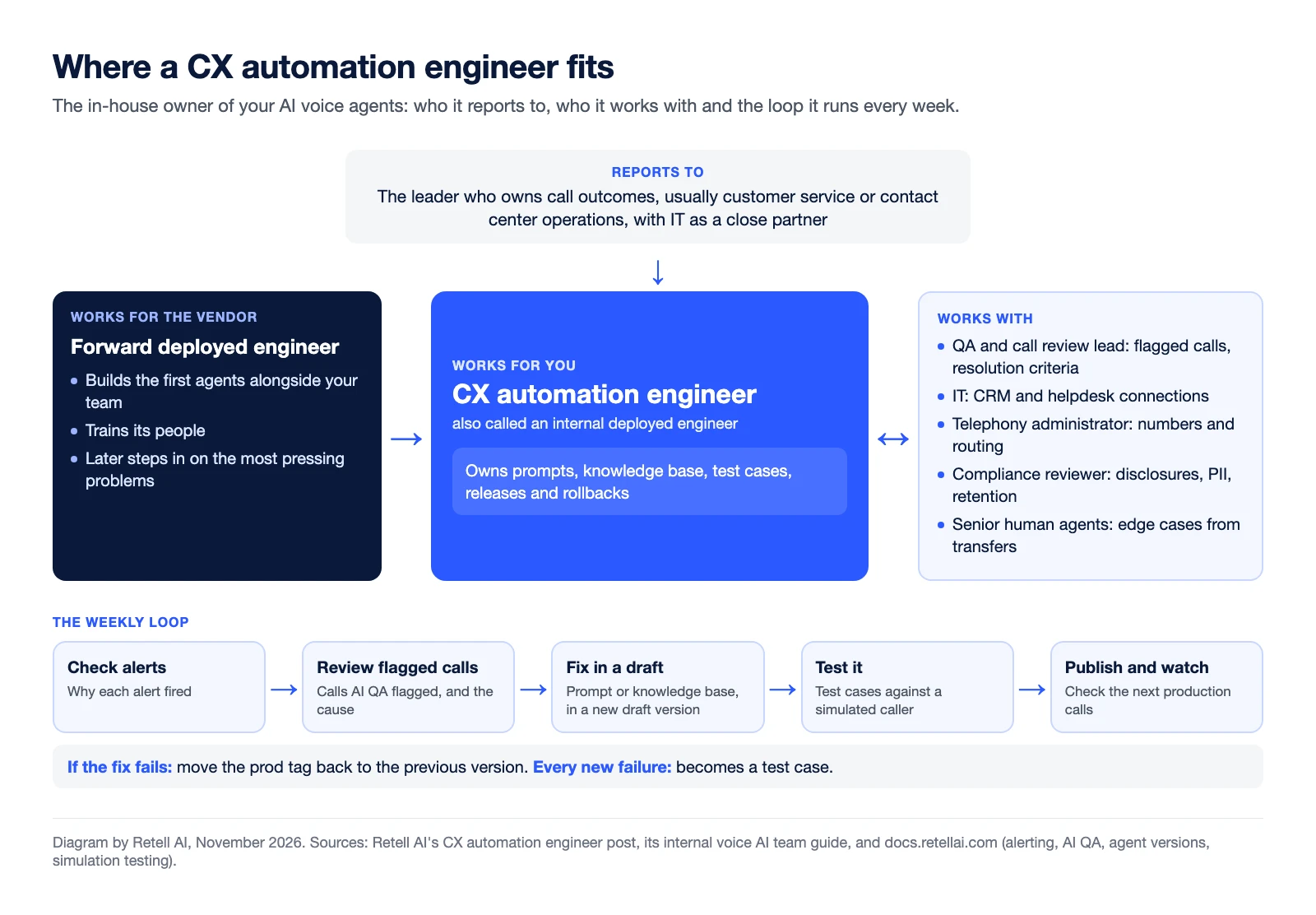
CX automation engineer vs forward deployed engineer
A forward deployed engineer (FDE) works for the vendor and leads the launch. A CX automation engineer works for the customer and owns the agents from then on. Retell's CX post puts the split this way: the organization's employees have the customer knowledge, and FDEs translate it into working agents. Kept going indefinitely, that arrangement "leaves organizations dependent on outside experts for significant changes," and every fix waits in the vendor's queue. With an internal deployed engineer, the people who know about a policy change can update the agent themselves.
Who does a CX automation engineer report to?
Usually to the leader who owns the call outcomes, in customer service or contact center operations, with IT as a close partner. That is where Retell's guide places the internal voice AI team the role belongs to. The decisions the role makes each week, such as what the agent says, when it transfers and what counts as a resolved call, are customer decisions. The guide to building an internal voice AI team covers the other roles around it.
Good candidates are often already doing the work: operations managers rewriting prompts to fix mishandled calls, IVR administrators, QA leads, workforce management analysts and senior human agents. Use the CX automation engineer job description template to hire for the role.
Frequently asked questions about CX automation engineers
Is a CX automation engineer the same as an internal deployed engineer?
Yes. Both names describe the customer's own employee who builds, tests and improves its AI agents after launch, in contrast to the vendor's forward deployed engineer.
Does a CX automation engineer need to be a software engineer?
No. The core skills are writing clear prompts, reading transcripts to find why a call failed, designing test cases and releasing changes safely. A software engineering background helps but is not a requirement.
How is a CX automation engineer different from an AI agent manager?
An AI agent manager owns how the agents perform on live calls: the standard for a resolved call, what gets fixed and the reporting. The CX automation engineer builds the fixes and releases them. In a small team one person can do both.
What Retell AI workspace role does a CX automation engineer need?
Developer. Per Retell's access control docs, Developers can build and edit agents, run simulations, manage test cases and view raw transcripts and recordings, but cannot manage billing or workspace members.
Does Retell AI provide CX automation engineers?
No. It is a role customers staff. Retell AI's forward deployed engineers build the first agents alongside the customer's team and train its people, and the platform lets that team take on more of the work over time, at its own pace.
Give your voice agents an in-house owner
Retell AI is an AI voice agent platform for contact centers. AI QA, simulation testing and agent versions give a CX automation engineer the tools to review, fix, test and release changes without waiting on a vendor. Talk to the Retell team about your rollout and who will own it.