CX Automation Engineer Job Description Template
A copy-ready job description for a CX automation engineer: responsibilities, skills, who the role reports to, and interview questions for hiring one.
A CX automation engineer job description is the hiring document for the in-house person who owns a company's AI voice agents after launch: the employee who changes what the agents say and know, tests every change before it ships, and reviews the calls that follow. The template below is ready to paste into a job posting. Replace the text in [brackets].
The role is the one Retell describes in what a CX automation engineer does: a customer's own employee, also called an internal deployed engineer, who takes over the work a vendor's forward deployed engineers start. This page is the hiring kit for that one seat. The team around it is covered in how to build an internal voice AI team.
What goes in a CX automation engineer job description?
Seven parts. The first five describe the job. The last two tell candidates how they will be judged and paid, which matters more for a new title, because nobody at your company has held it before.
| Section | What it should say | Mistake to avoid |
|---|---|---|
| Role summary | Which agents and call types the person owns, and that they take over from the vendor | Describing a machine learning or data science job |
| Reporting line | The leader who owns call outcomes, with IT as a partner | Placing the role in IT alone, far from the calls |
| Responsibilities | The weekly work: changes, tests, releases, call review, integrations, compliance | Listing tools instead of outcomes |
| Required skills | Instruction writing, transcript diagnosis, test design, change discipline, business knowledge | Requiring a computer science degree |
| Nice-to-have skills | Scripting, voice AI platform experience, knowledge of the rules your calls fall under | Turning nice-to-haves into requirements |
| Success measures | What done looks like at 30, 60 and 90 days, then ongoing | No measures, so the first review is a guess |
| Pay and location | Your own band and work arrangement | A figure copied from an unrelated title |
CX automation engineer job description (copy-ready)
Copy from "Job title" to the end of "How success is measured". Everything in [brackets] is yours to fill in.
Job title
CX Automation Engineer (Internal Deployed Engineer)
About the role
[Company] uses AI voice agents to handle [call types, for example appointment changes and order status] for our [customers, patients or members]. We are hiring a CX Automation Engineer to own those agents day to day: what they say, what they know, which systems they reach, how their calls are checked and when they hand a caller to a person.
Our voice AI vendor's engineers built the first agents with us. Your job is to bring that work in-house, so a policy change or a badly handled call becomes a tested fix in production without waiting on anyone outside [Company].
Reports to: [Program owner for voice AI, for example Director of Contact Center Operations or Head of CX]
Works with: [AI agent manager or QA lead], [IT or CRM team], [telephony administrator], [compliance], and our vendor's support team
Location and type: [On-site, hybrid or remote, city], full-time
Pay range: [Your band]
What you will do
- Own the prompts, conversation flows and settings of our live voice agents, starting with [first use case].
- Make every change in a draft version, compare it with the live version before release, and roll it back if results drop.
- Keep the agents' knowledge base current whenever a policy, price, product or opening time changes.
- Write test cases that describe a caller, their goal and what a successful call looks like, and run the full set before every release.
- Run a weekly call review with [QA lead]: read the calls flagged for problems, find the pattern behind them and decide the fix.
- Agree with [QA lead or AI agent manager] on what counts as a resolved call, and keep that definition current in call scoring and in tests.
- Specify the data the agents need from [CRM or helpdesk], work with IT to connect it, and diagnose failed function calls.
- Maintain the escalation rules: when an agent transfers a caller to a person, to whom, and with what context.
- Build dashboards and alerts on call success and transfer rates, and respond when an alert fires.
- Review disclosures, PII redaction, data retention and outbound calling rules with [compliance] before each new use case goes live.
- Recommend the next call types to automate, using call reason and volume data.
- Keep a change log: what changed, why, and which tests it passed.
What you bring
- [2+] years in contact center operations, quality assurance, IVR or telephony administration, workforce management or support operations, or as a senior human agent.
- Clear written instructions: call scripts, knowledge articles or prompts that others follow correctly.
- Hands-on experience changing a voice agent, chatbot or IVR flow and checking the result on real conversations.
- The habit of reading transcripts for the cause of a failure: an unclear instruction, a missing fact, a failed integration or a caller who should have been transferred.
- Test discipline: you write down what success looks like before you change anything, and you do not ship an untested change.
- Enough technical literacy to read a webhook payload or an API error and explain the problem to IT.
- Comfort working with call data in spreadsheets or dashboards.
- Knowledge of our [products, policies and the exceptions human agents learn on the job], or the ability to learn them fast.
Nice to have
- Python or JavaScript, for webhooks, custom functions and test data.
- Experience on a voice AI platform, ideally [your platform].
- Call quality calibration experience in a contact center.
- Working knowledge of the rules our calls fall under, such as [TCPA for outbound calls in the US, HIPAA for patient calls, GDPR].
- Experience working alongside a vendor's implementation or forward deployed engineering team.
What this role is not
This is not a machine learning research, model training or speech infrastructure role. Our voice AI platform runs that layer. You own the business layer on top of it.
How success is measured
First 30 days
- Has the workspace access the job needs and can explain how each live agent handles its top [5] call reasons.
- Has written the definition of a resolved call for [first use case], agreed with [QA lead].
- Has shipped at least one change alongside the vendor's engineer: made in a draft, tested, compared and released.
By day 60
- Ships fixes without vendor help, and every fixed failure has a test case.
- Runs the weekly call review, and the call success rate alert reaches them.
By day 90
- Can change, test, release and roll back any of our agents without opening a vendor ticket.
- Has written our release process: who can publish, which tests must pass and how to roll back.
- Has proposed the next use case, with the call volume behind it.
After 90 days, measured on
- Resolution rate for the call types they own: [target].
- Time from finding a failure to a tested fix in production: [target].
- Share of agent changes made without the vendor: [target].
How should you adapt the template?
Change three things before you post it: the call types in the summary, the reporting line and the success targets. Keep the responsibilities broad, since in a first deployment one person often covers all of them.
Post it internally first. Retell's CX automation engineer post names the people best placed for the job: operations managers already fixing prompts, telephony or IVR administrators, QA leads, workforce management analysts and senior human agents. Often the clearest sign is that colleagues already bring them their voice AI problems.
Pay is left blank on purpose. The title is new, so set the band against your own bands for the roles candidates come from and the scope you are handing over, and check whether your location requires a range in the posting.
Each responsibility has a guide your new hire can work from: the weekly review in the voice agent QA scorecard, fixes in how to improve a voice agent after launch, releases in how to test and release voice agent changes, and recurring upkeep in the voice agent maintenance checklist.
Who should a CX automation engineer report to?
To the leader who owns call outcomes, usually the head of customer service or contact center operations, with a close working line into IT. The decisions the role makes every week are customer decisions: what the agent says, when it transfers and what counts as resolved. IT owns the integrations, security and access around it.
In a larger contact center the role often sits next to an AI agent manager, who owns day-to-day results while the CX automation engineer owns the build. In a smaller team, one person does both.
What interview questions should you ask a CX automation engineer?
Test the work, not the vocabulary. Many strong candidates have done this job informally without the title, so ask them to do it in the interview with your own calls and your own agent.
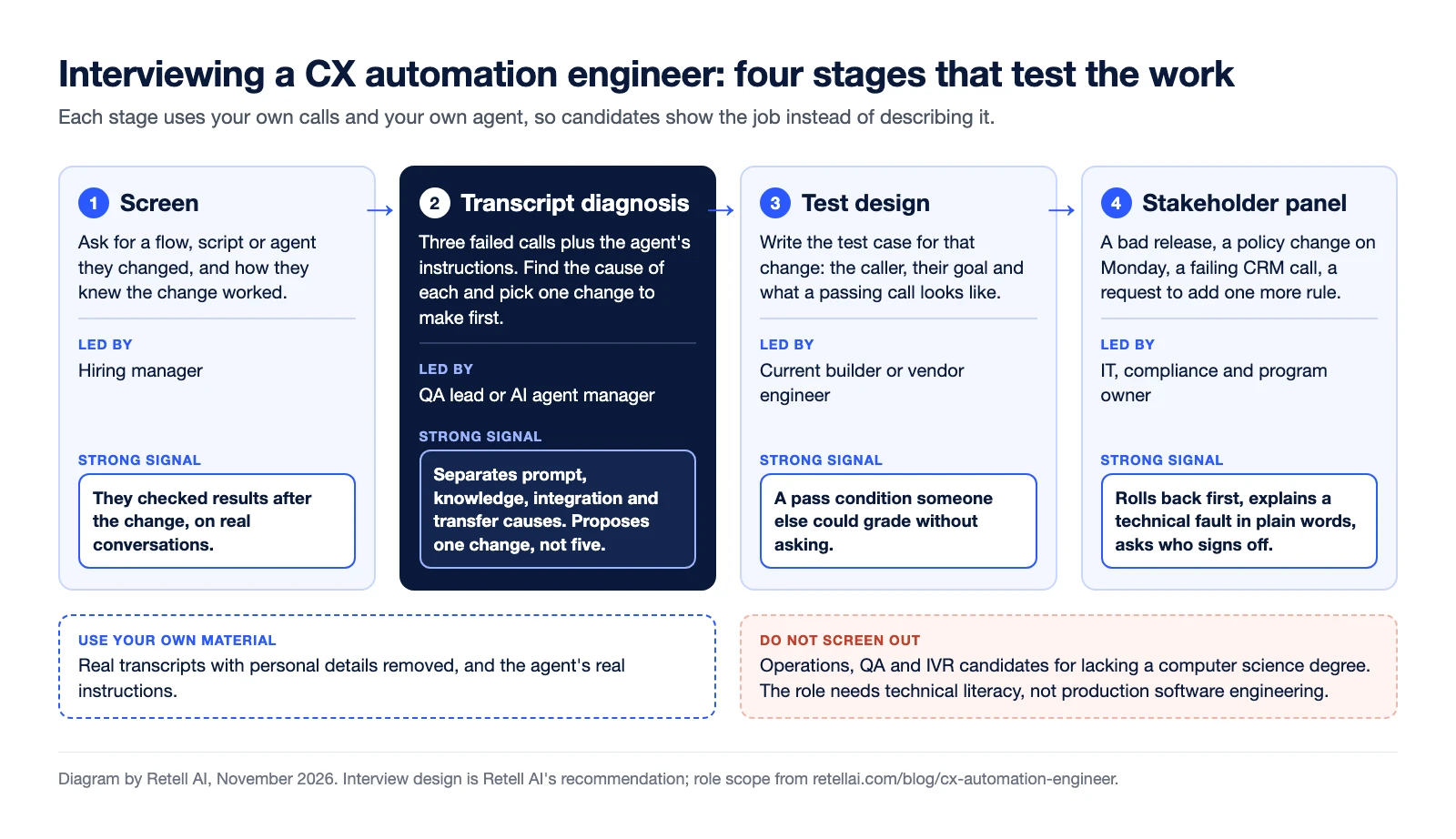
| Question | What a strong answer shows |
|---|---|
| Walk me through a flow, script or agent you changed. How did you know it worked? | They checked results on real conversations after the change, not only before it |
| Here are three calls the agent handled badly, and its instructions. What went wrong in each, and what would you change first? | They tell an unclear instruction from a missing fact, a failed integration or a missed transfer, and pick one change |
| Write the test case for that change. | A caller, a goal and a pass condition someone else could grade |
| A manager asks you to add a rule so the agent never says one specific thing. What do you do? | They look for the unclear instruction behind the mistake before stacking rules, as Retell's prompting guide advises |
| A change went live this morning and the success rate dropped by lunch. What do you do in the first hour? | Roll back first, then diagnose |
| The refund policy changes on Monday. What changes in the agent, and in what order? | Knowledge, then tests, then release, with a named sign-off |
| A CRM lookup failed on some calls last week. How do you find out why? | They read the function call and its error, then write IT a clear, specific ticket |
| Which calls should the agent never take? | Judgment about sensitive, regulated and high-stakes calls |
The second question works best with real transcripts, personal details removed. Voice agent failure modes lists the patterns worth choosing examples from.
How does the role differ from a vendor's forward deployed engineer?
You hire one, and the vendor employs the other. A forward deployed engineer (FDE) works for the vendor and leads the launch. A CX automation engineer is your own employee who owns and improves the agents after it. Retell's post describes the goal as customers moving "from FDEs teaching them the ropes to internal deployed engineers taking care of as much of that work as possible."
That is why an FDE posting is the wrong template to copy. FDE postings are written for software engineers. OpenAI's San Francisco forward deployed engineer posting, for example, asks for "5+ years of engineering or technical deployment experience that includes customer-facing work", production code across frontend and backend, and travel of up to 50%. Copy that, and you filter out the operations and QA people best placed to run your agents.
| Vendor forward deployed engineer | CX automation engineer | |
|---|---|---|
| Employed by | The vendor | Your company |
| Hired for | Software engineering and customer-facing delivery | Knowledge of your callers, policies and systems, plus technical literacy |
| Usually comes from | Software engineering or technical deployment roles | Contact center operations, QA, IVR or telephony administration, workforce management, senior human agents |
| On your account | Launch and the most pressing problems | Every day after launch |
| A fix ships | When it reaches the top of the vendor's queue | When your team has tested and published it |
| Judged on | Production adoption and measurable workflow impact, in OpenAI's posting | Resolution, time to a tested fix and changes made without the vendor |
The forward deployed engineer glossary entry covers the FDE role itself in more depth.
Frequently asked questions
Who does a CX automation engineer report to?
Usually the leader who owns call outcomes, such as the head of customer service or contact center operations, with a close working line into IT for integrations, security and access.
Does a CX automation engineer need to know how to code?
Not to production software engineering level. The role needs enough technical literacy to read a webhook payload or an API error and explain it to IT. Python or JavaScript is a useful extra for webhooks and custom functions, not a requirement.
What is the difference between a CX automation engineer and a forward deployed engineer?
A forward deployed engineer works for the voice AI vendor and leads the launch. A CX automation engineer, also called an internal deployed engineer, is the company's own employee who owns and improves the agents after launch, so fixes do not wait in the vendor's queue.
How much does a CX automation engineer earn?
This template gives no figure because the title is new. Set the band against your own bands for the roles candidates usually come from, such as contact center operations, QA and IVR administration, and against the scope you are handing over.
Should you hire a CX automation engineer internally or externally?
Look internally first. The strongest candidates are often already rewriting agent prompts, reviewing call transcripts and drafting escalation rules, and they bring knowledge of your callers and policies that an outside hire has to learn.
Give your new hire the tools to own the agents
Retell AI is an AI voice agent platform for contact centers. On Retell, the Developer workspace role fits this hire: it can build and test agents and view raw transcripts and recordings, but cannot manage billing or members. Simulation testing, AI QA, agent versions with environment tags and alert rules on call success rate cover the work in the template, so your CX automation engineer can change, test, release and roll back without a vendor ticket.