What Is Local Presence Dialing?
What local presence dialing is, how a local presence dialer matches caller ID to the area code you call, and the caller ID rules that keep it compliant.
Local presence dialing is an outbound calling method in which each person sees a caller ID number from their own area code or region, picked automatically by a local presence dialer from a pool of numbers the business owns. A campaign calling Dallas shows a 214 number, and the same campaign calling Houston shows a 713 number.
The aim is more answered calls. It changes the number on screen, not who you may call or when.
How does a local presence dialer work?
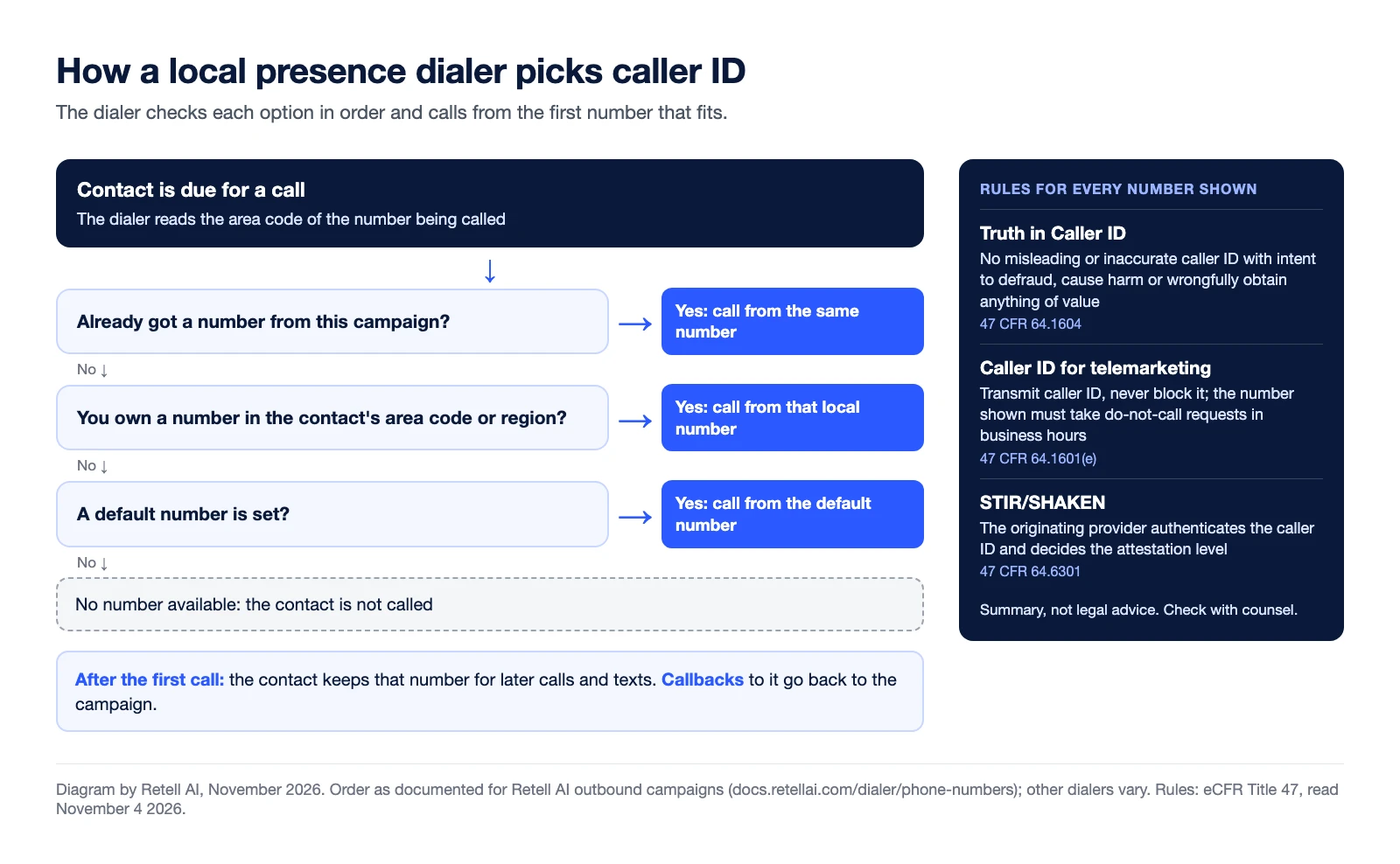
It matches each contact to a number in your pool. A typical order, which varies by dialer:
- Read the area code of the number being called.
- Pick a number you own in that area code or region, such as one city's overlay codes.
- With no match, use a default number or skip the contact.
- Reuse that number for later calls and texts to the same person.
- Route callbacks to the campaign.
An area code may not match where the person is today, so "local" is a best guess.
Local presence dialing vs other caller ID options
| Caller ID option | What the person sees | When teams use it |
|---|---|---|
| One central number | The same number on every call | Customers who already know the number |
| Toll-free number | An 8XX number | National service lines |
| Local presence dialing | A number from their own area code or region | Contacts spread across many area codes |
| Branded caller ID | The business name instead of a number | Adding identity on top of any option above |
Local presence and branded caller ID can run together: one makes the number look familiar, the other shows who is calling.
Is local presence dialing legal? The caller ID rules
Federal rules do not name local presence dialing, but three caller ID rules apply to any local presence dialer. This summarizes the rule text as of November 2026 and is not legal advice; review your setup, including state rules, with counsel.
- Truth in Caller ID. 47 CFR 64.1604 bars knowingly causing caller ID to show "misleading or inaccurate caller identification information" with "the intent to defraud, cause harm, or wrongfully obtain anything of value." The statute is 47 U.S.C. 227(e).
- Caller ID for telemarketing. 47 CFR 64.1601(e) requires telemarketers to transmit caller ID and bars blocking it. The seller's name and customer service number may be shown instead, and the number "must permit any individual to make a do-not-call request during regular business hours." Plan for every number in the pool to take those requests.
- STIR/SHAKEN. Under 47 CFR 64.6301, voice service providers authenticate caller ID on the SIP calls they originate, and the originating provider makes each call's attestation-level decision. Ask your carrier how calls from your numbers are attested.
Consent, do-not-call and calling-hour rules apply as before; see the TCPA compliance guide for outbound AI voice calls.
What local presence dialing does not fix
It does not stop "Spam Likely" labels, which follow a number's reputation, not its area code. Carriers can label a number that places many calls, and a recycled number can arrive already flagged. Cycling in fresh numbers to dodge a label is not a fix: each new number starts over. What helps: verified numbers with a branded name, one number per contact, calling people who expect to hear from you and honoring every stop request. The outbound phone number checklist covers the rest.
Where AI voice agents fit with a local presence dialer
In an AI dialer, an AI voice agent holds the conversation. Local presence works with any pacing mode, from a preview dialer to a parallel dialer. In Retell AI, outbound campaigns use local presence dialing by default, per the caller ID docs: each contact is called from a number assigned to its region, contacts with no match use a default phone number or are not called, and a contact keeps its first caller ID for later calls and texts. Compliance checks can screen contacts against federal and state do-not-call registries before the first dial.
Frequently asked questions about local presence dialing
Is local presence dialing the same as caller ID spoofing?
They are different practices. A local presence dialer shows real numbers from the business's own pool that people can call back. The Truth in Caller ID rule targets misleading or inaccurate caller ID shown with intent to defraud, cause harm or wrongfully obtain anything of value.
Does a local presence dialer need a number in every area code?
No. It can cover the regions where your contacts are and use a default number for the rest. Retell's docs suggest one number per 50 contacts in a region.
What happens when someone calls back a local presence number?
It rings the number they saw, so each number needs an answer path for do-not-call requests. In Retell AI, a callback within 30 days reaches the campaign's agent while the contact awaits its next attempt.
Should you use local presence dialing or branded caller ID?
Often both. Local presence dialing changes which number appears; branded caller ID shows your business name. Retell AI offers both for US numbers.
Make every outbound number one people can trust
Retell AI is an AI voice agent platform for contact centers, with verified phone numbers and branded call ID for US outbound calls. Talk to the Retell team about your program.