Proactive Customer Service With Outbound AI
Proactive customer service explained: reaching customers before they call, which outbound calls to automate, and how to measure the effect.
Proactive customer service is when a company contacts a customer about a problem, deadline or change before the customer has to reach out, such as a call about a delayed delivery, a reminder before a renewal date, or a heads-up about a past-due balance. Reactive service is the opposite: the company waits for the customer to call, email or open a chat.
This guide covers the phone: which proactive calls to automate with an AI voice agent, how they run, the US legal limits, and how to measure them. A call lets the customer act on the news in the same conversation, and in the US it carries strict consent rules under the TCPA.
What is the difference between proactive and reactive customer service?
The difference is who starts the conversation and when. In reactive service, the customer notices a problem and contacts you. In proactive service, your systems notice it first and you contact the customer.
| Reactive service | Proactive service | |
|---|---|---|
| Who starts the contact | The customer | The company |
| When it happens | After the customer notices a problem | When a date, status or balance in your system changes |
| What the customer has to do | Find the number, wait, explain the issue | Confirm, pick an option, or say no |
| Typical channels | Inbound calls, email, chat | Outbound calls, SMS, email, in-app messages |
| What you measure | Speed and resolution of incoming contacts | Reach, outcomes, and the inbound contacts that never happened |
Most teams need both: proactive outreach takes predictable contacts off the inbound queue.
Which proactive calls are worth automating?
The best candidates have a trigger already in your systems, one job per call, and an outcome you can record as a field. Each row links to a page showing how the call works on Retell.
| Trigger in your system | What the call does | Outcome to record | How it works |
|---|---|---|---|
| Upcoming appointment | Confirms, cancels or reschedules the visit | Confirmed, rescheduled or cancelled | Appointment reminders |
| New patient visit booked | Confirms the visit from a batch list; intake runs when the patient calls your new-patient line | Confirmed, or needs staff follow-up | Patient pre-registration |
| Renewal date approaching | Reminds the customer what they have, answers questions, asks whether they want to renew | Renewing, has questions, or wants to cancel | Renewal calls |
| Card payment failed | Says the payment didn't go through and texts a link to update the card | Link sent or passed to a person | Failed payment calls |
| Balance past due | States the balance, sends a payment link or transfers to your payment line | Promise to pay, link sent or transferred | Billing and payment calls, patient billing calls |
| Refill overdue | Confirms identity and pharmacy, offers to start the refill | Refill started or sent to a pharmacist | Pharmacy refill calls |
| Delivery exception | Tells the customer about the delay before they notice, offers the alternative | The customer's choice | Order-status calls |
| Visit, delivery or ticket closed | Asks CSAT or NPS questions | Scores and reasons as fields | Phone surveys |
To pick the first one, check that:
- The trigger is a date, status or balance your system already tracks.
- The call has one main decision: confirm, reschedule, pay, renew, or answer a survey.
- Anything outside that job goes to a person by transfer or callback.
- You can name the field that proves the call worked.
When should proactive outreach be a call instead of a text or email?
Make it a call when the customer has a decision to make or a likely question, and the timing matters. Use a text or email when the message is one-way. A shipping notice needs no conversation. A late perishable order, a failed card payment or tomorrow's appointment usually does.
The channels can work together. A Retell agent can send an SMS during the call, such as a payment link. Texting from your own number requires A2P 10DLC registration, available for US numbers except toll-free. Retell's SMS-approved numbers skip that step but send a preset template you cannot edit, so a custom link needs your own registered number.
How does an outbound AI voice agent run proactive calls?
A proactive calling program has four parts: trigger, call, outcome and next round.
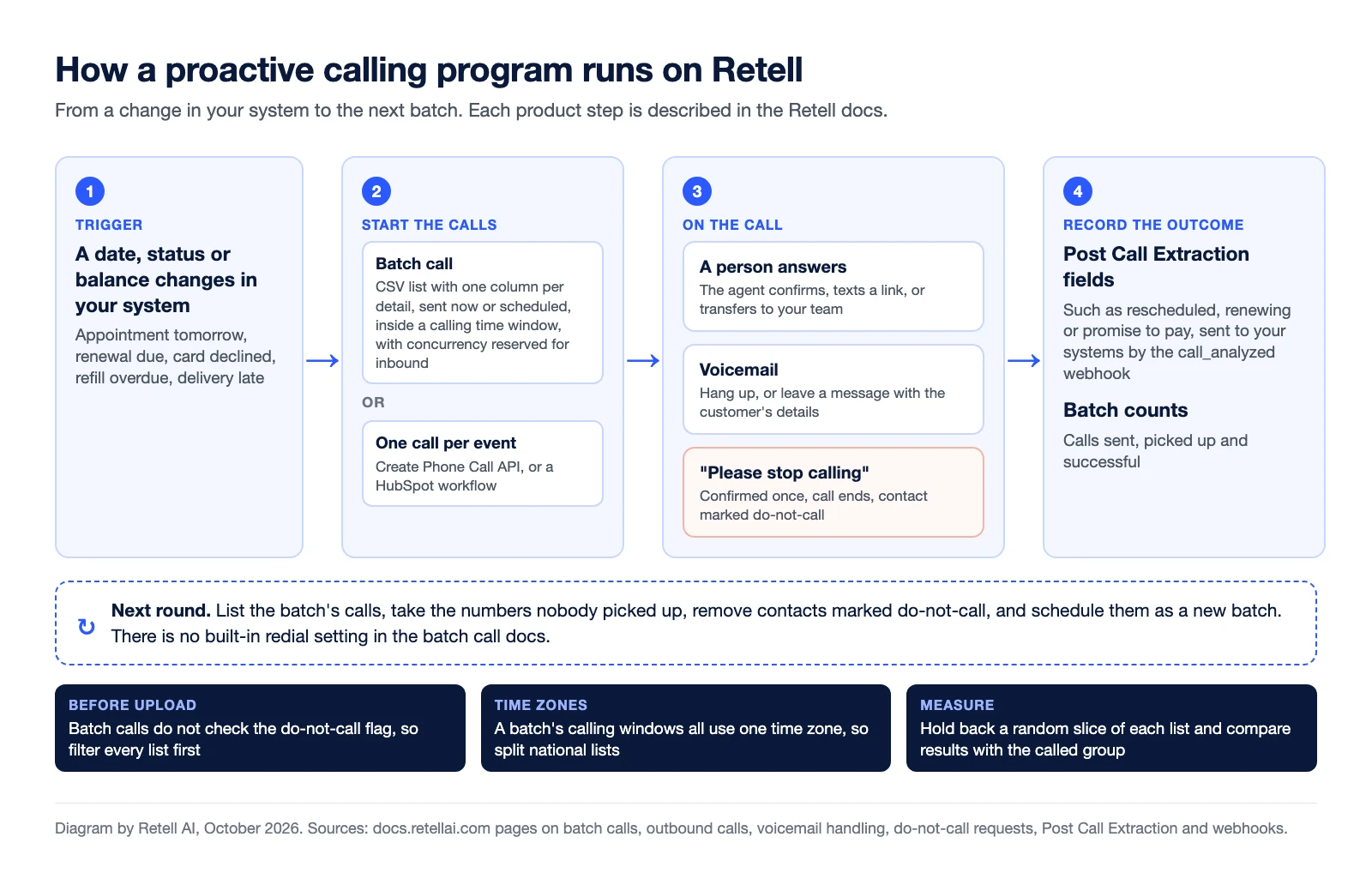
Start the calls. For a list, create a batch call: a CSV with a phone number column plus one column per detail, such as a renewal date, which the agent reads as dynamic variables. Send it now or schedule it, set the calling time window, and reserve concurrency for inbound callers. For single events, such as a ticket changing status, start each call through the Create Phone Call API or a HubSpot workflow with the Retell AI HubSpot app.
Handle the call. If a person answers, the agent works from that customer's details and can text a link or transfer. At a voicemail, it can hang up or leave a message using the same variables; detection runs for the first 3 minutes after the call connects. If the person asks not to be called again, Do-not-contact Handling (off by default, so turn it on for outbound agents) confirms once, ends the call and marks the contact do-not-call.
Record the outcome. Post Call Extraction turns each transcript into fields you define, such as "rescheduled" or "promise to pay", and the call_analyzed webhook sends them to your systems. Each batch shows how many calls were sent, picked up and successful.
Plan the next round. The batch call docs list no redial setting. To retry, list the batch's calls by batch_call_id and schedule the unanswered numbers as a new batch.
Three details from the docs to plan around:
- Batch calls don't check the do-not-call flag. Remove marked contacts from every list before you upload it. Calls started through the API are refused for marked contacts only when you pass
honor_internal_dnc: true. - A batch's calling windows all use one time zone. Split national lists by the recipient's time zone.
- Carriers can label numbers "Spam Likely". US numbers can apply to be verified; see the outbound phone number checklist.
What are the legal limits on proactive calls?
In the US, outbound AI voice calls fall under the Telephone Consumer Protection Act (TCPA). This is general information, not legal advice; have counsel review your program, including state laws where your customers live.
- AI voices count as artificial voices. In February 2024 the FCC confirmed that the TCPA's restrictions on "artificial or prerecorded voice" calls cover AI technologies that generate human voices. These calls need the prior express consent of the person called unless an emergency purpose or exemption applies (FCC 24-17).
- Selling raises the bar. An artificial-voice call to a mobile or residential number that includes an advertisement or is telemarketing needs prior express written consent, with narrow exceptions (47 CFR 64.1200(a)(2) and (a)(3)). A renewal reminder that adds an upgrade pitch can move a call into this category.
- Say who is calling. Every artificial or prerecorded voice message must name the business responsible at the start and give its phone number during or after the message (64.1200(b)).
- Watch the clock. Telephone solicitations to residential subscribers may go out only between 8 a.m. and 9 p.m. in the called party's local time, and not to numbers on the National Do Not Call Registry (64.1200(c)). Setting every batch window to those local hours is a simple default for service calls too.
For consent types, exemptions, opt-out rules and record keeping, see our TCPA guide for outbound AI voice calls and the call consent and disclosure checklist.
How do you measure proactive customer service?
Measure what the calls changed, not how many went out. Hold back a random slice of each list that gets no call, then compare the two groups.
| Metric | Where it comes from | What it tells you |
|---|---|---|
| Reach rate | Calls picked up divided by calls sent, from the batch view | Whether your numbers and calling hours work |
| Outcome rate | A Post Call Extraction field such as "rescheduled" or "renewing", charted in the analytics dashboard | Whether the call did its job |
| Opt-out rate | Calls that end with the user_requested_dnc disconnection reason (requires Do-not-contact Handling) | Whether the outreach is welcome |
| Prevented contacts | Inbound calls and tickets on the same topic, called group vs. holdout | Whether you headed off contacts |
| Business result | No-shows, renewals or payments, called group vs. holdout | Whether the program pays off |
Compute the outcome rate over connected calls only, because Retell does not fill custom extraction fields for calls that did not connect. Start with one trigger, one list and one holdout before adding the next call type.
Frequently asked questions about proactive customer service
What is proactive customer service?
Proactive customer service means contacting customers about a problem, deadline or change before they reach out, such as a delayed delivery, an upcoming renewal or a past-due balance. It is the opposite of reactive service, where the company waits for the customer to call, email or chat.
What is an example of proactive customer service?
A retailer calls a customer whose delivery has slipped, gives the new date and offers an alternative before the customer notices. Others are appointment reminders that let the patient reschedule on the call, renewal reminders, and failed-payment calls.
What is the difference between proactive and reactive customer service?
Reactive service starts when the customer contacts you about a problem they noticed. Proactive service starts when your systems notice it first and you contact the customer.
Is it legal to use an AI voice agent for proactive calls?
In the US, generally yes, with the right consent. The FCC treats AI-generated voices as artificial voices under the TCPA, so the calls need the prior express consent of the person called unless an emergency purpose or exemption applies, and calls that advertise or sell generally need prior express written consent. State laws can add rules, so have counsel review your program.
Can an AI voice agent follow up on an open support ticket by phone?
Yes. Your ticketing system or CRM can start a call through Retell's Create Phone Call API when a ticket changes status, passing the ticket number as a dynamic variable. The agent can confirm the fix or transfer to a person, and the outcome comes back to your systems by webhook.
Run proactive calls with Retell AI
Retell AI is a platform for AI voice agents that place and answer phone calls. With batch calling, an agent calls every contact on a list inside your time window, uses each customer's details, and returns each outcome as structured data. Pricing starts from $0.07 per minute; see Retell AI pricing for current details.