What Enterprise CX Leaders Need From an AI Voice Agent Platform




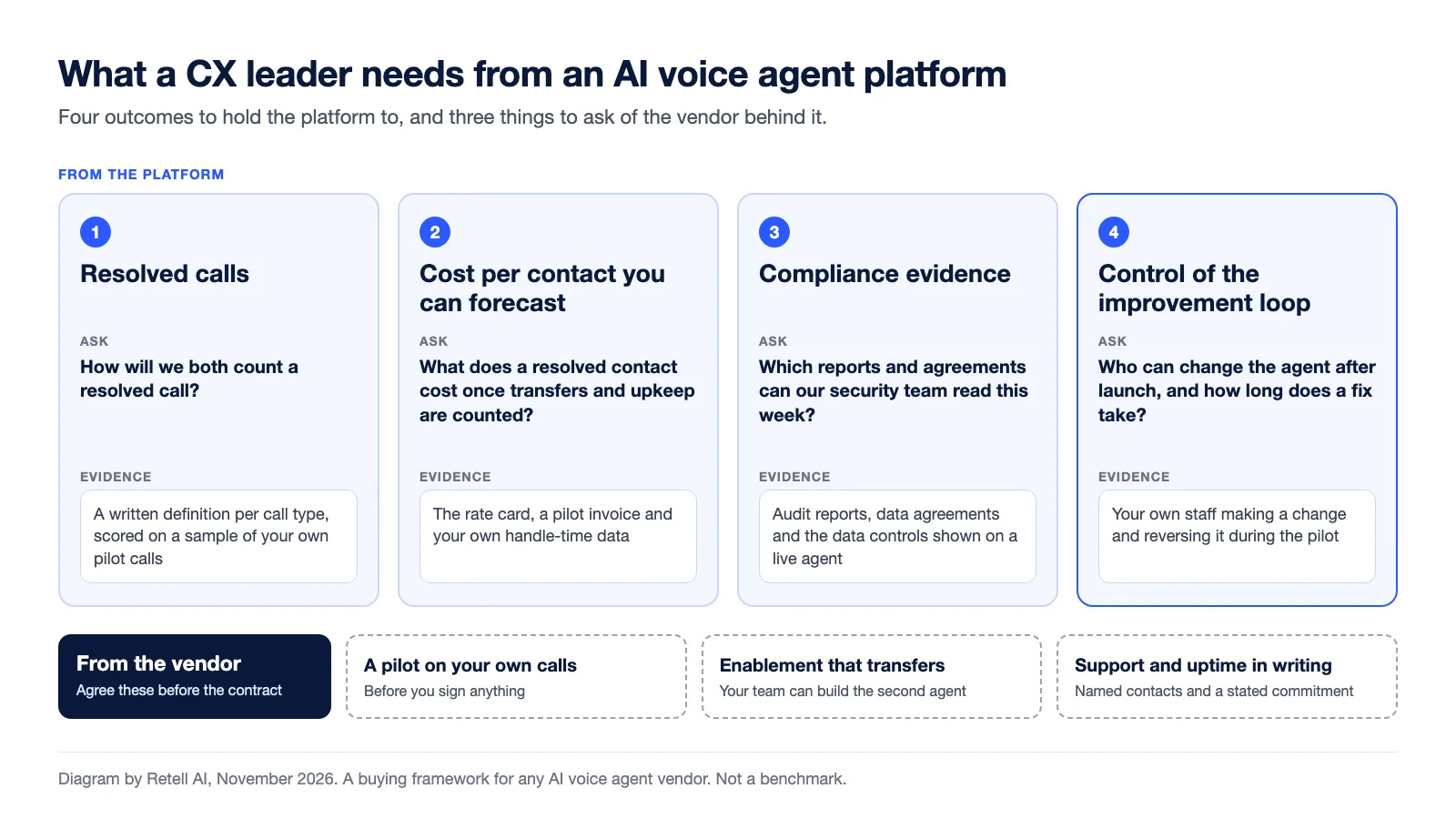
A CX leader buying AI voice agents needs four things from the platform and the vendor behind it: calls that end resolved, a cost per contact that can be forecast, compliance evidence that holds up in a security review, and control of the agent after launch. Voices, features and demos matter only as far as they move those four.
This guide is for the person who signs for the outcome: a head of customer experience, a VP of contact center operations, a CIO, or a chief transformation or digital officer. It sets out what to ask for and what evidence to accept. Retell AI publishes this guide and sells an AI voice agent platform. The questions apply to any vendor, including us.
Why do CX leaders judge AI voice agents on outcomes?
CX leaders judge AI voice agents on outcomes because they answer for the result on the phone line, and few think their current approach is working. Deloitte Digital's release on its 2026 Global Contact Center Survey says less than 1 in 5 leaders feel their current strategies are fully effective. The same research lists the top challenges cited by the contact center leaders falling behind: integration of technology, systems and tools (72%), legacy systems (58%), and data security and compliance (53%).
None of those is a voice quality problem. They are operating problems: connecting the agent to the systems where work gets done, proving the data is handled correctly, and keeping the agent current. So the useful question for a vendor is what will be true on your phone lines 90 days after launch, and who makes it true.
| What you need | Question for the vendor | Evidence to accept |
|---|---|---|
| Resolved calls | How will we both count a resolved call? | A written definition, scored on a sample of your own pilot calls |
| A cost per contact you can forecast | What does a resolved contact cost once transfers and upkeep are counted? | The rate card, a pilot invoice and your own handle-time data |
| Compliance evidence | Which reports and agreements can our security team read this week? | Audit reports, data agreements and the data controls shown on a live agent |
| Control of the improvement loop | Who can change the agent after launch, and how long does a fix take? | Your own staff making a change and reversing it during the pilot |
How should resolution be defined before the pilot starts?
Resolution means the caller's task was completed on that call and confirmed in your system of record. It is a different number from containment, which counts every call that did not reach a person. A caller who gives up and hangs up is contained and unresolved, which is why call containment only means something next to resolution. If your contact center already reports first contact resolution, hold the AI voice agent to the same definition your human teams use.
Ask for three things before the first pilot call.
- A written definition per call type. "Appointment booked and visible in the scheduling system" is a definition. "The call went well" is an opinion. On Retell, AI QA resolution criteria combine AI-evaluated conditions with performance metric thresholds to decide whether each sampled call counts as successful.
- A transfer path that counts as a good outcome. Some calls should reach a person, and a clean handoff is a success for those calls. Retell's transfer call tool documents cold, warm and agentic warm transfers. How call transfers work between AI voice agents and human teams covers the design.
- Both shares in every report. In its case study, Medical Data Systems says Retell's voice agents handle 100 percent of its inbound calls, with about 30 percent transferred to a live agent and roughly 70 percent completed end to end.
For which calls to automate first, see choosing voice AI use cases.
What should cost per contact include?
Cost per contact should include everything it takes to finish the contact. For an AI voice agent that means usage minutes, telephony, the human time spent on transferred calls, the cost of checking changes before release, and the time of whoever owns the agent. A low per-minute rate on calls that end in a transfer can cost more per resolved contact than a higher rate on calls that finish.
Three questions keep the number honest.
- What is the unit of billing? Retell's pricing is usage-based, from $0.07 per minute on the pricing page, and the total depends on the model, voice and telephony you choose.
- Is upkeep billed? On Retell, testing an agent bills at the same rates as production, so plan it as usage.
- Can finance see spend without asking the vendor? Retell's analytics dashboard charts combined cost by agent or by day, and alert rules can notify you when total call cost over a window exceeds a budget.
Compare vendors on cost per resolved contact, using handle times and transfer rates from your own pilot. The business case sits in the ROI of AI voice agents, and reference points are in cost per resolution benchmarks.
What compliance evidence should be on the table before the pilot?
Your security team should have the audit reports, the data agreements and a walkthrough of the data controls at the start of the pilot. A compliance review that starts after the pilot can stall a good result.
Retell's security and compliance documentation states that Retell is HIPAA compliant, GDPR compliant and SOC 2 Type 1 and Type 2 certified. Retell offers a self-service BAA and a Data Processing Addendum, and the docs say a signed BAA is required before protected health information is sent through Retell. The controls a reviewer will ask about are set per agent:
- Data storage settings with three modes: everything, everything except PII, or basic attributes only.
- Data retention that can be set from 1 day to 2 years, after which call and chat data is permanently deleted. The default keeps data indefinitely.
- Guardrails that check agent responses and caller input for prohibited topics.
The Enterprise plan on the pricing page lists custom MSA and DPA terms, custom SSO and role-based access control. This is not legal advice. Confirm your own obligations with your compliance and legal teams. The enterprise voice AI compliance guide lists the documents procurement usually asks for.
Who controls the agent after launch?
Your team should. The agent that goes live is a first version. Policies change, new call reasons appear, and the cost of each fix depends on who is allowed to make it.
Unlike a managed AI vendor or a BPO, a platform your own team operates does not turn each change into a ticket, a queue or another statement of work. On Retell, a change starts as a draft agent version, publishing makes it a fixed configuration you can return to, and environment tags such as prod and staging let your team switch versions or move back. AI QA scores a sampled set of calls so the owner knows what to fix next.
Some teams give that loop to one named owner, a CX engineer (also called a CX automation engineer or an internal deployed engineer). Retell's post on what a CX automation engineer does describes the role. Two related decisions have their own pages: build, buy or managed service for the operating model, and the voice AI buying bar for the vendor questions on how fast and how safely changes ship.
What should you ask of the vendor, beyond the platform?
Ask for a pilot on your own calls before a contract, enablement that leaves the skills with your team, and a support and uptime commitment in writing.
- A pilot on real calls. A demo shows the vendor's best call, and a pilot shows yours. Retell's pay-as-you-go plan is listed with full platform access and no commitments, so a pilot can start before any contract. From voice AI demo to production covers pilot design and success criteria.
- Enablement that transfers. Ask who builds the first agent and who can build the second. Retell's post on the role says its forward deployed engineers usually build the first agents alongside the customer's team and train its people along the way.
- Support and uptime in writing. Retell's Enterprise plan lists 24/7 support with a dedicated portal, with dedicated implementation support as an add-on. Its reliability documentation states a guarantee of more than 99.9% uptime and links a public status page.
Who else on the buying committee needs an answer?
A CX leader rarely signs alone. The pilot should produce an answer for each person in the room.
| Role | What they need to see | Where to start |
|---|---|---|
| Head of CX or contact center | Resolution by call type, and what callers experience on a transfer | The resolution definition and pilot call reviews |
| CIO or IT | How the agent connects to telephony and systems of record | How to evaluate a platform before go-live |
| Security and compliance | Audit reports, data agreements, storage and retention settings | The vendor's trust documentation |
| Finance and procurement | Cost per resolved contact and contract terms | The rate card and the pilot invoice |
| Operations | Who changes the agent and how a bad change is reversed | A change made and rolled back by your own staff |
Retell's earlier piece on what AI-handled interactions mean for CX leaders covers the wider shift. For the hands-on side of the evaluation, see what product teams look for in a voice AI platform.
Frequently asked questions
Who counts as a CX leader in an AI voice agent purchase?
In this guide, a CX leader is the executive who answers for how customers are served across channels, with titles such as head of customer experience, VP of customer experience or VP of contact center. In an AI voice agent purchase, that person usually owns the outcome targets, while IT, security, finance and operations each review one part of the decision.
What should a CX leader ask an AI voice agent vendor first?
Ask how both sides will count a resolved call, and get the definition in writing for each call type before the pilot starts. Every later number, including cost per contact and the size of the business case, depends on that definition.
Does a CX leader need engineers to run AI voice agents?
Usually for integrations with internal systems, and often not for day-to-day changes to prompts, knowledge and call flows when the platform is built for operations staff to make them. Some teams name one owner for that work, often called a CX engineer.
How much do AI voice agents cost per contact?
It depends on minutes per contact, the model and voice you choose, telephony, and the share of calls that still need a person. Retell's usage-based pricing starts from $0.07 per minute. Multiply your rate by average minutes per contact, then add the human time for transferred calls to get a cost per resolved contact.
Prove the four outcomes on your own calls
Retell is an AI voice agent platform for contact centers. More than 4,000 customers run over 100 million calls a month on it, and Retell reached $100M in annualized run rate in November 2026. Versioning, AI QA, analytics, alerting and per-agent data controls let the people closest to your customers measure resolution, watch cost and change the agent themselves. Pricing is usage-based, from $0.07 per minute on the pricing page. Bring one call type and your own definition of resolved, and run a pilot on real calls before you sign anything.
See how much your business could save by switching to AI-powered voice agents.
ROI Result
Total Human Agent Cost
AI Agent Cost
Estimated Savings
Estimate your monthly voice AI cost
Read Other Blogs

Revolutionize your call operation with Retell