Purpose-Built vs General-Purpose LLMs for Contact Centers





A general-purpose LLM is the safer starting point for most contact centers. A purpose-built LLM earns its place when one call type runs at high volume and a general model keeps missing in the same measurable way: slow first words, wrong tool calls, or replies that sound like a web page read aloud. Neither wins by category. The model to choose is the one that passes your own calls, run after run, at a cost per minute you can forecast.
This guide is for the leader who answers for the phone line. Retell AI publishes this guide and has a stake on both sides. Its platform offers general-purpose models from OpenAI, Anthropic and Google, and it builds its own: Tell-1, Retell's own LLM, made for contact center calls. Tell-1 ranks #1 overall on Retell's public benchmark, the Retell vCX Benchmark (read November 13, 2026). Treat it like any vendor benchmark: a reason to shortlist, then something to check on your own calls.
What does a contact center call demand of a language model?
A contact center call asks a model for five things on every turn: follow a long script, call tools correctly, sound natural when spoken, answer quickly, and stay affordable at volume.
- Long scripts. The agent's prompt holds the steps, policies and exceptions for a call type, and the model has to apply the right rule on each turn. In the Multi-IF benchmark, all 14 models evaluated failed more instructions with each added turn.
- Tool calls. Bookings, lookups and transfers run through tools, and a wrong call changes a real record. The 2024 tau-bench paper found that function-calling agents built on a leading general-purpose model succeeded on fewer than 50% of its customer service tasks, and passed all eight repeated trials of a retail task less than 25% of the time.
- Natural speech. The reply is heard, not read. Lists and symbols that work on a screen sound wrong in a synthetic voice.
- Speed. People leave short gaps between turns. A review of turn-taking research puts the typical gap at around 200 milliseconds. The model is one stage between the caller's last word and the agent's first, so the time it spends before starting a reply is heard as silence.
- Cost at volume. Every turn sends the script and the conversation so far back to the model. Providers discount that repeated input (OpenAI's prompt caching guide lists cached input at up to 95% off), but at contact center volume a small difference per minute becomes a budget line.
Where do general-purpose LLMs fit in a contact center?
General-purpose LLMs fit best where calls vary: many call types, many languages, and questions nobody scripted. They are trained broadly and sold by several providers, so a team can change models as its needs change.
They also need less custom work than many buyers assume. OpenAI's model optimization guide describes a loop of evals and prompt engineering, with fine-tuning added "for some use cases." Much of what keeps an agent on script lives in the prompt, the call flow and the tools, and that work carries over when the model changes.
The limits show up on the phone. Reasoning modes that think before they answer add delay before the first word. Models tuned for written chat need prompting to keep replies short and speakable. And the provider sets the calendar: OpenAI's deprecation policy gives at least 6 months' notice before it retires a generally available model, and the agent then has to be checked on the replacement. For a model-by-model view, see which LLM should power your voice AI agent.
What does a purpose-built or fine-tuned LLM change?
A purpose-built LLM moves behavior out of the prompt and into the model's training. Instead of instructing a general model to speak briefly, follow policy and call tools at the right moment, the vendor trains on examples of exactly that, often on a smaller model. Three terms get mixed up:
- A domain-specific or vertical LLM is trained or tuned by a vendor for one industry or job and offered to all of its customers.
- A fine-tuned model is a base model trained further on a narrower dataset, often your own. The glossary entry on AI model fine-tuning covers the mechanics.
- A custom LLM usually means any model you bring to a platform yourself, tuned or not.
OpenAI's guide to LLM accuracy gives two reasons to fine-tune: to improve accuracy on a specific task, and to improve efficiency, meaning the same accuracy for fewer tokens or from a smaller model. On calls, that can mean steadier script following, shorter prompts and a lower cost per minute.
The idea is not new. Observe.AI announced a Contact Center LLM in June 2023, which it describes as a 30-billion-parameter model trained on a domain-specific dataset of hundreds of millions of customer interactions. The accuracy gains in that announcement come from the vendor's own initial benchmarks. That is normal for the category, and it is why your own evaluation matters more than any announcement.
What are the trade-offs between the two?
The trade-offs are lock-in, coverage and evaluation burden, and each one cuts in both directions.
| Factor | General-purpose LLM | Purpose-built or fine-tuned LLM |
|---|---|---|
| Best fit | Varied call types, many languages, unscripted questions | One high-volume call type with stable rules |
| Script and tool behavior | Set by the prompt and the call flow | Trained in, so less prompt is needed |
| Speed and cost per minute | Depends on model size and reasoning mode | Can be lower when the model is smaller |
| Lock-in | Several providers, each retiring models on its own schedule | Often one vendor or one platform |
| Coverage | Broad | Narrower outside the training data |
| Evidence you can get | Public benchmarks, few of them on phone calls | Often the vendor's own benchmark |
| Evaluation burden | A recheck whenever a model is retired | A check before adoption and after every retrain |
Lock-in. A purpose-built model is often sold by one vendor, sometimes inside one platform. Ask whether you can switch models without rebuilding the agent, and whether the prompts, flows and test cases stay yours. General-purpose models carry a quieter version of the same risk when a provider retires a version.
Coverage. A model trained on English appointment calls may be weaker in Spanish, or on a billing dispute it never saw. Ask for results by language and by call type, not an average.
Evaluation burden. Public benchmarks rarely measure phone calls, and a vendor benchmark is evidence chosen by the seller. If you fine-tune your own model the burden grows. OpenAI's accuracy guide says training examples "must exactly represent what the model will see in the real world" and recommends a hold-out set to detect overfitting.
How do you evaluate either model on your own calls?
Evaluate both the same way: fixed scenarios drawn from your own calls, graded against written pass criteria, run more than once, then a split of live traffic.
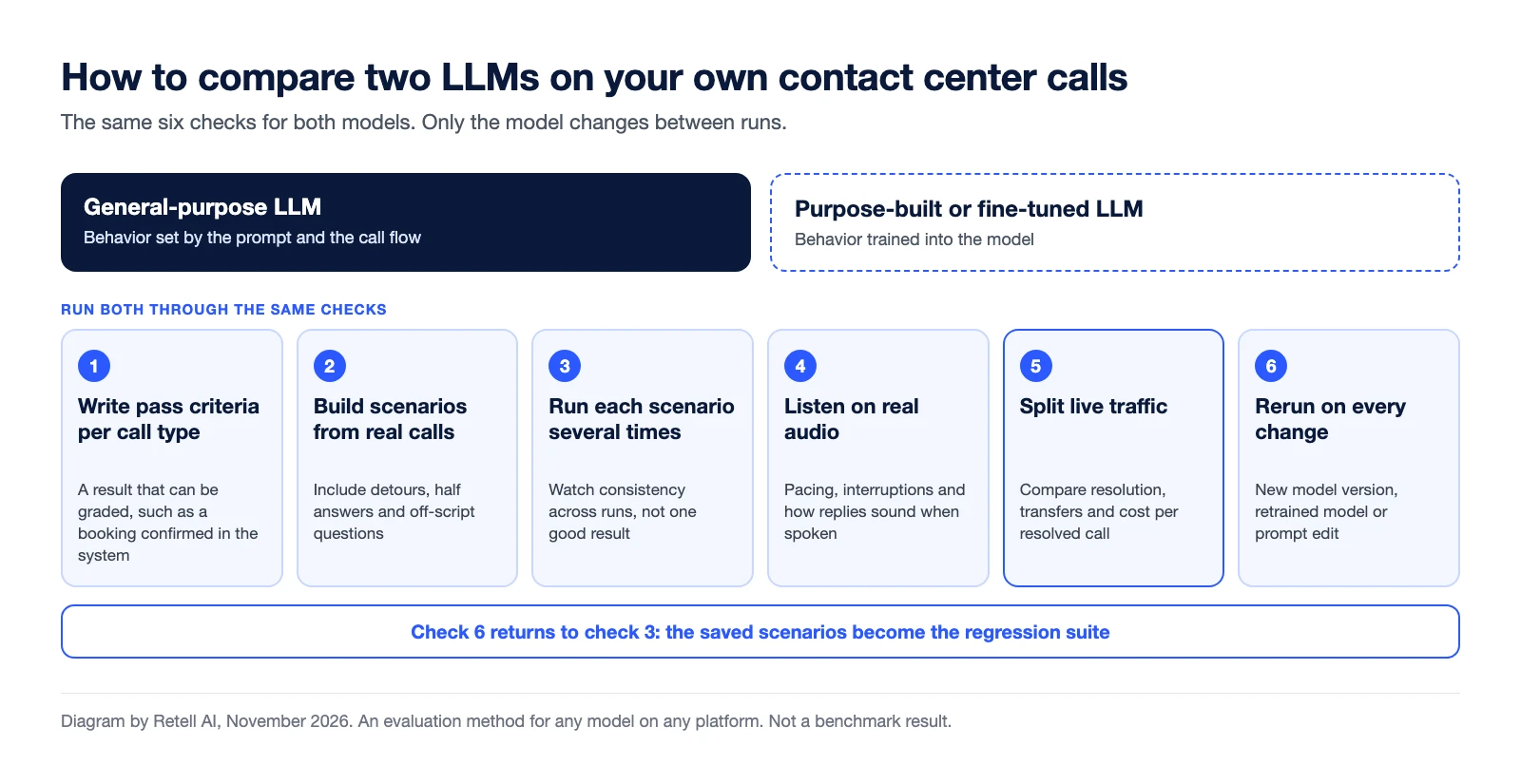
- Write pass criteria per call type. "Appointment booked in the scheduling system and confirmed to the caller" can be graded. "Sounded good" cannot.
- Build scenarios from real calls. Include the detours: the caller who changes their mind, asks an off-script question, or gives half an answer.
- Run every scenario several times on each model. The tau-bench authors proposed a pass^k metric to measure reliability over repeated trials.
- Listen on real audio. Text results miss pacing, interruptions and how a reply sounds when spoken.
- Split live traffic. Send a share of calls to each option and compare resolution, transfers and cost per resolved call.
- Rerun on every change. A new model version, a retrained model and a prompt edit all call for the same suite.
On Retell, simulation testing grades each run pass or fail against success criteria, batch tests rerun the saved cases as a regression suite, and A/B testing splits call traffic between agents by percentage. The docs say you can switch models later without rewriting your prompt. If you bring your own model, simulation and batch tests do not apply, and web and phone calls are the way to check it. For the wider pilot, see how to evaluate an AI voice agent platform before going live.
Where does Tell-1 fit in this comparison?
Tell-1, Retell's own LLM, is a purpose-built model for contact center calls, so every trade-off in this guide applies to it. Here is where it stands on each, with the source for every number.
- Scripts, tools and speech. On the Retell vCX Benchmark, Tell-1 averages 94.45 and ranks #1 overall. By suite it scores 88.6% on instruction following (rank 2), 97.2% on grounding (rank 2), 95.4% on tool calling (rank 5) and 96.6% on colloquial speech (rank 1), all read November 13, 2026. Retell runs that benchmark, so use it the way this guide suggests: as a reason to shortlist.
- Speed. It has the lowest median latency on the board, at 76 ms (read November 13, 2026). That is the model's figure on the benchmark, not the end-to-end response time of a call.
- Cost. The benchmark lists it at 3.5 cents per minute. That is the LLM line only, not the price of a call, and some general-purpose configurations on the board cost less. Retell pricing starts from $0.07 per minute.
- How it works. The model starts its reply and keeps reasoning while the first words play. The technical post, Retell LLM: Interleaved Reasoning for Real-Time Voice Agents, reports about 200 reasoning tokens mid-reply on average and describes the three training stages behind it.
- Lock-in. Tell-1 is offered inside Retell. It sits in the same model selector as models from OpenAI, Anthropic and Google, and Retell's docs say you can switch models later without rewriting your prompt, so choosing it does not close off the others.
- Coverage. A model built for calls is narrower by design. Run Tell-1 on your own languages and call types before you rely on it, and keep a general-purpose model for any call type where it comes second.
- Evaluation. The six checks above apply unchanged. Because Tell-1 is a Retell-managed model, simulation and batch tests work with it, and an A/B split can send the same traffic to two copies of an agent that differ only in model.
The fair summary: Tell-1 is the purpose-built option to put on your shortlist if you run on Retell, and the general-purpose models next to it are the control. See Tell-1 for the product details.
Frequently asked questions
What is a purpose-built LLM?
A purpose-built LLM is a language model trained or tuned for one job, such as handling contact center calls, instead of general use. It is also called a domain-specific or vertical LLM. A general-purpose large language model is adapted to the job through prompts and tools.
Are purpose-built LLMs more accurate than general-purpose LLMs?
On the job they were trained for, they can be. Outside it, often not. Most published comparisons come from the vendor that built the model, so run both on your own scenarios.
Does a contact center need to train its own LLM?
Usually not. OpenAI's optimization guide starts with evals and prompt engineering and adds fine-tuning only for some use cases. Training your own also means owning the training data and a hold-out set.
Is a custom LLM the same as a fine-tuned model?
Not always. On most voice platforms, a custom LLM is any model you host and connect yourself, which may or may not be fine-tuned. Retell's custom LLM option connects your own model over a WebSocket while Retell handles telephony, transcription and turn-taking.
Can a contact center use more than one LLM?
Yes. On Retell, each agent has its own model setting, and the LLM settings docs describe a fast fallback that runs a backup model alongside the primary.
Is Tell-1 a purpose-built LLM?
Yes. Tell-1 is Retell's own LLM, built for contact center calls. It ranks #1 overall on the Retell vCX Benchmark with an average of 94.45 (read November 13, 2026). It is one option in Retell's model selector, next to general-purpose models from OpenAI, Anthropic and Google.
Compare models on your own calls before you commit
Retell is an AI voice agent platform for contact centers. Each agent has a model selector, and the pricing page lists models from OpenAI, Anthropic and Google alongside a custom option for a model you host. Tell-1, Retell's own LLM, is in the same selector. The people closest to your customers can change the model, rerun the test suite and split traffic themselves. Unlike working with a managed AI vendor, that change does not become a ticket, a queue or another SOW. Pricing is usage-based, from $0.07 per minute on the pricing page. Bring one call type and your own pass criteria, and run a pilot on real calls before you sign anything.
See how much your business could save by switching to AI-powered voice agents.
ROI Result
Total Human Agent Cost
AI Agent Cost
Estimated Savings
Estimate your monthly voice AI cost
Read Other Blogs

Revolutionize your call operation with Retell